
What pin setting gives you the resistance you actually want — rounded to a weight your stack can really select, and split into what you feel lifting versus lowering.
The number nobody publishes and everybody forgets. Cable tower carriages run 11–14 lb; the Rogue Rhino trolley is 27. Weigh yours if you can — on light isolation work this number is bigger than the plates.
Precor, Hammer Strength, Inspire and some Life Fitness models write the same thing reversed — their “1:2” is this 2:1, and “1:4” is this 4:1. Both mean you feel a fraction of the stack.
Plate-loaded gear has no fixed increment. Your resolution is whatever your smallest plate is, divided by the ratio.
Friction, added weight and cable travel
Frictionless math. Fine for matching loads between machines of similar build.
Losses compound per sheave, so path length matters more than most specs admit. No effect while friction is ignored.
Weight on the stack is divided by the ratio. Weight at the handle end is not.
As an Amazon Associate I earn from qualifying purchases. Links marked “affiliate link” cost you nothing extra. Full disclosure.
Adding cables to a power rack
No cable tower yet? These rack-mounted pulley systems bolt onto uprights you already own. The same math applies: check the ratio the maker states, then run it through the calculator above. Before you order, confirm your upright size and hole diameter in the Rack Attachment Fit Checker.
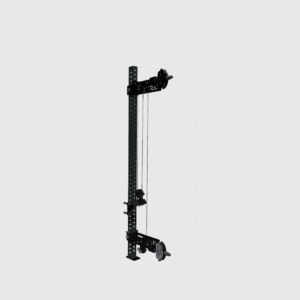
High/Low Pulley System (single side)
Bulletproof says it works with its VTS, VTS Lite and compatible 3×3 rack uprights. One unit covers one upright, and it sticks out up to 25.16″ in front of it.
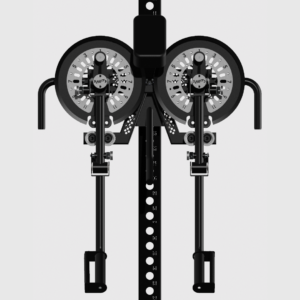
Direct Flight Multi-Flight
Bulletproof says it needs 3×3 uprights with 1″ or 5/8″ holes for rack-face mounting, and that it does not work with 2×2, 2×3 or other non-standard uprights.
Product images courtesy of Bulletproof Fitness Equipment, used with permission. I earn a commission on Bulletproof purchases made through these links, at no extra cost to you. Full disclosure.
How the math works
A cable machine is a block and tackle. A 2:1 supports the stack on two rope segments, so the handle carries half the load and travels twice as far. Force and distance trade against each other, always.
That second line matters as much as the first and is ignored almost everywhere. Matching your load across two machines tells you nothing about whether you will still have cable left at the top of the rep.
Friction does not just make it heavier
It makes the lift heavier and the lowering lighter. Friction opposes motion, whichever way the cable is moving. With system efficiency η (the product of every sheave the cable bends around):
This matters more than it looks. Eccentric loading is a meaningful driver of hypertrophy, and a long-path machine quietly takes some of it away: the harder the concentric feels, the lighter the eccentric actually is. Two machines set to the same pin can deliver noticeably different eccentric tension.
On a 1:1 there is no mechanical advantage for the drag to divide against, so the handle carries the full stack plus friction on the way up. A 1:1 lat pulldown reads heavier than the plates suggest, not lighter.
Where the efficiency figures come from
The honest position is that nobody has published a measurement of pulley efficiency for gym cable machines. Manufacturers treat it as proprietary, and sports science papers assume the nominal ratio and move on.
The closest hard numbers come from a pulley manufacturer’s own bench comparison of two near-identical rescue pulleys: 95.6% with a bearing against 91.4% with a bushing, a 4.2 point gap attributable to the bearing alone. Gym conditions should sit a little better than that, because a 4.5 inch sheave on 3/16 inch cable gives a D/d ratio of 24:1 against roughly 4:1 in rescue rigging, and bending losses fall sharply as that ratio rises. The mechanism is documented: Máté and Szekrényes measured tension loss in 7×19 cable — the same construction gyms use — over pulleys at low speed, and separated it into bearing friction and cable bending hysteresis.
So this tool uses 96–98.5% per sheave for sealed bearings and 92–95% for bushings: the measured figures nudged up for gentler gym geometry, presented as a range because a single decimal would be false precision.
What this tool does not model
The guide rods. The top plate slides on bushings around two steel rods, and there is good reason to think that drag rivals or exceeds the pulleys, particularly on a stack that is tilted or dry. It is not modelled here because there is no figure worth quoting, and inventing one would defeat the purpose.
Also unmodelled: cable stretch, the inertia of the stack itself during fast reps, and any binding from an unbalanced load. If a number matters, hang a known weight from the handle and read it on a scale.
Does sheave material change anything?
Not the resistance, no. Efficiency is set by the bearing and the sheave diameter, not by what the sheave is cast from. Aluminium, steel and nylon sheaves of the same size on the same bearing pass essentially the same load.
What material changes is inertia. A 4.5 inch steel sheave contributes roughly 1.1 lb of effective mass at the cable; the same sheave in aluminium contributes about 0.4 lb, and in nylon about 0.15 lb. Across a six-pulley functional trainer that is around 6.6 lb of equivalent mass in steel against 2.4 lb in aluminium. You only feel it while accelerating, so it is invisible on a slow grinding set and mildly noticeable on explosive work.
The tradeoff is wear. Aluminium is light but soft, and steel cable running in a soft groove will cut it over time, which is why quality aluminium sheaves are anodised or lined. Steel sheaves are heavy but take steel cable indefinitely. Nylon is the lightest and self-lubricating but the weakest. If you are choosing parts, choose the bearing first and the material second.
Plate-loaded is a different problem
Selectorized and plate-loaded machines share the same pulley math, and then diverge on four things that nobody puts on a spec sheet.
The carriage is not weightless
On a selectorized stack the top plate is part of the stack and the decal counts it. On a plate-loaded tower the horns are welded to a trolley that rides the upright, and that trolley hangs on the cable whether you load it or not. Cable tower carriages generally run 11 to 14 lb. The Rogue Rhino’s trolley is 27 lb.
The error this creates is worst exactly where precision matters most. Load 20 lb of plates on a 2:1 expecting 10 lb at the handle and an 11 lb carriage makes it 15.5 — a 55% overload. On a 5 lb target it is a 110% overload. On a 100 lb lat pulldown (1:1) the same carriage is an 11% error and barely worth mentioning — on a 2:1 the same carriage is only about a 5.5% error at 100 lb, because the ratio divides the carriage’s share too. Light isolation work on a plate-loaded machine is where training logs quietly stop meaning anything.
Almost nobody publishes this number. Put the carriage on a bathroom scale if you can get it off, or work it out by hanging a known weight from the handle and comparing.
You get continuous loading instead of fixed steps
This is the real advantage, and it is the mirror image of the micro-plate problem. A selectorized 2:1 with 10 lb plates locks you into 5 lb jumps at the handle. A plate-loaded 2:1 with 1.25 lb change plates gives you 1.25 lb jumps, and with half-pounders, 0.5 lb. No magnets, no extender pin, no aftermarket anything — your resolution is (smallest plate × number of horns) ÷ ratio. Load both horns evenly and a 1.25 lb plate on each side of a 2:1 is 2.5 lb of added plate, or 1.25 lb at the handle.
Bumper plates strangle the machine
This one is counterintuitive and it costs people real capacity. Horn sleeves run roughly 8.5 to 11 inches. A 45 lb competition bumper is about 3.5 inches thick, so you fit three per horn at best. A 45 lb cast iron plate is about 1.4 inches, so seven fit in the same space.
On an 11 inch horn at 2:1, that is the difference between roughly 140 lb and roughly 320 lb of resistance at the handle — on the identical machine, decided entirely by which plates you own. If you are loading a cable tower, thin cast iron or machined steel plates are worth more to you than bumpers, and the wide rubber discs also sit closer to the frame and are likelier to foul it.
Every plate is cantilevered
Horns stick out horizontally, so the load always sits several inches off the guide axis. Matched plates on both sides cancel the side-to-side moment but not the fore-aft one, and mismatched plates twist the carriage into its guides. Budget towers that slide on a powder-coated upright with plastic blocks rather than chrome rods with linear bearings feel this most, and it shows up as a wider gap between how heavy the lift feels and how light the lowering does.
A correction worth making
The distance half of this relationship is stated backwards in places you would expect to be reliable.
“20lbs feels like 10lbs to move.”
“For every foot you pull the handle, the weight stack travels two feet upward.”
Both describe a 2:1, and they cannot both be true.
If the handle moved one foot while the stack rose two, conservation of energy requires the handle force to be twice the stack weight, not half. The first statement would be wrong.
The first statement is the correct one. On a 2:1 you feel half the stack, so the handle must travel two feet for every one foot the stack rises — the reverse of the second sentence. Halve the force, double the distance.
RitFit, to their credit, states it correctly in their own guide: “pulling the handle 2 feet raises the stack roughly 1 foot.” Same ratio, opposite description, and only one of them can be right.
This is not pedantry. It is why people match their load correctly when switching machines and then run out of cable partway through the rep. When a spec sheet and the physics disagree, measure the machine.
Ratios and increments by manufacturer
Stated ratios and real plate increments, from manufacturer sources. Two things worth noting before you read it: the increment is almost never a round 10 lb once you divide it by the ratio, and several manufacturers write the ratio reversed.
| Machine | Stated ratio | Stack | Plate | Felt per plate | Micro weights |
|---|---|---|---|---|---|
| Rogue CT-1 | 2:1 | 250 lb | 10 lb | 5 lb | Sold separately |
| Rogue Monster Lat | 1:1 | 300 lb | 10 lb | 10 lb | No |
| REP Ares 2.0 | 2:1 trolleys, 1:1 combined | 2 × 260 lb | 10 lb | 5 lb | Included, 2.5 lb (1.25 felt) |
| REP FT-5000 2.0 | 2:1 | 2 × 224 lb | 10.5 lb | 5.25 lb | Included, 2.75 lb (1.375 felt) |
| REP Athena | 2:1 | 170 lb | 10 lb | 5 lb | Sold separately |
| Titan Functional Trainer | 2:1 | 2 × 200 lb | 10 lb | 5 lb | Sold separately |
| Bells of Steel Cable Tower | 2:1, or 1:1 with adapter | 210 lb | 10 lb | 5 lb | Adapter included |
| Force USA G12 | 1:1 | 2 × 220 lb | 11 lb | 11 lb | Sold separately |
| Force USA G15 Pro | 2:1 or 4:1, switchable | 2 × 289 lb | not published | — | Sold separately |
| Life Fitness Signature DAP | 4:1 | 2 × 390 lb | 10 lb | 2.5 lb | Optional dial |
| Life Fitness Optima DAP | written “1:2” | 165 lb | 10 lb | 5 lb | No |
| Hammer Strength DAP | written “1:4” | 400 lb (per-side split not stated) | 10 lb | 2.5 lb | Optional |
| Precor FTS Glide | 2:1, written “1:2” | 2 × 200 lb | 10 lb | 5 lb | No |
| Cybex Bravo 8800 / 8830 | 2:1 or 4:1 | 170 lb | 10 lb | 5 / 2.5 lb | Decals show felt weight |
| Inspire FT1 | 2:1 | 165 lb | 10 lb | 5 lb | Included, 5 lb (2.5 felt) |
| MikoloF4-Elite | 1:1 | 110 lb | 12.5 lb | 12.5 lb | Olympic horn included |
Read the Cybex row twice. On the Bravo, the numbers printed on the stack already show effective load, not physical plate weight. Put those numbers into this calculator and you will divide by the ratio a second time and end up at half the weight you wanted. Any machine with calibrated decals needs the physical plate weight, not the sticker.
Every machine the calculator knows
The calculator carries published ratios for 79 machines across 27 brands. Every figure below comes from the manufacturer’s own product page, spec sheet or manual. Where a maker publishes no ratio, the machine is not listed — an estimate would be worse than a gap, because people load bars from these numbers.
One warning before you read the table. The colon notation is not standard and you cannot trust it across brands, or even within one brand. Force USA prints “2:1” on the G1, G6, G15 and G20 to mean you feel half, then prints “1:2” on the C20 for the case where two stacks add together. Inspire uses “1:2” to mean you feel half. That is why the table has a plain-English column: read that one, not the ratio.
| Brand | Machine | Station or setting | Ratio | What you actually feel | Stack | Type |
|---|---|---|---|---|---|---|
| Bells of Steel | Functional Trainer Cable Tower | Each side 2:1 | 2:1 | half the number | 210 lb ×2 | Weight stack |
| Bells of Steel | Functional Trainer Cable Tower | Both pulleys combined, with cable adapter 1:1 | 1:1 | the number on the pin | 210 lb ×2 | Weight stack |
| Bells of Steel | Kraken rack attachment (plate-loaded) | 2:1 (default) | 2:1 | half the number | — | Plate-loaded |
| Bells of Steel | Kraken rack attachment (plate-loaded) | 1:1 (with adapter) | 1:1 | the number on the pin | — | Plate-loaded |
| Bells of Steel | Kraken rack attachment (210 lb stack) | 2:1 (one cable) | 2:1 | half the number | 210 lb | Weight stack |
| Bells of Steel | Kraken rack attachment (210 lb stack) | 1:1 (both cables, with adapter) | 1:1 | the number on the pin | 210 lb | Weight stack |
| Bells of Steel | Lat Pulldown / Low Row | 1:1 | 1:1 | the number on the pin | 310 lb | Weight stack |
| Bells of Steel | Oblivyon 3×3 (210 lb stack) | 2:1 (default) | 2:1 | half the number | 210 lb | Weight stack |
| Bells of Steel | Oblivyon 3×3 (210 lb stack) | 1:1 (with adapter) | 1:1 | the number on the pin | 210 lb | Weight stack |
| Bells of Steel | Oblivyon 3×3 (plate-loaded) | 2:1 (default) | 2:1 | half the number | — | Plate-loaded |
| Bells of Steel | Oblivyon 3×3 (plate-loaded) | 1:1 (with adapter) | 1:1 | the number on the pin | — | Plate-loaded |
| Body-Solid | GDCC200 / GDCC210 | 2:1 | 2:1 | half the number | 160 lb | Weight stack |
| Body-Solid | GDCC250B Cable Crossover | 2:1 | 2:1 | half the number | 160 lb ×2 | Weight stack |
| Body-Solid | GLM85B Lat Machine | 1:1 | 1:1 | the number on the pin | — | Plate-loaded |
| Body-Solid | Powerline PFT100 | 2:1 | 2:1 | half the number | 160 lb | Weight stack |
| BodyCraft | DFT Functional Trainer | 2:1 | 2:1 | half the number | 200 lb ×2 | Weight stack |
| BodyCraft | HFT Pro | 2:1 | 2:1 | half the number | 150 lb | Weight stack |
| BodyCraft | RFT Pro | 2:1 | 2:1 | half the number | 150 lb ×2 | Weight stack |
| Cybex | Bravo 8800 / 8810 | 2:1 | 2:1 | half the number | 170 lb | Weight stack |
| Cybex | Bravo Pro 8830 / 8840 | 4:1 | 4:1 | a quarter of the number | not published | Weight stack |
| Force USA | C20 All-In-One | Freestyle arms 2:1 | 2:1 | half the number | 200 lb ×2 | Weight stack |
| Force USA | C20 All-In-One | Top centre, one pulley 2:1 | 2:1 | half the number | 200 lb ×2 | Weight stack |
| Force USA | C20 All-In-One | Top centre, both pulleys 1:1 | 1:1 | the number on the pin | 200 lb ×2 | Weight stack |
| Force USA | C20 All-In-One | Bottom centre, one pulley 1:1 | 1:1 | the number on the pin | 200 lb ×2 | Weight stack |
| Force USA | C20 All-In-One | Bottom centre, both pulleys (double) | doubling | double the number (two stacks add) | 200 lb ×2 | Weight stack |
| Force USA | G1 All-In-One | 2:1 | 2:1 | half the number | — | Plate-loaded |
| Force USA | G12 All-In-One | 1:1 | 1:1 | the number on the pin | 220 lb | Weight stack |
| Force USA | G15 Pro | 2:1 | 2:1 | half the number | 289 lb ×2 | Weight stack |
| Force USA | G15 Pro | 4:1 | 4:1 | a quarter of the number | 289 lb ×2 | Weight stack |
| Force USA | G20 Pro | Functional trainer 2:1 | 2:1 | half the number | 289 lb ×2 | Weight stack |
| Force USA | G20 Pro | Lat / row station 1:1 (optional third stack) | 1:1 | the number on the pin | 289 lb ×2 | Weight stack |
| Force USA | G6 | 2:1 | 2:1 | half the number | 220 lb ×2 | Weight stack |
| Fringe Sport | Cloverfield Cable Tower | Lat pulldown / low row 1:1 | 1:1 | the number on the pin | 220 lb | Weight stack |
| Fringe Sport | Cloverfield Cable Tower | Functional trainer 2:1 | 2:1 | half the number | 220 lb | Weight stack |
| Fringe Sport | Slim Gym wall-mounted | 2:1 | 2:1 | half the number | 160 lb | Weight stack |
| Fringe Sport | The Dane 2.0 | 1:1 | 1:1 | the number on the pin | 160 lb ×2 | Weight stack |
| Fringe Sport | The Fenrir | 2:1 | 2:1 | half the number | 160 lb ×2 | Weight stack |
| Get RXd | Plate-loaded tower 2000 | Single handle 2:1 | 2:1 | half the number | — | Plate-loaded |
| Get RXd | Plate-loaded tower 2000 | Dual handle 1:1 | 1:1 | the number on the pin | — | Plate-loaded |
| Get RXd | Weight stack tower 2000 | Single handle 2:1 | 2:1 | half the number | 200 lb | Weight stack |
| Get RXd | Weight stack tower 2000 | Dual handle 1:1 | 1:1 | the number on the pin | 200 lb | Weight stack |
| Hammer Strength | Dual Adjustable Pulley | 4:1 (written 1:4) | 4:1 | a quarter of the number | 400 lb | Weight stack |
| Hoist | Mi6 | 2:1 | 2:1 | half the number | 150 lb | Weight stack |
| Inspire | FT1 | 2:1 | 2:1 | half the number | 165 lb | Weight stack |
| Inspire | FT1 PRO | 2:1 | 2:1 | half the number | 165 lb ×2 | Weight stack |
| Inspire | FT2 Pro Smith (cable side) | Cables 2:1 | 2:1 | half the number | 165 lb | Weight stack |
| Inspire | FTX | 2:1 | 2:1 | half the number | 165 lb | Weight stack |
| Inspire | M1 Compact Multi-Gym | Cable / free-movement pulleys 2:1 | 2:1 | half the number | 165 lb | Weight stack |
| Inspire | M2 Multi-Gym | High / lat pulley 1:1 | 1:1 | the number on the pin | 165 lb | Weight stack |
| Inspire | M2 Multi-Gym | Mid pulley 2:1 | 2:1 | half the number | 165 lb | Weight stack |
| Inspire | M2 Multi-Gym | Lower pulley 2:1 | 2:1 | half the number | 165 lb | Weight stack |
| Inspire | M3 Multi-Gym | High pulley 2:1 | 2:1 | half the number | 215 lb | Weight stack |
| Inspire | M3 Multi-Gym | Mid pulley 2:1 | 2:1 | half the number | 215 lb | Weight stack |
| Inspire | M3 Multi-Gym | Lower pulley 2:1 | 2:1 | half the number | 215 lb | Weight stack |
| Inspire | M5 Multi-Gym | Lower pulleys 2:1 | 2:1 | half the number | 215 lb ×2 | Weight stack |
| Inspire | M5 Multi-Gym | Lat / row / curl 1:1 | 1:1 | the number on the pin | 215 lb ×2 | Weight stack |
| Inspire | M5 Multi-Gym | Leg extension 1:1 | 1:1 | the number on the pin | 215 lb ×2 | Weight stack |
| Inspire | SCS Smith Cage System | Cables 2:1 | 2:1 | half the number | 165 lb ×2 | Weight stack |
| Inspire | SF3 Smith Functional Trainer | Cables 2:1 | 2:1 | half the number | 165 lb ×2 | Weight stack |
| Life Fitness | Axiom Dual Adjustable Pulley | 2:1 | 2:1 | half the number | 165 lb ×2 | Weight stack |
| Life Fitness | Optima Dual Adjustable Pulley | 2:1 (written 1:2) | 2:1 | half the number | 165 lb | Weight stack |
| Life Fitness | Signature Series Dual Adjustable Pulley | 4:1 | 4:1 | a quarter of the number | 390 lb | Weight stack |
| Major Fitness | B52 Pro Smith | 2:1 | 2:1 | half the number | 170 lb | Weight stack |
| Major Fitness | Raptor F22 (plate-loaded) | 2:1 | 2:1 | half the number | — | Plate-loaded |
| Marcy | MD-9010G Smith cage | Low pulley 1:1 | 1:1 | the number on the pin | — | Plate-loaded |
| Marcy | MD-9010G Smith cage | Crossover 2:1 | 2:1 | half the number | — | Plate-loaded |
| Matrix | Versa Functional Trainer | 2:1 (written 1:2) | 2:1 | half the number | 150 lb | Weight stack |
| Mikolo | F4 rack lat package | 1:1 | 1:1 | the number on the pin | — | Plate-loaded |
| Mikolo | Falcon 2.0 | 2:1 | 2:1 | half the number | 200 lb ×2 | Weight stack |
| Mikolo | Falcon 2.0 | 1:1 | 1:1 | the number on the pin | 200 lb ×2 | Weight stack |
| Mikolo | M4-2.0 Smith + trainer | 2:1 | 2:1 | half the number | — | Plate-loaded |
| Powertec | Lat Machine | 1:1 | 1:1 | the number on the pin | — | Plate-loaded |
| Powertec | Streamline (plate-loaded) | 2:1 (one side in use) | 2:1 | half the number | — | Plate-loaded |
| Precor | FTS Glide | 2:1 (written 1:2) | 2:1 | half the number | 200 lb | Weight stack |
| PRx | Build Limitless wall-mounted | 2:1 | 2:1 | half the number | 250 lb ×2 | Weight stack |
| PRx | Profile PRO Ark | 1:1 | 1:1 | the number on the pin | 160 lb | Weight stack |
| PRx | Profile PRO Functional Trainer | 1:1 | 1:1 | the number on the pin | 250 lb | Weight stack |
| PRx | Sidewinder (plate-loaded) | 1:1 | 1:1 | the number on the pin | — | Plate-loaded |
| REP Fitness | Adonis Cable Tower | Lat pulldown / low row 1:1 | 1:1 | the number on the pin | 210 lb | Weight stack |
| REP Fitness | Adonis Cable Tower | Adjustable trolley 2:1 | 2:1 | half the number | 210 lb | Weight stack |
| REP Fitness | Altitude Cable Attachment | 2:1 | 2:1 | half the number | 170 lb ×2 | Weight stack |
| REP Fitness | Arcadia Functional Trainer | 2:1 | 2:1 | half the number | 170 lb ×2 | Weight stack |
| REP Fitness | Ares 2.0 | Front trolleys 2:1 | 2:1 | half the number | 260 lb ×2 | Weight stack |
| REP Fitness | Ares 2.0 | Both stacks bridged (needs the 2 to 1 Bar Connector) | 1:1 | the number on the pin | 260 lb ×2 | Weight stack |
| REP Fitness | Athena (plate-loaded) | 2:1 | 2:1 | half the number | — | Plate-loaded |
| REP Fitness | Athena (selectorized) | 2:1 | 2:1 | half the number | 170 lb | Weight stack |
| REP Fitness | FT-5000 2.0 | 2:1 | 2:1 | half the number | 224 lb | Weight stack |
| RitFit | M1 PRO Smith | 2:1 | 2:1 | half the number | — | Plate-loaded |
| RitFit | M1 PRO Smith | 1:1 (RTM1 kit) | 1:1 | the number on the pin | — | Plate-loaded |
| Rogue | CT-1 Cable Tower | 2:1 | 2:1 | half the number | 250 lb | Weight stack |
| Rogue | CTM-1 Functional Cable Tower | Functional trainer 2:1 | 2:1 | half the number | not published | Weight stack |
| Rogue | CTM-1 Functional Cable Tower | Lat pulldown / low row 1:1 | 1:1 | the number on the pin | not published | Weight stack |
| Rogue | FM-6 Functional Trainer | Functional trainer 2:1 | 2:1 | half the number | not published | Weight stack |
| Rogue | FM-6 Functional Trainer | Lat pulldown / low row 1:1 | 1:1 | the number on the pin | not published | Weight stack |
| Rogue | FM-6 Twin Functional Trainer | Functional trainer 2:1 | 2:1 | half the number | 250 lb ×2 | Weight stack |
| Rogue | FM-6 Twin Functional Trainer | Lat pulldown / low row 1:1 | 1:1 | the number on the pin | 250 lb ×2 | Weight stack |
| Rogue | INDY Functional Trainer | 2:1 | 2:1 | half the number | not published | Weight stack |
| Rogue | LP-2 Lat Pulldown / Low Row | 1:1 | 1:1 | the number on the pin | 300 lb | Weight stack |
| Rogue | Monster Lat Pulldown / Low Row | 1:1 | 1:1 | the number on the pin | 300 lb | Weight stack |
| Rogue | Monster Rhino (plate-loaded) | Front trolleys 2:1 | 2:1 | half the number | — | Plate-loaded |
| Rogue | Monster Rhino (plate-loaded) | Lat / low row 1:1 | 1:1 | the number on the pin | — | Plate-loaded |
| Technogym | Dual Adjustable Pulley MB43 | 2:1 (written 1:2) | 2:1 | half the number | 77 lb | Weight stack |
| Titan | Cable Crossover (plate-loaded) | 2:1 | 2:1 | half the number | — | Plate-loaded |
| Titan | Functional Trainer | 2:1 | 2:1 | half the number | 200 lb | Weight stack |
| Titan | Lat Tower (10-300 lb selector) | 1:1 | 1:1 | the number on the pin | 300 lb | Weight stack |
| Torque | F9 Fold-Away | 2:1 (written 1:2) | 2:1 | half the number | not published | Weight stack |
| Valor | BD-62 wall station | 1:1 | 1:1 | the number on the pin | — | Plate-loaded |
| Vanswe | Wall-mount cable station | Both handles 1:1 | 1:1 | the number on the pin | — | Plate-loaded |
| Vanswe | Wall-mount cable station | One handle 2:1 | 2:1 | half the number | — | Plate-loaded |
| Vulcan | FORGE functional trainer rack | 2:1 | 2:1 | half the number | 170 lb | Weight stack |
A machine missing from this list is not a machine without a ratio — it is a machine whose maker does not publish one. Plenty of brands sell cable equipment and never state the ratio anywhere: Freemotion, Keiser, Batca, TuffStuff and several others were checked and came back empty. If you own one of those, measure it: hang a known weight from the handle and compare it against the pin setting.
Worked examples
Your gym’s cable row, rebuilt at home
You row 120 lb on the gym’s 2:1. Your home trainer is 1:1 with a 10 lb increment.
home pin needed = 60 × 1 = 60 lb
nearest selectable = 60 lb — exact
The load matches. The travel does not: the 1:1 gives half the handle movement per inch of stack rise.
Why your micro plates feel like nothing
You clip 2.5 lb of magnets to a 2:1 stack expecting a 2.5 lb jump.
at the handle = 2.5 ÷ 2 = 1.25 lb
for a 2.5 lb gain you need 5 lb on the stack
REP ships the Ares 2.0 with 2.5 lb micro-plates and the FT-5000 2.0 with 2.75 lb ones, precisely because a 10 lb plate on a 2:1 is a 5 lb jump and that is too coarse near the top of a set. Clip the same weight to the handle end instead and nothing divides it.
The eccentric you are not getting
A six-pulley functional trainer, bushings, pin at 100 lb on a 2:1. Nominal is 50 lb.
lifting = 50 ÷ 0.67 = 74.8 lb
lowering = 50 × 0.67 = 33.4 lb
The concentric is brutal and the eccentric is barely there. Same pin, same ratio, same exercise. If you train eccentrics deliberately, the machine you do them on is not a neutral choice.
Common questions
Why does my 2:1 feel heavier than half the stack?
Friction, and probably path length. Half the stack is the frictionless ideal. Every sheave adds drag and the losses compound, so a functional trainer routing cable through six pulleys loses far more than a single tower through two. The same pin genuinely feels different on different machines.
Do magnetic micro plates work the same on a 2:1?
No. Weight added to the stack is divided by the ratio, so 2.5 lb of magnets moves a 2:1 handle by 1.25 lb. Weight added at the handle end is not divided at all.
My machine says 1:2, not 2:1. Which is it?
Same thing. Precor, Hammer Strength, Inspire and some Life Fitness models write the fraction the other way round. If the spec says you feel less than the stack, it behaves as this tool’s 2:1 or 4:1 regardless of which order the numbers are printed in.
How do I find my ratio without a spec sheet?
Measure it. Pull the handle a known distance and watch the stack. Handle 20 inches, stack 10 inches, you are on a 2:1. Thirty seconds, and more reliable than a spec sheet.
Is 1:1 or 2:1 better for building muscle?
Neither, if the resistance at the handle is matched. Mechanical tension is set by the force your muscle produces over the range it produces it, not by the pulley arrangement delivering it. What the ratio changes is practical: a 2:1 gives smaller effective jumps and more cable travel, a 1:1 gives bigger jumps and heavier top-end loading in a shorter range. Choose on range of motion and increment size.
Are aluminium pulleys better?
Lighter, not stronger and not more efficient. Efficiency comes from the bearing and the sheave diameter. Aluminium cuts rotational inertia, which you notice only during acceleration, and it is soft enough that steel cable will wear an unlined groove. Pick the bearing first.
Estimates for training and programming, not engineering specifications. Efficiency values are adapted from a pulley manufacturer’s bench comparison and adjusted for gym sheave geometry; no gym-specific measurement has been published. Guide rod drag is not modelled and may be significant. Verify any load that matters with a scale. For the background on why these ratios exist and how the pulley systems differ mechanically, see Cable Pulley Ratios Explained: 1:1 vs 2:1 Systems.