
This guide is researched from manufacturer manuals, retailer prices and published cost guides, checked October 13, 2026. This page contains no affiliate links.
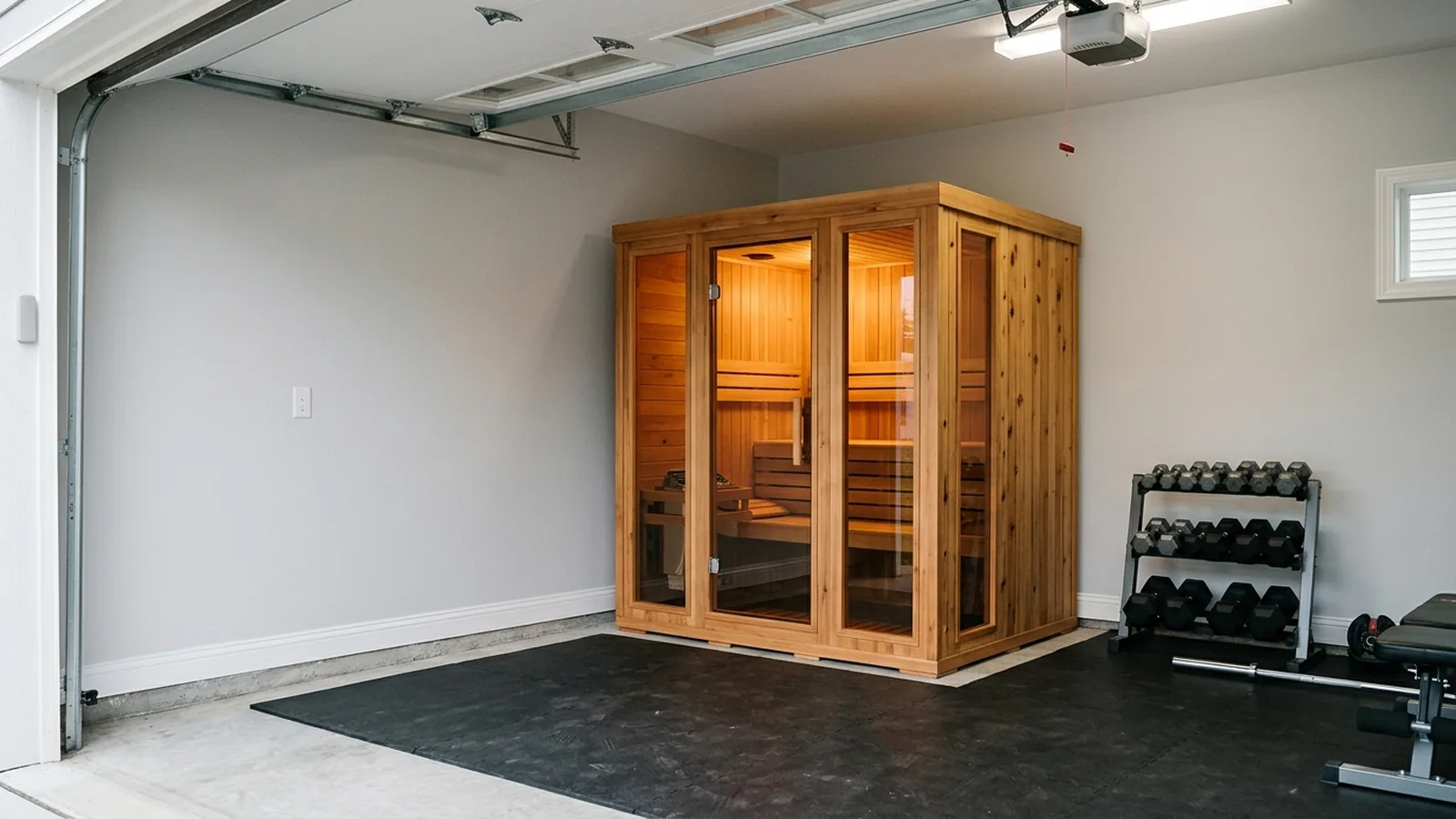
Yes, you can usually put a sauna in a garage, as long as the model is rated for indoor use or approved for that location and your garage can feed its heater. The heater decides almost everything. A traditional sauna’s electric heater typically needs a hardwired 240 V circuit on a 30 or 40 A breaker, run by a licensed electrician. A plug-in infrared cabin may only need a dedicated 120 V, 20 A outlet. Budget for that wiring before you budget for the sauna, and read the section below on what the manuals leave out, because none of them talk about the car parked next to it.
1. The sauna
2. Electrician and wiring
3. Running cost
| Item | Cost |
|---|
Which kind of sauna fits a garage?
There are two families, and they ask very different things of your garage. Traditional saunas heat the air with an electric stove of rocks to around 150–185°F. Infrared cabins use panels that warm you more directly at lower air temperatures, and Clearlight’s manual describes them as most effective at about 115–125°F. Here’s how four real models compare on the specs that decide a garage install.
| Model | Type | Price (Oct 2026) | Outside size | Power it needs | Warm-up |
|---|---|---|---|---|---|
| Almost Heaven Rainelle 4-person | Traditional, indoor | $5,859 sale ($7,324 regular) | 71.5 x 62.75 x 77.6 in | 6 kW (30 A) or 8 kW (40 A), 240 V, hardwired | About 45–60 min |
| Clearlight Sanctuary 2 | Far infrared | $7,299 at one authorized retailer (Clearlight quotes on request) | 51.75 x 47.75 x 77 in, 450 lb | 120 V, 2,260 W (18.83 A), dedicated 20 A circuit, NEMA 5-20 plug | 10–15 min (2022 manual) |
| Dynamic Barcelona (DYN-6106-01) | Budget far infrared | $1,999 at a retailer | 39 x 36 x 73 in | 120 V, dedicated 15 A circuit | 20–30 min to 122°F |
| Almost Heaven Watoga barrel | Traditional, outdoor-rated | $6,183 | 78 x 59 x 75.4 in | 6 kW, 240 V, 30 A, hardwired | About 45–60 min |
Manufacturer product pages and manuals, checked October 13, 2026. On that date Almost Heaven’s heater options for both models showed as unavailable, so confirm stock. Clearlight’s own page asks you to request pricing; the price shown is from an authorized retailer.
The practical split: if your garage panel has no spare capacity or you rent, a plug-in infrared cabin is far easier to power. If you want a traditional sauna’s heat and steam, plan on a 240 V circuit.
Will it physically fit?
Start with the footprint and height. The Rainelle needs about a 6 by 5.2 ft patch of floor and stands 77.6 in tall; the Sanctuary 2 is closer to 4.3 by 4 ft. Clearlight’s manual asks for at least 4 inches of clearance on all sides. Almost Heaven’s indoor cabin manual doesn’t give a room clearance. Heater makers’ figures vary: Harvia’s UL spec page for its KIP60B heater lists 3.5 ft of clearance above the heater, but another Harvia page gives different figures, so go by the manual that ships with your heater. Either way, that clearance is inside the cabin, not your garage.
Two garage-specific details catch people out. Garage slabs are often sloped toward the door for drainage, and Almost Heaven’s barrel manual says to shim a sloped floor level. And the floor has to carry the weight: the barrel manual asks for a surface that supports 1,000+ lb. Concrete is fine; Almost Heaven lists concrete among suitable floors and says carpet is not recommended.
Measure the garage door track and opener too. A 77-inch cabin under a door that rolls up to 84 inches leaves little room to tip it upright during assembly.
What electrical work does a garage sauna need?
This is the expensive part, and the part not to guess at. Almost Heaven’s heater manual specifies, for its 6 kW heater, a 240 V single-phase circuit on a 30 A double-pole breaker with 10/2 copper wire (8/2 if the run is over 90 ft), and for its 8 kW heater a 40 A breaker with 8/2 copper. It says GFCI protection is not permitted for those heaters and that all connections should be done by a licensed and certified electrician. Clearlight’s Sanctuary 2, by contrast, plugs into a dedicated 120 V, 20 A outlet, and its manual strongly recommends a GFCI device in any potentially wet location and advises against extension cords. These are model-specific instructions. Separately, the National Electrical Code (NEC 210.8(A), 2017 edition onward, as your area adopts it) requires GFCI protection for receptacles in garages, so plan on GFCI protection for a plug-in unit like the Sanctuary 2. Have your electrician resolve any conflict between the exact heater instructions and applicable local requirements with the manufacturer and permitting authority before installation. The calculator checkbox only changes a price estimate; it does not determine whether GFCI protection is required or suitable. Heater models and manual revisions change, so treat the figures here as examples and follow the manual for the exact heater you buy.
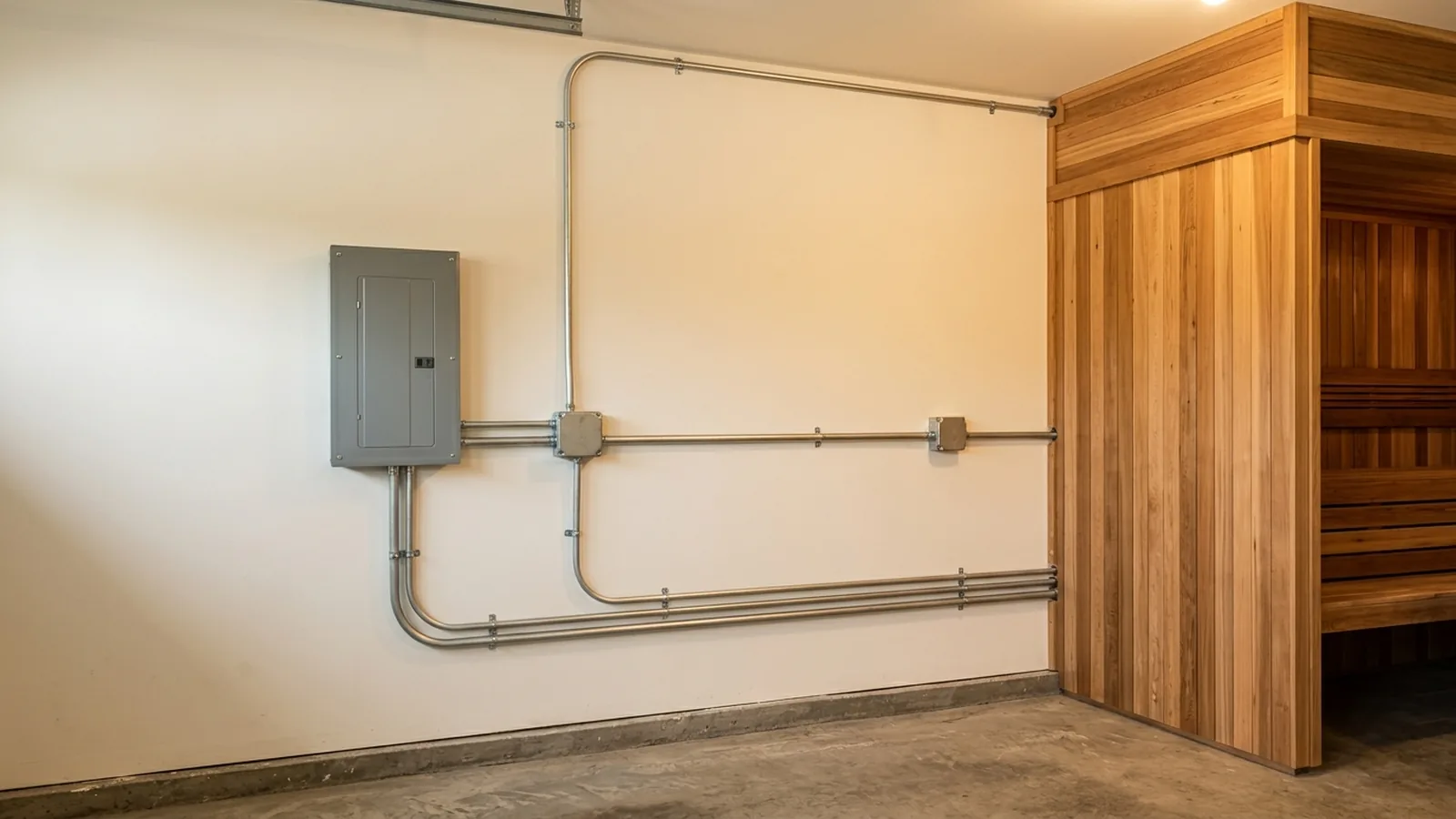
Code backs that up. The International Residential Code, as adopted in Seattle’s residential code (section M1902), requires sauna heaters to comply with UL 875 (the standard for electric dry-bath heaters), to be installed per the manufacturer’s instructions, and to have a thermostat that limits room temperature to no more than 194°F. A sauna controller manual from HUUM puts it plainly: the electrical work may only be performed by a licensed electrician, and you must obtain all required permits before installation.
What the electrician and permit cost
Cost guides put a typical installed dedicated circuit at about $570–$1,000 (HomeAdvisor, June 2026), with Angi and HomeGuide giving similar middles around $650–$700. Electricians typically charge $50–$130 an hour, and many charge a $100–$200 service call that includes the first hour. The parts themselves are a small share: at Home Depot in October 2026, 10/2 NM-B copper wire worked out to about $3.46 per foot, 8/2 to about $3.58 per foot, and a 30 or 40 A double-pole breaker to about $18.
Permits vary by city. Cost guides quote $50–$350. San Diego’s 2026 fee bulletin charges $176.57 for up to five 15–45 A circuits on a simple residential permit.
Three things can multiply the bill:
- No room in the panel. A subpanel runs about $400–$1,750 installed (Angi, October 2026), and a service upgrade to 200 A about $1,300–$2,500. A free breaker slot isn’t the same as spare capacity: an electrician’s load calculation tells you whether your service can carry the sauna, and a subpanel adds breaker space, not capacity.
- Finished walls. Fishing wire through drywall and patching each hole adds roughly $300–$500 (the calculator uses $400).
- A detached garage. Trenching runs about $5–$12 per foot, and HomeGuide puts a full 50–150 ft underground feed at $500–$3,800 before interior wiring.
Worked example from the calculator above: a Rainelle with the 6 kW heater, a 40 ft run in an open garage wall, four hours of labor at $90 and a $150 permit comes to about $667 of electrical work, or about $7,926 up front with Almost Heaven’s $1,400 professional assembly. The Sanctuary 2 on the same 40 ft run comes to about $605 of electrical work with a GFCI breaker, mostly labor and permit, because 12/2 wire costs about $0.72 a foot.
What the manuals don’t cover: cars, fuel and cold
We read the installation and owner’s manuals for all four models above. Only Clearlight names a garage as a possible location. None of them says anything about parking a car beside the sauna, storing gasoline, solvents or paint nearby, carbon monoxide from a running engine, or how cold the garage can get. That silence isn’t permission. Before you buy, ask the manufacturer in writing:
- Is this model approved for a garage that also houses a vehicle or stored fuel, and what clearance do you require from them?
- What’s the minimum ambient temperature for operation and storage? Dynamic’s manual only notes that warm-up takes longer in a cold room.
- Does installing it in a garage affect the warranty? None of the four warranties we read mentions garages either way.
Common sense fills the rest: keep fuel cans, solvents and oily rags out of the garage or well away from the cabin, never run a vehicle in the garage while the sauna is on, and keep a working CO alarm and smoke alarm there.
What does a session cost to run?
Energy is simple arithmetic: heater kilowatts × hours on × your electricity rate. The US residential average was 18.31¢ per kWh in July 2026 (EIA), but check your own bill. At that rate a 6 kW heater at full power costs about $1.10 an hour, an 8 kW about $1.46, and the 2.26 kW Sanctuary 2 about $0.41. Warm-up counts, and a traditional sauna’s 45–60 minute warm-up is often longer than the session itself.
The calculator assumes the worst case, a heater running flat out, until you lower the on-time; thermostats cycle heaters off once the room is up to temperature, so real costs come in lower. At the worst case and the calculator’s default 18.3¢ per kWh, a 6 kW traditional sauna with a 50-minute warm-up and 20-minute sessions three times a week costs about $16.65 a month. The Sanctuary 2 with a 20-minute warm-up and the same sessions costs about $3.58.
Garage or outside?
If your garage holds cars, fuel and a sloped slab, an outdoor-rated barrel can be the cleaner answer. The Watoga is built for outdoor use (Almost Heaven says it’s also fine indoors), needs a level pad that carries 1,000+ lb, and uses the same 240 V, 30 A hardwired heater, so the wiring cost is similar or higher once you add a trench. Almost Heaven suggests a roofed shelter or rain jacket for full weatherproofing. An indoor-only cabin like the Barcelona can’t go outside at all; its warranty is voided by outdoor use.
Does a sauna help your lifting?
Not in any way the research has shown for muscle growth. A 2025 systematic review of 14 studies and 194 people on post-exercise heat found low to moderate quality evidence and concluded it wasn’t possible to draw definitive conclusions about recovery or performance. A 2025 trial in 40 female team-sport athletes found that 10 minutes of infrared sauna after training, three times a week for six weeks, did not significantly change hypertrophy gains. Use a sauna because you enjoy it, not as a growth tool.
Heat has real risks. Harvard Health advises avoiding alcohol and medications that impair sweating before and after a sauna, and staying in no more than 15–20 minutes. If you have a heart condition or take medication that affects heat tolerance, ask your doctor first.
Quick decision guide
| Your situation | Likely fit |
|---|---|
| Dedicated gym garage, panel has space, want real heat | Traditional indoor cabin on a new 240 V circuit |
| Garage also parks cars or stores fuel | Get the maker’s written OK first, or put an outdoor barrel outside |
| Renting, or no panel space | Plug-in infrared on a dedicated 120 V circuit |
| Detached garage | Price the trench first; it can cost more than the sauna’s wiring |
For the rest of the garage, the 10×10 home gym guide shows how to zone equipment around a fixed footprint like a sauna, and the cold plunge and muscle growth guide covers the other half of the hot-cold routine.
Sources
- Almost Heaven: Rainelle, heater manual, cabin manual, Watoga, barrel manual.
- Clearlight: Sanctuary 2, manual. Dynamic Barcelona manual. Harvia KIP60B UL specs. HUUM UKU manual.
- Code: Seattle Residential Code M1902 (IRC-based); UL 875.
- Costs: HomeAdvisor dedicated circuit, HomeAdvisor electrician rates, Angi subpanel, Angi 200 A upgrade, HomeGuide detached garage, HomeGuide drywall, San Diego DSD bulletin 103; Home Depot Southwire wire and Square D breaker listings.
- EIA Electric Power Monthly.
- Research: Ahokas et al., Sports Medicine Open (2025); Ahokas et al., Frontiers in Sports and Active Living (2025); Harvard Health.