

Disclosure: Hypertrophy Protocol participates in the Bulletproof Fitness Equipment affiliate program and may earn a commission from qualifying purchases made through links on this page.
You have a landmine, a monolift or a cable attachment in your cart, the listing says it fits 3×3 racks, and you own a 3×3 rack. That’s rarely enough. Rack attachment compatibility comes down to seven things: upright size, hole diameter, hole spacing, your exact rack model and height, the room around the rack, the extra parts the attachment needs, and whether your rack is bolted down. Every example below comes from Rogue, REP, Titan and Bulletproof attachment pages, checked September 22, 2026.
Write down your rack’s specs first
Get these numbers before you open a product page. Most are on your rack’s spec sheet, and the rest take a tape measure and calipers.
- Brand, model name, and roughly when you bought it
- Upright tube size (for example 2×2, 2×3, 3×3)
- Hole diameter (5/8″ or 1″ are the common sizes)
- Hole spacing, and whether it changes through the bench zone
- Upright height
- Inside width between uprights, and rack depth
- Base type: bolt-down, flat foot, or wall-mounted
- Which crossmembers and pull-up bars are installed, and where
Not sure how to take a measurement? The power rack attachment compatibility guide shows how to measure hole diameter and inside width, and power rack upright sizes covers the tube.
The 7-point rack attachment compatibility checklist
1. Upright size
The attachment wraps around, slides over or bolts to your upright, so the tube has to match. Some attachments come in one size only. Rogue’s Monster Landmine 2.0 “Mounts ONLY to 3×3″ uprights of Rogue Monster Series rack/rigs/stands,” and 2×3 owners get pointed to the standard landmine instead (Rogue).
Others come in several sizes. Bulletproof sells the VTS Rack Attachment in 3×3, 2×3 and 2×2 versions, and you pick yours at checkout. 3×3 has the widest choice of attachments, and why 3×3 racks became the standard explains why.
Uprights that are close to a standard size but not exact leave a gap. Bulletproof’s ISOLATOR Carriage Shims exist to “eliminate gaps and wobble” on racks such as the REP PR-4000 and PR-5000 and “2.3 x 2.3 racks,” and take up gaps of up to 5mm per side. For other attachments, ask the maker before you add spacers of your own.
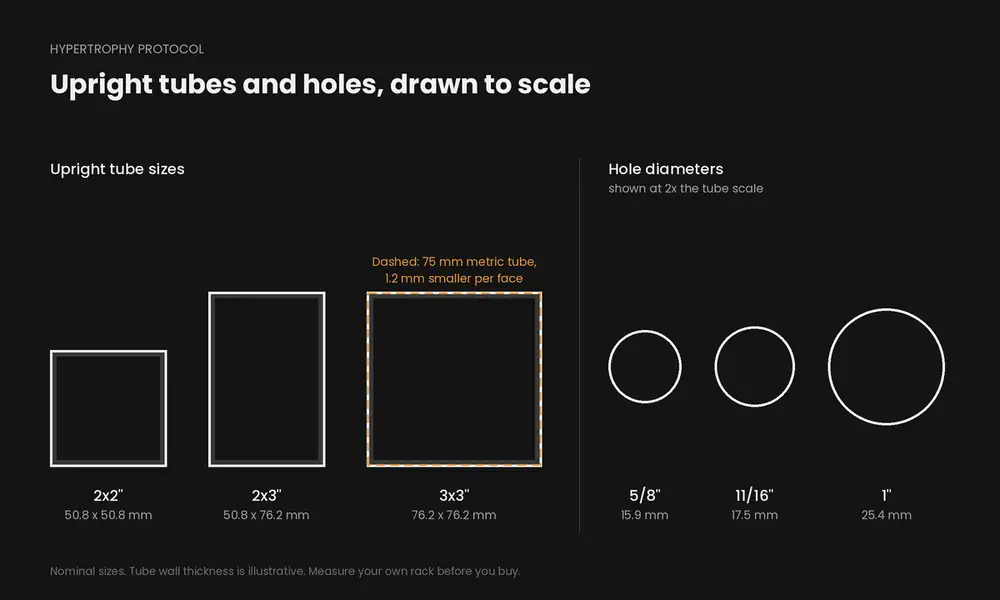
2. Hole diameter and pin size
Two racks with the same tube can use different hardware. Rogue’s Monster Lite line uses 5/8″ hardware and its Monster line uses 1″, which is why there are two monolifts: the AML-2 mounts with “5/8″ detent pins” and the AM-2 with “1” detent pins.” The Monster Lite Matador Hanger guide spells it out, “Monster racks use 1″ hardware,” so Monster owners need the Monster version (Rogue).
Some attachments let you choose. The ISOLATOR 2×2/2×3 comes with 1/2″, 5/8″, 3/4″ or 1″ pins, with adapter plates for the three smaller sizes, and the product page asks you to “Verify your rack’s upright size (2×2, 2×3, or 3×3) and hole diameter (1″ or 5/8″) before purchase.” The VTS front hole hooks fit 1″, 3/4″ or 5/8″ hitch pin holes.
A few attachments ignore your holes entirely. Titan’s X-Dip Bar “Clips onto the Pin and Pipe Safety Set,” with a 1.8 in. clip for the pipe (Titan), so what has to match is the safety set. 5/8″ vs 1″ hole size covers the two main standards.
3. Hole spacing and bolt pattern
A pin-on attachment only needs a hole at a usable height. A bolt-on attachment needs holes an exact distance apart, and Rogue’s patterns vary from product to product:
- The Rogue Monolift for Monster Lite and Infinity racks: “5/8″ Mounting Holes, 1″ on center” (Rogue)
- The Monster Lite Matador Hanger: “Mounting holes are 6″ on center”
- The Monster Lite Slinger: mounts using 8″ on-center holes (Rogue)
Spacing also sets how finely you can adjust. REP’s lowered J-cups give “1” hole spacing on a rack with 2″ hole spacing” (REP). If your rack has tighter spacing through the middle, Westside hole spacing explains what that changes.
4. Exact rack model, generation and height
Many attachments fit one product line, and some exclude older versions or certain heights within it:
- Generation: Titan’s T-3 Series Y-Dip is “Not compatible with T-3 Series Racks purchased before October 2021” (Titan). The Titan Lat Tower excludes the same older racks.
- Height: REP’s Plate-Loaded Lat Pulldown & Low Row comes in 80″ and 93″ versions, and “if you order an 80″ rack, the 93″ Lat and Low Row Attachment will not be compatible.” The reverse holds too (REP).
- Upright markings: Rogue’s Monster Lite Lat Pulldown Seat + Low Row Kit is “Designed solely for Rogue Monster Lite Racks (90″ & 100″ models only)” and is “Not compatible with 108″ uprights or 100″ uprights lacking laser-cut numbers” (Rogue).
- Configuration: The same REP lat attachment “is not compatible with the PR-4000 24″+24″ 6-Post configuration.”
A matching brand and series isn’t enough. Check the model year, height and configuration too.
5. Inside width, depth and clearance
Some attachments work between the uprights and others stick out from the rack, so measure both inside the rack and around it.
- Inside width: The VTS has “been tested with a maximum 43″ inside width for racks” and is “designed for 7′ Olympic barbells.”
- Added depth: REP’s Plate-Loaded Lat Pulldown & Low Row adds 27″ of depth, and you need “an additional 10″ of clearance behind the attachment” for loading plates.
- Projection: The AML-2 monolift is 16.75″ deep from the mounting face. The Monster Lite Slinger “will extend approximately 7″ out from the face of the upright” and “approximately 7″ above the top of that same upright,” so measure your ceiling as well.
- Between uprights: Titan’s Lat Tower “Mounts in-between the uprights” and is 42 inches wide overall (Titan).
Working in a small room? See the 10×10 home gym layout.
6. Crossmembers, pull-up bars and extra parts
Many cable and pulley attachments hang from a crossmember or need other parts before they work:
- Crossmember position: The Monster Lite Slinger fits the RML-390 only if you rearrange the crossmember and Fat/Skinny Pull-Up Bar, and weight-stack models need Monster Lite 3.0 crossmembers with pre-drilled holes. An existing crossmember “can be drilled by an experienced craftsman,” per the Slinger instructions (Rogue instructions).
- Required base: REP’s Plate-Loaded Lat Pulldown & Low Row “requires the Rear Base Stabilizer,” and the 4000 and 5000 stabilizers aren’t interchangeable.
- Another attachment: Rogue’s Monster Lite lat pulldown seat kit needs “an existing Monster Lite Slinger attachment (sold separately) to function.”
- A system to hang from: The High/Low Pulley System is compatible with “Bulletproof VTS, VTS Lite, and compatible 3×3 rack uprights,” with a standalone trolley marked as coming soon. VTS vs VTS Lite vs HOME covers how those fit together.
- Hardware: Rogue’s Monster Lite crossmember page is blunt: “Hardware Not Included with any of the products above” (Rogue).
Add up every extra part before you compare attachments. The attachment on its own may not be a working setup.
7. Base type, anchoring and mounting side
Attachments that pull sideways or upward can tip a rack that isn’t held down, and the product pages are plain about it:
- Rogue’s Slinger: “Any Rack or Rig utilizing the Slinger attachment must be securely fastened to the floor for use.” It isn’t compatible with the RML-390F Flat Foot Rack, fold-back racks or wall-mounted racks.
- Titan’s Lat Tower “Does NOT fit Flat Foot Power Racks.”
- Bulletproof’s VTS Lite “must be installed on a firmly mounted rack” because “racks have a propensity to tip based on weight amount and angle of pull” (Bulletproof).
- Titan’s Y-Dip: “For safety, if your rack isn’t bolted down, install the Y-Dip on the inside.”
Check the mounting face too. An attachment may go on the front, side or inside of the uprights, and your rack needs holes on that face.
The checklist at a glance
| What to measure | Why it matters | Example manufacturer requirement |
|---|---|---|
| Upright size | Brackets and sleeves are sized to one tube | Monster Landmine 2.0: “Mounts ONLY to 3×3″ uprights” (Rogue) |
| Hole diameter | Pins and bolts must pass through your holes | Matador Hanger: “Monster racks use 1″ hardware” (Rogue) |
| Hole spacing / bolt pattern | Bolt-on parts need holes at a set distance | Monolift: “5/8″ Mounting Holes, 1″ on center” (Rogue) |
| Rack model, year, height | Designs change between versions and heights | Y-Dip: “Not compatible with T-3 Series Racks purchased before October 2021” (Titan) |
| Inside width and depth | Barbell and trolley travel, room footprint | VTS: “tested with a maximum 43″ inside width” (Bulletproof) |
| Crossmembers and extra parts | Pulleys hang from, or anchor to, other parts | Lat & Low Row “requires the Rear Base Stabilizer” (REP) |
| Base type and anchoring | Off-axis pulls can tip an unanchored rack | Slinger: rack “must be securely fastened to the floor for use” (Rogue) |
What to do if your rack isn’t listed
If the attachment page names your rack, model year and height, and your measurements match, order it. If your tube and hole size match but your rack isn’t named, the fit is likely but unconfirmed: email the maker your specs before you order anything that bolts on, hangs from a crossmember or pulls off-axis. If the page says “only” or “not compatible” next to anything that describes your rack, believe it.
To run your numbers against attachments from Rogue, REP, Titan, Bulletproof and others, use the Rack Attachment Fit Checker. Once fit is settled, rack attachments for lats covers which ones are worth buying.
Specifications checked against manufacturer pages on September 22, 2026. Manufacturers change specs; confirm on the product page before ordering.