
Prices, sizes and weights were checked on retailer and manufacturer pages on October 13, 2026. This page contains no affiliate links.
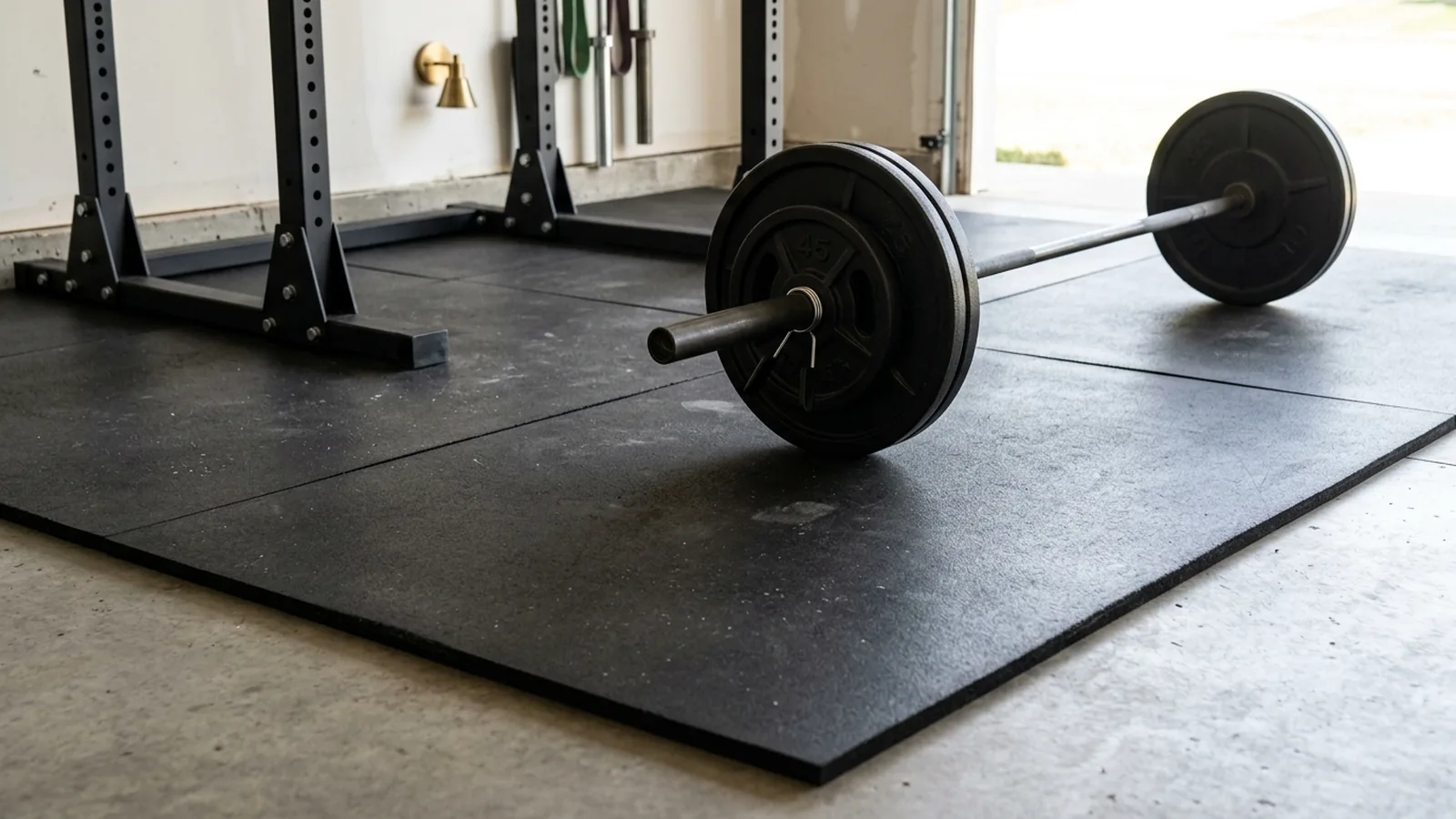
For most garage gyms, 3/4-inch rubber stall mats are the best-value home gym flooring: about $2.67 per square foot at Tractor Supply, thick enough for deadlifts and dropped weights, and nearly indestructible. If you won’t drop weights and want something easier to lay, 3/8-inch interlocking rubber tiles cost about the same per square foot and weigh a fraction as much per piece. Foam puzzle tiles are the cheapest, but sellers class them as light duty, so keep them for stretching and bodyweight work. Use the calculator to count exactly how many pieces you need and to check whether your rack fits the room.
How much flooring to buy, what it costs and weighs, whether your rack fits, and how much your floor slopes.
Tax and shipping (optional)
Sources and assumptions
- Prices are dated examples checked October 13, 2026, before tax and shipping: Tractor Supply stall mat $63.99 and 94 lb (price shown for one Tennessee store; yours may differ); Greatmats Sport tile $10.47 and 8.0 lb; Greatmats 3/8 in roll $2.70 per sq ft, 4 ft wide, 2.2 lb per sq ft, 15 ft minimum length; FlooringInc 3/4 in tiles $264.99 per 20 and EVA foam tiles $34.99 per 6 at Home Depot (weights not listed). Edit any of them.
- Piece count is a simple grid: whole pieces in rows, in whichever of the two orientations needs fewer, rounded up to whole packs. It doesn’t reuse offcuts or mix orientations, so a careful cut plan can sometimes use fewer.
- Rolls are bought as one length cut into strips on site; the minimum length applies to what you order, not to each strip. Very long rolls are heavy, so you can split the order into several rolls, each at least the minimum.
- Weight to haul is everything you buy. Weight on the floor assumes the material’s weight is spread evenly and offcuts are removed. Neither is a structural rating.
- Thickness guidance: U.S. Rubber and Greatmats (3/8 in for free weights you set down; 3/4 to 1 in for deadlifts and intentional drops). Thickness alone doesn’t make a product suitable for drops, a loaded rack or car tires.
- Rack fit: Rogue R-3 53 × 34 × 90.4 in; Titan T-3 82 in 54 × 44.75 in with a 78 in maximum pull-up bar height. The lifting zone is a 9 ft clear run for a 7 ft bar, about 3 ft each side of the rack and about 4 ft in front (Block Renovation). The pull-up target is your reach plus 6 to 12 in (Bullbarfit).
How thick should home gym flooring be?
Thickness should match the heaviest thing that will hit the floor. Two flooring makers publish guidance that lines up closely:
| What you’ll do | Suggested thickness | Source |
|---|---|---|
| Cardio machines, bodyweight work | 8 mm (5/16 in) | U.S. Rubber |
| Free weights, not dropped | 9 mm (3/8 in); Greatmats says 8 mm to 3/8 in for 50–120 lb | U.S. Rubber, Greatmats |
| Weights over 120 lb, dropped weights, Olympic lifts | 1/2 in or more | U.S. Rubber, Greatmats |
| Deadlifts, cleans and intentional drops | 3/4 to 1 in | Greatmats |
The reason to go thick for drops is the slab underneath. U.S. Rubber notes thicker flooring protects concrete from cracking under dropped weights. If you deadlift heavy, 3/4 inch is the practical floor, and a platform is better still.
What does home gym flooring cost?
| Flooring | Size and thickness | Price (Oct 2026) | Weight | Per sq ft |
|---|---|---|---|---|
| Tractor Supply stall mat | 4 x 6 ft, 3/4 in | $63.99 | 94 lb | $2.67 |
| L&M Supply stall mat | 4 x 6 ft, 3/4 in | $54.99 | Not listed | $2.29 |
| REP 4×6 floor mat (urethane-bound) | 47 x 71 in, 3/4 in | $76.99 each, minimum 3 | 88 lb | $3.32 |
| Greatmats Sport interlocking tile | 2 x 2 ft, 3/8 in | $10.47 | 8.0 lb | $2.62 |
| Greatmats Pacific interlocking tile | 2 x 2 ft, 3/8 in | $11.84 | 8.54 lb | $2.96 |
| FlooringInc soft rubber tile (Home Depot) | 2 x 2 ft, 3/4 in | $264.99 per 20 | Not listed | $3.31 |
| Greatmats rolled rubber | 4 ft wide, 3/8 in | $2.70/sq ft (15 ft minimum) | 2.2 lb/sq ft | $2.70 |
| EVA foam puzzle tiles (Home Depot) | 2 x 2 ft, 1/2 in | $34.99 per 6 | Not listed | $1.46 |
Per-square-foot figures are price divided by nominal area. Prices change often; Greatmats’ tile prices were sale prices on the day we checked.
How much flooring do you need?
Start by deciding whether you’re covering the whole room or just a lifting zone. A 10 x 10 ft area is a common baseline for a rack, bench and barbell, and one-car garages typically start around 12 x 20 ft. The calculator rounds up for cut rows, which is how you’ll actually buy.
- 10 x 10 ft lifting zone, stall mats: 6 mats, about $384 before tax at Tractor Supply prices and 564 lb to haul home; about 390 lb of that ends up on the floor after trimming. You’ll trim the last row because 10 ft isn’t a multiple of the 4 x 6 ft mats.
- Whole 12 x 20 ft one-car garage: 10 stall mats for about $640 (940 lb), 60 Greatmats Sport tiles for about $628 (480 lb), 60 ft of 4 ft wide rolled rubber for about $648, or 60 foam tiles for about $350.
Interlocking tiles usually need edge or border pieces to finish cleanly. Greatmats sells borders for its Sport tile separately and says its Pacific tile is cut straight with a utility knife; FlooringInc’s 3/4-inch tiles have edges you detach.
Stall mats vs rubber tiles vs rolls vs foam
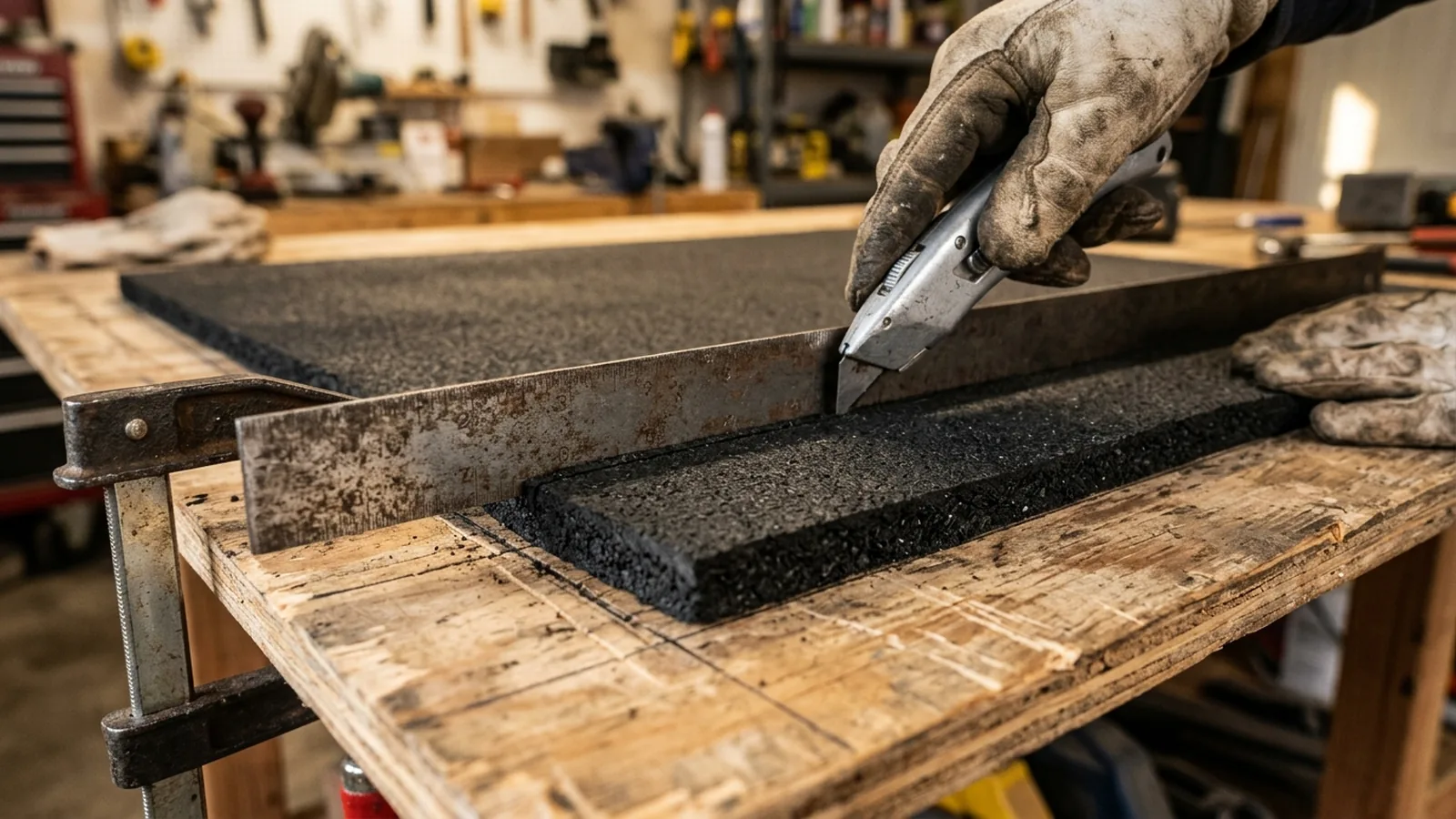
Stall mats are the cheapest thick option and the default for serious garage gyms. The trade-offs are weight and smell. A 3/4-inch, 4 x 6 ft mat weighs about 94 lb, so moving and cutting them is a two-person job. To cut one, lay it on scrap board, clamp a straightedge along the line, and score it several times with a sharp utility knife, cutting away from your body, rather than forcing one deep pass. Tractor Supply warns they have a strong rubber smell at first, and Greatmats recommends washing them and letting them dry in the sun, unstacked, before bringing them inside, because the odor can last for months indoors.
Interlocking rubber tiles are the easiest to lay and replace one at a time. At 3/8 inch they’re right for free weights you set down, but not for heavy drops; for comparison, Greatmats rates its separate 3/8-inch rolled rubber, not these tiles, for dropped weights up to 80 lb.
Rolled rubber gives the cleanest look with the fewest seams, but rolls are heavy, need a 15 ft minimum length from Greatmats, and are harder to cut accurately.
EVA foam tiles are cheap and light. FlooringInc doesn’t recommend soft tiles for heavy free weights, and American Floor Mats calls its foam tiles lighter duty. Fine for a stretching corner, not under a loaded rack.
Whatever you choose, look for low-VOC or FloorScore-certified products if smell matters; U.S. Rubber says cheap recycled rubber smells strongly at first.
Do you need a deadlift platform?
If you pull heavy or drop the bar, a platform spreads the impact better than mats alone. Pre-built options in October 2026:
- Rogue Deadlift Platform: $495 frame, about $795 with an 8-pack of 1.5-inch tiles; 4’4″ x 8’4″.
- Titan Deadlift Platform: $299.97 frame, $469.97 half kit, $729.97 full; 99 x 59.5 in.
- Rogue 8×8 Oly Platform: $562 frame; 24 x 24 x 1.5-inch rubber tiles sold separately, listed from $85 (sold in packs from a pair up to 16).
The DIY route is plywood plus stall mat. Bells of Steel’s plan glues and screws two layers of 3/4-inch plywood, puts a third sheet in the center as the standing surface, and lays strips of 3/4-inch stall mat on each side where the plates land.
Will your rack fit the room?
Flooring is only half the plan. Space for the rack, bar and plates is the other half, and ceiling height catches most people. Common planning guidance (Block Renovation) is a 9 ft clear run for a 7 ft barbell, about 3 ft on each side of a rack for loading plates, and about 4 ft in front of it. A men’s Olympic bar is 2.2 m, about 7.2 ft, long.
| Rack | Footprint (W x D) | Height | Lifting zone needed |
|---|---|---|---|
| Rogue R-3 | 53 x 34 in | 90.4 in | About 10.4 x 6.8 ft |
| Titan T-3 (82 in) | 54 x 44.75 in | 82 in | About 10.5 x 7.7 ft |
Rogue says its R-3 fits easily under a standard 96-inch ceiling. For pull-ups, a bar at your standing overhead reach plus 6–12 inches is a common target, which for many people is 7.5–8.5 ft, above most racks’ top crossmember. That’s why rack pull-ups are often done with bent knees. For overhead pressing, Block Renovation says a 6-foot lifter wants close to 8 ft clear. The calculator’s second tab runs these checks for your room and rack, including the height your flooring or platform adds under the rack.
Is your garage floor sloped?
Probably. Garage slabs are usually poured to fall toward the door so water drains out, and the International Residential Code (R309.1 in the 2021 edition) requires the parking area of a garage floor to slope toward a drain or the main vehicle door. Expect a gentle pitch toward the door, and plan to shim or level anything that has to sit flat. Measure yours before you lay a platform: put a long level or straight board on the floor, lift the low end until the bubble centers, and measure the gap. A 2-inch drop over 12 ft is about 0.17 in per foot, a 1.4% grade. Across an 8 ft platform, that puts the low end about 1.3 inches below the high end. The calculator’s third tab does this conversion for your numbers.
That’s geometry, not a leveling plan. It won’t tell you how to shim, whether shims will stay put under dropped weights, or whether a rack can be bolted down on the slope; follow the rack maker’s instructions and get a contractor’s advice if you need to level a platform. If a car shares the garage, check that the mat maker allows vehicle traffic before you park on it, and keep the car’s door-swing space clear of equipment.
Can your floor handle it?
On a garage slab, flooring weight doesn’t matter. Upstairs, it’s worth knowing: a 94 lb, 24 sq ft stall mat weighs about 3.9 lb per square foot once it’s down, so a 10 x 10 ft area of mats adds roughly 390 lb. That number is the flooring’s own weight, not a capacity check. What a framed floor can carry depends on its joists, span and condition, and a loaded rack’s four feet or a dropped barbell is a concentrated load rather than an even one. Ask a structural engineer before you build a heavy gym on a framed floor.
The short version
- Heavy lifting in a garage: 3/4-inch stall mats, aired out first, plus a platform if you pull heavy.
- Free weights without drops, or a finished room: 3/8-inch interlocking rubber tiles.
- Clean look, big area: rolled rubber, if you can handle the weight.
- Stretching corner or kids’ area: EVA foam.
Planning the whole room? The 10×10 home gym guide lays out zones around a rack, and if a sauna or cold plunge is on the list, the garage sauna guide covers its footprint and wiring.
Sources
- Flooring: Tractor Supply stall mat; L&M Supply; REP floor mats; Greatmats Sport tile; Greatmats Pacific tile; FlooringInc 3/4 in tiles; Greatmats rolled rubber; EVA puzzle tiles; American Floor Mats.
- Thickness and care: U.S. Rubber; Greatmats thickness guide; Greatmats on stall mat odor.
- Platforms: Rogue Deadlift Platform; Rogue 8×8 Oly Platform; Titan Deadlift Platform; Bells of Steel DIY platform.
- Space: Rogue R-3 guide; Titan T-3; Block Renovation home gym dimensions; one-car garage sizes; pull-up bar height.