
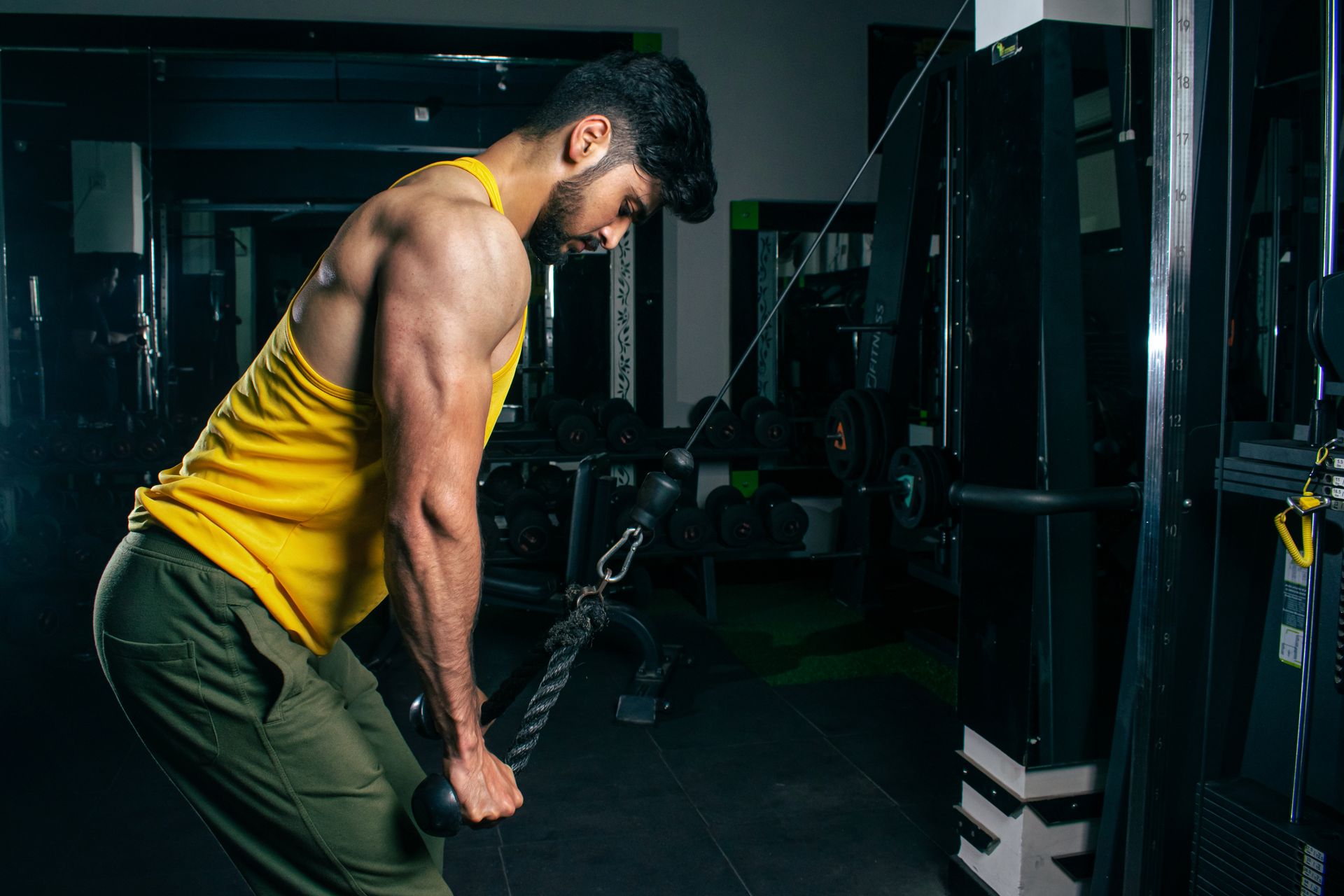
The VOLTRA I’s eight training modes are the actual reason to buy a digital resistance trainer over a normal cable stack. The full VOLTRA I Guide covers the rest of the specs. But “the app can do it” and “the research supports it for hypertrophy” are two different claims, and marketing copy tends to blur them. This goes mode by mode through what has actually been studied.
I own a VOLTRA I, but this page sticks to what the published research says about each mode; my own setup notes are in the guide linked above.
Weight Training (Baseline Mode)
This is constant resistance through the range of motion, mechanically the closest thing to a normal cable stack or plate-loaded machine. It’s the best-supported mode in the list by a wide margin, because it’s what almost all resistance-training hypertrophy research is actually built on. If you’re unsure which mode to default to, this is it.
Eccentric Overload
This is the mode most likely to get oversold, so it’s worth being direct about the evidence: a 2026 systematic review and meta-analysis of accentuated eccentric loading (AEL) vs. constant-load training found no statistically significant advantage for AEL on any chronic outcome measured: maximal concentric strength (SMD 0.12, p=0.41), maximal eccentric strength (SMD 0.19, p=0.58), maximal isometric force (SMD 0.03, p=0.93), or muscle cross-sectional area (SMD −0.06, p=0.84). Confidence intervals crossed zero on every measure.
That doesn’t make the mode useless; some lifters like it for technique work and variety. But if the pitch is “eccentric overload builds more muscle,” the current chronic-outcome evidence doesn’t back that up. The same review also flagged that AEL increases metabolic stress and perceived exertion, so it recommends longer rest periods when you do use it.
Resistance Band Mode
This simulates accommodating resistance: lighter at the start of the range and heavier at lockout, the way a physical band behaves. The mechanism is plausible for lifts that get easier near lockout (presses, some pulls), since it can keep tension higher through the strongest part of the range.
The evidence specifically isolating “banded/accommodating resistance mode” as a superior hypertrophy driver over straight-weight training is thin. Most of the literature on bands looks at strength and power transfer rather than muscle growth. Treat it as a variation tool for feel and lockout-strength work.
Damper Mode
Velocity-based resistance that increases as you move faster. This is more about movement control than raw hypertrophy stimulus. It discourages sloppy, ballistic reps by punishing speed with more resistance. Useful for tempo work and controlling eccentrics in isolation movements; dedicated hypertrophy-outcome research on it as a named mode is lacking.
Isokinetic Mode
True isokinetic training, where resistance adjusts in real time to hold movement speed constant, has historically been a rehab and sports-science research tool (think physical therapy clinics and athlete testing labs) rather than a mainstream hypertrophy method. That’s reflected in the literature: there’s a reasonable body of isokinetic research in rehab and return-to-sport contexts, but comparatively little on isokinetic training as a chronic hypertrophy driver for general lifters.
It’s an interesting capability to have access to at home, and it’s useful for standardized strength testing (comparing left/right or session-to-session output at a fixed speed), but don’t assume it’s a proven hypertrophy shortcut just because it’s a sophisticated mode.
Isometric Testing Mode
This is the pleasant surprise on the list. Despite “isometrics are inferior for hypertrophy” being a fairly common assumption, the current evidence doesn’t support that. A 2025 meta-analysis (Ghayomzadeh et al., summarized by Stronger by Science) found isometric training produced larger isometric-strength gains than dynamic training (SMD 0.43), which is expected, since you get better at the task you train.
For muscle size, a 12-week study by Kubo and colleagues trained one leg isometrically and the other dynamically in 10 subjects and found similar quadriceps volume gains (4.5% for the isometric leg vs. 5.6% for the dynamic leg, both statistically significant). It’s a small study, so treat it as supportive rather than settled.
The real caveat is joint-angle specificity: isometric strength gains are largest at the trained joint angle. Muscle length matters for size too. A 2019 systematic review of 26 isometric training studies found that holds at longer muscle lengths built more muscle than equal volumes at shorter lengths (about 0.9 to 1.7% per week vs. 0.1 to 0.8%) and transferred better to dynamic lifts, though few studies qualified. So bias this mode toward longer-muscle-length positions rather than just testing at lockout.
This evidence is about isometric training in general, such as the sustained holds at 70% of maximum used in the Kubo study, not about this app mode specifically.
Custom Curves
App-programmable resistance profiles. It’s a flexibility feature that lets you approximate band mode, damper mode, or your own hybrid curve. Useful for experimentation once you understand what the named modes above are actually good for; the evidence for each named mode still applies.
Rowing / Skiing
Cardio-oriented modes simulating those movement patterns. These are conditioning options that come with the unit, and they shouldn’t be judged as hypertrophy modes or treated as a reason to buy it.
Which Modes Are Actually Worth Using for Hypertrophy
Direct verdict: for building muscle, Weight Training mode does the job the research actually supports, and Isometric Testing mode is a legitimately underrated option if you position it at longer muscle lengths. Eccentric Overload, Damper, and Resistance Band modes are reasonable variation and feel tools. Use them for exercise variety, technique work, or because you enjoy them; the current evidence doesn’t show them building more muscle than straight sets.
Isokinetic is the most technically impressive mode and the least applicable to a typical hypertrophy program; it’s a nice-to-have for testing, not a training driver.
Safety
Higher-force modes like Eccentric Overload and Isokinetic can load tendons and connective tissue differently than standard concentric-biased training. Progress load and volume in these modes gradually, the same way you would with any new training stimulus, and don’t jump straight to a heavy eccentric-overload session on an exercise you haven’t built a base in.
Related Guides
- Beyond Power VOLTRA I Guide: full specs, mounts, and who it’s for
- Cable Pulley Ratio Calculator
Sources
- Acute and Chronic Effects of Accentuated Eccentric Loading vs. Constant-Load Resistance Training: A Systematic Review and Meta-analysis, Sports Medicine
- Kubo et al. (2009), Effects of static and dynamic training on the stiffness and blood volume of tendon in vivo, Journal of Applied Physiology
- Hold Still: What Does the Evidence Actually Say About Isometric Training for Strength and Hypertrophy?, Stronger by Science
- Ghayomzadeh et al. (2025), isometric vs. dynamic training meta-analysis, Journal of Science and Medicine in Sport
- Oranchuk et al. (2019), Isometric training and long-term adaptations: effects of muscle length, intensity, and intent, Scandinavian Journal of Medicine & Science in Sports