
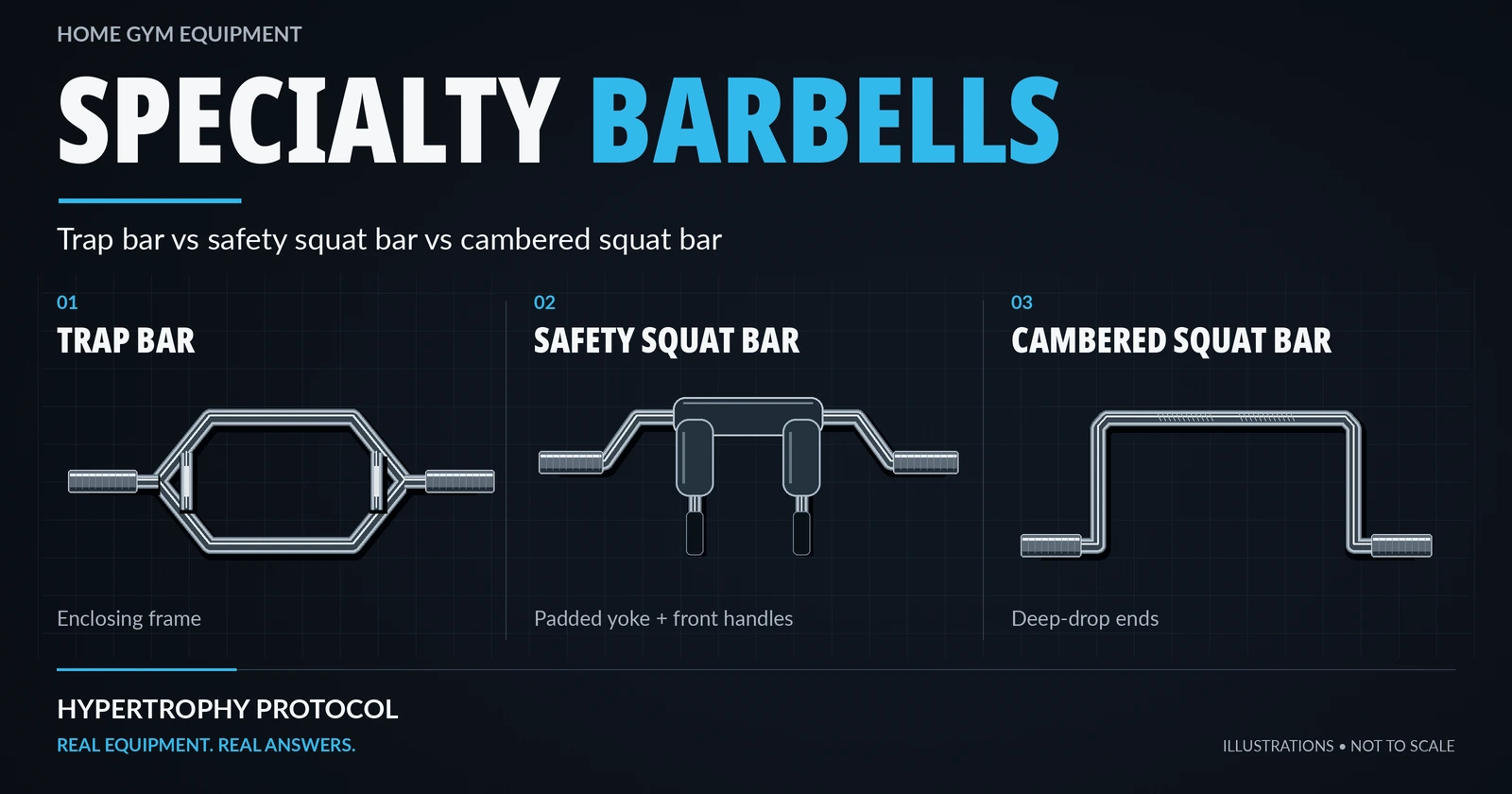
Short answer: a trap bar is the most versatile of the three for a home gym, a safety squat bar (SSB) is worth it if your shoulders, elbows or wrists make back squats uncomfortable, and a cambered squat bar is a niche tool you can skip unless you already squat a lot. None of the three has been shown to build more muscle than a straight bar. What they change is where the load sits, how comfortable the lift is, and how much weight you can move.
This guide covers what the research measured for each bar, what it didn’t, and what to check before buying one for a home rack.
Quick Comparison
| Bar | What changes | Best for | Evidence |
|---|---|---|---|
| Trap (hex) bar | You stand inside the load; less demand at the lower back and hips, more at the knees | Deadlifts, shrugs, carries | Several acute studies |
| Safety squat bar | Yoke and handles; no need to hold the bar behind your back; more upright torso | Squatting around shoulder, elbow or wrist discomfort | Several acute studies |
| Cambered squat bar | Plates hang below the shoulders and can swing | Variety for experienced squatters | No direct studies found |
What the Research Can and Can’t Tell You
Almost every study on specialty bars is acute: lifters perform a few sets with each bar in one or two sessions while researchers measure joint angles, forces, muscle activation (EMG) or bar speed. None of the studies found for this guide trained people with one bar for weeks and measured muscle growth. So the evidence tells you how each bar changes a lift, not which one builds more muscle. For growth, the bar you can train hard and consistently with is the right one.
Trap (Hex) Bar
With a trap bar you stand inside the frame and hold handles at your sides, so the load stays closer to your centre of mass than a straight bar in front of your shins.
In 19 male powerlifters, the hexagonal bar produced lower peak moments at the lumbar spine, hip and ankle and a higher peak moment at the knee than the straight bar. They also lifted more: a one-rep max of 265 kg vs 245 kg, about 8% higher, with greater peak force, velocity and power across submaximal loads (Swinton et al., 2011, doi:10.1519/JSC.0b013e3181e73f87). A second study of 20 men found no difference in one-rep max (181.4 kg straight vs 181.1 kg hex) but more vastus lateralis (quad) activity with the hex bar, and more hamstring and lower-back activity with the straight bar (Camara et al., 2016, doi:10.1519/JSC.0000000000001352).
In practice, the trap bar deadlift sits between a squat and a straight-bar deadlift: a bit more quad, a bit less lower back and hamstring. That makes it a good main pull for lifters whose back limits deadlifting, and a comfortable bar for shrugs and farmer’s carries.
Check before buying: high and low handle options, whether you want an open-ended frame (easier to step into and usable for lunges), and loadable sleeve length if you pull heavy. A trap bar is lifted from the floor, so it doesn’t need to fit your rack, only your floor space and plate storage.
Safety Squat Bar (SSB)
An SSB has a padded yoke that sits on your upper back and two handles that come forward over your shoulders. You hold the handles in front of you instead of gripping the bar behind your back, which takes the shoulder, elbow and wrist position of a back squat out of the lift.
The studies agree on two things. First, you lift less with an SSB: one-rep max was 128.8 kg vs 144.7 kg with a standard bar in 32 men (Vantrease et al., 2021, doi:10.1519/JSC.0000000000003541), and three-rep max was 11.3% lower in 12 powerlifters (Hecker et al., 2019, doi:10.1519/JSC.0000000000002912). Second, the torso stays more upright: trunk and hip flexion were lower with the SSB in the Hecker study, and a 2024 biomechanics study found lower peak hip extensor torque with similar demand at the knee (Johansson et al., 2024, doi:10.1519/JSC.0000000000004719).
The studies disagree on muscle activation. Working at the same percentage of each bar’s own max, one found similar activation across seven lower-body and trunk muscles (Vantrease et al., 2021), while the other found lower quad, hamstring and calf activation with the SSB, which its authors put down to the lighter absolute load (Hecker et al., 2019). Either way, the practical rule is the same: set SSB loads from an SSB max, not your straight-bar max, and expect the numbers to be lower.
Who it suits: anyone whose shoulders, elbows or wrists complain in the back squat position, and anyone who wants to keep squatting hard while those joints recover. It’s also a comfortable bar for split squats, lunges and good mornings.
Check before buying: that the yoke pad and handle angle suit your build, that the sleeves clear your rack uprights, and where the bar will land on your safeties. An SSB sits and racks differently from a straight bar, so run a light test rep to set the safety height.
Cambered Squat Bar
A cambered squat bar bends down at each end so the plates hang below your shoulders. The lower plate position can let the load swing slightly, which adds a stability demand, and some lifters find the lower handle position easier on the shoulders.
No peer-reviewed studies of cambered squat bars themselves turned up for this guide. The closest research uses weights hung from a straight bar by elastic bands. At 60% of one-rep max, that unstable setup increased rectus abdominis, external oblique and soleus activity and reduced peak ground force by only 3.9% (Lawrence and Carlson, 2015, doi:10.1519/JSC.0000000000000955). A cambered bar’s plates swing much less than band-hung weights, so treat that as a loose comparison. Claims that a cambered bar “fixes” sticking points or builds more glute muscle aren’t supported by any study found here.
Owner’s note: I squatted with a curved Bells of Steel squat bar for a while. I eventually moved most of my squatting to belt squats to take load off my spine, which is the bigger decision for a lot of home lifters: whether a different squat pattern would suit you better than a different bar. The squat machines comparison covers those options.
Check before buying: that the hanging plates clear your uprights and safeties, including if they swing.
Which Bar Should You Buy First?
- Your lower back limits your deadlifts: trap bar.
- Your shoulders, elbows or wrists make back squats uncomfortable: safety squat bar.
- You squat comfortably and want variety: a cambered bar is an option, but a belt squat or leg press may add more to a home gym.
- You’re choosing between the trap bar and SSB with no joint issues: the trap bar, because it covers deadlifts, shrugs and carries.
Whichever you buy, check its sleeve length and diameter fit your plates and that it racks cleanly in your J-cups. The power rack buying guide covers the rack specs that matter.
Before buying an SSB or cambered bar, check that it sits level in your J-cups: the specialty bars in a power rack guide shows the rackable-width check for 11 bars.
Sources checked September 30, 2026. The studies cited are short-term comparisons in trained young adults; none measured muscle growth over time, and individual results vary.
Check specialty-bar rack fit