
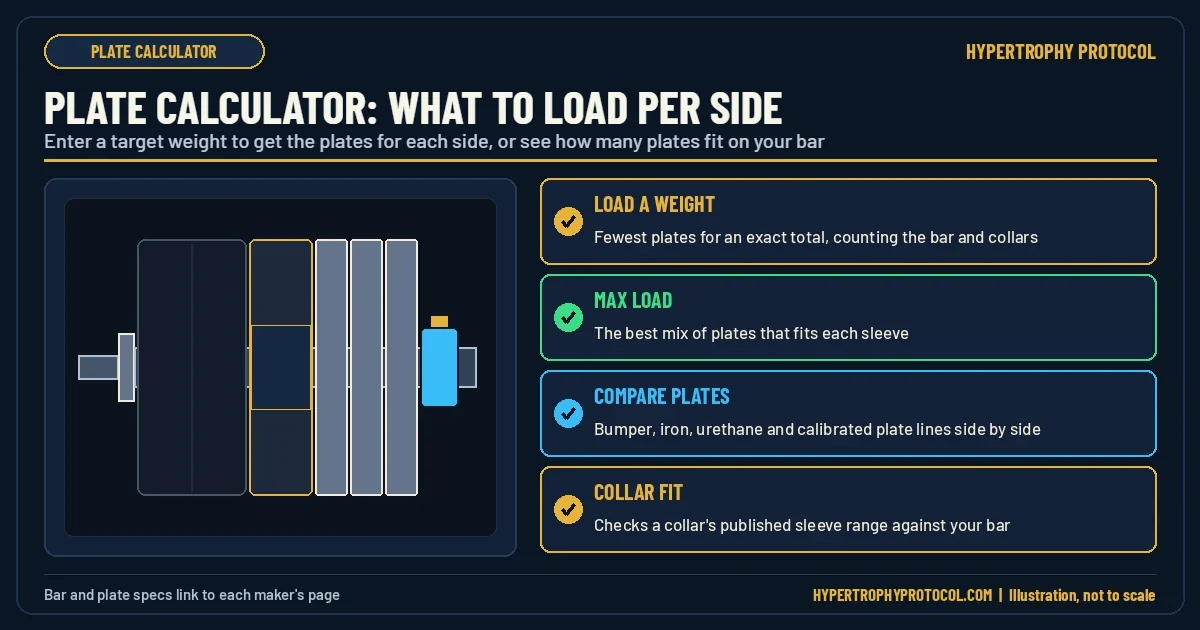
Enter the weight you want on the bar and see exactly which plates to load on each side. Or see how many plates fit on your bar.
Disclosure: this guide contains affiliate links, and Hypertrophy Protocol may earn a commission at no extra cost to you.
The sleeve is the part of the bar plates slide onto.
Collars use up sleeve space too. In a meet, each one weighs 2.5 kg and counts toward the total. Pick a collar or enter your own width and weight.
Most makers don’t list sleeve diameter. Measure the sleeve with calipers where the collar sits, and the collar check will use your number.

Plates you own optional
Enter how many pairs of each plate you have. Leave a box blank if you have as many as you need.
Every plate line on this bar, ranked by the most weight that fits. Each row also shows how many of that line’s heaviest plate fit per side.
Bumpers vs plates: what each type actually is
Words like “competition,” “calibrated,” “bumper” and “Olympic” are used loosely in product names. Some have rulebook definitions and some are just marketing. The table covers the 153 plate models in the calculator from 21 brands. The width column shows the range of widths makers publish for one plate size.
| Type | What it is | Accuracy (stated) | Width of one plate | Built for |
|---|---|---|---|---|
| Competition bumper | Rubber over a large steel disc, 450 mm across (±1 mm), in the colors set by weightlifting’s governing body (IWF) | ±10–15 g; IWF allows +0.1% / −0.05% over 5 kg | 20 kg: 50–55 mm 45 lb: 54–55 mm | Olympic lifting, dropped from overhead |
| Training bumper, virgin or blended rubber | Solid rubber vulcanized around a steel or stainless hub | ±1% to ±3% | 20 kg: 48–89 mm 45 lb: 48–89 mm | Home and gym lifting where the bar gets dropped |
| Training bumper, recycled crumb rubber | Ground tire rubber bonded and pressed around a stainless ring | ±1% to ±2%, or ±0.5 lb | 45 lb: 61–95 mm | Lowest-cost bumpers; most bounce and smell |
| Urethane | Urethane over a steel disc (bumper style) or over a cast iron plate | ±1% (where stated) | 45 lb: 33–60 mm | Commercial gyms, durability, low odor |
| Rubber-coated iron | Cast iron with a thin rubber skin, often under 450 mm | ±3% (where stated) | 45 lb: 35–52 mm | Quieter iron; not made to be dropped |
| Cast or machined iron | Sand-cast gray iron, sometimes machined flat | ±2% to ±3% | 45 lb: 19–51 mm | Most weight per dollar; not for dropping |
| Calibrated (powerlifting) | Machined iron or steel trimmed to a tight weight | ±10 g; IPF 0.25% or 10 g | 20 kg: 19–23 mm 25 kg: 23–29 mm | Powerlifting; most weight per sleeve |
| Specialty plates | Oversized steel wagon wheels, heavy grip plates and deficit plates | ±2% where stated; often not stated | 45 lb: 24–51 mm | Block pulls, grip work and deficit pulls, not everyday loading |
Competition bumper plates
A true competition bumper is built to the equipment rules of the International Weightlifting Federation (IWF). The IWF sets the disc diameter at 450 mm, give or take 1 mm. It sets the colors: 25 kg red, 20 kg blue, 15 kg yellow, 10 kg green, 5 kg white. Discs of 10 kg and up must be covered in rubber or plastic. The IWF’s licensing guidelines hold discs over 5 kg to +0.1% / −0.05% of their stated weight. On a 25 kg disc that’s 12.5 g under to 25 g over. Plates sold as “IWF certified” have been through that licensing. “Competition style” on a cheaper plate usually just means the colors.
Calibrated plates
“Calibrated” means a plate is machined and trimmed to match its labeled weight very closely, usually within 10 g. It says nothing about the metal: Rogue lists its calibrated plates as ductile cast iron and Eleiko lists its IPF discs as cast iron, while REP lists solid steel. Rogue is the one maker that explains the trim: plugs in pockets on the back are added to or drilled out (lead in small plates, brass in 5 lb and up). The IPF rules set the largest discs at no more than 45 cm across, a hole between 52 and 53 mm, and a weight within 0.25% or 10 g of face value. They also cap thickness: no more than 6 cm for 20 kg and heavier discs, and 3 cm for 15 kg and lighter. Calibrated plates are thin, so far more weight fits on a sleeve. They aren’t built to be dropped.
Training bumpers
Training bumpers copy the 450 mm diameter so the bar sits at the same height off the floor, but no rulebook sets their thickness or accuracy. Makers state anything from ±1% to ±3%. Thickness varies even more: a 45 lb Rogue Echo is 2.40 in wide, and Rogue’s Hi-Temp 45 is 3.75 in. That difference decides how much you can load before the sleeve runs out.
Iron and urethane plates
Cast iron plates are the cheapest weight per pound and much thinner than bumpers, but they aren’t for dropping and their tolerance is loose. Rogue’s deep-dish plates run +2% / −0%, and Titan states ±3%. Urethane and rubber-coated plates protect floors and run quieter, at some cost in thickness.
What plates are made of, and how
- Virgin rubber bumpers. New rubber (natural rubber, SBR or a blend) is mixed with fillers such as carbon black and a sulfur cure, packed into a mold around the steel hub or disc, and vulcanized with heat and pressure. Vulcanizing cross-links the rubber, so it can’t be melted down again. “Virgin rubber” has no regulated definition; treat it as the maker’s claim.
- Recycled crumb bumpers. Old tires are shredded, the steel and fiber are pulled out, and the crumb is coated in a polyurethane binder and pressed in a heated mold. Crumb density varies batch to batch, which is one reason these plates carry looser tolerances (Titan ±2%, Hi-Temp ±0.5 lb). The “new tire” smell comes from leftover curing chemicals; EPA tests on tire crumb found the main emissions were low and fell over time.
- Urethane. Either cast polyurethane (liquid poured into a heated mold and cured) or thermoplastic urethane (pellets melted and injection molded). None of the plate makers we checked says which it uses.
- Cast iron. Molten gray iron is poured into sand molds. The graphite flakes that form as it cools make iron easy to machine and good at damping vibration, but they also act as tiny cracks, so iron chips or cracks when dropped. Machined plates are turned flat after casting to tighten thickness and weight.
- Rubber- and urethane-coated iron. An iron plate with a molded skin. Quieter and kinder to floors and racks, but the iron core still hits the floor through a few millimeters of coating, so makers don’t rate them for drops.
- Hubs and inserts. Rubber alone can’t hold a precise 50 mm hole under impact, so bumpers have a steel, stainless or chrome-plated insert. Stainless resists rust without a coating; plated steel relies on its plating.
Why a bumper is so much thicker than iron
It comes down to density (how heavy a material is for its size). Iron and steel are about 7.2 to 7.85 g/cm³; rubber and urethane are about 1.1 to 1.25. A solid 20 kg disc 450 mm across with a 50.4 mm hole would be about 18 mm thick in cast iron and about 106 mm thick in hard rubber.
See the math
Thickness = plate weight ÷ (material density × the area of the plate face)
Competition and urethane bumpers are only 50 to 58 mm thick for 20 to 25 kg, which works out to an average density of about 2.4 to 2.7 g/cm³. The only way to get there is a big steel disc inside. In a simple model that treats the plate as only steel (7.85 g/cm³) and hard rubber (1.2 g/cm³), that density works out to roughly 59 to 66% steel by mass. Makers don’t publish the split, so treat that as an estimate. That steel is a large part of why thin bumpers cost more. Crumb plates near 95 mm thick are almost all rubber.
Bumpers or iron plates?
- Dropping. Bumpers are made to be dropped from overhead onto rubber. Iron isn’t. Even bumper warranties expect a rubber floor: Rogue excludes damage from drops onto non-rubber surfaces, and Hi-Temp and Rogue both warn against dropping light 10 lb plates on their own.
- Space on the sleeve. On a 16.4 in sleeve, 45 lb Hi-Temp bumpers fit four per side, 45 lb competition bumpers seven, and 45 lb cast iron twelve. Run your own bar above.
- Cost. On maker pages checked October 19, 2026: Titan cast iron about $1.89 per lb, crumb bumpers about $2.11 to $2.56, calibrated $3.27 to $4.52, Rogue LB competition $3.90 and urethane bumpers about $4.78. Prices change and shipping isn’t included.
- Noise and floors. Rubber and urethane are quieter and gentler on floors. No maker publishes decibel figures, so treat “quiet” claims as relative.
- Bounce. Durometer (Shore A) measures how hard the surface is, not how much it bounces. Polyurethane compounds of the same hardness return anywhere from 40% to 63% of the impact energy, so “94 durometer means dead bounce” is a rule of thumb, not physics. Rubber thickness, how much steel is inside and your floor matter as much.
Collars take sleeve too
Collars sit on the sleeve outside the last plate, so they use loadable length. The collars in the calculator take from 5/8 in (Fringe spring clips) to about 74 mm (Ivanko 2.5 kg collars) of sleeve, though most makers don’t publish the figure. In weightlifting and powerlifting meets each collar weighs 2.5 kg and counts toward the total. Pick your collar in the calculator and it subtracts the width and adds the weight.
Will your collars fit your bar?
Most collar makers only say “2 in” or “50 mm Olympic.” A few publish an actual sleeve range: Titan PROLOC 1 (47.5–50.9 mm), Rogue Proloc and American Barbell Proloc (1.937–2.007 in, about 49.2–51.0 mm), Texas Power Bars’ magnetic collars (49.2–50.9 mm) and Titan TwistLock (49.5–51.5 mm). Bar makers do a little better: 43 of the 98 bars in the calculator have a stated sleeve diameter, but Rogue publishes none for its barbells.
Specialty bars are where collar fit most often goes wrong. Titan’s safety squat bar has 49 mm ribbed sleeves, and Rogue lists the TB-2 trap bar’s sleeves at 1.91 in (48.5 mm). Both are below the minimum size for the Proloc, TwistLock and Texas collars. Of the ranges listed above, only Titan PROLOC 1 covers them. Powerlifting bars can run larger, since the IPF allows sleeves from 50 to 52 mm. If your bar’s diameter isn’t published, caliper the sleeve where the collar sits and enter it in the calculator. It then checks your collar against that number.
What “Olympic” means on a plate
An Olympic plate has a hole around 2 in (50 mm) to fit the 50 mm sleeves on Olympic bars. The plates in the calculator list holes of about 50.4 to 51 mm. It says nothing about competition approval. A cheap iron plate and a certified Eleiko disc are both “Olympic” plates.
How the calculator works
Each sleeve has a set amount of room for plates, measured from the inner collar to the end of the sleeve. Plates stack flat against each other, so the number that fits is the sleeve length, minus any clip or collar, divided by the plate’s thickness, rounded down.
Plates per side = (sleeve length − collar width) ÷ plate thickness, rounded down
The Load a weight mode works the other way around. Enter the total you want and it finds the fewest plates that hit it exactly, heaviest first, counting the bar and collars. If that doesn’t fit on the sleeve, it switches to a thinner mix that does. If the weight can’t be hit exactly, it shows the closest load below and above. Enter the plates you own and it only uses those.
The Most that fits mode goes further. It tries every mix of the plates in a line and keeps the combination that puts the most weight on the sleeve. Thin heavy plates usually win, with smaller ones filling the gap. The bar’s own weight is added once and each sleeve counted twice.
Worked examples
Same bar + Rogue Deep Dish 45s: 416.6 mm ÷ 50 mm = 8.33 → 8 per side → 16 × 45 lb + 44.1 lb = 764 lb
Same bar + Titan 25 kg calibrated: 416.6 mm ÷ 28 mm = 14.9 → 14 per side → 28 × 25 kg + 20 kg = 720 kg
Real loading leaves small gaps between plates, and a clip or collar takes sleeve too, so treat the last plate as optional if the leftover space is under a few millimeters.
Questions
How much weight can an Olympic barbell hold?
How much fits depends on the sleeve length and how thick your plates are. A typical 16.4 in sleeve takes six 2.4 in bumper 45s (584 lb total) or fourteen 28 mm calibrated 25 kg plates (720 kg). Whether the bar can safely carry that much is a separate question. That depends on the bar’s own weight rating, which many makers don’t publish.
Why do bumper plates run out of room so fast?
Rubber has to be thick to weigh the same as steel. A 45 lb training bumper can be 2.4 to 3.75 in wide, so only four to six fit per sleeve. A 25 kg calibrated plate is about 23 to 29 mm.
Are competition bumpers worth it for a home gym?
You get tighter weight accuracy, consistent colors and a thinner plate for the weight. Most home lifters don’t need IWF certification. A good training bumper with a stated ±1% tolerance does the same job for less.
Do barbell collars fit every Olympic bar?
Not always. Standard bars are about 50 mm and most collars are made for that, but makers rarely publish a tolerance. Trap bars and safety squat bars with 48.5 to 49 mm sleeves are under several collars’ published minimums, so check the range or measure your sleeve first.
Do calibrated plates make a difference?
For meet-accurate attempts, yes: the weight on the bar is the weight on the label within about 10 g. For everyday training, a 1% tolerance means a 45 lb plate could be about 0.45 lb off. That matters far less than consistent technique.
Sources: sleeve lengths and diameters from each bar maker’s product page (linked in the calculator), checked October 19, 2026. Plate widths, materials and tolerances from each plate maker’s product page, product guide or dimension drawing (linked in the calculator), checked October 19, 2026; the few lines taken from dealer listings say so. Materials and manufacturing: maker product guides (Rogue, Eleiko, REP, Titan, Hi-Temp, Bells of Steel), Gallagher Corporation on cast versus thermoplastic urethane and on resilience versus hardness, BASF Elastollan data, US EPA tire crumb emission research, and Engineering ToolBox and Matmatch density tables. Prices from maker pages on October 19, 2026. IWF equipment page and IWF Sport Equipment Licensing Guidelines (disc diameter 450 mm ±1 mm, colors, rubber or plastic covering, weight tolerance, 2.5 kg collars). IPF Technical Rules Book 2026 (maximum 45 cm diameter, 52–53 mm hole, thickness limits, colors, 0.25% or 10 g tolerance, 2.5 kg collars). Collar widths, weights and sleeve ranges from Rogue, Titan, Texas Power Bars, Bells of Steel, Eleiko and Life Fitness (Lock-Jaw) product pages and guides; the Eleiko Öppen collar width is from an Eleiko dealer’s listing. Sleeve diameters from REP, Eleiko, Titan, Bells of Steel and Rogue product pages, the IWF rules and the IPF Technical Rules Book 2026. Where a maker’s pages disagree, the calculator notes it and uses the spec-table figure. This is a space calculation only. It doesn’t rate how much load a bar or collar can safely carry.