
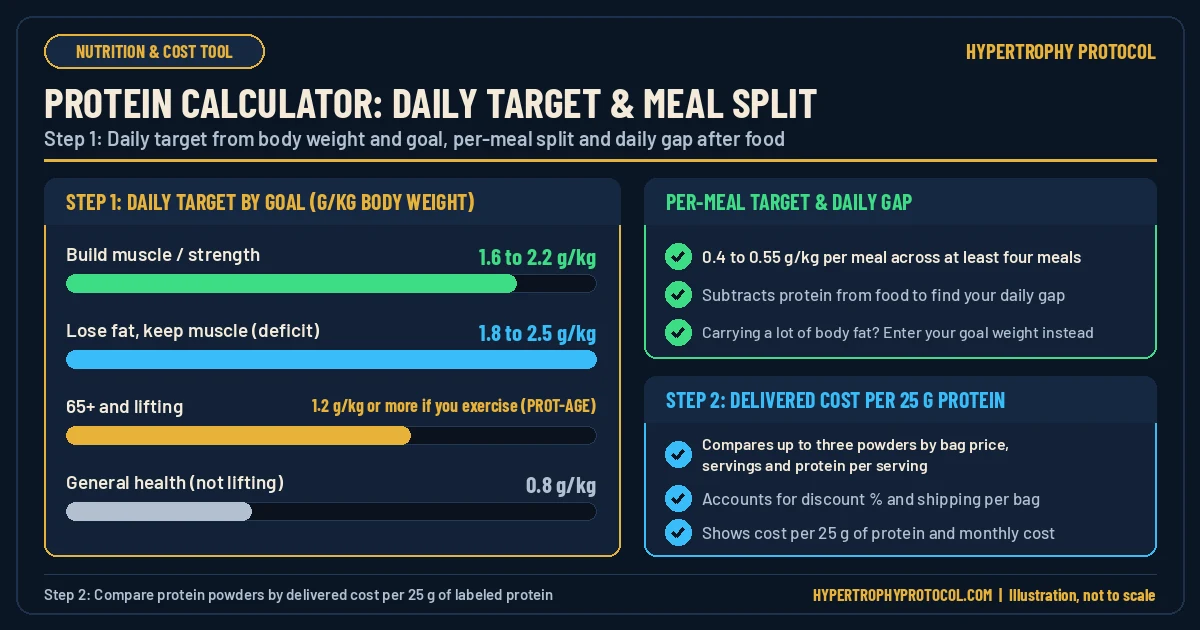
Step 1 estimates how much protein to eat each day, based on your weight and goal. The ranges come from studies that pooled results from many weight-training trials. Step 2 compares up to three powders by cost per 25 g of protein and shows what filling your gap would cost. The prices shown are samples, not live store prices.
Your protein target
Your comparison
Example calculations will appear here.
Swipe or scroll the table sideways to see the additional cost details.
| Product | Cost per 25 g protein | Monthly cost (25 g portions) | Cost per serving | Delivered bag | Protein per bag |
|---|
How powder compares with grocery protein
| Food (as bought) | U.S. average price | Protein per unit | Cost per 25 g protein |
|---|
Prices are the U.S. city averages for September 2026 from the Bureau of Labor Statistics average price data; your store will differ. Protein grams use raw, as-bought weights from USDA FoodData Central (SR Legacy): a large egg counted as 50 g without the shell, a gallon of milk as about 3.9 kg. BLS does not state the fat ratio for its ground beef items, so 80/20 and 90/10 are assumptions. Dried beans also bring carbohydrate and have a lower protein-quality score than animal foods. These rows compare cost only, the same as the powder table above.
All numbers use the protein grams on the label. They do not assume how much your body absorbs or how much muscle you gain. Protein quality scores (PDCAAS, DIAAS), leucine, allergies, taste and ingredients are separate decisions.
Shipping means the cost assigned per bag. Taxes, coupon eligibility and retailer stock are not checked. Monthly cost compares equal 25 g labeled-protein portions; full-bag purchases can have different payment timing.
No account, tracking, medical data or affiliate link is required. Numbers never leave your browser through this calculator. The copy-link button stores your inputs after the # in the link, a part of the address browsers do not send to our server.
How much protein do you need to build muscle?
For most adults who lift, aim for about 1.6 g of protein per kg of body weight a day (0.73 g per lb). That covers what studies can measure. Up to 2.2 g/kg (1 g per lb) is a reasonable upper end. The best single source is a 2018 review that pooled 49 randomized trials with 1,863 people (Morton et al.). People who added protein while lifting gained 0.30 kg more fat-free mass (the true gain could be anywhere from 0.09 to 0.52 kg) and 2.49 kg more on a one-rep max than people who only trained. Above about 1.62 g/kg a day, extra protein added no more measurable lean mass. That cut-off is a rough estimate: it could be anywhere from 1.03 to 2.20 g/kg a day, and it fell short of the usual bar for a solid finding (p = 0.079). So the authors suggest about 2.2 g/kg a day if you want to be sure.
Those effects are real but small: training, total calories and consistency drive most muscle growth. A 2022 review of 74 trials (Nunes et al.) found the same: more protein gave a small extra gain in lean mass during weight training (effect size 0.22, which counts as small). The benefit showed up at 1.6 g/kg a day (0.73 g per lb) or more in adults under 65.
The popular “1 g per pound” rule sits at the top of the evidence range. It is fine if you like it, but it is not required.
Protein while losing fat
When you eat fewer calories than you burn (a deficit), your body is more willing to break down muscle, so more protein is commonly recommended. The International Society of Sports Nutrition (ISSN) advises 2.3 to 3.1 g/kg (1.0 to 1.4 g per lb) for trained lifters in a deficit. That advice comes from a review (Helms et al.) of only six studies, which set it per kg of lean mass (everything except fat) and raised it for leaner people and bigger deficits. The calculator therefore uses 1.8 to 2.5 g/kg of body weight (that range converted at about 20% body fat), with 2.2 g/kg (1 g per lb) as the default. Treat this as a sensible guide, not a precise requirement.
Protein for lifters over 65
The PROT-AGE expert group recommends at least 1.0 to 1.2 g/kg/day for adults over 65, 1.2 g/kg (0.54 g per lb) or more for those who exercise, and 1.2 to 1.5 g/kg for most older adults with acute or chronic illness. In the Nunes meta-analysis, lifters 65 and older gained lean mass at 1.2 to 1.59 g/kg/day. Older muscle responds less to small doses, so bigger protein meals matter more with age. The exception is severe kidney disease: people with an eGFR under 30 who are not on dialysis may need to limit protein, so they should follow their doctor’s advice.
If you carry a lot of body fat
Body fat needs very little protein, so calculating from total weight overshoots for people with obesity. Enter your body fat percentage and the calculator shows your lean mass (your weight minus fat) and what your target works out to per kg of it. For the fat-loss goal it then sets the target from lean mass directly, using 2.3 to 3.1 g per kg of lean mass (Helms et al., 2014). That range comes from studies of lean, trained athletes eating fewer calories than they burn. It has not been tested in people carrying more body fat. The calculator uses its midpoint, 2.7, as a starting point, not a requirement. For the other goals the trials report protein per kg of total body weight, so the usual fix is still to enter your goal weight instead. That is expert practice, not something trials have compared directly.
How much protein per meal?
A 2018 review (Schoenfeld and Aragon) suggests about 0.4 g per kg of body weight (0.18 g per lb) at each meal, across at least four meals, up to about 0.55 g/kg (0.25 g per lb) if you are aiming for 2.2 g/kg/day. The ISSN gives 20 to 40 g, or 0.25 g/kg, every 3 to 4 hours, with 700 to 3,000 mg of leucine per dose.
The old claim that you can only “absorb” 25 to 30 g at once is wrong. In a 2023 study that tracked protein through the body (Trommelen et al.), 100 g of protein after exercise produced a bigger and longer (more than 12 hours) muscle-building response than 25 g. That was one study measuring muscle building over hours (muscle protein synthesis), not months of growth. Spreading protein over at least four meals is still a practical default, but one large protein meal is not wasted.
Does protein timing matter?
Much less than total intake. A meta-analysis of 23 trials (Schoenfeld, Aragon and Krieger, 2013) found no significant effect of eating protein right around workouts once total daily protein was accounted for. Total intake was the strongest predictor of muscle growth. One timing idea with some support is 30 to 40 g of casein before bed, which raises overnight muscle protein synthesis. Most of that evidence is short-term lab work.
Is a high-protein diet safe for your kidneys?
For healthy adults, the evidence says yes. A 2018 review of 28 trials with 1,358 people (Devries et al.) found that the change in kidney filtration rate (GFR, a standard measure of kidney function) did not differ between higher-protein diets (at least 1.5 g/kg a day) and normal or lower intakes. The difference was small and could be zero (0.11, 95% confidence interval −0.05 to 0.27). If you have kidney disease, diabetes with kidney involvement, or another condition that limits protein, follow your clinician’s target instead of this calculator.
Food first, powder second
Protein powder is a convenience, not a requirement. Hitting your daily target matters; whether it comes from food or a shaker does not. The ISSN notes that rapidly digested proteins high in essential amino acids and leucine are the most effective per dose. Many plant proteins contain less leucine per gram than dairy proteins, so plant blends or slightly larger servings are common ways to compensate. Use Step 1 to see how big your gap really is before buying anything, then Step 2 to find the cheapest way to close it.
Our preferred protein powder: SpaceMilk
When food alone does not close the gap, our preferred powder is SpaceMilk (affiliate link), a protein isolate made from fermented baker’s yeast. We prefer it for people who want a dairy-free option without giving up protein quality. The maker reports 20 g of protein per serving, 0 g sugar, a PDCAAS of 1.0 (the same as whey) and over 21% branched-chain amino acids, and says it is free of all nine major allergens. It also publishes a lot-by-lot testing library for heavy metals, microbes, pesticides and selected allergens, so you can check the batch you actually buy.
To keep that recommendation honest, here are the limits. Yeast-protein trials, funded by the ingredient maker, found lean-mass gains similar to whey alongside training, not larger ones, and those trials tested a yeast-protein ingredient rather than SpaceMilk’s finished product. SpaceMilk usually costs more per gram of protein than mainstream whey (use Step 2 to compare it with what you buy now). Its bag’s amino-acid chart lists 9.2 g of leucine per 100 g of protein against 10.9 g for whey, so a 20 g serving supplies about 1.84 g of leucine versus about 2.18 g from the same amount of whey protein. Every bag carries a California Proposition 65 lead warning, because the company says some batches test above California’s limit. If you tolerate whey and price matters most, whey remains a perfectly good choice.
Affiliate disclosure: the SpaceMilk shopping links on this page are affiliate links, and HYPERTROPHYPROTOCOL is our affiliate code. If you buy through them, Hypertrophy Protocol earns a commission at no extra cost to you. We have also received promotional emails from SpaceMilk. We list the trade-offs above either way. The listed price in the “Load SpaceMilk” button was checked on October 17, 2026 and will change.
How to compare protein powder prices fairly
Package price is not a fair unit when products contain different numbers of servings or different grams of labeled protein. A cheaper-looking bag can actually cost more per 25 g of protein. This tool normalizes cost using the grams stated on each product label and the delivered price you enter. It does not rank supplements by proven muscle-growth effectiveness.
What the calculator measures
Daily target multiplies your body weight in kg by the goal’s evidence-based figure (1.6, 2.2, 1.6 or 0.8 g/kg) and rounds to the nearest gram. If you enter body fat with the fat-loss goal, it uses 2.7 g per kg of lean mass instead (lean mass = body weight × (1 − body fat %)). Per meal divides that target by your meals. Protein still needed subtracts the protein you already eat. Cost to fill gap multiplies the gap by the cost per gram of the cheapest powder in Step 2.
Delivered bag price is the purchase price after your entered percentage discount plus any shipping cost allocated to one bag. Cost per serving divides that total by the label’s servings per container. Cost per 25 g standardizes the serving cost to 25 g of labeled protein: it is useful when one product has 20 g per scoop and another has 25 g.
Monthly cost multiplies the cost of a 25 g labeled-protein portion by the number of 25 g portions you enter. It is a comparison estimate rather than the exact cash charge for a shipment, which may include minimum bag quantities, sales tax, temporary promotions or delivery fees. If you only buy full bags, your up-front spend and leftover servings will differ.
What it intentionally leaves out
Protein powder quality depends on essential amino acids, the rest of your diet, digestibility evidence, allergens, ingredient suitability and real tolerance. A PDCAAS or DIAAS score can inform nutrition evaluation but cannot be multiplied into a guaranteed number of muscle-building grams, so the cost ranking is not adjusted for protein quality. The daily target is a general, evidence-based estimate for healthy adults, not medical or dietetic advice.
Every preloaded value is illustrative. Enter the actual label and checkout prices to compare a finished powder fairly.
Sources
- Morton RW et al. Protein supplementation and resistance-training gains: meta-analysis and meta-regression. Br J Sports Med, 2018.
- Nunes EA et al. Protein intake, muscle mass and function in healthy adults: meta-analysis. J Cachexia Sarcopenia Muscle, 2022.
- Jäger R et al. ISSN position stand: protein and exercise. J Int Soc Sports Nutr, 2017.
- Helms ER et al. Dietary protein during caloric restriction in resistance-trained lean athletes. Int J Sport Nutr Exerc Metab, 2014.
- Bauer J et al. PROT-AGE recommendations for protein intake in older people. J Am Med Dir Assoc, 2013.
- Schoenfeld BJ, Aragon AA. How much protein can the body use in a single meal? J Int Soc Sports Nutr, 2018.
- Trommelen J et al. The anabolic response to protein ingestion has no upper limit in magnitude and duration. Cell Rep Med, 2023.
- Schoenfeld BJ, Aragon AA, Krieger JW. Protein timing and muscle strength and hypertrophy: meta-analysis. J Int Soc Sports Nutr, 2013.
- Devries MC et al. Kidney function with higher- vs lower-protein diets in healthy adults: meta-analysis. J Nutr, 2018.
- SpaceMilk FAQ: protein per serving, PDCAAS, allergens and Prop 65 statement (checked October 17, 2026).
- FAO. Dietary protein quality evaluation in human nutrition (DIAAS), 2013.
- US protein-labeling regulation, 21 CFR 101.9.