
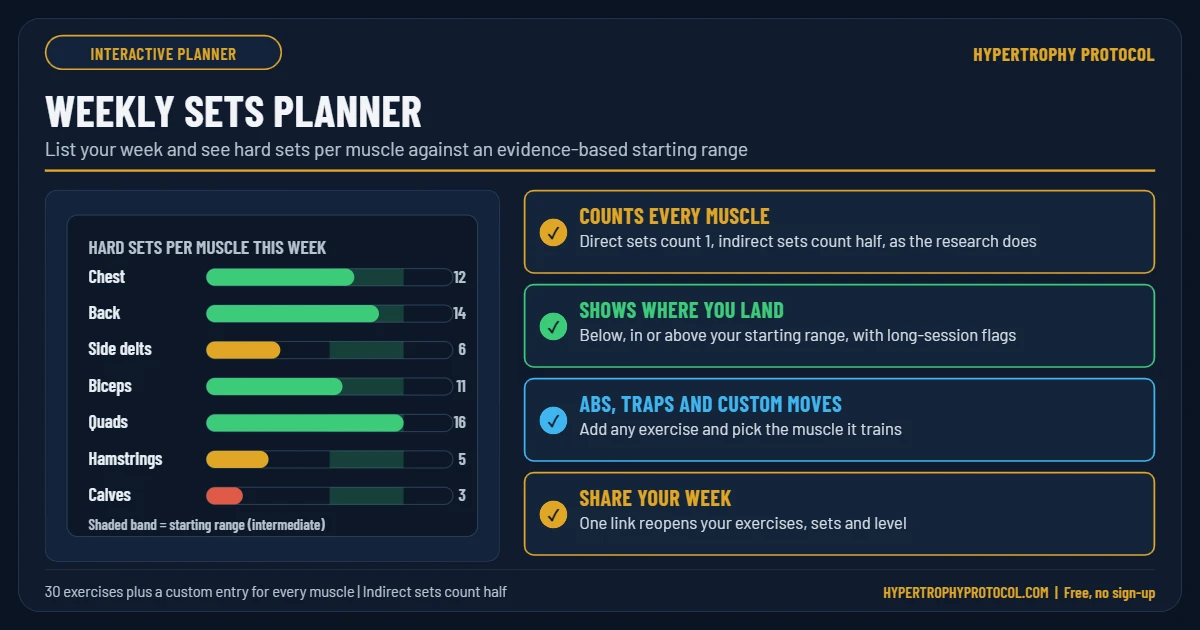
List the hard sets you do in a week. The planner counts them per muscle the way the largest study on training volume found works best (indirect sets count as half) and shows where each muscle lands against an evidence-based starting range.
1. You
2. Your week
Count only hard working sets, taken to or near failure, across the whole week. Leave out warm-ups and easy back-off sets.
3. Sets per muscle
| Muscle | Weekly | Per session |
|---|
Green band = your starting range. The bar tops out at 30 sets. Per session = weekly sets divided by the days you train that muscle.
How the planner counts
A set counts only if it’s hard: a working set taken to or near failure. An exercise counts as a full set for the muscle it mainly targets and as half a set for muscles it trains indirectly, so a row is one set for your back and half a set for your biceps. That “fractional” count predicted muscle growth better than counting indirect sets as full sets or as zero in the largest analysis so far, a meta-regression of 67 studies (Pelland et al., 2026; details in the 2024 preprint).
Where the starting ranges come from
For most lifters, 10 to 20 hard sets per muscle per week is the range the evidence supports. Growth keeps rising as you add sets, but each extra set buys less: in the preprint’s model, each extra set near 12 weekly sets added about 0.24% more growth, and about 4 sets a week was the smallest dose that still grew muscle. The planner uses rough starting points by experience: 6 to 10 sets for new lifters, 10 to 16 for intermediates and 12 to 20 for advanced lifters, who can push one or two priority muscles higher for a block.
Very high volumes are where the research splits. Among trials in trained lifters, two found more growth at the highest volumes they tested, up to 30 and 45 weekly sets in one (Schoenfeld et al., 2019) and 32 in the other, while three found no extra growth above moderate volumes. Most trials ran 8 to 12 weeks in young men and measured the quads and upper arms, so treat every number here as a starting point and adjust to how your own muscles respond over months.
How often you train a muscle mattered little for growth once weekly sets were equal. The per-session column is there because a long run of hard sets for one muscle gets done tired; splitting the same total across more days keeps each set closer to full effort. To make the sets themselves count, see mechanical tension and muscle growth and progressive overload in a small home gym.