
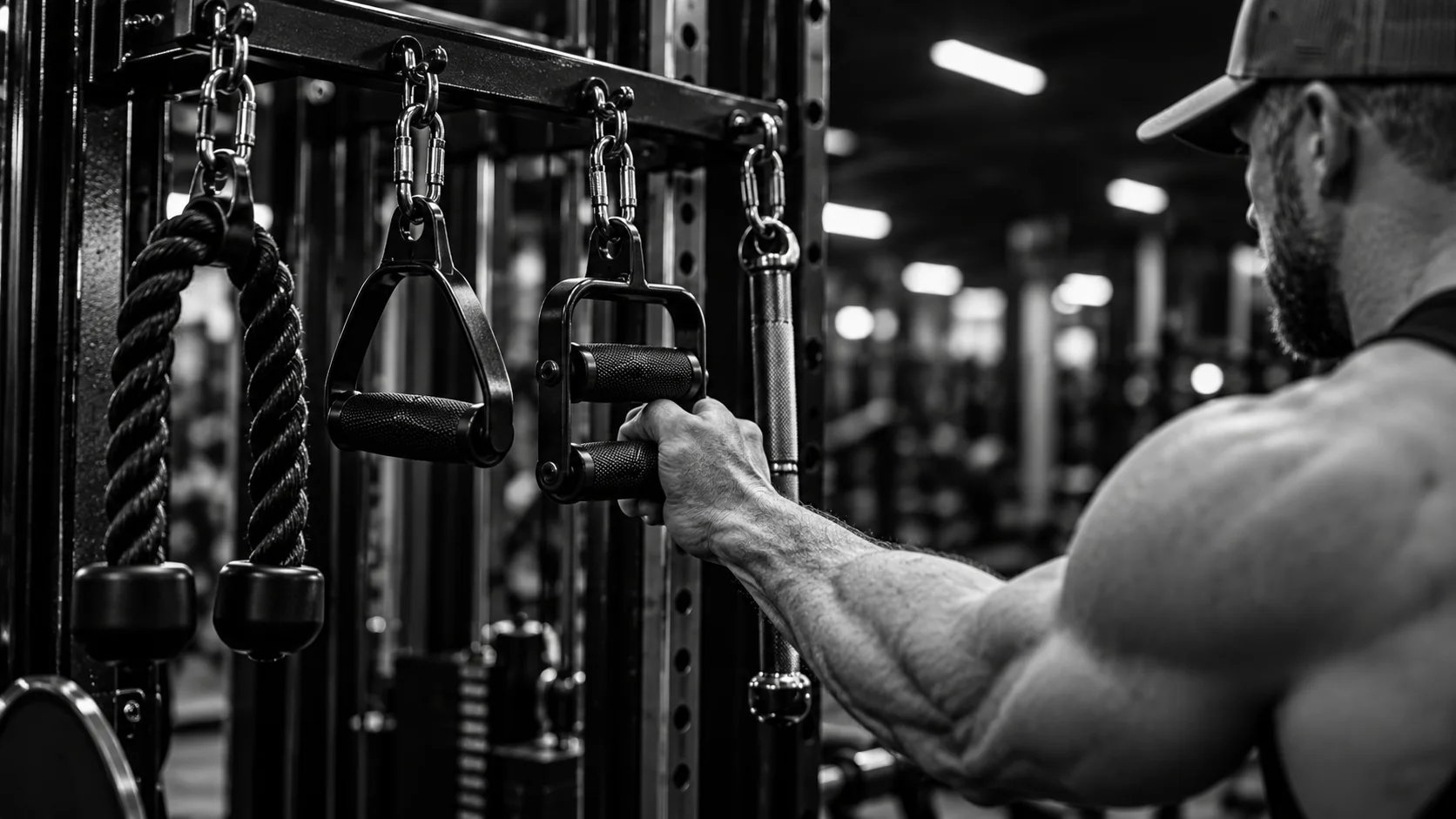
Short answer: a handful of cable attachments covers every major muscle, and the handle itself matters less than where it lets you put your arm and how much range it allows. Research directly comparing handles for muscle growth is thin. The clearest evidence is about arm position, not the grip itself: overhead triceps extensions, which a rope makes easy, grew the triceps substantially more than the same exercise done with the arms at the sides.
This guide matches common attachments to the muscles they suit, covers the hardware that connects them, and lists a starter kit for a home cable setup.
The Hardware Between Cable and Handle
Most attachments clip to the cable with a carabiner, often through a swivel.
- Carabiners: use a load-rated steel carabiner, with the rating usually stamped on it, rather than a light keychain-style clip, and replace any that are bent or won’t close fully.
- Swivels: a swivel lets the handle rotate as your hand turns through the movement. That’s most noticeable with single D-handles on flyes, lateral raises, and one-arm rows, where a fixed connection can twist the handle against your wrist.
- Rack mounts: if your pulleys mount to a power rack, the mount has to match your rack’s tube size, hole size, and hole spacing. The Rack Attachment Fit Checker checks tube size and hole size against the major brands, and flags any hole-spacing requirement the maker lists so you know what to measure.
Matching Attachments to Muscles
| Muscle | Useful attachments | Common exercises |
|---|---|---|
| Lats and upper back | Straight pulldown bar, close V-handle, D-handles | Pulldowns, seated rows, one-arm rows |
| Triceps | Rope, straight or angled bar | Overhead extensions, pushdowns |
| Biceps | Straight or EZ bar, D-handles | Cable curls, one-arm curls |
| Chest | D-handles | Cable flyes, crossovers, presses |
| Side and rear delts | D-handle or wrist cuff, rope | Lateral raises, reverse flyes, face pulls |
| Glutes and hamstrings | Ankle cuff | Kickbacks, standing leg curls |
Lats and Upper Back
EMG studies on the lat pulldown find grip width makes little difference to lat activity between about one and two times shoulder width (Andersen et al., 2014, doi:10.1097/JSC.0000000000000232), and an overhand grip produces more lat activity than an underhand one (Lusk et al., 2010, doi:10.1519/JSC.0b013e3181ddb0ab). For seated rows, a closer grip with elbows nearer the sides is linked to more lat activity (Di Fonza et al., 2026, doi:10.3390/jfmk11030315). A straight bar and a close V-handle cover both. EMG shows activation, not growth, so treat these as reasonable defaults rather than rules. The lat attachments guide goes deeper.
Triceps
This is where attachment choice has the best evidence behind it, because the rope makes overhead extensions easy. In a 12-week study of 21 adults training one arm overhead and the other with the arm at the side on a cable, the overhead arm grew more: about 28.5% vs 19.6% in the long head (effect size 0.61) and 19.9% vs 13.9% for the whole triceps (effect size 0.54), despite using lighter loads (Maeo et al., 2022, doi:10.1080/17461391.2022.2100279). The likely reason is that the long head crosses the shoulder and is stretched further with the arm overhead.
That makes a rope, used for overhead extensions, the most useful triceps attachment. Pushdowns with a rope or bar are still a good second exercise. Pick whichever handle feels best on your elbows.
Other Muscle Groups

Biceps
A straight bar, an EZ-style angled bar, or single D-handles all work for cable curls. The angled bar puts the wrists at a slight angle that some lifters find more comfortable. Single handles let each arm move independently. There’s no good evidence that one of these grows the biceps more than the others, so comfort and consistent progression should decide.
Chest
Single D-handles, one on each cable, are the standard for flyes and crossovers because each arm can follow its own arc. A swivel on each handle keeps the grip from twisting as your hands come together.
Shoulders
For lateral raises and reverse flyes, a D-handle or a wrist cuff works. A cuff takes grip out of the movement entirely, which some lifters prefer for high-rep shoulder work. A rope is the usual choice for face pulls, since it lets your hands separate at the end of the pull.
Glutes and Hamstrings
An ankle cuff turns a low pulley into a station for cable kickbacks and standing leg curls. Look for a cuff with a secure closure and a sturdy D-ring.
Grip and Comfort
If your grip or hands give out before the muscle you’re training, the set ends early. Handles you can hold comfortably, lifting straps on heavy pulls, or a cuff instead of a handle all help keep the target muscle as the limit. Some lifters with elbow irritation also find neutral-grip handles easier on their joints than straight bars. Evidence that one grip protects the elbow better than another is limited, but training pain-free is what keeps you consistent.
A Starter Kit
- Straight pulldown bar for pulldowns, pushdowns, and curls
- Close-grip V-handle for seated rows
- Rope for overhead triceps extensions and face pulls
- Two D-handles with swivels for flyes, one-arm rows, curls, and lateral raises
- Ankle cuff for glute and hamstring work
- Load-rated carabiners for every connection
That covers every muscle in the table above. Beyond it, extra attachments are mostly about comfort and variety. If you’re still choosing rack attachments themselves, the power rack attachments ranking covers which to buy first.
Sources checked September 30, 2026. EMG studies measure muscle activation during a lift, not long-term growth; research summaries describe the cited studies, and individual results vary.
Calculate resistance at the handle