
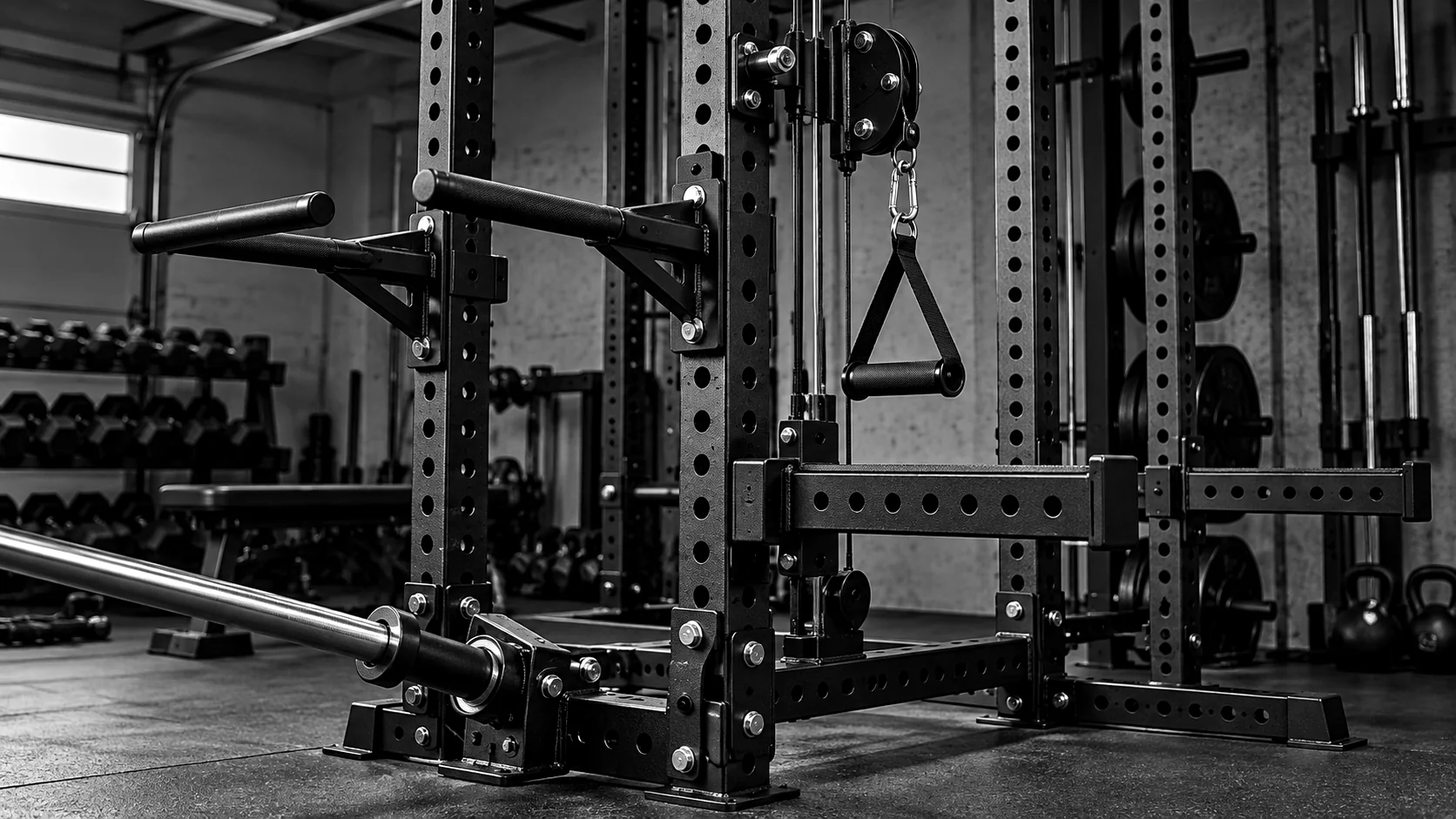
Short answer: if your power rack already has safeties, the attachment that adds the most for muscle growth is a cable pulley, followed closely by a lat pulldown and low row combo. After that, a dip station, a leg extension and curl attachment, and lever arms fill the biggest gaps a bare rack leaves. A belt squat, landmine, leg press, Smith attachment, and band pegs are useful for specific needs but aren’t essential.
The ranking below is based on one question: what does each attachment let you train that a rack, barbell, and bench can’t? Each entry covers what it adds, who it suits, and who can skip it.
Before any of these: if your rack didn’t come with safety pins, spotter arms, or straps, buy those first. Sets need to be hard to build muscle, and safeties set at the right height reduce the risk of a failed last rep when you bench or squat alone. You don’t have to go all the way to failure: a meta-analysis found only a trivial growth advantage for training to failure over stopping a little short (effect size 0.19) (Refalo et al., 2023, doi:10.1007/s40279-022-01784-y).
Quick Comparison
| # | Attachment | Main muscles | Skip it if |
|---|---|---|---|
| 1 | Cable pulley | Triceps, delts, chest, biceps | You already own a functional trainer |
| 2 | Lat pulldown and low row | Lats, upper back | You do weighted pull-ups and plenty of rows already |
| 3 | Dip station | Chest, triceps | Dips bother your shoulders |
| 4 | Leg extension and curl | Quads, hamstrings | You have space for a standalone machine |
| 5 | Lever (jammer) arms | Chest, shoulders, back | Your rack is short or not bolted down |
| 6 | Belt squat | Quads, glutes | Your back handles squats and leg presses fine |
| 7 | Landmine | Back, shoulders, legs | Rarely; it’s cheap and small |
| 8 | Leg press | Quads, glutes | You already have a belt squat or hack squat |
| 9 | Smith attachment | Chest, quads, shoulders | You want to keep the rack’s inside clear |
| 10 | Band pegs | Depends on the lift | You don’t use bands |
1. Cable Pulley
A rack-mounted pulley, single or dual, covers the small muscles a barbell trains poorly: side and rear delts, triceps, biceps, and chest flyes. It’s also the most flexible attachment, since moving the pulley up or down changes the exercise.
The best evidence for cables is on the triceps. In a 12-week study, overhead cable extensions grew the whole triceps more than pushdowns with the arm at the side (19.9% vs 13.9%, effect size 0.54), likely because the long head is stretched with the arm overhead (Maeo et al., 2022, doi:10.1080/17461391.2022.2100279). A barbell can’t easily load that position; a cable and rope can.
Check: the pulley ratio, since a 2:1 pulley gives about half the stack or plate weight at the handle (the 1:1 vs 2:1 pulley guide explains it), and whether plate-loaded or stack loading suits you (plate-loaded vs weight stack). The cable attachments guide lists the handles worth owning.
2. Lat Pulldown and Low Row
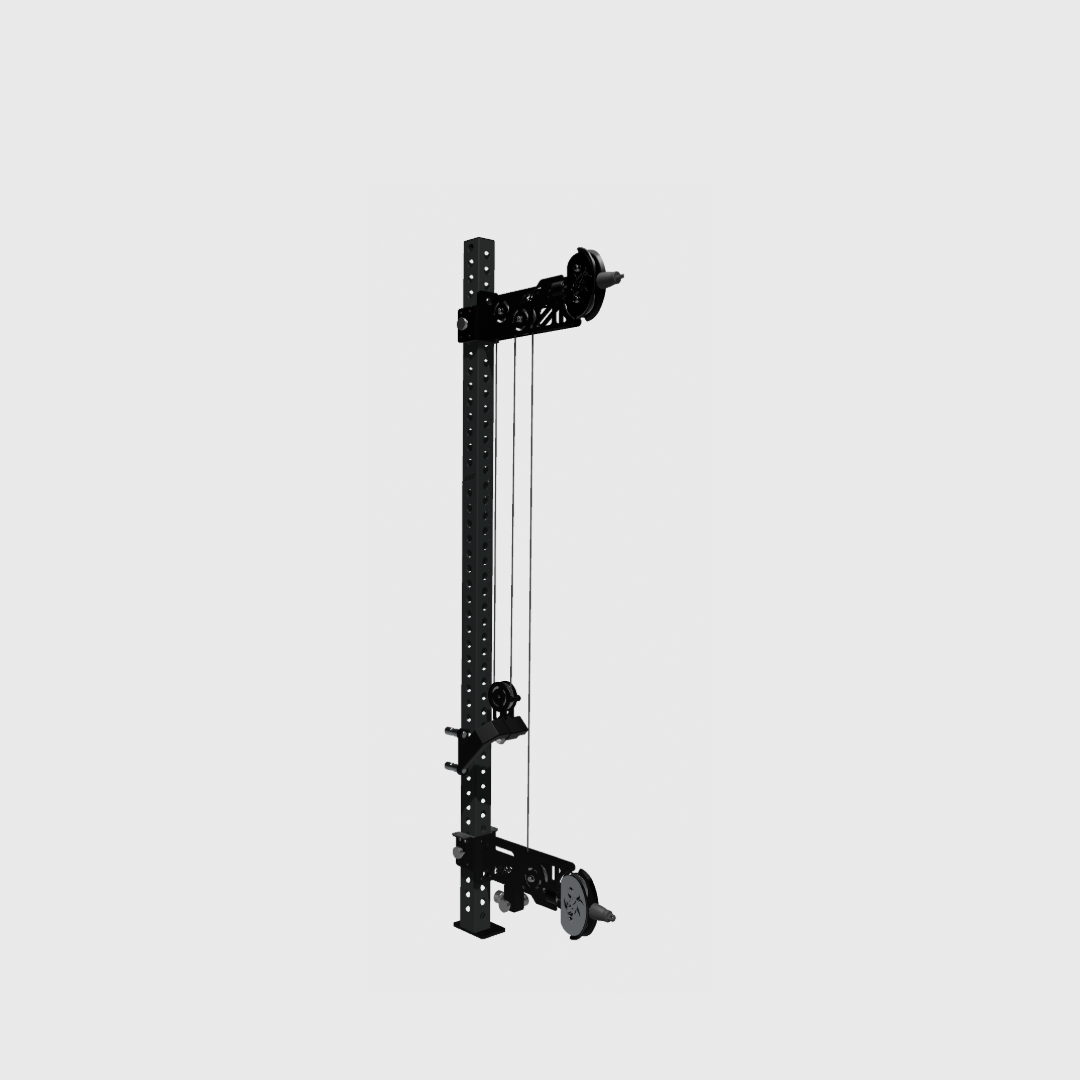
A combo unit gives you a pulldown and a seated row inside the rack’s footprint. Pull-ups and barbell rows already train the back, so this ranks second rather than first, but it solves two real problems: pull-ups are hard to load below bodyweight or progress in small steps, and barbell rows are often limited by the lower back before the lats.
EMG research finds more lat activity with an overhand grip than an underhand one on pulldowns (Lusk et al., 2010, doi:10.1519/JSC.0b013e3181ddb0ab), and little difference between grips of about one and two times shoulder width (Andersen et al., 2014, doi:10.1097/JSC.0000000000000232). EMG measures activation, not growth, so treat that as a sensible default. The lat attachments guide covers handles, travel, and fit.
Skip it if you already do weighted pull-ups and chest-supported rows and your back is growing.
3. Dip Station
A dip attachment is one of the cheapest, smallest upgrades, and it adds a loadable compound press for the lower chest and triceps that a rack can’t otherwise offer. Add weight with a dip belt once bodyweight reps get easy.
Skip it if deep dips irritate your shoulders. Stopping a little higher helps some lifters; others do better with cable or lever pressing instead.
4. Leg Extension and Leg Curl
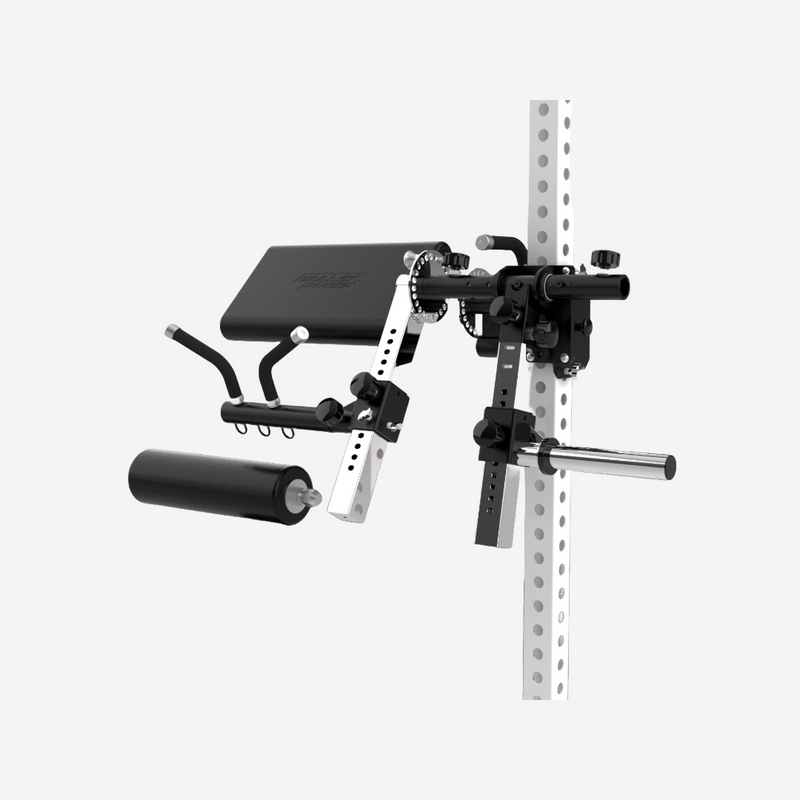
Squats and leg presses train the quads and glutes well, but no barbell exercise trains knee flexion, which is what the hamstrings do at the knee. A leg curl fills that gap, and a leg extension lets you take the quads to failure without your back or breathing ending the set first.
Position matters for the hamstrings. In a 12-week study, seated leg curls, where the hamstrings are stretched at the hip, grew the whole hamstrings more than lying leg curls (+14% vs +9%) (Maeo et al., 2021, doi:10.1249/MSS.0000000000002523). Bench and rack-mounted curl attachments are done lying or seated depending on the design, so check which one you’re buying.
Check: that the pad and pivot line up with your knee. Rack and bench-mounted units are more compromised in fit and range than a standalone machine, so try the adjustments against your own leg length.
5. Lever (Jammer) Arms
Lever arms pivot from the uprights and turn the rack into a plate-loaded pressing and rowing station. They add presses with a fixed arc, one-arm work, and chest-supported rows with a bench inside the rack, which take most of the lower back out of rowing.
Check: the arms’ load rating, the quality of the pivot, and your rack’s height. Loaded lever arms put a lot of leverage on the uprights, so check whether the maker requires the rack to be bolted down.
Owner’s note: I’ve used rack lever arms and like the idea, and I may go back to them. The hassle was adjusting them: moving the arms up or down the uprights is awkward on your own. A tool balancer, a spring-loaded hanger that holds the arm’s weight, makes height changes much easier, so budget for one if you buy a set.
6. Belt Squat
A belt squat hangs the load from your hips, so the legs work hard with less external load through the shoulders and spine than a barbell squat. It’s the most useful leg attachment for lifters whose lower back or upper back limits squats. It’s less essential if barbell squats and a leg press already work for you. The squat machines comparison covers belt squats alongside hack squats, pendulums, and lever squats.
7. Landmine
A landmine pins one end of a barbell to the rack base. It’s cheap, takes almost no space, and adds T-bar and Meadows rows, angled presses that many lifters find easier on the shoulders, and goblet-style squats. It adds variety more than anything a cable or lever arm can’t do, which is why it sits mid-list.
8. Leg Press
Rack-mounted and Smith-mounted leg presses exist, but they vary a lot in travel, sled weight, and load rating, and a standalone machine is usually better if you have the space. The home gym leg press guide compares the options. Skip it if you already have a belt squat or hack squat and your quads are growing.
9. Smith Machine Attachment
A Smith attachment gives you a guided bar path for presses, squats, and split squats, and makes solo training to failure simpler. The trade-offs are that it takes up the inside of the rack and needs a close match to your rack’s tube size and hole spacing.
Owner’s note: I owned the Bells of Steel Smith attachment. It ran smoothly once installed, but it’s heavy, installing it was a two-person job, lining up the bracket angles and hole spacing was frustrating, and it took up two full uprights. Plan for that before buying one.
10. Band Pegs
Band pegs anchor resistance bands to the rack base or uprights, adding resistance that increases as a band stretches. They’re cheap and useful for variety, but evidence that bands build more muscle than plain loading is limited, so they’re optional.
Will It Fit Your Rack?
Every attachment here has to match three things on your uprights:
- Tube size. 2×3 and 3×3 attachments aren’t interchangeable, and some racks sold as “3×3” are 75 mm tube rather than a true 3 inches (76.2 mm), which can leave brackets loose.
- Hole size. Racks use either 5/8-inch or 1-inch hardware; the 5/8 vs 1 inch hardware guide explains the two standards.
- Hole spacing, for anything that spans more than one hole.
The Rack Attachment Fit Checker checks tube size and hole size against attachments from the major brands, and flags any hole-spacing requirement the maker lists so you know what to measure. Also check each attachment’s load rating and whether the maker wants the rack bolted down, especially for pulleys, lever arms, and dips.
Frequently Asked Questions
What’s the first attachment to buy for muscle growth?
Safeties if your rack lacks them, then a cable pulley. It trains the most muscles a barbell misses, especially the triceps, delts, and chest.
Do I need a lat pulldown if I can do pull-ups?
Not necessarily. If you can progress weighted pull-ups and rows, your back is covered. A pulldown helps most if you can’t do many pull-ups or want finer steps in load.
Are rack-mounted machines as good as standalone ones?
Usually a little less adjustable, but far smaller and cheaper. For a home gym, a well-fitting rack attachment is often the better trade.
Sources checked September 30, 2026. EMG studies measure muscle activation, not long-term growth; research summaries describe the cited studies, and individual results vary.
Check attachments for your rack