
Stiffness in Bending
An upright’s resistance to bending is set by its moment of inertia, which depends on the tube’s outside dimensions and wall thickness. For a square tube with a given wall thickness, it grows roughly with the cube of the tube’s width (not the fourth power, as is sometimes claimed; that applies to solid bars), which is why a modest size increase buys a lot of stiffness. Working it out for common rack uprights:| Upright | Bending stiffness (in4) | Torsional stiffness (in4) |
|---|---|---|
| 3×3, 11-gauge | 1.91 (both directions) | 2.86 |
| 2×3, 11-gauge | 1.41 strong / 0.74 weak | 1.47 |
| 3×3, 14-gauge | 1.25 (both directions) | — |
| 2×2, 14-gauge | 0.36 (both directions) | 0.53 |
Idealized square-cornered tubes. Real tubing has rounded corners, which lowers each value a few percent without changing the ranking.
What that means:- Against a 2×3 in its narrow direction, a 3×3 11-gauge upright is about 2.6 times as stiff (157% stiffer). Against the 2×3’s wide direction, it’s about 35% stiffer. An earlier version of this article put the gap at 185%; that figure was wrong.
- Against an entry-level 2×2 14-gauge upright, a 3×3 11-gauge upright is about 5.4 times as stiff in bending.
- The 3×3 is the same in both directions. A 2×3 is strong one way and much weaker the other, which matters because a walkout, a missed rep, or a band pulling off-center loads the upright from more than one side.
Stiffness in Twisting
Single-arm landmine presses, lever arms, and offset band setups twist the uprights as well as bending them. Torsional stiffness for a closed square tube depends on the area it encloses, so the 3×3 11-gauge upright resists twisting about twice as well as a 2×3 11-gauge upright (2.86 vs 1.47 in4) and about 5.4 times as well as a 2×2 14-gauge one.Hole Bearing
Every J-cup and safety arm rests its load on the edge of a hole. The contact area is the pin’s diameter times the wall thickness, so at the same pin load a 14-gauge wall sees about 1.6 times the bearing stress of an 11-gauge wall. That’s the mechanism behind the hole wear and slop that thin-walled uprights tend to develop over years of use.Why 11-Gauge Is the Usual Pairing
11-gauge steel is 0.1196 inches thick, and most established makers use it on their 3×3 lines. Compared with thinner walls, it gives you:- More stiffness. At the same 3×3 size, 11-gauge is about 1.5 times as stiff as 14-gauge. The 11-gauge vs 14-gauge guide works through the numbers.
- Less hole wear, from the lower bearing stress described above.
- Easier, sturdier welds. A thicker wall is less prone to burn-through during welding and leaves more material around the joint.
- More corrosion margin. Rust eats wall thickness from the surface in, so a thicker wall takes longer to lose a meaningful share of its section. That matters most in humid garages and coastal areas; the rust prevention guide covers how to slow it down.
The Attachment Ecosystem
The second reason 3×3 won is commercial rather than structural: it’s where most attachments are made. Every major rack brand sells at least one 3×3 line, and REP’s own rack guide credits its 3×3 PR-5000 with the largest attachment range it offers. Lat pulldowns, monolifts, lever arms, dip stations, and landmines are all easiest to find for 3×3.“3×3” Doesn’t Mean Universal Fit
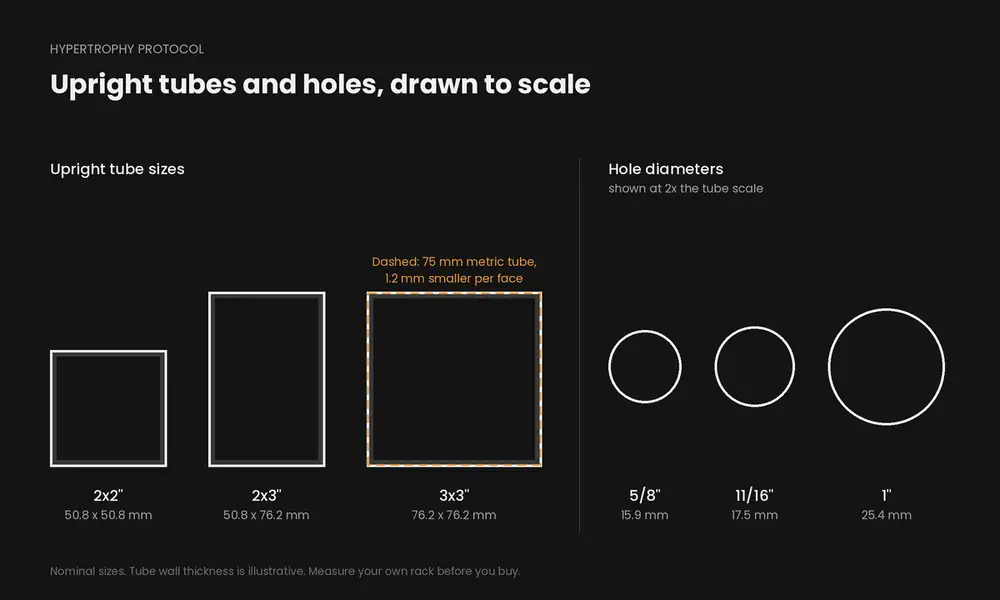
Owning a 3×3 rack doesn’t guarantee every 3×3 attachment fits. Three things still have to match:- Hole size. 3×3 racks split between 5/8-inch hardware (Rogue Monster Lite, REP PR-4000, Bells of Steel Hydra) and 1-inch hardware (Rogue Monster, REP PR-5000, Bells of Steel Manticore, Sorinex XL), with some Titan models listing 11/16-inch holes. The 5/8 vs 1 inch hardware guide explains the difference.
- Hole spacing, for anything with two pins or a bracket spanning several holes.
- True size. Some imported racks sold as “3×3” use 75 mm metric tube, about 1.2 mm smaller per face than a true 76.2 mm 3×3.
What a 3×3 Rack Does and Doesn’t Guarantee
A 3×3 11-gauge rack is a strong starting point, not a guarantee on its own. A few things vary brand to brand even within the standard:- Height. 3×3 racks range from about 72 inches to 108 inches depending on brand and model, so measure your ceiling before choosing.
- Base and anchoring. Footprints and bolt-down patterns differ between brands, and some racks must be bolted down while others are flat-foot. Don’t assume a replacement rack will match existing floor anchors.
- Expansion. Many bolt-together 3×3 racks can be extended within the same product line with extra uprights and crossmembers, but parts rarely cross brands.
- Load rating and build quality. Welds, hardware, and the maker’s tested capacity still matter. Check them per model.
Cost
3×3 11-gauge racks cost more up front than lighter racks. For a lifter who trains heavy for years, the stiffer uprights, lower hole wear, and larger attachment catalog usually justify it. For someone lifting moderate weights who doesn’t plan to add attachments, a lighter rack can be a reasonable choice, as long as it’s used within its rating.Bottom Line
3×3 is the standard because the math favors it and the market followed. A 3×3 11-gauge upright is about 2.6 times as stiff as a 2×3 in its weak direction, twice as resistant to twisting, and about 5 times as stiff as an entry-level 2×2 14-gauge upright, and it’s the size most attachments are built for. It is not a universal-fit guarantee: check hole size, spacing, and true tube size before you buy attachments.Stiffness figures calculated September 29, 2026 with the standard formulas for hollow rectangular sections (bending) and closed thin-walled sections (torsion), checked with Wolfram|Alpha. Gauge thicknesses from the Manufacturers’ Standard Gauge for sheet steel. Rack hardware specs as listed on manufacturer pages, checked September 22, 2026.