How Rust Forms
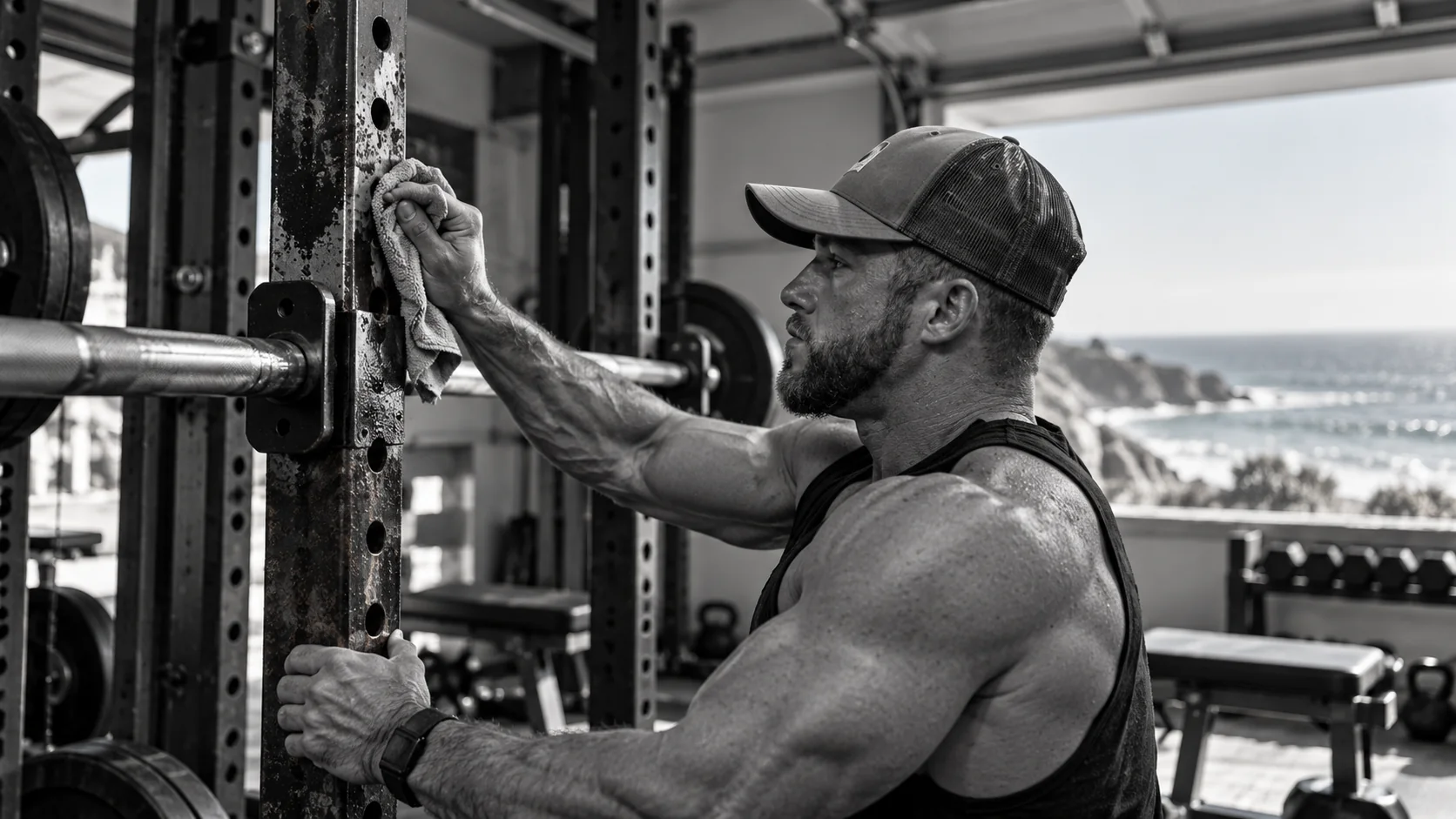
Rusting is an electrochemical reaction: iron in the steel reacts with oxygen and water to form hydrated iron oxides and oxyhydroxides, the flaky reddish-brown material called rust. It needs iron, oxygen, and moisture; take away the moisture and the reaction slows to a crawl. Once it starts, rust tends to keep itself going. It’s porous and holds moisture against the steel, so a small spot on a barbell sleeve or rack upright becomes a damp pocket that keeps corroding underneath.Why Salt Speeds It Up
Chloride ions, from sweat and from sea air, make corrosion much faster. They make surface moisture more conductive, and they break down the thin protective oxide films that otherwise slow corrosion, especially on stainless steel. Sweat is saltier than plain water but well below the roughly 0.9% salt of isotonic saline (an earlier version of this article said sweat itself was 0.9% salt, which overstates it). How salty it is varies a lot from person to person and session to session (Baker, 2017, doi:10.1007/s40279-017-0691-5). Either way, a film of dried sweat left on knurling is a steady salt deposit on bare steel. Near the coast, airborne salt adds a continuous chloride load to every exposed surface. Salt deposition is heaviest close to the shoreline and drops off inland, with wind and terrain deciding how far it reaches, so there’s no single distance where it stops mattering. If you can smell the ocean or see salt film on your car, assume your gym is getting it too. Uncoated carbon steel doesn’t last long in those conditions.Why It Matters Structurally
Rust isn’t only cosmetic on load-bearing equipment. Pitting tends to start at weld joints, bolt holes and chipped corners, which are also where stress concentrates. An 11-gauge upright’s wall is 0.1196 inches, and bending stiffness falls roughly in proportion to wall thickness, so every bit of lost wall is lost stiffness, and a localized pit at a weld matters more than the same loss spread evenly. The 11-gauge vs 14-gauge guide shows how wall thickness translates into stiffness.Finishes: What Holds Up and What Doesn’t
The base material and surface finish set how much rust protection you start with.Bare Steel and Black Oxide
These need the most care. Black oxide isn’t a coating in the usual sense; it’s a chemical conversion that leaves a thin layer of magnetite (Fe3O4) on the surface. On its own it offers little corrosion resistance and mainly helps oil cling to the steel. A black oxide bar that isn’t oiled regularly will rust faster than most owners expect. Bare and black oxide steel make the most sense in climate-controlled rooms, with an owner willing to oil them regularly.Zinc Plating and Galvanizing
Zinc protects steel two ways: it covers it, and it acts as a sacrificial anode, corroding first and protecting the steel even where the coating is scratched. Hot-dip galvanizing leaves a thick zinc layer and lasts well outdoors. Zinc plating (electro-galvanizing) is much thinner but still better than paint or black oxide alone. For J-cups, pins, and other hardware in a humid space, zinc-plated or galvanized parts are a sensible baseline.Stainless Steel
Stainless steel contains at least 10.5% chromium, which forms a thin, self-repairing chromium oxide film. That film is what makes it so rust-resistant, but it isn’t immune: high chloride exposure can cause pitting, especially in 304 stainless. For coastal or outdoor use, 316 stainless, which adds molybdenum for better chloride resistance, is the better grade. Stainless still needs occasional cleaning to remove sweat and salt deposits.Powder Coat and Paint
Most racks come powder coated: a polymer powder applied electrostatically and baked on, which is tougher than ordinary wet paint. Its weak point is continuity. Any chip or crack, especially at welds, bolt holes and J-cup contact points, exposes bare steel and lets rust creep under the coating. A quick look every few months at those high-wear spots, with touch-up paint or cold galvanizing spray on anything down to bare metal, prevents most of it.Controlling Humidity and Condensation
Finishes are the first line of defense. Controlling moisture is the second, and in a lot of garages and basements it makes the bigger difference.Humidity
Clean steel corrodes very slowly in air below roughly 60% relative humidity. Salt and grime on the surface lower that threshold, because they pull moisture out of the air and form a wet film at lower humidity. That’s why keeping the room at or below about 50% is a sensible target, especially near the coast. Garages and basements regularly run well above that in humid seasons.- A dehumidifier sized for the room. Use the maker’s room-size and dampness chart rather than a rule of thumb. Pint ratings changed under the 2019 U.S. Department of Energy test procedure, so an older unit’s rating will look higher than a newer unit with the same real capacity.
- A cheap hygrometer so you know what the humidity actually is.
- Ventilation, especially after sessions, when body heat and sweat raise the humidity.
- A vapor barrier or sealed floor in basements, where moisture wicks up through the slab.
Condensation
Garages swing in temperature from day to night. When steel cools below the dew point of the surrounding air, water condenses directly on it, even if the room’s humidity reading looked fine. Repeated overnight wetting drives corrosion even on coated surfaces. Keeping the space from getting cold (modest heat is enough to stay above the dew point), running a dehumidifier, or using desiccant absorbers near the equipment all help.A Maintenance Routine
After Each Session
- Wipe down everything you touched with a dry microfiber cloth to take off sweat and salt before it dries on.
- Oil bare steel and black oxide bars lightly, using 3-in-1 oil, camellia oil, or a barbell oil applied with a cloth rather than sprayed, so it doesn’t collect dust and grit in the knurling.
- Brush the knurling with a stiff nylon brush now and then, since sweat and rust start there first.
Every Few Months
- Inspect welds, bolt connections, and coatings on racks and storage. Note any chips, cracks, or rust spots.
- Touch up bare metal with cold galvanizing compound on zinc-coated parts, or matching touch-up paint on powder-coated parts.
- Service barbell sleeves per the maker’s instructions. Moisture in the bushings or bearings corrodes them from the inside and hurts spin.
- Deal with surface rust right away. Light rust on bare steel comes off with 0000 steel wool or a Scotch-Brite pad, followed by oil. Surface rust is a quick fix; pitting isn’t.
Storage
For bars and plates stored for long stretches, vapor corrosion inhibitor (VCI) bags, wraps, or emitters work well in a closed space. They release compounds that settle onto metal surfaces as a thin protective layer, and they’re widely used for storing metal parts.Outdoor and Coastal Setups
Training outdoors or in an open structure raises the bar for materials and upkeep.Materials for Outdoor Use
Bare steel, black oxide, and ordinary powder-coated equipment aren’t good choices for permanent outdoor use. Rain, UV damage to coatings, and constant air exposure corrode carbon steel quickly.- Stainless steel, preferably 316, for bars, pull-up bars, and anything your hands touch.
- Hot-dip galvanized steel for rack frames.
- 316 stainless hardware for bolts, nuts, and washers. Ordinary zinc-plated hardware can corrode and seize within a few seasons in salt air.
Coastal Routine
- Wipe equipment down with a damp cloth and then dry it regularly to remove salt deposits, rather than letting salt build up.
- Apply a corrosion-inhibiting wax or spray to exposed metal every month or so, including inside open tube ends where you can reach.
- Keep equipment off wet floors and leave space around it for air to move.
Checklist
| Task | How often | Why |
|---|---|---|
| Wipe down touched steel | Every session | Removes sweat salt before it dries on |
| Oil bare and black oxide bars | After use in humid weather; weekly otherwise | These finishes rely on oil for protection |
| Check humidity | Ongoing (hygrometer) | Target about 50% or lower |
| Inspect and touch up coatings | Every few months | Chips let rust creep under the finish |
| Service barbell sleeves | Per the maker’s schedule | Prevents internal corrosion |
| VCI for stored gear | Whenever gear is stored | Protects metal in closed spaces |
Bottom Line
Rust comes down to moisture and salt. Pick finishes that suit your environment (stainless or galvanized for coastal and outdoor use), keep the humidity down, wipe off sweat after every session, and fix chips before they spread. A well-built rack that’s looked after this way can last decades, even in salt air.Sources checked September 29, 2026. Research summaries describe the cited study; individual results vary.