
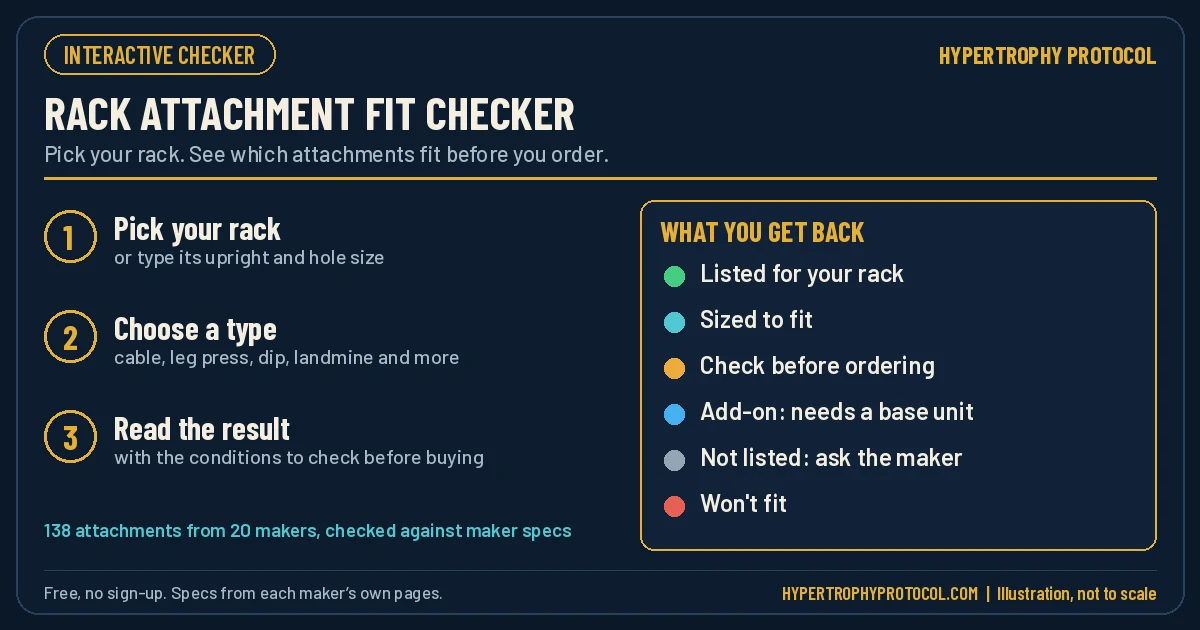
Pick your power rack or rack-style functional trainer (a cable machine), or type in its upright and hole sizes. See which of the catalog fit, need a check, or won’t fit. Check the conditions on each result before ordering.
1. Your rack
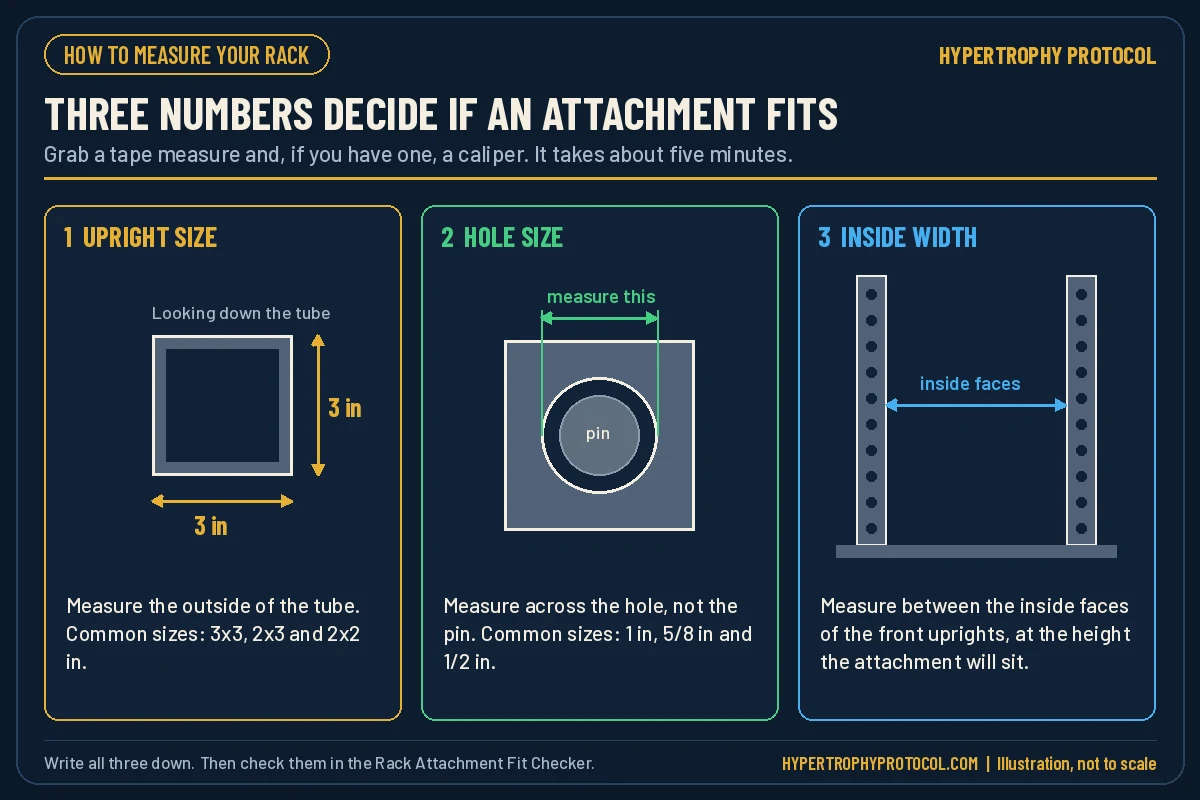
Measure across the hole, not the pin. A caliper, or a drill bit from a set you know, settles it in a minute.
Compare two racks
Rack A is the rack in section 1.2. Attachments
Which racks fit this attachment?
Already have your eye on an attachment? Pick it here to check it against every power rack in our catalog at once. Each rack links to its full result above.
What each fit result means
A size match is only a starting point. Before you order or use it, check the attachment’s exact version, the install instructions and any measurements still marked unknown.
| Result | What to do next |
|---|---|
| Listed for your rack | The maker names your rack’s product line. Still check your exact model, its version and the install steps. |
| Sized to fit | The listed sizes match what this tool checks. This is not maker approval, and not every clearance is checked. |
| Check before ordering | Resolve the conditions shown, such as inside width, rack depth, hole spacing or anchoring. |
| Add-on: needs a base unit | Needs a base attachment first. Make sure you own a compatible one, plus a rack that fits. |
| Not listed: ask the maker | The maker doesn’t list your rack. Ask them to confirm your exact setup. |
| Won’t fit | One size or rule doesn’t match your rack. Pick a version that does, or ask the maker for an approved option. |
These results show how the tool decided. They are not strength tests and do not replace the maker’s instructions. See rack specifications and manufacturer sources when comparing a different rack.
How the fit checker decides
Each result comes from what the attachment’s maker publishes. “Listed for your rack” means the maker names your rack on its product page. “Sized to fit” means the attachment comes in several upright and pin sizes, and one matches yours. “Check before ordering” means it matches on paper, but a requirement such as bolting down, inside width or rack depth has to be confirmed first. “Not listed” means the tube and hole size line up, but the maker doesn’t name your rack, so ask before you buy. “Won’t fit” means the upright size, hole size, width or depth rules it out.
Why upright size alone isn’t enough
Two racks sold as 3×3 (3-inch square posts) can still take different attachments. The usual reason is hole size: Rogue’s Monster Lite and REP’s PR-4000 use 5/8″ hardware, while Rogue’s Monster and REP’s PR-5000 use 1″. Titan’s X-3 and T-3 list 11/16″ holes, which take 5/8″ pins with a little wiggle room. Width, depth, model year and whether the rack is bolted down decide the rest. For the full background, read 5/8″ vs 1″ rack hole sizes.
Functional trainers in the checker
Some cable machines (functional trainers) are built into a squat rack, like the Mikolo, Major Fitness, RitFit and XMark all-in-ones. If the maker lists the upright and hole size, you can pick the trainer and check attachments just like a rack. A standalone trainer has no squat-rack uprights, so the checker tells you that pin-on rack attachments don’t apply. A trainer that bolts onto a rack, such as REP’s Athena, is checked through the rack it mounts on.
When a spec says “not published”
Some makers don’t list the inside width or depth for every rack. If that number decides the result, the checker asks you to measure instead of guessing. Measure the open gap between the inner faces of your front uprights, at the height the attachment will sit. Your tape measure beats a product page that may be out of date.
Related tools
Own Bulletproof gear? The Bulletproof Attachment Checker goes deeper on the ISOLATOR and VTS. Comparing racks or functional trainers before you buy? Use the Power Rack Comparison Tool to see specs side by side.