
Disclosure: We participate in the Bulletproof Fitness Equipment affiliate program and may earn a commission from qualifying purchases made through links on this page.
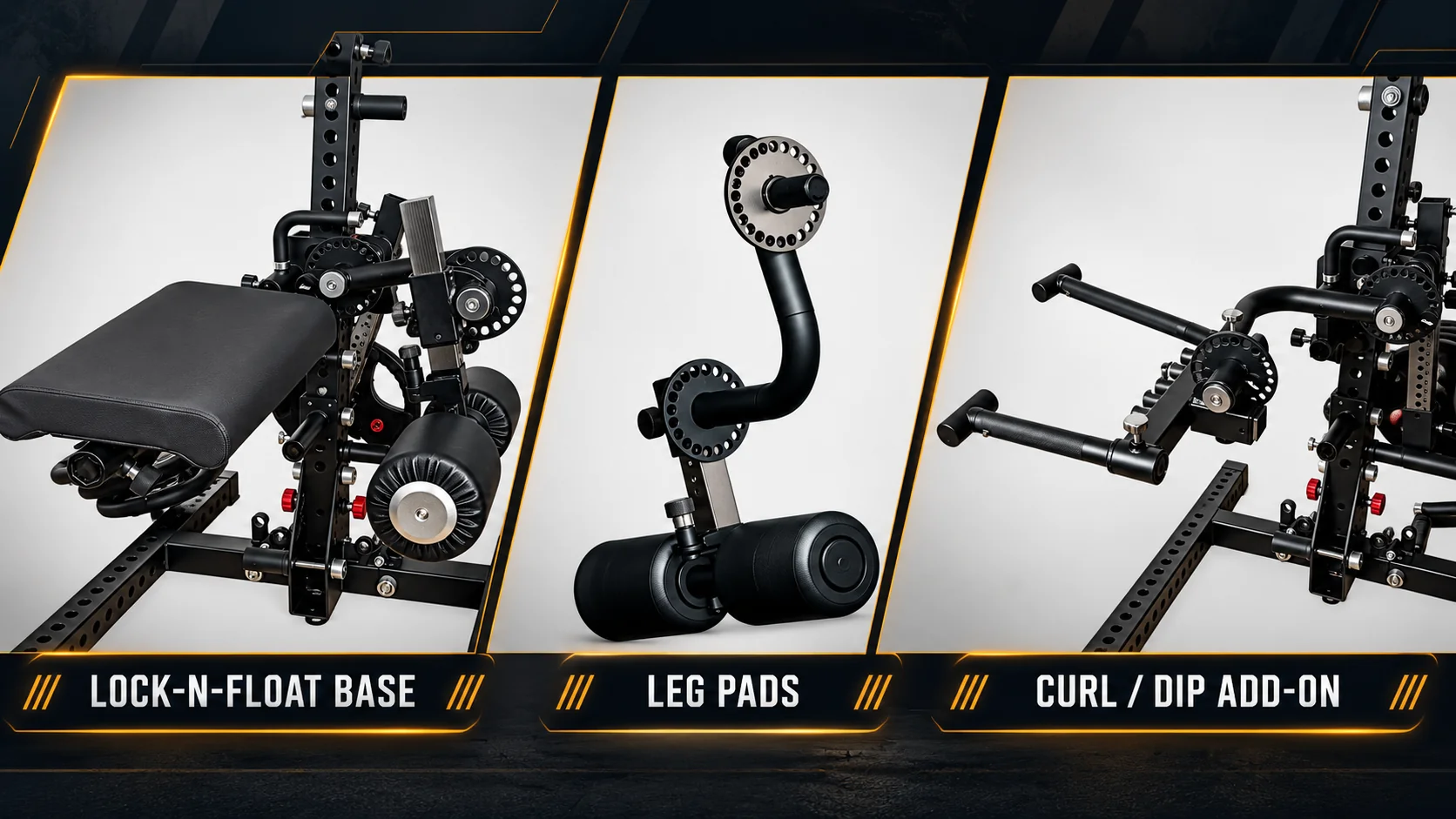
The Lock-N-Float system is one of the more important Isolator expansions because it turns one rigid, center-mounted lever arm into a base for both lower- and upper-body training: leg pads for extensions and curls, or the Curl/Dip Add-On for preacher curls and machine-style dips.
I own the Lock-N-Float lever arm. The architecture, components and compatibility statements below come from Bulletproof’s current product page.
Shop the Lock-N-Float Center Mount Lever Arm
The Basic System
The architecture is: Bulletproof Isolator → Lock-N-Float Center Mount Lever Arm → either leg pads (mounted through the same hex ports as your existing Isolator pads) or the Curl/Dip Add-On.
The Center Mount Lever Arm is the core product, and both add-ons attach to it. Bulletproof describes the leg pads as using the same hex-port interface as standard short roller pads, purchasable as a single pad or a pair — but they mount to this lever arm, not directly to a plain Isolator without it. The Curl/Dip Add-On has the same dependency. Know that before you buy either one.
What the Center-Mount Design Changes
Bulletproof describes the Lock-N-Float as a center-mounted lever that “plants itself dead center,” aiming for a balanced, even load rather than the geometry of a generic long lever arm bolted off to one side. That’s Bulletproof’s claim, not independent testing. The practical takeaway is simpler: the arm was designed around the Isolator’s center from the beginning, with a dual-cam design that includes a secondary cam at the middle stem for smooth 360° rotation, plus a telescoping stem for depth and setup adjustments.
Lock Mode vs. Float Mode
The product name refers to two different movement behaviors.
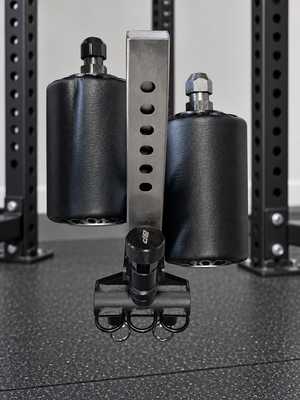
Lock Mode — the two sides are locked into a rigid, fixed configuration for synchronized, commercial-gym-style solidity. Use this when you want predictable bilateral tracking and maximum rigidity.
Float Mode — pulling the spring pop-pin unlocks the pads so they can float independently, which Bulletproof says forces both limbs to pull their own share of the load rather than letting a stronger side compensate. That’s potentially useful for unilateral or self-correcting work, upper or lower body.
Leg Extensions
Bulletproof lists leg extensions among the primary uses. The setup requires the Isolator, the Lock-N-Float Lever Arm, leg pads, a stable seat/body-support arrangement, and a chosen resistance source.
The leg pad should contact the lower leg in a position that’s comfortable and doesn’t force the knee into an awkward angle. The Isolator’s pivot position and seat height determine how closely the lever path matches the user’s knee — that’s why seat setup matters as much as the leg attachment itself. A perfect lever arm with a poor seat position still produces a poor exercise.
Leg Curls
Bulletproof also explicitly lists seated leg curls and prone leg curls. The exact body position can vary with the chosen Isolator and seat configuration, but the mechanical requirement stays the same: the knee joint should sit sensibly relative to the Isolator’s rotational axis, and the pad should contact the lower leg without creating an unstable body position. Don’t force a curl setup merely because the attachment can physically reach the leg — seat/support stability comes first.
Curl/Dip Add-On: Upper-Body Work
The same rigid lever arm also accepts Bulletproof’s Curl/Dip Add-On, which the company says turns it into “an adjustable upper-body station for preacher curls and machine-style dips.” It’s a separate add-on from the leg pads, not a different arm, and Bulletproof lists the Lock-N-Float Lever Arm as required.
Per Bulletproof’s product page, the add-on includes removable knurled dip bars, 30mm knurled curl handles and 38mm knurled dip handles, with three width positions (narrow, medium, wide) that change hand position, elbow position and the feel of the movement. Resistance comes from however the Isolator is loaded, so dips are loaded like a dip machine rather than with a dip belt. Bulletproof also markets it for leverage-changing variations and mechanical drop sets.
Bulletproof says the add-on works in both Lock Mode and Float Mode. In Float Mode, each arm has to move its own share of the load, the same idea as unilateral leg work.
Shop the Lock-N-Float Curl/Dip Add-On
Resistance Source
The Isolator ecosystem can be loaded through different supported paths depending on setup: plates, cable resistance, or supported trolley/cable systems. This article doesn’t assume one resistance source, because the same lower-body geometry can be paired with different resistance behavior.
If you’re using cable resistance, use the Cable Pulley Ratio Calculator to understand the cable system before attributing the resulting feel to the lever arm — cam leverage and pulley mechanical advantage are separate effects.
Seat Support Is Part of the System
For leg extensions and curls, body stabilization is critical. Bulletproof currently offers the Isolator Seat/Pad, a Seat Spotter for racks with an outer upright, and a Kickstand-type support for layouts without one. A buyer shouldn’t budget only for the lever and leg pads — the practical system may also require seat, support, adapter/hardware, and a resistance source. That’s exactly why the Bulletproof ecosystem is best planned by movement rather than by individual SKU.
See: Bulletproof Isolator Seat Support Guide
Why the Lock-N-Float Matters for a Small Gym
A dedicated leg-extension machine occupies permanent space. A dedicated seated or lying leg-curl machine occupies more. The Lock-N-Float approach uses the Isolator as the rotational platform, one central lever arm, modular pads, and shared seat/support hardware — which can dramatically reduce permanent machine count.
The tradeoff is setup: you may need to adjust Isolator height, set seat position, change lever configuration, change pad position, choose Lock or Float behavior, and connect resistance. That’s the same recurring Bulletproof trade — less permanent footprint, more configuration.
What to Record Once You Find a Good Setup
For repeatability, record: Isolator carriage height, seat height, seat angle, support position, lever-arm position, pad depth/width, Lock vs. Float mode, plate/cable setting, and cam position if used. Take a photo from the same angle. That turns a complicated first setup into a repeatable configuration.
Who Should Consider It?
Good fit: Isolator owner who wants leg extension/curl, preacher curl or dip capability without dedicated machines, values modularity, is willing to document setup positions.
Poor fit: wants instant exercise transitions, doesn’t own an Isolator, wants a selectorized commercial leg-machine feel, doesn’t have a stable seat/support solution, or dislikes changing attachments.
Safety
Keep the body supported. Make sure the lever is fully engaged, pads are secured, pins are seated, the seat/support can’t shift, and the resistance route follows manufacturer geometry. Don’t use an unsupported seat position for heavy dynamic reps. If the rack or seat shifts under a leg extension, stop and correct the support setup first.
Final Take
The Lock-N-Float should be viewed as a modular Isolator platform, not just a pair of leg pads. The core is the Center Mount Lever Arm; from there, leg pads create extension/curl capability and the Curl/Dip Add-On adds preacher curls and machine-style dips. For a compact gym, that’s a strong use of one rotary machine platform — the cost is setup time and the need for a stable seat/support system.
Related: Bulletproof Fitness Equipment Ecosystem Guide · Isolator Seat Support Guide · Isolator Cam vs Crossbow Cam