
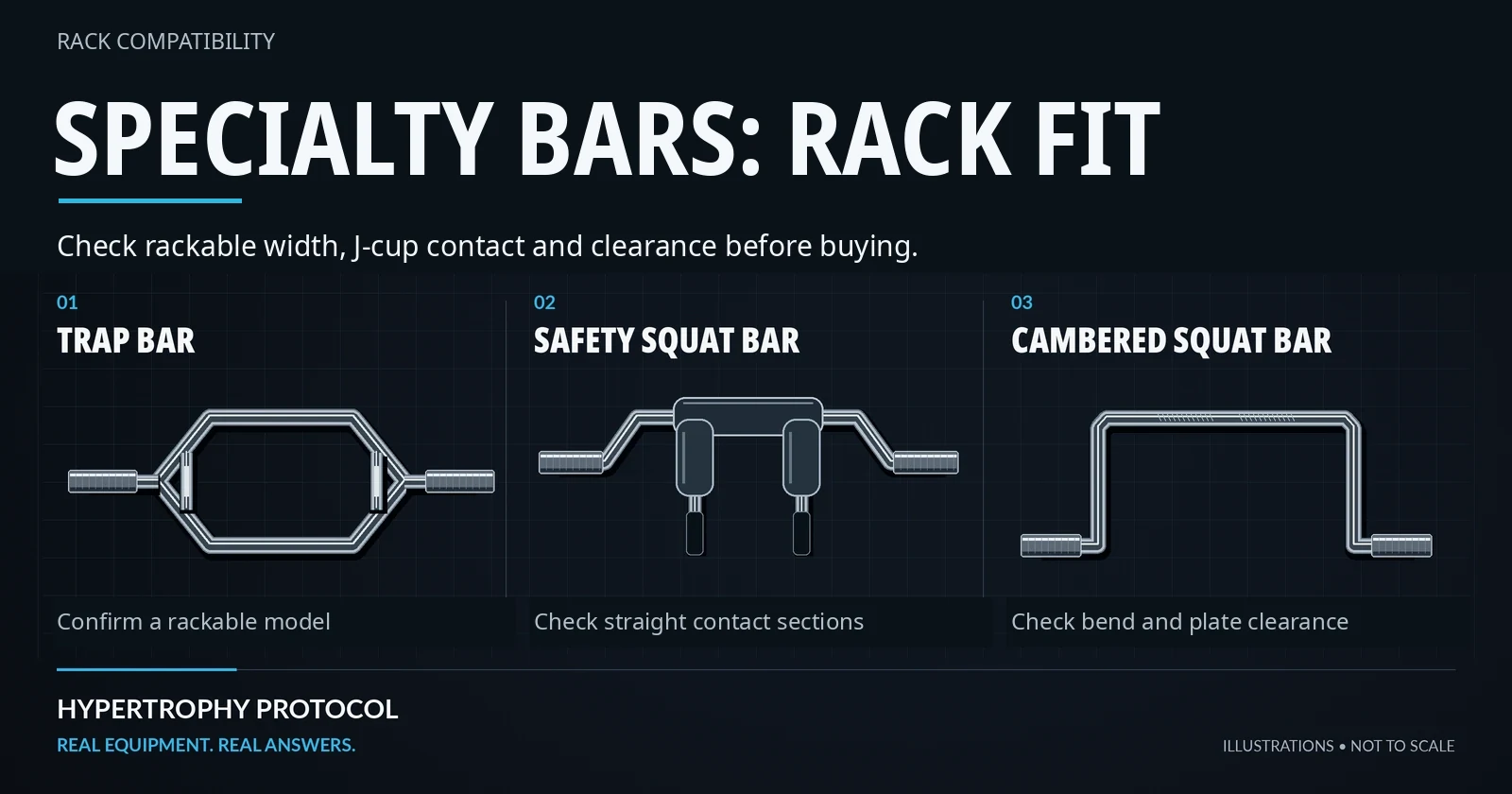
You own a power rack, and a safety squat bar, a cambered bar or a trap bar is next on the list. Whether specialty bars in a power rack sit level comes down to one comparison: the straight span between the bar’s bends has to be wider than the outside of your uprights and J-cups. On a 46 or 47 inch wide rack, the safety squat bars that publish that number clear with roughly an inch or two per side.
The cambered bar checked here publishes no rackable width, and most trap bars are floor tools that never touch a J-cup. Every spec and study below was checked on September 28, 2026, on the maker’s own product page or on PubMed.
Which measurement decides whether specialty bars fit your power rack?
That one comparison matters because of where a specialty bar can touch the rack. A straight barbell can rest anywhere along its shaft. A safety squat bar or cambered bar has only a short straight run near each sleeve before the bend starts, and that run is what has to land in the J-cup.
Makers give this number under different names: rackable width, sleeve to sleeve, distance between cambers, or distance between brackets. Loadable sleeve length and overall length matter less for fit, because plates hang outside the uprights on every bar here. Inside width only has to clear the pad and handles, and safety squat bar handles sit 12 to 13 inches apart, well inside any rack.
| Bar | Length | Loadable sleeve | Weight | Camber / drop | Rack fit note | Source |
|---|---|---|---|---|---|---|
| REP Safety Squat Bar | 92.5″ | 15.6″ sleeve | 68 lb | 5.5″ | 49.1″ between cambers; rated for REP’s 47″ racks and racks up to 49″ | REP |
| Rogue SB-1 | 93″ | Not published | 70 lb | 5.5″ sleeve drop, on center | No rackable width published | Rogue |
| Titan Safety Squat Bar | 90.5″ | 14.75″ | 58 lb | 20 degrees (no inch figure) | 50″ rackable width | Titan |
| Titan Series Safety Squat Bar | 90.5″ | 16″ | 67 lb | 22 degrees in specs; 5″ in overview | 49″ sleeve to sleeve | Titan |
| EliteFTS SS Yoke Bar | 92″ | Not published | 65 lb | Not published | 49.5″ between cambers | EliteFTS |
| Kabuki Transformer Bar | 91.25″ | 15.75″ | 25 kg (about 55 lb) | Adjustable: 6 camber positions, 4 sleeve settings | 54″ between brackets | Rogue (maker) |
| Rogue CB-4 Camber Bar | 95″ | 16″ | 60 lb | 4.4″ drop over a 55″ wide bend | Extra 9″ between sleeves; no rackable width published | Rogue |
| REP Open Trap Bar | 84.3″ | 16.5″ | 58.4 lb (frame only) | None | 50.5″ collar to collar; rated for REP’s 47″ racks and racks up to 49″ | REP |
| Rogue TB-2 Trap Bar | 88.5″ | 16″ | 60 lb | None | No rack guidance | Rogue |
| EliteFTS Rackable Trap Bar | 88″ | 16″ | 85 lb | None | Sold as rackable; no width published | EliteFTS |
| Titan Rackable Hex Trap Bar | 85″ | 16″ | 60 lb | None | Sold as rackable with J-hooks; no width published | Titan |
Three gaps stand out. Rogue publishes no rackable width for the SB-1 or the CB-4, and Titan gives camber in degrees, with its Titan Series page showing 22 degrees in the spec block and 5 inches in the overview. When the number you need is missing, ask the maker for the straight span between bends before you order.
How much room does a safety squat bar in a power rack leave you?
With the rackable width in hand, the fit check is one subtraction. Titan’s T-3 has a 46-inch outside width over a 42-inch inside width, and REP builds its racks around a 47-inch width. Subtract the rack width from the bar’s rackable width, then halve the result for the margin at each J-cup.
Clearance at each J-cup: bar rackable width minus rack width, split in half
Uses the outside width of the uprights. Your J-cups may add width beyond that.
The tightest pairing is REP’s own bar on REP’s own rack, at about an inch per side. REP also rates that bar for racks up to 49 inches, which would leave a tenth of an inch in total, so treat 49 as the ceiling and expect a snug fit near it. The Kabuki Transformer is the roomy outlier, with its brackets far enough apart to clear either rack by several inches.
Your J-cups can eat into that margin. Measure across the outside of both J-cups at the hole you rack from, because that is the width the bend has to clear. Upright profile also shifts outside width at the same inside width, and the power rack upright sizes guide shows how 2×3 and 3×3 frames compare.
Will a cambered bar sit level in your J-cups?
Cambered bars fail in a different way than safety squat bars. When the J-cups catch a curved section instead of a straight one, the bar can roll, and an empty bar can swing its cambered middle downward. Rogue built extra room between the CB-4’s sleeves so that the cambered portion won’t flip down on most racks.
“Most racks” is the only fit guidance on that page, with no rackable width to subtract. If your rack runs wider than 46 to 47 inches, get the straight-span figure from Rogue before you commit. If you are unsure which J-cups fit your uprights in the first place, the power rack attachment compatibility guide covers attachment fit across rack standards.
Drop also changes where the plates sit. Every bar with a drop in the table puts its sleeves below the shaft, so loaded plates hang lower than a straight bar’s would at the same hole. Before a heavy pin squat or low box squat, run the lowest position with plates on and confirm they clear the floor.
Does a trap bar belong in a power rack at all?
For most lifters, a trap bar never goes near the rack. Trap bar deadlifts start from the floor, and a standard frame like Rogue’s TB-2 carries no rack guidance at all. If floor pulls are the plan, rack fit is irrelevant and floor space for a bar just over 7 feet long is the real constraint.
A few models are sold as rackable for partial pulls and isometric holds from J-cups or safeties. REP’s Open Trap Bar is the only one here with a stated width range, and REP adds that it sits flush without tilting the J-cups inward, the exact failure to watch for with a too-narrow frame. EliteFTS and Titan sell rackable trap bars without a width number, so treat their fit on your rack as unconfirmed until the maker gives you one.
Is a specialty bar worth it if muscle growth is the goal?
Fit tells you whether a bar works in your rack, not what it changes in the lift. The short version: no study found for these guides shows any of these bars building more muscle than a straight bar. A safety squat bar keeps you more upright at a lighter load, and a trap bar shifts some work from the hips and lower back toward the knees. The trap bar vs safety squat bar vs cambered bar comparison covers what each study measured and which bar to buy first.
The one training study here compared trap bar deadlifts with barbell half squats, twice a week for eight weeks, in 22 recreationally active women (Hagerupsen et al., 2024). Lean mass gains did not differ between groups, and the two groups together gained an average of 0.84 kg of total-body lean mass on DXA. With 10 and 12 people per group, read that as no clear difference rather than proof the two lifts are equal.
For hypertrophy, choose the bar you will push close to failure week after week. If upright, quad-focused squatting is what you want, a machine can do that job with less upper back demand, and the squat machine styles comparison covers eight loading options.
Which specialty bar should you buy for your rack?
If you train in a 46 to 47 inch rack and want one specialty bar, pick a safety squat bar with a published rackable width of 49 inches or more. REP, EliteFTS and both Titan models all clear, so choose on weight and handle style.
If your rack is 49 inches wide or more, most fixed safety squat bars are at or near their limit. The Kabuki Transformer’s wider brackets give you room, while the others need a measured check before you buy.
If you want a cambered bar, the CB-4 comes with Rogue’s assurance for most racks and no number behind it. Confirm the straight span with Rogue first if your rack is wide or your J-cups are bulky.
If trap bar deadlifts are the goal, buy for the floor and ignore rack fit. Only pay for a rackable frame if rack pulls or holds are part of your plan, and only one with a stated width range.
Before you order, measure across the outside of your J-cups and run your rack through the Rack Attachment Fit Checker to confirm your J-cups and safeties match the uprights you have. A bar that clears by less than an inch per side is worth a call to the maker first.
Sources checked September 28, 2026. Manufacturers change specs; confirm on the product page before ordering. Research summaries describe the cited studies; individual results vary.