
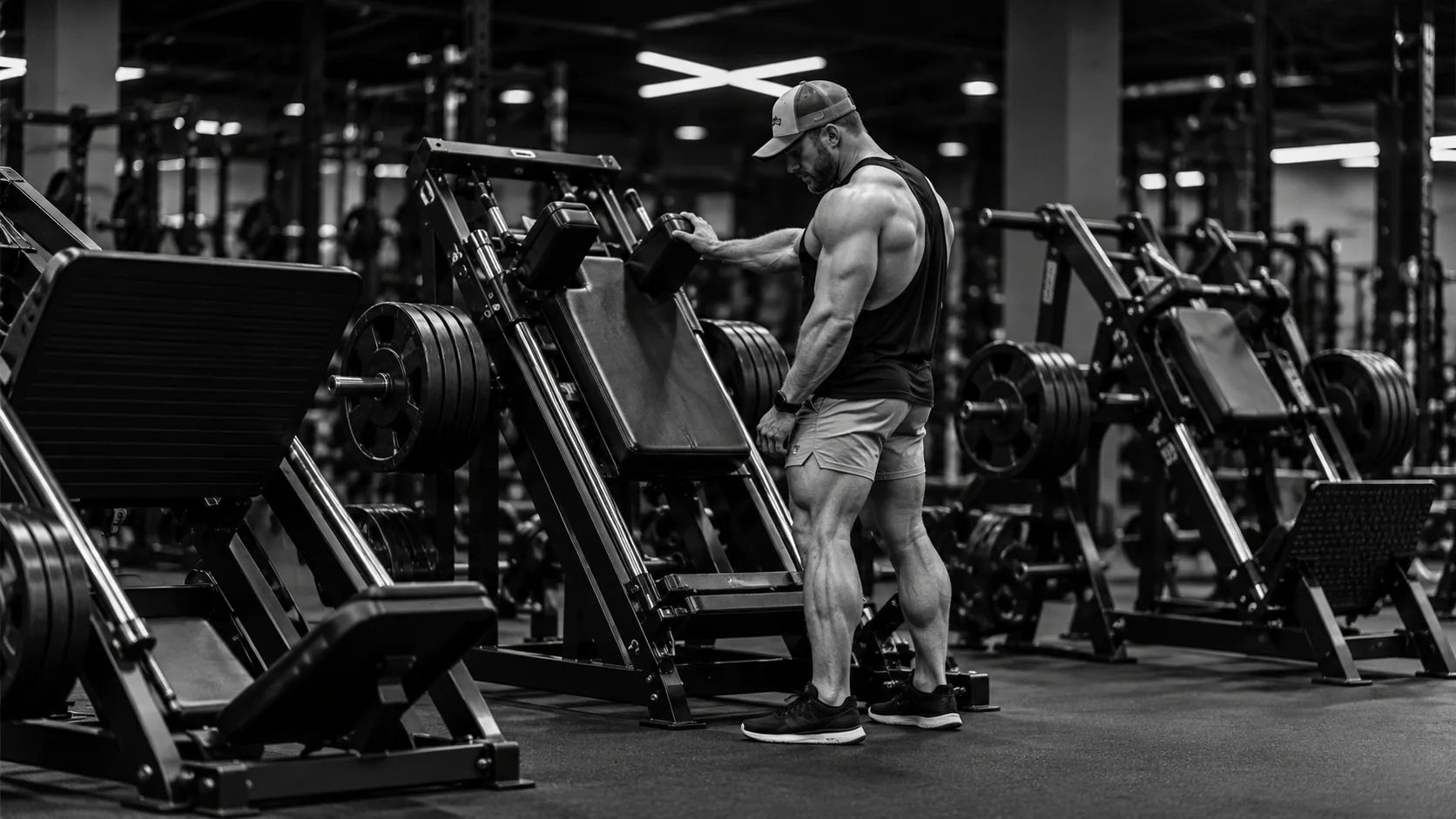
Short answer: every squat machine trains your quads. What changes is where the load sits, what path you move on, and where in the rep it’s hardest. Those three things decide how much your glutes, adductors, and back get involved — and whether the machine is worth the floor space for you. Most home gyms need one heavy, deep, low-fatigue quad option. Very few need three.
Some links below are affiliate links. I may earn a commission at no extra cost to you. As an Amazon Associate and Titan Fitness affiliate I earn from qualifying purchases. It doesn’t change what I recommend — see the affiliate disclosure. Beyond Power doesn’t run a formal affiliate program, but I have a personal referral link for them; if you buy through it, I may receive referral credit toward my own account.
The three variables that actually matter
Ignore the brand names for a minute. Every squat style is some mix of three choices.
- Load placement. On your spine (barbell), on shoulder pads with your back supported (hack, pendulum), or on your hips through a belt (belt squats). Spine loading adds trunk and back work. Hip loading removes most of it.
- Movement path. Free (you balance it), a fixed straight track (hack squat), an arc (pendulum, lever arms), or a vertical line (SquatMax-MD, VBS). Fixed paths let you push closer to failure safely. Free paths train balance and bracing.
- Resistance curve. Plates on a barbell weigh the same through the whole rep, but leverage changes how hard each position feels. Arcs and cams change the curve on purpose. Motor-driven cables can change it in software.
Once you see a machine as those three choices, the marketing gets a lot easier to read through.
What the research actually supports (and what it doesn’t)
Before the machine-by-machine breakdown, it’s worth being honest about the evidence. There’s less of it than equipment ads suggest.
Muscle activation differences between squat styles are smaller than people think. A systematic review and meta-analysis of eight EMG studies comparing back, front, overhead, and belt squats found no significant overall differences in muscle activation (the link goes to the belt squat study the review drew on, since the review itself isn’t freely hosted), with standardized mean differences ranging from about −0.49 to 0.66. Belt squats landed almost identical to back squats (SMD 0.09). Squat variations are more alike than different.
EMG is not growth. Most “this machine hits more quad” claims come from EMG, which measures electrical activity during a set, not muscle gained over months. Treat EMG as a hint, not proof.
Depth matters more than the machine. In a 10-week MRI study, full squats (~140° knee bend) grew the glutes about 6.7% vs 2.2% for half squats, and the adductors about 6.2% vs 2.7%. Quad growth was similar between groups, and hamstrings barely grew in either. That was 17 untrained men, so it’s a small study — but the direction is consistent with other work.
Training at long muscle lengths seems to help a little. A 2023 meta-analysis found full and partial range of motion produce similar growth on average, but partials done in the stretched position trended slightly better. A later trial in trained lifters found lengthened partials matched full-range reps. The practical read: a machine that stays hard at the bottom of the squat is a real advantage, but a modest one.
No squat fully trains your rectus femoris. In a head-to-head study in young women (squats done on a Smith machine), leg extensions grew the rectus femoris far more (about +11–18% across sites vs +2–8% for squats), while squats grew the distal vastus lateralis more (+18.2% vs +11.2%). Whatever squat style you choose, plan on a knee-extension movement too.
And a gap worth naming: I couldn’t find peer-reviewed hypertrophy studies on pendulum squats, SquatMax-MD, the Rogue Rhino, Voltra, or the Bulletproof VBS specifically. Everything below about those machines comes from how they’re built, not from controlled trials.
1. Barbell back squat
Load: on your spine. Path: free. Curve: constant load, with leverage making the bottom hardest.
The barbell squat is the reference point everything else gets compared to. It trains quads, glutes, and adductors hard at depth, and your trunk has to hold the whole thing up. That trunk demand is both its biggest strength and its biggest cost. Heavy sets generate a lot of whole-body fatigue, and you’re usually stopping a set because your back or bracing gives out before your quads do.
One detail matters for hypertrophy: as loads climb toward a max, lifters lean forward more. A study of 80–100% 1RM squats found forward lean increased at maximal loads, shifting work toward the hips and lower back. For quad growth, moderate loads with an upright torso beat grinding heavy singles.
For years I squatted with a curved Bells of Steel squat bar. It worked. But as I’ve gotten older, I wanted to take the shear and compression of a loaded bar off my spine altogether — which is what pushed me toward belt squats in the first place.
- Pros: cheapest if you own a rack; trains bracing and total-body strength; strong glute and adductor stimulus at depth; nothing to break.
- Cons: high systemic fatigue; spinal loading; hard to take close to failure safely alone; shoulder mobility can limit it.
- Skip it as your main quad builder if: your back or shoulders already limit you, or you train alone and won’t push sets hard without a spotter. Follow your doctor’s restrictions if you’re working around an injury.
2. Hack squat (linear track)
Load: shoulder pads, back supported. Path: fixed straight track, usually angled. Curve: close to constant.
The hack squat takes balance and trunk out of the equation. Your back is pinned to a pad, the sled runs on a track, and you can push to failure without worrying about losing position. In an EMG comparison of five squat variations at 60% 1RM, the hack squat showed significantly lower erector spinae and semitendinosus activity than every other variation. That’s the point: less back, less hamstring, more quad-focused work per unit of fatigue.
Foot placement changes emphasis a lot. Feet low and narrow biases the quads. Feet high shifts work toward glutes and hips.
- Pros: very stable; easy to take to true failure; low back demand; simple to learn.
- Cons: dedicated machines are big and heavy; the fixed track doesn’t fit every body — long femurs can feel jammed at the bottom; the curve doesn’t specifically bias the stretched position.
- Skip it if: you’re short on floor space. A full plate-loaded hack squat is one of the biggest single-purpose footprints in a home gym.
3. Pendulum squat (arc)
Load: shoulder pads on a swinging arm. Path: arc. Curve: changes through the rep, depending on pivot geometry.
A pendulum puts you on a platform under an arm that swings on a pivot. The arc lets your knees travel far forward, so most people reach much deeper knee flexion than on a hack squat. That depth is the pendulum’s real selling point for quad growth.
Here’s where I’d push back on the marketing: manufacturers don’t agree on the resistance curve. Some describe pendulums as hardest at the bottom; others describe them as heavier at the top, lighter at the bottom. Both can be true for different machines, because the curve depends on where the pivot sits and the arm’s angle at each point. The torque you fight is the load times its horizontal distance from the pivot, and that distance changes as the arm swings. Ask the maker for the curve — or test it yourself before assuming it biases the stretch.
- Pros: very deep knee flexion; back supported; often feels easier on knees than a straight track; some models add lunges and calf raises.
- Cons: large footprint; resistance curve varies by model; you lift part of your own bodyweight on the arm; no peer-reviewed hypertrophy data I could find.
- Skip it if: you can’t give it a dedicated corner, or you already have a deep, stable squat option.
4. Lever arms on a rack
Load: handles or a belt attached to a pivoting arm. Path: arc. Curve: changes as the arm angle changes.
Rack-mounted lever arms — like Titan’s X-3 adjustable arms, rated 600 lb per arm — pin onto your uprights and turn your rack into a plate-loaded machine. For squats you either hold handles at the shoulders or run a belt from the arm. They’re the cheapest way to add a guided squat if you already own a compatible rack.
The catch is the arc. Because the arm pivots on the rack, the load doesn’t move straight up and down — it pulls you forward or back through part of the rep. That changes your position under load and can shift stress toward your knees or low back depending on setup. Some reviewers cite a study showing lower glute EMG on lever-style belt squats than back squats; I couldn’t locate that study to verify it, so treat it as a claim, not a finding.
I tried rack lever arms for squats myself and didn’t stick with them. Setting them up and moving them between positions was a hassle every session, and the movement felt too rigid for me — locked into the arm’s arc rather than moving with my body.
- Pros: low cost; uses the rack you already own; also works for presses, rows, and deadlifts; no extra floor space.
- Cons: arc path pulls you out of a vertical line; resistance curve depends on arm angle; hole size and upright size must match your rack.
- Skip it if: squatting is the main reason you’re buying — a vertical belt squat does that one job better.
Check fit first: lever arms are hole-size and upright-size specific. Run your rack through the Rack Attachment Fit Checker before you order anything, and read up on 5/8″ vs 1″ hole compatibility if you’re not sure which you have.
4b. Belt squat arms: Fringe Mammoth, PRx Profile, and Force 6
Load: hips, through a belt hung from a pivoting arm. Path: arc. Curve: heaviest when the arm is level.
This is the cheapest way into belt squatting, and the category most home gyms actually buy. A single long arm pins to an upright (or a wall), plates load near the end, and a belt hangs from it. Unlike general-purpose lever arms, these are built around the belt squat first and add rows, curls, and calf raises second.
How the arc actually behaves
Every arm here swings on a pivot, so your hips travel a curve, not a straight line. How much that matters depends on arm length and where the pivot sits. Here’s the geometry for a 45″ arm with 18″ of hip travel:
- Pivot set so the arm is level mid-rep (9″ above to 9″ below level): the belt drifts only about 0.9″ front to back, and the load changes by about 2% through the rep.
- Pivot set so all travel happens on one side of level: drift grows to about 3.8″, and the load changes by about 8% — lightest at whichever end the arm is steepest.
Two takeaways. First, a long arm set up well is closer to vertical than its reputation suggests. Second, pivot height is the setting that matters most. If you want the bottom — the stretched position — to be the heaviest part of the rep, set the pivot so the arm is roughly level near the bottom. Fringe’s own guidance is to mount the pivot at or slightly below standing hip height, which gets you close.
Fringe Sport Mammoth
The Mammoth’s standout feature is an adjustable arm from 39″ to 48.75″, with a 14″ loading pin. Fringe lists it as fitting both 5/8″ and 1″ holes, with a lifetime warranty on the arm and one year on the belt. A wall-mount option exists if your rack won’t work. Add-ons include dual weight horns, a kickstand, and a “Swan Neck.” An independent reviewer noted a small amount of play from its pin-based mounting — the tradeoff for broad compatibility.
- Best for: the lowest-cost entry, odd rack sizes, or anyone who wants to tune arm length.
- Watch for: slight wobble at the mount; adjustable length means one more thing to set each session.
PRx Performance Profile Belt Squat
PRx built this one with Vendetta Strength & Athletics, and it folds vertically against a wall or rack when you’re done. It ships with a Spud Inc. belt and mounts to a single wall stud or to racks with 5/8″ or 1″ holes. Rack hardware isn’t included, it won’t mount to PRx’s own Profile PRO or ONE folding racks, and PRx says your rack must be true 3×3 — they don’t guarantee competitor fit. A mag pin locks the arm to a straight path or releases it for limited side-to-side movement, which is useful for unilateral work.
- Best for: small garages where the belt squat has to disappear between sessions.
- Watch for: rack mounting hardware sold separately; strict 3×3 requirement.
Force 6 Mega Squat Elite
Force 6’s belt squat arm is rated for 500 lb and listed as compatible with most power racks. On the product page, one buyer reports it fitting a REP PR-4000 without issue. Another reports it didn’t fit their rack, and that returns carry a 20% restocking fee plus return shipping. That makes a fit check before ordering especially important here. Force 6 also sells a separate belt squat collar that turns a landmine into a belt squat — a lower-cost, lower-capacity route.
- Best for: standard 3×3 racks where you’ve confirmed fit.
- Watch for: the return policy if it doesn’t fit; 500 lb rating is lower than vertical systems.
Where I land, from the outside: I don’t own any of these three, so this is a buyer’s read, not an owner’s. Force 6 is the one whose build quality I’d trust most, Fringe is the easiest on the budget, and PRx is the one I’d want to look at in my garage every day. Which of those matters most to you is a fair way to break the tie — after the fit check.
Arm vs vertical belt squat: the honest comparison
A well-set arm gets you most of a belt squat’s value — hips loaded, spine unloaded — at a fraction of the cost and footprint of a vertical system. What you give up is a perfectly straight path, a very high load ceiling, and some rigidity at the mount. If your belt squats are a supplement to barbell work, an arm is probably enough. If belt squats are becoming your main heavy leg movement, a vertical system like the SquatMax-MD or VBS earns its extra cost.
All three arms depend on your rack’s hole size and upright size. Check yours in the Rack Attachment Fit Checker first.
5. SquatMax-MD style (vertical pin, belt-loaded)
Load: hips, through a belt. Path: vertical, along a guide rod. Curve: constant free-weight load.
The SquatMax-MD hangs plates on a loading pin that slides up and down a guide rod under the platform. The load stays directly below your hips, so the line of pull is vertical instead of arcing. Titan’s rack-mounted version is rated to 1,300 lb on the loading pin. I owned a Titan SquatMax-MD, so this is the one style here I can speak to from real use.
Because the load hangs from your hips, your spine and shoulders are out of it. That’s the main reason to own a belt squat: you can train quads, glutes, and adductors hard on days your back or upper body needs a break. The vertical line also means the machine doesn’t pull you forward like a lever arm does.
Worth a flag: Titan’s product copy claims it provides “spinal decompression” and helps eliminate existing back pain. I haven’t seen evidence for either claim. Removing load from the spine is real. Treating back pain is a medical claim — follow your doctor’s guidance, not a product page.
What living with it was actually like: the squat itself was good. The problem was everything around it. Loading and unloading plates on a pin that low was the part I dreaded — getting plates off at the end of a session was genuinely hard. Black Widow Training Gear’s horizontal loading attachment made that much easier (note that on the Titan version it only takes plates 35 lb and smaller). What it couldn’t fix was the footprint. The SquatMax-MD takes a real chunk of floor, and in my garage that eventually became the dealbreaker. That’s why I preordered the Bulletproof VBS covered below.
- Pros: true vertical line; zero spinal loading from the bar; very high load ceiling; accepts bands for accommodating resistance.
- Cons: loading plates low on a pin is slow; mostly a one-exercise tool; the rack-mounted version needs specific upright spacing.
- Skip it if: you want one attachment that also does pulldowns, rows, and cable work.
5b. Rogue Rhino style (plate-loaded cable belt squat)
Load: hips, through a belt on a cable. Path: follows the cable. Curve: constant plate load at 1:1.
The Rogue Monster Rhino puts the plates on a trolley that rides a separate tower, and a cable runs from that trolley under the platform to your belt. Rogue designed it with Westside Barbell, and it runs at a 1:1 pulley ratio from a single weight source — what you load is what you lift. Between sets the trolley parks at the top on a UHMW hook Rogue calls the “Rhino Horn,” so you start the squat standing instead of digging the weight out from the bottom.
This style solves the two things I disliked most about the SquatMax-MD. The plates live on a trolley at a comfortable height instead of low on a pin, and the same weight source can run other exercises. The newer Rhino Trainer versions add a 1:1 lat pulldown and low row, and the Functional Trainer version adds 2:1 cable columns — all without reconfiguring cables.
The tradeoff is the cable itself. A cable only pulls straight when you stay directly over it. Drift forward or back and it pulls you along. Reviewers who’ve used both consistently say the SquatMax-MD feels better for pure squatting, while the Rhino wins on versatility. One Rhino owner also notes the trolley can feel draggy at light weights, which matters for warm-ups and accessory work more than heavy squats.
It comes three ways: standalone, as a drop-in for Rogue Monster and Fortis racks, or packaged with an RM-3 rack. The standalone version is a large, permanent piece of equipment.
- Pros: true 1:1 loading; trolley starts at the top; plates at a comfortable height; the same weight source can run pulldowns and rows on Trainer versions.
- Cons: big footprint, especially standalone; cable pulls you off line if you drift; the drop-in only fits Rogue Monster and Fortis racks; some trolley drag at light loads.
- Skip it if: floor space is your main constraint, or you want the strictest vertical path for squats alone.
6. Voltra style (motor-driven cable)
Load: wherever you attach the cable — belt, bar, or handles. Path: free, following the cable. Curve: programmable.
A digital cable unit like the Beyond Power Voltra 1 replaces plates with a motor. Resistance runs 5–200 lb in 1 lb steps, with modes for standard weight, bands, damper, isometric, isokinetic, and custom curves. A 2025 firmware update removed the old eccentric resistance ceiling, so you can load the lowering phase heavier than the lifting phase. I run a Voltra 1 in my gym.
That programmability is the real difference. You can make the bottom of a belt squat harder than the top, or overload the eccentric — both things plates can’t do. Whether eccentric overload builds meaningfully more muscle than matched conventional training is still debated, so I’d call it a useful option, not a guaranteed edge.
The limit is load. At 200 lb per unit as shipped (the beta firmware I’m running pushes that ceiling a bit higher), a single Voltra won’t challenge a strong lifter’s belt squat. Running two units is possible, but reviewers report twin mode isn’t fully synced. And a cable only pulls in a straight line from wherever it’s anchored — drift off that line and it drifts you with it.
The setup reality: belt squatting with a rack-mounted Voltra isn’t plug-and-play. The unit sits low on the rack and the cable has to pull straight down on your belt, so you need to stand on something — I use plyo boxes — to get enough depth and the right angle. Getting the box height and your position over the cable dialed in takes time every session. A dedicated belt squat mount or platform built for these units would probably fix most of that, but right now, setting it up is a chore. If you’re buying a Voltra mainly to belt squat, budget for a stable platform too.
Mount options worth a look (I haven’t tried these yet): Beyond Power’s own Travel Platform keeps the cable pulling straight down, but a long-term owner found its range of motion nowhere near enough for belt squats. The third-party makers are where the belt squat solutions are. EVE’s Mount Olympus is a 37″ × 15″ × 1/4″ steel plate with a grid of mounting positions for one or two Voltras — it’s made to order (about two months) and non-refundable once production starts. VoltraMounts makes rack and bar mounts, and at least one owner has paired theirs with a raised platform and a custom crossmember to build a DIY belt squat station. Once I’ve tested one of these, I’ll update this section.
- Pros: programmable resistance curves and eccentric overload; tiny footprint; no plates; works for dozens of other exercises.
- Cons: 200 lb ceiling per unit; battery and electronics to maintain; line of pull depends on your anchor; belt squats need a platform or boxes to stand on and fiddly setup; the most expensive way to get a belt squat.
- Skip it as a squat tool if: your belt squat working sets are already near 200 lb. Buy it for everything else it does, not for heavy squats.
Check current price on the Beyond Power site.
7. Bulletproof VBS (vertical belt squat with linear bearings)
Load: hips, through a belt. Path: vertical, with an optional front-to-back float. Curve: constant plate load.
The VBS is the newest design here. It mounts to a 3×3 upright and loads plates on a vertical carriage, like the SquatMax-MD. The twist is a set of horizontal linear bearings. Bulletproof describes two modes: locked for strict vertical reps, or unlocked so your hips can move forward and back naturally without the swing you get from a free-hanging load. The listed conservative max load is 650 lb, on an 8-roller base.
What that means in practice: locked mode behaves like a vertical belt squat. Unlocked mode lets you sit back into more hip-dominant reps without being dragged forward the way a lever arm or cable does. That’s a genuinely different option from anything else on this list. It’s also brand new, so there’s no long-term owner data or independent testing yet. For full transparency: I’ve preordered one to replace my SquatMax-MD, mainly for the smaller footprint. I don’t have it yet, so everything here comes from Bulletproof’s published specs. I’ll write a full owner review once it’s in my garage.
Practical details from the spec sheet: it ships with a 72″ wall-mounted 3×3 upright with 1″ holes, and can run off other 3×3 uprights or the Tri-Post Rack if they’re bolted or weighed down. Folded, it sits 25.5″ off the wall. There’s an optional Lift Assist that reduces the starting weight by about 30 lb — worth knowing, because it means the empty carriage isn’t light. Bulletproof also lists a hack squat attachment in development for the same base. Check current price on the Bulletproof site.
- Pros: vertical load with an optional natural hip path; high load rating; folds close to the wall; plugs into a larger rack ecosystem.
- Cons: needs a bolted or weighted 3×3 upright with 1″ holes; meaningful starting weight; new product with no independent testing yet.
- Skip it if: your rack is 5/8″ hardware or not anchored, or you only want the lowest-cost way into belt squats.
Already in the Bulletproof ecosystem? The Bulletproof Attachment Compatibility Checker shows which of their attachments fit your rack.
Side-by-side
| Style | Load sits on | Path | Back demand | Stretch bias | Load ceiling | Footprint |
|---|---|---|---|---|---|---|
| Barbell squat | Spine | Free | High | Depth-dependent | Very high | Uses rack |
| Hack squat | Shoulder pads | Linear track | Low | Moderate | High | Large |
| Pendulum | Shoulder pads | Arc | Low | Varies by model | High | Large |
| Lever arms | Hands or belt | Arc | Low–moderate | Varies with arm angle | 600 lb/arm (Titan X-3) | Uses rack |
| ↳ Fringe Mammoth | Hips (belt) | Arc, 39–48.75″ arm | Very low | Set by pivot height | Not listed | Rack or wall |
| ↳ PRx Profile Belt Squat | Hips (belt) | Arc, locks straight or slight lateral | Very low | Set by pivot height | Not listed | Folds to rack or wall |
| ↳ Force 6 Mega Squat Elite | Hips (belt) | Arc | Very low | Set by pivot height | 500 lb | Uses rack |
| SquatMax-MD | Hips | Vertical | Very low | Constant load | 1,300 lb pin (rack version) | Small–medium |
| Rogue Rhino | Hips (belt) | Follows cable, 1:1 | Very low | Constant load | Not listed | Large (standalone) or drop-in |
| Voltra | Wherever cable attaches | Follows cable | Depends on attachment | Programmable | 200 lb per unit | Tiny |
| Bulletproof VBS | Hips | Vertical, optional float | Very low | Constant load | 650 lb (listed) | 25.5″ from wall folded |
Which one do you actually need?
Before you buy anything, answer these honestly:
- What’s stopping your squat sets right now? If it’s your back or bracing — not your legs — a belt squat or back-supported machine fixes the actual problem. If your legs give out first, the barbell may already be enough.
- How much floor space can you give up permanently? Hack squats and pendulums are single-purpose and big. Rack-based options cost you almost nothing.
- What’s your rack? Upright size, hole size, and whether it’s bolted down decide half these options before price does.
- How heavy are your working sets? Near 200 lb on a belt squat and a single digital unit is already your ceiling.
- Do you have a knee extension option? If not, that may be a better next purchase than a second squat machine, because no squat fully trains the rectus femoris.
My verdict for most home gyms: keep the barbell for strength and bracing, add one hip-loaded vertical belt squat for high-effort, low-fatigue quad volume, and add a knee extension. A hack or pendulum makes sense only if you have the space and you want a dedicated back-supported quad machine above everything else. Lever arms are the budget path. A digital unit is worth it for everything it does besides heavy squats.
If you’re considering the leg-press route instead, I break down every home option in Leg Press Machines for Home Gyms. And if you’re comparing racks to build around, the Power Rack Comparison Tool filters by upright and hole size.
A note for coastal and humid garages
Belt squats and track machines have more exposed moving steel than a barbell: guide rods, loading pins, rollers, and bearings. In salt air, those surfaces pit and bind first. Wipe exposed guide rods and pins after humid sessions and keep a light oil film on bare steel. Digital units add a battery and electronics to keep dry. My rust-prevention guide covers the routine.
Frequently asked questions
Does a belt squat build as much muscle as a barbell squat?
For the legs, probably close to it. Pooled EMG data shows belt and back squats activate muscles almost identically (SMD 0.09). Long-term hypertrophy trials comparing them directly are still missing. The belt squat won’t train your trunk the way a barbell does.
Are pendulum squats better than hack squats for quads?
They usually allow deeper knee flexion, which likely helps. But the resistance curve varies by model, and there are no controlled hypertrophy studies comparing them. Depth and effort matter more than the name on the machine.
Do squats build hamstrings?
Not much. Hamstrings barely grew with either full or half squats in MRI research. Add leg curls and Romanian deadlifts.
Is a lever-arm belt squat bad for your back?
Not inherently, but the arc pulls you out of a vertical line, which changes your position under load. If you have a back issue, a vertical belt squat is the more predictable choice. Follow your doctor’s restrictions first.
Specifications checked against manufacturer pages and listings on September 23, 2026. Manufacturers change specs; confirm on the product page before ordering.