
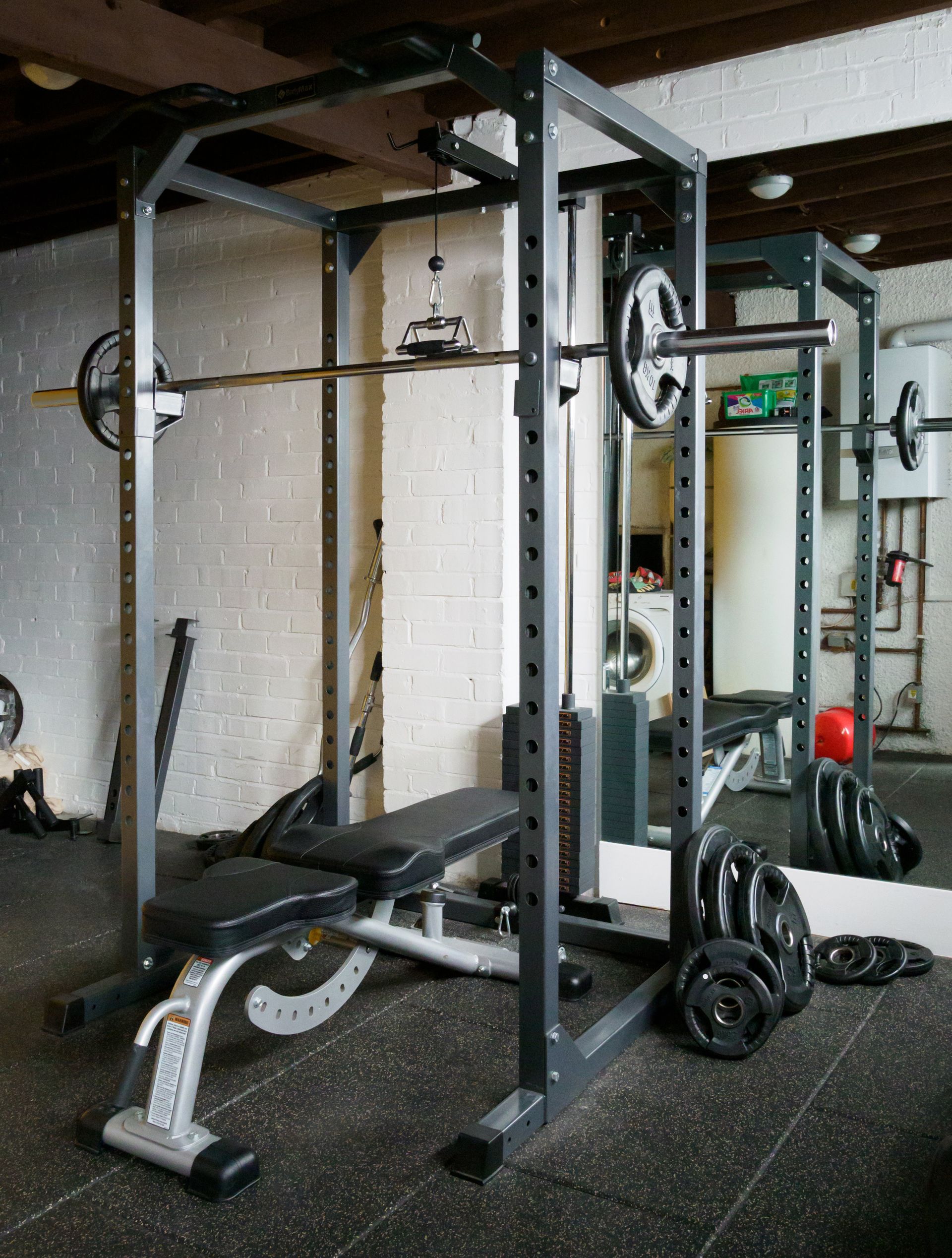
You’re comparing two racks. One spec sheet has “Westside hole spacing” and the other has “2-inch spacing throughout,” and you can’t tell if the difference matters. Westside hole spacing puts the holes 1″ apart through the bench zone, and on Rogue and Titan racks the clean pull zone too, with 2″ spacing above and below. That lets you set J-cups and safeties in 1″ steps where bench setup is fussiest. Below is which racks have it, what their spec sheets leave out, and who should let it decide a purchase.
Specs come from each maker’s own product pages, checked September 22, 2026.
Which racks have Westside hole spacing
Rogue and Titan use the Westside name. Rogue’s Infinity Series (R-3, R-3W, R-4 and R-6) is “based on the Westside design (5/8″ holes, spaced 1″ through the bench & clean pull zone, 2″ above and below),” and the RML-390 Power Rack 3.0 carries the same pattern on 3×3″ tube. Titan’s X-3 and T-3 spec pages use almost identical wording, plus 6″ side-hole spacing along the full upright.
Two brands sell the same pattern without the name. REP’s PR-4000 has 1″ spacing through the bench zone and 2″ elsewhere. Bells of Steel’s Hydra uprights have 1″ in the bench zone and 2″ at the top and bottom, and on 72″ and taller uprights the side holes run 2″ apart near the ends and 6″ apart through the middle. If you search a spec sheet for “Westside” and find nothing, look for “1-inch” before you rule the rack out.
The name comes from Westside Barbell, the Ohio powerlifting gym. Garage Gym Reviews credits the pattern to a partnership between Rogue and Westside Barbell, and Rogue still prints “West Side Hole Pattern” in its spec lists.
| Rack line | Spacing as the manufacturer states it | Upright / hole | Source |
|---|---|---|---|
| Rogue R-3 (bolt-together) | 1″ through bench and clean pull zone, 2″ above and below | 2×3″, 11-gauge, 5/8″ hardware | Rogue |
| Rogue R-4 | 1″ through bench and clean pull zone, 2″ above and below | 2×3″, 11-gauge, 5/8″ holes | Rogue |
| Rogue R-6 | 1″ through bench and clean pull zone, 2″ above and below | 2×3″, 11-gauge, 5/8″ holes | Rogue |
| Rogue RML-390 Power Rack 3.0 | 1″ through bench and clean pull zone, 2″ above and below | 3×3″, 11-gauge | Rogue |
| Titan X-3 Series | Westside through bench and clean pull zone, 2″ above and below; 6″ side holes | 3×3″, 11-gauge, 11/16″ holes | Titan |
| Titan T-3 Series | Westside through bench and clean pull zone, 2″ above and below; 6″ side holes | 2×3″, 11-gauge, 11/16″ holes | Titan |
| REP PR-4000 | 1″ throughout the bench zone, 2″ elsewhere | 3×3″, 11-gauge | REP |
| Bells of Steel Hydra | 1″ in the bench zone, 2″ at top and bottom | True 3×3″, 5/8″ holes | Bells of Steel |
| REP PR-5000 (for contrast) | 2″ throughout by default, no Westside section (1″ bar-height steps need Lowered J-Cups 2.0 used with Standard J-Cups 2.0) | 3×3″, 11-gauge, 1″ pinholes | REP |
Upright size and hole diameter are in the table because spacing alone doesn’t tell you what fits. A 2×3″ rack with 5/8″ holes and a 3×3″ rack with 1″ holes can both have Westside spacing and take completely different attachments. Power rack upright sizes and 5/8″ vs 1″ hole sizes cover those two specs.
Where the 1-inch section starts and stops
None of these product pages gives the 1″ section as a height from the floor. They stop at “bench zone” or “bench and clean pull zone.” That matters if you use a tall bench, a thick pad or a low-profile one, because your J-cup height might fall just outside the 1″ run. If it’s close, ask the maker for an upright drawing or hole chart before you order.
What 1-inch steps change on bench
With 2″ spacing, J-cups and safeties move in 2″ steps. If your ideal unrack height falls between two holes, you pick one that’s too high or too low. The finer steps in the bench zone buy you a more precise liftoff height, and that’s the whole benefit.
J-cup height. Cups set too high make you press the bar off the hooks before the first rep. Set too low, you reach up for it and lose your shoulder position. A 1″ step also halves the worst-case miss, from 1″ to 1/2″.
Safety height. Safeties should sit just below the bar at the bottom of your rep, so they catch a miss without cutting your range of motion. A 1″ step makes it more likely you’ll find a hole that clears your chest without leaving a long drop onto the arms.
Rack pulls. Rogue and Titan extend the 1″ section into the clean pull zone, lower on the upright, where you’d set pins for pulls from just below or just above the knee.
Do you need Westside spacing?
Most lifters don’t. Garage Gym Reviews calls traditional 2″ spacing fine for “the majority of lifters,” and REP’s own higher-end PR-5000 ships with 2″ spacing throughout by default, with 1″ spacing throughout available through its rack builder.
It earns its place if you bench heavy and often and a 1″ change in cup or safety height changes how the setup feels. It also helps when several people with different arm lengths share the rack, and when you do pin presses or partials, where the pin height sets the range you’re training. It matters less if you mostly squat, bench on a separate setup, or your heights already line up with 2″ holes.
Westside spacing and attachment fit
For a single-pin J-cup, upright size, pin diameter, bracket clearance and retention matter; hole spacing determines the available height steps. An attachment with two pins, or a pin plus a locating tab, also needs the correct centre-to-centre span. A 2-inch span can line up with every other hole in a 1-inch section, so finer spacing alone does not rule an attachment out. Check the actual hole positions, mounting face, bracket clearance and the attachment maker’s requirements rather than judging fit from the Westside label.
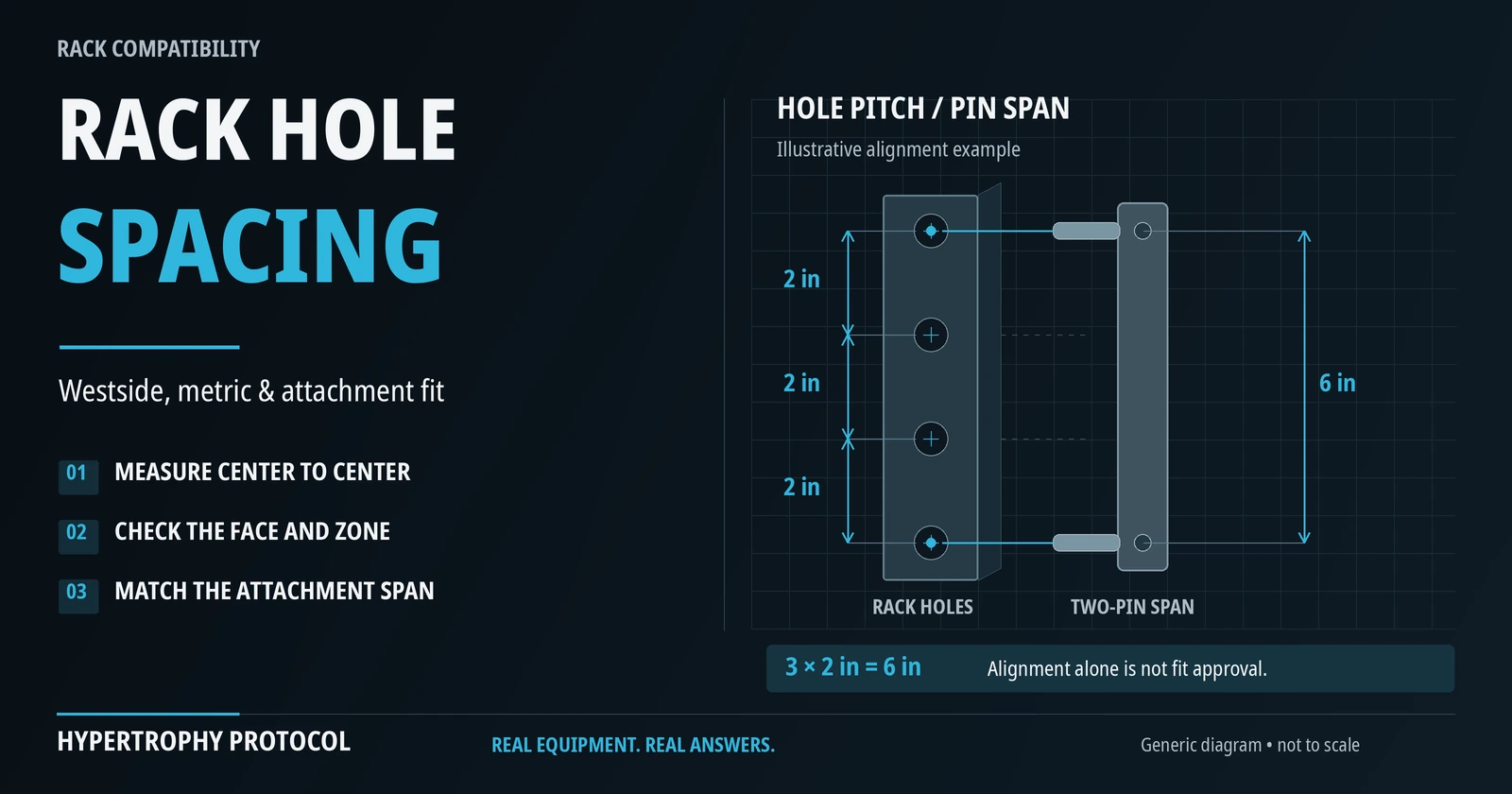
Side holes follow their own pattern, 6″ on Titan’s X-3 and T-3 and a 2″ and 6″ mix on taller Hydra uprights, so side-mounted storage has to match that instead. Two racks both labelled Westside can still reject the same attachment. Check the attachment maker’s compatibility list, or enter your rack in the Rack Attachment Fit Checker to check tube, hole and spacing together.
What to check before you buy
- Read the spec line. Look for “Westside,” “West Side” or “1” through the bench zone.” REP and Bells of Steel don’t use the name.
- Ask where the 1″ section sits if your bench or J-cup height is near the edge of it.
- Match upright size and hole diameter first. Spacing doesn’t make attachments cross-compatible. The Power Rack Buying Guide covers the other specs worth comparing.
- Check side-hole spacing if you plan to add side-mounted storage or attachments.
- Look for numbered holes. They’re a separate feature, but they make it easy to set both uprights to the same height. REP numbers the PR-4000 every five holes and the PR-5000 at every hole.
Should Westside spacing decide your rack?
If you bench heavy several times a week, or share the rack, treat it as a real reason to pick one rack over another: the Rogue Infinity and RML-390 3.0, Titan X-3 and T-3, REP PR-4000 and Bells of Steel Hydra all have it. If you mostly squat and pull, it’s a tiebreaker at best. For everyone, upright size, hole diameter and the attachments you plan to buy come first, because those decide what fits. Still choosing a tube size? Why 3×3 racks became the standard covers that choice.
Specifications checked against manufacturer pages on September 22, 2026. Manufacturers change specs; confirm on the product page before ordering.