
Disclosure: Hypertrophy Protocol participates in the Bulletproof Fitness Equipment and Titan Fitness affiliate programs and may earn a commission from qualifying purchases made through links on this page.
Updated October 9, 2026. Specs from manufacturer pages, checked October 2026. Prices and stock change too often to list here, so they’re left out.
If you’re shopping for a leg press machine for your home gym, the type you choose matters more than the brand. If you already own a compatible rack, Smith machine or Bulletproof VTS, an attachment adds leg pressing with almost no new floor space, but each one fits only its own maker’s equipment, and several carry lower load ratings than a standalone sled. If you own none of those, you’re choosing a standalone machine, and floor space becomes the deciding limit.
Below, every type is sorted by what it needs from you: floor, a specific piece of equipment, or both. I own one product here, the Bulletproof VTS Launch Pad. Everything else is a spec-only comparison built from the makers’ own pages.
How much floor space does a home gym leg press need?
That floor-space question has a less obvious answer than the product photos suggest. Multiply each mainstream standalone’s listed length by its width, and four of the five land in the same band, roughly 22 to 23.5 square feet. A compact machine is shorter, not smaller: the Force USA Compact and Body-Solid GVLP trade length for width, while the Titan and Bells of Steel combos are long and narrow.
The jump comes at the top of the range. The Force USA Ultimate needs about 41 square feet and the Rogue Iso Leg Press 35 about 44, close to double the others, which usually means giving one of them a wall of its own.
Footprint has already decided one purchase in my gym: I owned a Titan SquatMax-MD, a rack-mounted belt squat, and its footprint was the dealbreaker. Squat machines raise the same trade-off, and the squat machine styles comparison covers that side of the decision.
Attachments flip the equation. They add almost no permanent footprint, but they borrow a rack, Smith bar or VTS you already have, and you still need clear space in front of it to get into position and load plates.
Which standalone leg press machine fits your room?
Standalone machines are the only route if you own none of that equipment. Each has its own sled on rails, so you load plates and press with nothing to set up, and the empty sled is your lightest possible set.
Force USA Compact Leg Press & Hack Squat (spec only)
This one does a 30-degree leg press, hack squat and calf raise, with eight lockout positions. Its 38 lb starting sled is the lightest of any standalone here. It also carries a 320 lb maximum user weight and a 5’0″ to 6’8″ height range, two limits most buyers never think to check. Force USA product page.
Body-Solid GVLP Vertical Leg Press (spec only)
A vertical press puts you on your back pushing the sled straight up. That shortens the machine but asks for height, so check the 72-inch frame against your ceiling and garage door track. It takes Olympic or standard plates and starts with a 50 lb carriage, and Body-Solid describes the range of motion as suiting users up to 6’6″. Body-Solid product page.
Titan Plate-Loaded Leg Press Hack Squat Machine (spec only)
This 45-degree combo is the long, narrow layout. At 84 by 40 inches it uses about the same area as the compact machines, laid out as a strip along a wall instead of a square. It has a 1,000 lb capacity, an 80 lb carriage, three flip-down lockout positions and two plate-storage holders on the frame. At 53 inches tall, it’s also the lowest of the full-size combos. Titan Leg Press Hack Squat product page.
Bells of Steel Leg Press Hack Squat Machine (spec only)
It’s close to the Titan’s length, with a 1,000 lb sled capacity “at every angle,” a 55 lb empty sled and five racking positions for leg press, hack squat and calf raise. Two of its limits are tighter than its rivals: a 265 lb maximum user weight and a 5’0″ to 6’2″ height range. The width also appears two ways, 37 inches in the text and 37.5 inches in a photo caption, so plan with the larger figure. Bells of Steel product page.
Force USA Ultimate 45-Degree Leg Press Hack Squat Combo (spec only)
This four-in-one adds a forward thrust to the press, hack squat and calf raise. It weighs 410 lb, starts at 85 lb and stands 80 inches tall, so ceiling height may rule it out before floor space does. Unlike the Compact, it gives no user height range. Force USA product page.
Temple of Gainz Quadsend 37.5° Leg Press + Hack Squat (manufacturer info only)
The Quadsend is built as a modular system. According to its maker, it pairs a 37.5-degree leg press and seated calf raise with a hack squat and standing calf raise, and an optional 10-position leg press sled goes on or comes off in under a minute once you’re familiar with the process. It can also carry a Beyond Power VOLTRA I digital unit, bought separately with a fixed rack mount. Temple of Gainz product page.
The page gives no overall dimensions, weight capacity, machine weight or sled weight in text; the dimension drawings are images only. An independent HypertroFit review, written by a Kickstarter backer on a page that carries affiliate links, puts the unit at 99.3 inches long. That would make it the longest machine here, so get the footprint and load rating from Temple of Gainz in writing before you plan a room around it.
What about single-leg (isolateral) machines?
Two commercial-scale machines give each leg its own footplate, so a stronger leg can’t quietly carry the weaker one.
- Rogue Iso Leg Press 35 (spec only): four weight posts and a 2,475 lb total capacity with 1-inch cast iron plates, on the largest listed footprint in this guide. Its 182 lb sled weight is the heaviest starting load here, and the page doesn’t say whether that’s per side or combined. Rogue product page.
- Bells of Steel 2-in-1 Iso Leg Press & Hack Squat, The Juggernaut (spec only): a 1,500 lb sled capacity, 59 inches of sled travel and a hack squat mode. Its dimensions sit in a spec image that isn’t repeated in text, so request them. Bells of Steel product page.
Can your power rack double as a leg press?
If none of those footprints fits, the rack you already own is the next place to look. Rack attachments add little permanent floor, but compatibility decides everything, and both options covered here come from Titan for Titan racks.
Titan Stealth Leg Press (spec only)
The Stealth mounts on your J-hooks with added safety straps and fits T-3, X-3 and TITAN Series racks that are at least 36 inches deep. Its sleeves hold eight 45 lb plates, which is 360 lb of iron against a 500 lb rating, so you’ll run out of sleeve before you reach the rating. At 123 lb, it’s also a heavy piece to lift onto J-hooks. Titan Stealth Leg Press product page.
Titan Lever Arm Leg Press Attachment (spec only)
This is a 37.5 by 11.5 inch footplate that pins to Titan’s lever arms on T-3 and X-3 racks, with a 1,200 lb rating. The lever arms are required and sold separately, so the real purchase is two products. Titan Lever Arm Leg Press Attachment product page.
I tried rack lever arms in my own gym and didn’t like them. Setting them up and moving them around was a hassle, and they felt rigid. If you’re weighing this footplate, count the lever-arm setup as part of the cost.
What if your rack isn’t a Titan?
Mine isn’t. My rack is a Rogue Monster Lite with 3×3 uprights and 5/8 inch hardware, and neither Titan attachment is listed for it or for any other brand. Run your rack through the Rack Attachment Fit Checker, read the 5/8″ vs 1″ hole size explainer, and confirm with Titan before you order.
Measure behind the rack too. My uprights sit 17 inches from the wall, which limits rear-facing weight horns for plate loading.
What if you already own a Smith machine?
A Smith machine solves the rack problem differently, because its bar already rides on guides. A leg press plate clamps to that bar, and you lie underneath and press it up. It’s the smallest add-on here, but each plate fits one maker’s bar.
Force USA G3 Leg Press Attachment (spec only)
This plate fits the Smith bar of the G3 All-In-One Trainer, and only the current V2 (Gen 2, 2023) model, so check your G3’s generation first if you bought it earlier. It carries a 771 lb rating on a 35.5 by 15 inch footplate. Force USA product page.
Titan Vertical Leg Press Attachment (spec only)
Titan built this plate for its T-3 and X-3 Smith rack attachments. The overview also mentions TITAN Series, but no TITAN Series attachment appears in its compatibility list. Locking pins hold it on the bar, and you pivot your feet forward to lock out and stop at any level. No weight capacity is published, so treat your Smith attachment’s own rating as the ceiling and ask Titan before loading heavy. Titan Vertical Leg Press Attachment product page.
Get RXd RX3 Leg Press Plate (spec only)
This plate is made for Get RXd’s RX3 Smith racks and is “rated for over 1000+ LBs.” The page gives no product weight, and its dimensions appear only in an image. Get RXd product page.
If you’d be buying a Smith attachment just to get here, factor in the install. I owned a Bells of Steel Smith Machine Rack Attachment. It ran smoothly, but it was heavy, needed two people to install, was frustrating to line up, and took up two full uprights of my rack.
The load also sits directly above you, as on any vertical press. Set the Smith machine’s safety stops just below the bottom of your range before you load the bar.
What does the VTS Launch Pad add to a Bulletproof setup?
The VTS Launch Pad works on the same idea as a Smith plate, but it rides Bulletproof’s VTS trolleys instead of a Smith bar. It’s the one product in this guide I own, as part of my VTS setup. The specs below come from Bulletproof’s page.
It latches into the VTS barbell latch system and locks in with wrap-around hitch hooks, which come in short or long versions. It works with full VTS trolleys and with VTS Lite, and on VTS Lite the weight horns screw straight into the platform. It isn’t compatible with standard leg press machines or with barbell platforms that lack the VTS latch, and the page makes no statement about VTS Lite HOME.
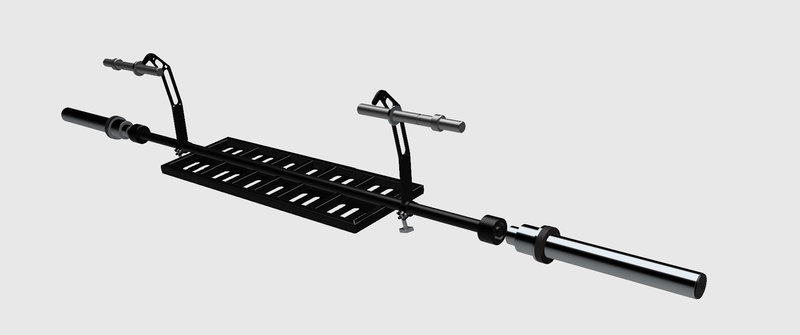
The kit includes the platform, a pair of hitch hooks and a pair of safety pins, and the page currently shows a padded cushion as included, which adds donkey and seated calf raises. Weight horns in 9 or 12 inch lengths are add-ons. If those calf variations matter, confirm the cushion is in your order.
The number to plan around is the 350 lb maximum load. Count your plates against it: I have about 350 lb of plates, so that cap sits right at my total. If you already need more than that on a leg press, this isn’t your machine.
Setup steps and hook choice are in the VTS Launch Pad guide. If you’re still choosing a base system, see VTS vs VTS Lite vs HOME, and check your rack in the Bulletproof Rack Compatibility Checker.
How do the specs compare side by side?
With every type covered, the whole field fits in one table. Sizes appear exactly as each maker gives them. For attachments, that size covers the hardware alone, so add the room you need to use it. “Spec only” means the row is built from the maker’s published specs.
| Product | Type | Listed size | Rated load | Sled / carriage | Needs | Basis |
|---|---|---|---|---|---|---|
| Force USA Compact | Standalone, 30° press + hack squat | 52″ W x 65″ D x 57″ H | 700 lb plates; 320 lb max user | 38 lb | Floor space | Spec only |
| Body-Solid GVLP | Standalone, vertical | 53″ L x 62″ W x 72″ H | 750 lb | 50 lb | Floor space, 72″ height | Spec only |
| Titan Leg Press Hack Squat | Standalone, 45° combo | 84″ L x 40″ W x 53″ H | 1,000 lb | 80 lb | Floor space | Spec only |
| Bells of Steel Leg Press Hack Squat | Standalone combo | 87″ L x 37″ W (37.5″ in caption), 58.25″ H | 1,000 lb; 265 lb max user | 55 lb | Floor space | Spec only |
| Force USA Ultimate 45° | Standalone, 45° 4-in-1 | 66″ W x 90″ D x 80″ H | 1,000 lb | 85 lb | Floor space, 80″ height | Spec only |
| Temple of Gainz Quadsend | Standalone, 37.5° press + hack squat | Not stated in text (99.3″ L per HypertroFit review) | Not stated | Not stated | Floor space | Manufacturer info only |
| Rogue Iso Leg Press 35 | Standalone, independent footplates | 98″ L x 64″ W x 47″ H | 2,475 lb (with 1″ cast iron plates) | 182 lb (per side or combined not stated) | Floor space | Spec only |
| Bells of Steel Juggernaut | Standalone, isolateral + hack squat | Not stated in text (59″ sled travel) | 1,500 lb | Not stated | Floor space | Spec only |
| Titan Stealth Leg Press | Rack-mounted (J-hooks) | 49″ W x 13″ D x 36.5″ H unit; 32″ W footplate | 500 lb (sleeves hold eight 45 lb plates) | Not stated (unit weighs 123 lb) | Titan T-3 / X-3 / TITAN rack, 36″+ depth | Spec only |
| Titan Lever Arm Leg Press | Rack-mounted (lever arms) | 37.5″ x 11.5″ footplate | 1,200 lb | Not stated (unit weighs 59 lb) | Titan T-3 / X-3 rack + lever arms (sold separately) | Spec only |
| Force USA G3 Leg Press Attachment | Smith bar plate | 35.5″ x 15″ footplate | 771 lb | Smith bar (not stated) | Force USA G3, current V2 only | Spec only |
| Titan Vertical Leg Press Attachment | Smith bar plate | 41″ W x 16.5″ H x 5.5″ D | Not stated | Smith bar (unit weighs 41 lb) | Titan T-3 / X-3 Smith attachment | Spec only |
| Get RXd RX3 Leg Press Plate | Smith bar plate | Not stated in text | Over 1,000 lb | Smith bar (not stated) | Get RXd RX3 Smith rack | Spec only |
| Bulletproof VTS Launch Pad | VTS barbell-latch platform | 31.5″ W x 10.2″ H platform | 350 lb | Not stated (unit about 40 lb) | VTS or VTS Lite | I own it |
“Not stated” means the maker doesn’t publish that number in text. Those cells are left blank rather than estimated.
Which numbers should make the decision for you?
That table holds more numbers than most buyers need. Three checks do most of the sorting, whichever type you’re leaning toward.
Working area and ceiling. Add room to get on and off and to load plates from the side, and for an attachment, measure in front of the rack and behind it. Then check height, since the GVLP and Force USA Ultimate are the tall ones. The 10×10 home gym layout guide helps if you’re fitting a press into a tight room.
Ratings against your plates and your body. Compare each rating with the plates you own and might add in a year. User weight limits are easier to miss, and the Force USA Compact and Bells of Steel combo both publish one.
Starting load and lock-in. If you need light sets, the empty sled matters, and the standalones run from the light Force USA Compact sled up to Rogue’s far heavier one. No attachment page states a starting load, and every attachment ties you to one maker: Titan’s are listed for Titan racks, each Smith plate fits one bar, and the Launch Pad needs a VTS or VTS Lite. If you’re building around Bulletproof, the Bulletproof ecosystem guide shows how the pieces connect.
Convenience is the last tiebreaker. A standalone machine is always ready, while an attachment has to go on and come off, and your rack, Smith or VTS does nothing else while it’s mounted.
Which leg press type should you buy?
Those checks sort the field once you know what’s already in your garage.
If you own nothing that takes an attachment and have about 23 square feet of clear floor plus working room, buy a mid-size standalone: the Force USA Compact or Body-Solid GVLP for a shorter room, the Titan or Bells of Steel combo for a long wall.
If you own a Titan T-3, X-3 or TITAN Series rack and won’t give up more floor, check the Stealth first, since it doesn’t need lever arms. If you own a Smith machine or Smith rack attachment, a plate made for that exact bar is the smallest addition you can make.
If you run a Bulletproof VTS or VTS Lite and your working weights stay under the 350 lb cap, the Launch Pad adds the movement for about 40 lb of hardware. If single-leg pressing matters and space and budget don’t, compare the Rogue Iso Leg Press 35 with the Juggernaut, and get the Juggernaut’s footprint in writing. If your rack isn’t on any maker’s list, don’t buy an attachment and hope it fits.
Your next step: enter your rack’s upright size and hole diameter in the Rack Attachment Fit Checker before you order any rack-mounted leg press.