
Affiliate and editorial disclosure: Hypertrophy Protocol received informational emails and promotional material about SpaceMilk. This is an independent, research-based buying guide, not a hands-on tasting review or a clinical test of a finished retail bag. Hypertrophy Protocol is a SpaceMilk affiliate: if you buy through our marked link or use code HYPERTROPHYPROTOCOL, we earn a commission at no extra cost to you. That relationship does not change the evidence assessment below, including the limits and the lead-warning context. Manufacturer information and studies checked October 13, 2026; listed prices rechecked October 17, 2026.
SpaceMilk is a protein powder made from fermented yeast rather than cow’s milk or a plant crop. The company advertises a complete amino-acid profile, a simple ingredient list, extensive batch testing and a digestion-friendly formula. But can a 20-gram serving actually replace whey for muscle growth, and is the premium worth paying?
Short answer: SpaceMilk is a credible dairy-free protein option to investigate. Research on a related yeast protein ingredient suggests it can support training when dietary protein is insufficient. There is not enough independent finished-product evidence to say SpaceMilk beats whey for muscle growth or reliably eliminates bloating. Its public batch-testing library is useful, but buyers should read the actual results instead of accepting “zero contamination” slogans.
What is in SpaceMilk, and who is it for?
Its main ingredient is a protein isolate from cultivated baker’s yeast, Saccharomyces cerevisiae. Yeast is a fungus, neither a milk protein nor a conventional pea or rice protein. The company says the processing separates the isolate from yeast biomass rather than selling active yeast. Finished formulas differ by flavor: certain versions contain cocoa, sunflower lecithin, konjac fiber, salt, natural flavors and Reb M sweetener.
That source can appeal to vegans or buyers avoiding dairy. It is not a reason to assume complete safety for every food allergy. SpaceMilk advertises absence of the nine major allergens and publishes selected allergen results, but the testing library lists named ELISA tests for peanut, soy flour and nonfat dried milk, and the linked lab report adds gluten (below 5 ppm). A person with another severe allergy should not mistake four tested analytes for a laboratory clearance of all nine categories. Yeast itself is the other consideration: SpaceMilk’s FAQ tells anyone with a true baker’s yeast allergy to check with an allergist first.
The manufacturer FAQ lists five flavors: Chocolate, Vanilla, Original, Pumpkin Spice and Unflavored. Chocolate and Vanilla have appeared in 15- and 30-serving sizes; the product lineup is actively changing, so compare the bag label and selected option rather than a promotional email from an earlier launch. Unflavored is the simplest one-ingredient option listed by the brand.
How much actual nutrition does a serving deliver?
Each listed serving supplies 20 grams of protein and zero listed sugar. Calories vary by flavor: the manufacturer reports 100 for Unflavored, 110 for Original, Vanilla and Pumpkin Spice, and 120 for Chocolate. That may be useful for someone trying to add protein without a very high-calorie shake. Per Anthony’s own bags (Chocolate, 30 servings): one 29 g scoop lists 20 g protein, 120 kcal, 1.5 g fat, 6 g carbohydrate (2 g fiber), 0 g sugar and 260 mg sodium.
It also reports a PDCAAS of 1.0, a favorable score reflecting essential amino-acid adequacy and digestibility. But that number is truncated at 1.0; it does not show that all high-scoring protein sources have identical muscle-growth effects. The company says its yeast protein supplies more than 21% branched-chain amino acids. The Chocolate bag’s own amino-acid chart lists 21.6 g of BCAAs and 9.2 g of leucine per 100 g of protein, against 22.0 g and 10.9 g for whey, so a 20 g serving supplies about 1.84 g of leucine versus about 2.18 g from the same amount of whey protein.
To see how much protein you need each day, and what closing the gap would cost with SpaceMilk or any other powder, use our protein calculator.
Compared with whole foods, a powder is convenient, not nutritionally complete as a meal. Compared with whey, SpaceMilk’s main differentiators are its non-dairy source, ingredient formulation and manufacturing approach, not a proven ability to turn 20 grams into a larger muscle gain.
Does the 2024 muscle-building trial actually prove SpaceMilk works?
The brand cites a 2024 randomized, double-blind study in which men aged 40 and over performed an eight-week bodyweight-oriented resistance program. Of 116 enrolled, 79 completed it. They received AnPro yeast protein, whey, or maltodextrin placebo; the prescribed supplement was 40 grams per day split between morning and lunch. (The paper’s abstract says 40 grams twice daily; its methods say 40 grams a day in total, and we go by the methods.)
Both protein groups gained total and trunk lean mass compared with their own starting points. The important distinction is that the total-lean-mass yeast-versus-placebo difference was not statistically significant for the full completed sample. The significant between-group result came in a subgroup of 48 men eating less than 1.2 g of protein per kg of body weight a day, where yeast beat placebo for total lean mass (+867 g against −99 g). Whey’s gain in that subgroup wasn’t significantly different from placebo, and in the full sample whey beat yeast on leg-press reps at 80% of maximum.
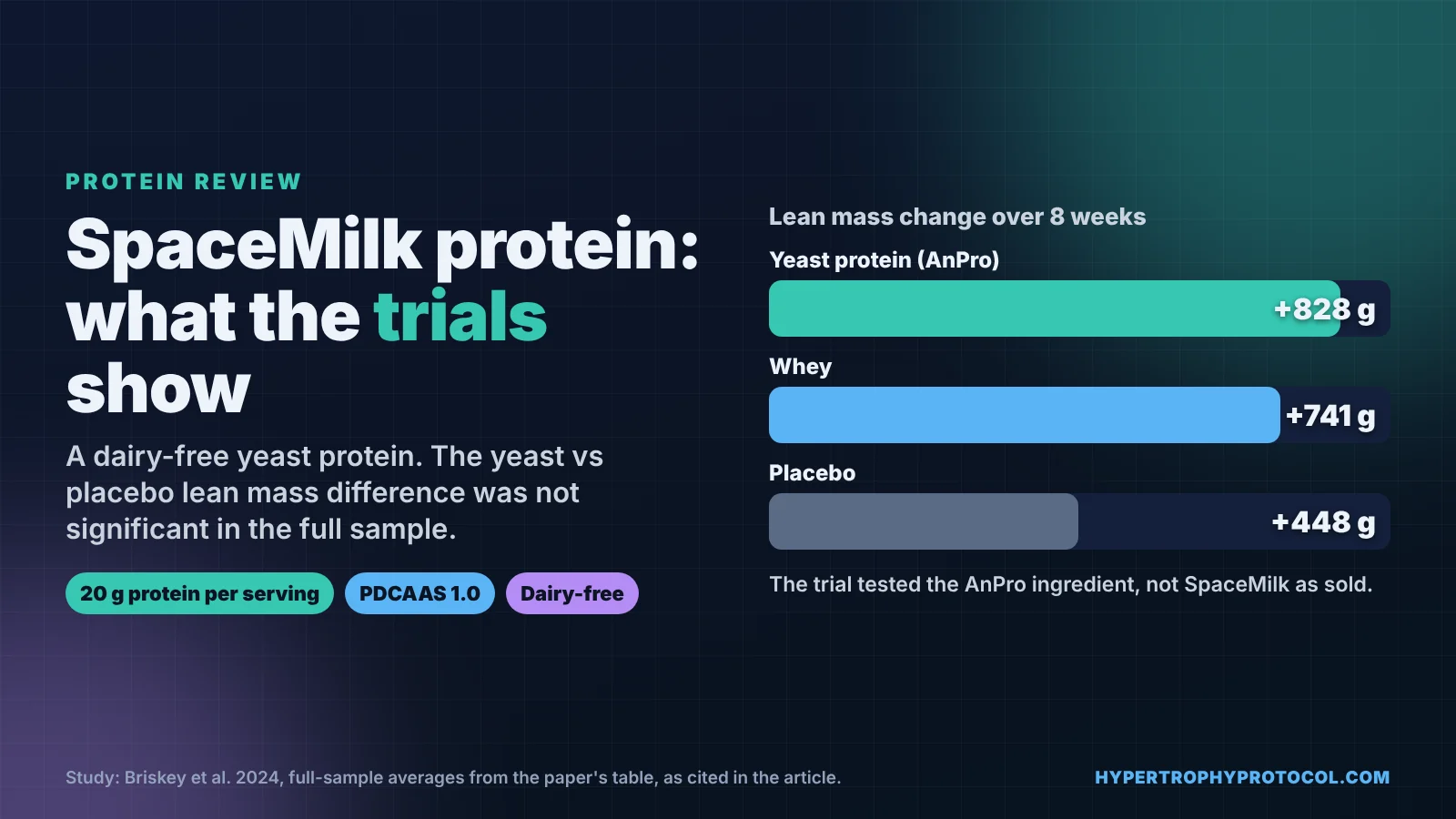
SpaceMilk’s marketing cites a numerical “85% more lean muscle” difference against placebo. The paper’s own table shows full-sample averages of +828 g for yeast, +741 g for whey and +448 g for placebo; 828 divided by 448 is where the 85% comes from. But computing the relative difference between averages does not erase the between-group statistical result. Nor does DEXA distinguish perfectly between new muscle fibers and changes in other components of lean tissue.
The study tested the ingredient AnPro and disclosed funding from Angel Yeast Company. It did not independently evaluate the exact finished retail flavors, taste or gastrointestinal response of SpaceMilk as sold today. These details make the trial worth reading, not dismissing, and also keep the conclusion proportionate.
Two more points matter for SpaceMilk specifically. Its own product page says the trial tested AnPro, not SpaceMilk, and its FAQ doesn’t name its yeast-protein supplier, so we can’t confirm the retail isolate is the same ingredient. The FAQ also says the trial found yeast protein “matched” whey; the paper didn’t formally test that.
What does the 2026 six-month trial add?
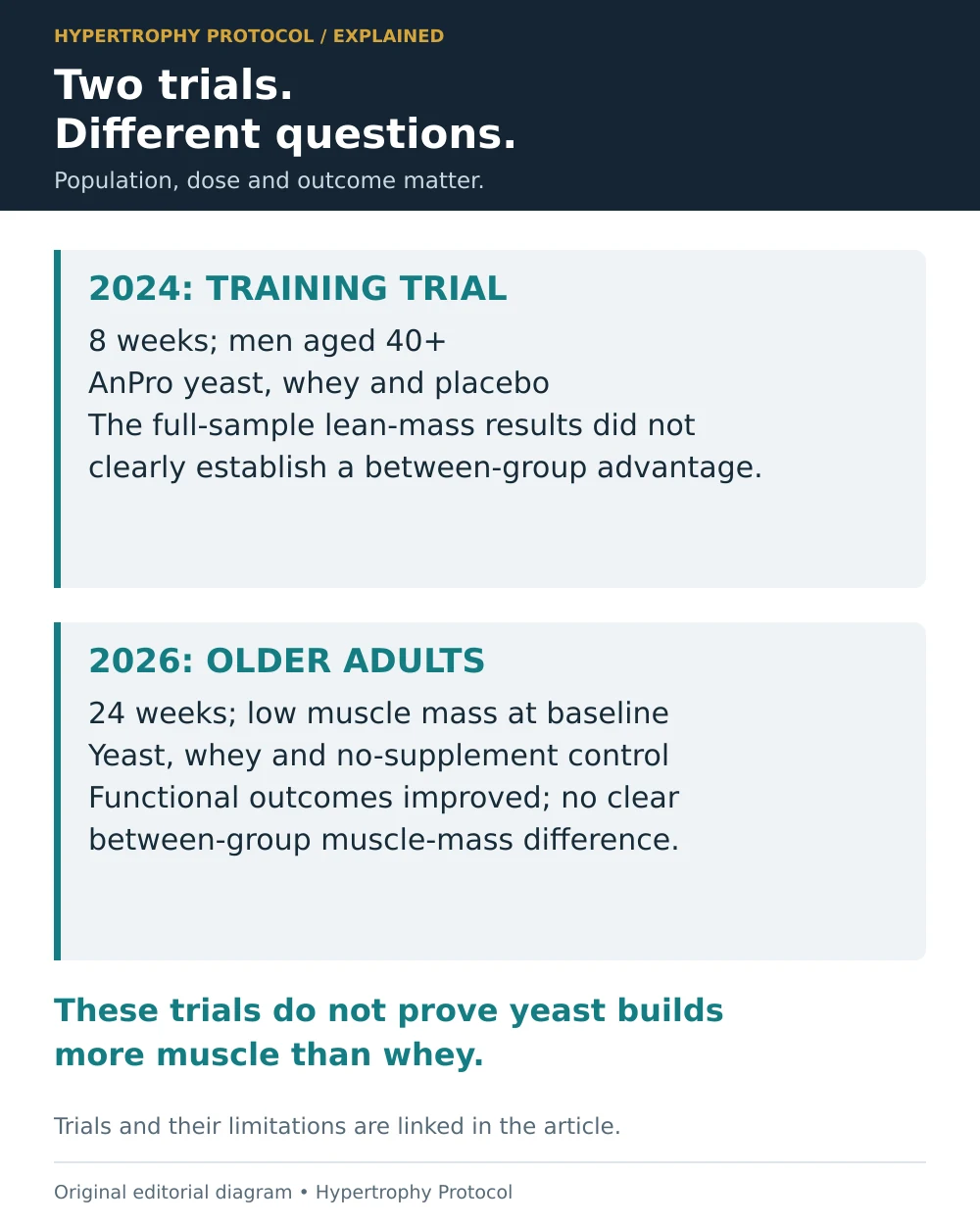
A 2026 randomized study followed 92 older Chinese adults for 24 weeks, assigning them to yeast protein, whey protein or an unsupplemented control. Average age was approximately 73. Participants in the supplemented groups showed better changes in walking speed and a physical-performance composite than those not receiving protein powder. The daily dose was 20 grams of powder, about 16 grams of actual protein, and the yeast group’s performance score rose 0.9 points while the unsupplemented group’s fell 1.7. The study was funded by the Angel Nutritional Fund, and Angel Yeast’s yeast-function laboratory analyzed the powders.
However, changes in measured appendicular muscle mass and grip strength did not differ significantly between groups. The controls were not supplied with a blinded placebo, and the intervention was not a heavy resistance-training program in established lifters. The findings strengthen the case for yeast as a potentially useful source of protein for older adults, but they do not prove an exclusive SpaceMilk muscle-growth advantage.
If your objective is hypertrophy, the broader protein-plus-resistance-training meta-analysis supports meeting your daily protein needs and training consistently. A fashionable new source cannot substitute for those basics.
Can it really prevent bloating and support gut health?
SpaceMilk presents itself as gut friendly and promotes a low-FODMAP-style formula. Being free of dairy and lactose may make it more suitable for someone who poorly tolerates lactose-containing shakes. But digestive symptoms depend on the entire product, serving, other ingredients and the person consuming it. “No bloating” is stronger than the evidence allows.
A 2026 laboratory gut-microbiome study tested yeast, whey and soy protein using samples from six male donors aged 50 to 65. In that ex-vivo model, yeast protein produced less gas relative to microbial fermentation outputs than whey or soy. It also affected laboratory markers associated with barrier function and immune signaling. The yeast protein came from Angel Yeast, three of the eight authors work there, and the paper notes that this yeast protein’s true digestibility was about 85%, against about 96% for whey isolate, which is part of why more of it reaches the gut bacteria at all.
The experiment did not ask actual consumers to drink finished SpaceMilk and report digestive outcomes. Another 2025 simulated digestion study is cited by SpaceMilk as showing digestibility comparable to whey in its model; we couldn’t access the full paper to check its numbers. Neither is proof of superior digestion, symptom relief or altered health outcomes in consumers.
A useful owner review could eventually contribute what laboratory data cannot: real taste, mixability, texture and digestion notes over time. Those observations must be reported as individual experience, not universal results, and they are not yet available for this review.
SpaceMilk heavy metals and lab tests: what the reports show
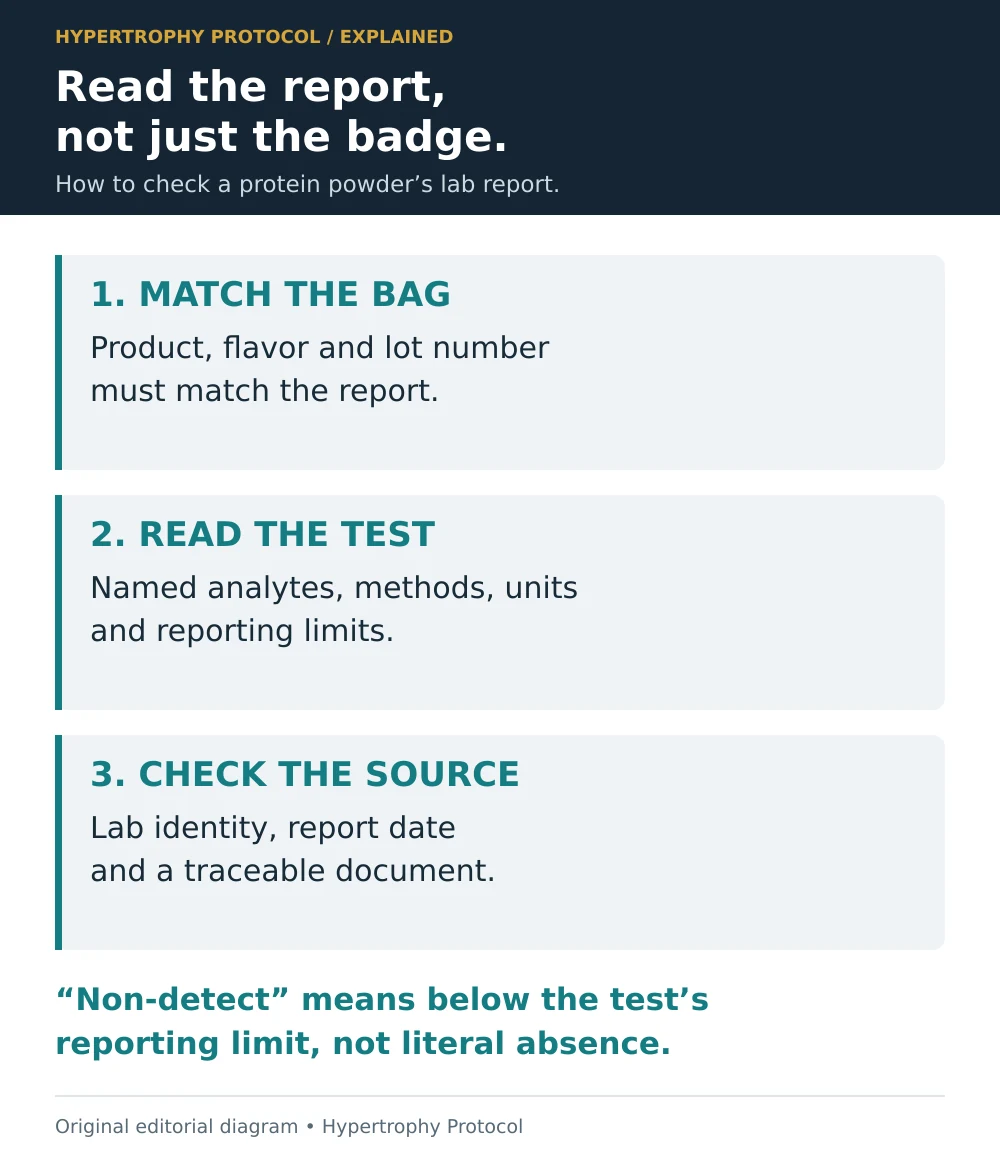
The brand provides a public lot-specific testing library, which is considerably more useful than saying “third-party tested” with no reports available. It shows product, panel, lot, date, method and linked certificates for heavy metals, microbes, pesticides and a selected group of allergens.
For example, the independent report for Chocolate lot 261974 (Advanced Laboratories report 161504-04, issued from Clayton, North Carolina, with the metals run at its Salt Lake City lab, completed September 8, 2026) measured heavy metals by ICP-MS and found 20.3 grams of protein per 29 grams of powder. One ppm equals one microgram per gram, so multiply by the powder weight of a serving, not its protein grams:
| Substance | Reported concentration | Per 29 g of powder (our math) |
|---|---|---|
| Total arsenic | 0.042 ppm | About 1.2 micrograms |
| Cadmium | 0.028 ppm | About 0.81 micrograms |
| Lead | 0.017 ppm | About 0.49 micrograms |
| Mercury | Below 0.001 ppm | Below about 0.03 micrograms |
A “below” result means under the method’s reporting limit, not proven absent. The report’s specification column for the metals reads “Report” rather than a pass/fail limit. Find the lot number on your own bag and match the product, flavor and panel: a Chocolate report does not cover Vanilla, and one lot does not set every future lot.
For context, California’s Proposition 65 uses 0.5 micrograms a day as the lead exposure that requires a reproductive-harm warning. SpaceMilk’s FAQ says every bag carries a Prop 65 lead warning, because although many batches test under California’s limit, some exceed it. One serving of this lot sits just under that line; two servings a day would be over it. Prop 65 is a conservative warning threshold, not the point where harm begins, and total arsenic isn’t the same as the inorganic form that matters most, so this is context, not a safety verdict.
This also explains why “zero heavy metals” wording on some marketing pages should not be copied literally: a measured value above zero is not zero, even if it meets a chosen safety or reporting threshold. Selected newer entries identify Advanced Laboratories; others are labeled manufacturer certificates. Match the lot on your own bag and inspect the actual certificate before treating any one sample as representative of every flavor and production run.
California Proposition 65 is a warning regime with specific legal exposure limits, not a generic yes/no measure of nutritional quality. We would not label a particular lot safe or unsafe based only on one report or a brand-comparison chart. Lots also vary: on the testing page on October 13, lead in the displayed protein lots ranged from 0.014 to 0.020 ppm across flavors. At the top of that range (Chocolate lot 261184, a manufacturer certificate), the same 29 grams of powder would hold about 0.58 micrograms of lead, over the 0.5 microgram line in a single serving. Check the report for your bag’s lot and its serving weight.
SpaceMilk’s FAQ also says its pesticide screen covers 77 compounds. That’s the kind of scope statement to look for: a panel supports claims about the compounds it lists, not every possible residue.
What does SpaceMilk cost per useful serving?
The website currently advertises a 15-serving bag for $29.99 in a standard one-time purchase selection, or roughly $2.00 per 20-gram serving. On October 17, 2026, the SpaceMilk page our affiliate link opens was advertising 20% off, showing $23.99 for the same bag (about $1.60 per serving). We haven’t confirmed that price at checkout or who qualifies, so treat it as an offer to check, not a guaranteed price. The 30-serving bags (Chocolate, Vanilla and Unflavored) are listed at $54.99, about $1.83 per 20-gram serving, and clear the $49 free-shipping minimum; a one-time 15-serving order adds $8.95 shipping. These are dated website examples, not universal prices for every flavor, bundle, subscription or shipping destination.
For a price comparison, divide the actual post-discount checkout price by the verified number of 20-gram protein servings. Then compare with whey, soy and plant blends that you actually tolerate. Also account for total ingredient preferences and whether you need added fiber or sweeteners.
Subscription and welcome promotions change frequently, so check the live terms before you buy. If you decide to try it, our SpaceMilk link (affiliate) and code HYPERTROPHYPROTOCOL credit Hypertrophy Protocol with a commission at no extra cost to you. We haven’t confirmed at checkout that our link or code gets you a discount, so we don’t promise one.
Who should buy it, and who can skip it?
Consider SpaceMilk if you need a non-dairy protein that supplies the essential amino acids, prefer its ingredient approach, and find the cost acceptable after comparing alternatives. Its open batch-report library also makes it possible to ask specific contamination and allergen-testing questions before ordering.
Keep whey if you tolerate it, already meet protein needs, and can get an equally useful serving at a meaningfully lower price. The current studies do not establish that switching to SpaceMilk will accelerate muscle growth.
Hold off if you require a verified absence of a particular major allergen not covered in the visible laboratory panel, have not resolved the actual product’s ingredient suitability, or are buying primarily because of guaranteed gut, metabolic or muscle-growth claims.
Our conclusion is that the yeast protein category deserves serious consideration, while the specific finished-product review should remain evidence-focused until there are actual ownership notes, current batch reports and confirmed promotional terms.
Primary research and manufacturer sources
- SpaceMilk current product and serving options.
- SpaceMilk current FAQs, ingredient and nutrition claims.
- SpaceMilk public lot-specific testing library.
- Briskey et al., 2024 randomized yeast-versus-whey trial.
- Bai et al., 2026 older-adult supplementation study.
- Van den Abbeele et al., 2026 ex-vivo gut study.
- FDA allergen list and labeling guidance.