
Short answer: neither is better across the board. Plate-loaded machines win on load ceiling, cost, and fine increments with small plates; weight stack machines win on speed of changing weight and a smoother, more controlled feel. For muscle growth, both work well. What matters more than the loading type is the specific machine’s pulley ratio and resistance curve, and whether it lets you train hard through a full range of motion.
This guide covers how each system creates resistance, the variables that change what you actually feel, and how to choose for a home or commercial gym.
How Plate-Loaded Machines Create Resistance
Plate-loaded machines use standard weight plates on a horn or carriage. Gravity on the plates provides the load, and the machine’s linkage (a lever arm, a sled, or a cable) delivers it to you. On a plate-loaded cable tower, the plates sit on a carriage that rides up and down, much like a stack. On lever machines such as plate-loaded chest presses and leg presses, the plates sit on an arm that pivots.
On lever machines, the weight on the horn isn’t the whole story. As the arm moves through its arc, the horizontal distance between the plates and the pivot changes, so the resistance you feel rises and falls through the rep. Depending on the design, a lever machine may feel hardest near the start, the middle, or lockout. That’s a design choice, not a flaw, but it means two machines loaded with the same plates can feel very different.
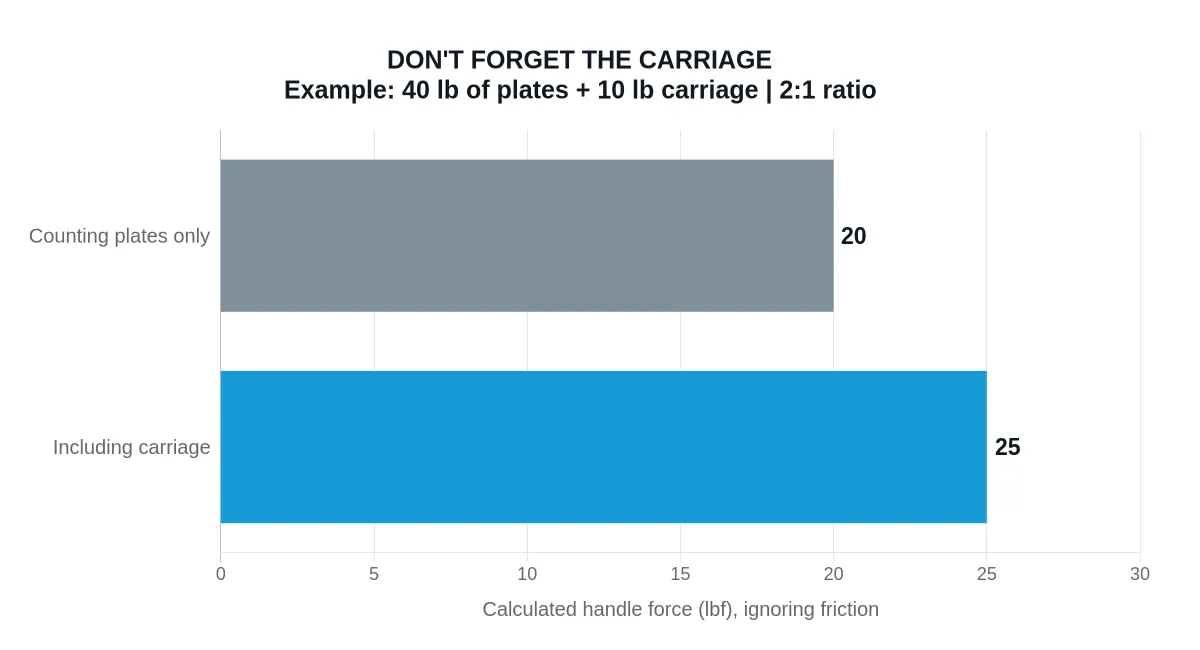
On plate-loaded cable towers, the empty carriage has weight of its own, and it counts toward the load. Know what yours weighs, and include it in your log.
Load Ceiling
Plate-loaded machines can usually take far more weight than a stack. A plate-loaded leg press can hold several hundred kilograms, while most weight stacks top out well below that. For strong lifters on lower-body machines, that higher ceiling matters.
How Weight Stack Machines Create Resistance
A weight stack is a column of plates on guide rods, with a pin to select the load in fixed steps, typically 5–10 lb or 2.5–5 kg. A cable runs from the selected plates through one or more pulleys to the handle, bar, or pad.
Friction
Friction in the guide rods and pulleys works against you as the stack rises and with you as it lowers. A stack usually feels a little heavier on the lift and lighter on the lowering phase than the number on the pin, and the gap depends on how clean and well-maintained the machine is.
Smoothness and Control
Guide rods keep the stack moving in a straight line, and changing weight takes a second. That makes stacks well suited to drop sets, supersets, beginners, and anyone who wants to focus on the muscle rather than balancing the load.
Pulley Ratio
Not every stack machine delivers the selected weight at the handle. On a 1:1 machine, 80 kg on the pin feels like roughly 80 kg. On a 2:1 machine, it feels like roughly 40 kg. That’s why comparing “the weight I use” across machines means little unless the ratio is known. The 1:1 vs 2:1 pulley guide explains the difference.
Resistance Curves
A resistance curve describes how hard a machine is at each point in the range of motion. It’s one of the biggest differences between individual machines, and it isn’t decided by the loading type alone.
- Lever machines (usually plate-loaded) change resistance through the arc because of their geometry.
- Cam machines (usually stack-loaded) use an oval or variable-radius pulley to raise or lower resistance at different points, often to match how strength changes through the movement.
- Simple round-pulley cables deliver fairly constant tension along the cable, with the effect on the muscle depending on the cable angle relative to your body.
Design quality varies a lot. A well-designed lever machine can outperform a poorly designed cam, and two chest presses of the same type can feel very different. Judge the individual machine rather than the category.
What It Means for Training
Muscle Growth
Both systems build muscle well when sets are taken close to failure through a full range of motion and progressed over time. One factor worth considering is where in the range a machine is hardest. Growing evidence suggests that challenging a muscle at longer lengths may help growth. In one 12-week study, cable triceps extensions done with the arm overhead, where the long head of the triceps is stretched, grew the triceps more than the same exercise with the arm at the side (whole triceps +19.9% vs +13.9%, effect size 0.54) (Maeo et al., 2022, doi:10.1080/17461391.2022.2100279). Machines and setups that load the stretched position well are worth favoring, whichever loading type they use.
Strength
For heavy lower-body work, plate-loaded machines’ higher ceiling is a real advantage. For strength on the barbell lifts themselves, the lifts are the most specific training, and machines are a supplement.
Beginners and Rehab
Weight stacks are often the easier starting point: fast, safe load changes, no plates to handle, and a guided path that lets a new lifter focus on the movement.
Side-by-Side Comparison
| Factor | Plate-loaded | Weight stack |
|---|---|---|
| Load ceiling | High; limited by horn length and rating | Limited by stack size and ratio |
| Smallest increment | As small as your smallest plate | Stack step, unless add-on weights are used |
| Changing weight | Slower; plates to load | Fast; move the pin |
| Footprint | Machine plus plate storage | Self-contained |
| Cost | Usually lower if you already own plates | Usually higher; the stack is built in |
Build Quality
- Frame. For heavy use, stiff tubing such as 3×3 11-gauge steel keeps the machine solid. The 11-gauge vs 14-gauge guide shows how much the thicker wall adds.
- Welds and pivots. On plate-loaded lever machines, the pivot and horn joints carry the most stress. Look for clean, consistent welds and smooth bearings at the pivots.
- Cables and pulleys. Most gym cables use 7×19 wire construction for flexibility. Check the rated strength, look for sealed-bearing pulleys, and replace any cable that’s frayed or kinked.
- Load rating. Check the maker’s rated capacity for the machine and, on plate-loaded units, for each horn.
Which Should You Choose?
Plate-loaded makes more sense when:
- You need more load than a stack can provide, especially for legs
- You already own plates and want to keep costs down
- You want very small increments using fractional plates
A weight stack makes more sense when:
- You want fast weight changes for drop sets, supersets, or circuits
- The machine will be used by beginners or people returning from injury
- You want the most compact, self-contained setup
Either way, judge each machine on its own: pulley ratio, resistance curve, build quality, and whether it lets you train through a full range of motion. The loading type matters less than those details.
Sources checked September 30, 2026. Research summaries describe the cited study; individual results vary.
Compare cable resistance