
Updated October 9, 2026. Equipment specs are from manufacturer pages, checked October 2026. This is general training information, not medical advice.
Your adjustable dumbbells top out at 80 lb, your goblet squat is getting easy, and there is no heavier weight in the garage. You can keep building muscle anyway, because across a wide range of loads, growth tracks how hard the set is more than how heavy the dumbbell is. Progressive overload in a small home gym means pulling the other levers in a set order.
Add reps first. Then slow the rep and keep the deep range, then move to one leg, and only then add outside resistance. Below is that ladder worked through with real numbers on an 80 lb ceiling, with the research behind each step and the signal that tells you to move on.
Does a lighter load still build muscle if the set is hard enough?
That claim carries the whole plan, so check it first. A 2017 meta-analysis pooled 21 studies of at least 6 weeks in which every set went to momentary failure (Schoenfeld et al., 2017). Loads at or below 60% of a one-rep max grew muscle about as well as heavier loads, while the heavy groups gained more max strength.
Effort is the condition. In one 8-week trial, untrained men did knee extensions at 30% or 80% of their max, either to failure or stopping short with volume matched (Lasevicius et al., 2022). The light load grew the quads 7.8% when taken to failure but only 2.8% (not significant) when stopped short. Both heavy conditions grew about 8%.
Adding reps instead of weight holds up in trained lifters too. In an 8-week trial of 43 people with at least a year of leg training, one group added load and the other added reps at a fixed load (Plotkin et al., 2022). Growth was similar, with small edges each way that were not clearly beyond chance.
A 2024 meta-regression adds that growth tended to rise as sets ended closer to failure, though its authors call the analysis exploratory (Robinson et al., 2024). For why effort matters at the muscle-fiber level, see mechanical tension and muscle growth.
| Study | Who and how long | What was compared | Growth result |
|---|---|---|---|
| Schoenfeld 2017 (meta-analysis) | 21 studies, 6+ weeks, all sets to failure | 60% of max or less vs heavier | Similar growth; heavier won for max strength |
| Lasevicius 2022 | 25 untrained men, 8 weeks, knee extension | 30% vs 80% of max, to failure or not | 30% to failure +7.8%; 30% short of failure +2.8%; 80% about +8% either way |
| Plotkin 2022 | 43 trained adults, 8 weeks, legs | Add load vs add reps | Similar; small, uncertain edges each way |
| Robinson 2024 (meta-regression) | Pooled trials, reps in reserve estimated | How close to failure sets ended | More growth closer to failure; exploratory |
What does the 80 lb ceiling look like on a real lift?
With that settled, here is the example. I own a pair of NUOBELL 80 lb adjustable dumbbells, which run from 5 to 80 lb in 5 lb steps; the maker notes the handle number can differ from the true weight by up to 5%. The goblet squat is usually the first lift to outgrow a single 80, so it carries the example.
Say you can goblet squat 80 lb for 3 sets of 8 with a rep or two left in the tank. The table is the whole plan. Each row is a lever, and you move down a row only when you meet its exit condition.
| Step | What changes | Example sets | Move on when |
|---|---|---|---|
| 1. Reps | Same 80 lb goblet squat, add reps each session | 3 x 8, building to 3 x 20 | All three sets reach 20 with 0 to 2 reps left |
| 2. Tempo and pause | 3 s down, 2 s pause at the bottom, 1 s up | 3 x 10, building to 3 x 15 | All sets reach 15 at that tempo |
| 3. Deep range | Heels raised; bottom-half reps after full reps | 3 x 12 to 15 full reps, then partials to failure | Partials no longer bring you near failure |
| 4. One leg | Rear-foot-elevated split squat, an 80 in each hand | 3 x 8, building to 3 x 15 per leg | 15 per leg with reps to spare |
| 5. Outside resistance | Band and harness, cable, or a digital unit | Back to 3 x 8 with the added load | Repeat steps 1 to 3 at the new load |
Adapt the set and rep numbers to yourself, because nobody has tested this exact sequence. The order is what matters: each step keeps the same dumbbell useful for as long as possible.
How many reps should you add before changing anything else?
Step one is the cheapest, so stay on it as long as it works. Going from 3 x 8 to 3 x 20 at 80 lb takes your volume load from 1,920 lb to 4,800 lb, 2.5 times the volume with no new equipment. Add a rep or two to any set you finish with more than two reps left.
Treat the 20-rep exit as a rule of thumb, since no study set it. The light-load group in the Lasevicius trial grew while averaging about 34 reps per set, so long sets can work. They just take a long time, and the next levers get you to failure faster.
Hold rest constant while you climb, or the rep numbers stop meaning anything. Shorter rest is a weak growth lever anyway. A 2024 meta-analysis of 9 studies found a small benefit to resting longer than 60 seconds and no clear difference beyond 90 seconds (Singer et al., 2024).
An earlier 8-week trial in 21 trained men found 3-minute rests beat 1-minute rests for thigh growth (Schoenfeld et al., 2016). Pick 2 to 3 minutes and keep it fixed.
Can tempo and range of motion keep the same 80 lb hard?
Once reps top out, make each rep harder without adding weight. At roughly 2 seconds per rep, a 12-rep set lasts about 24 seconds, while a 3-2-1 tempo stretches the same 12 reps to 72 seconds. That 6-second rep is still inside the 0.5 to 8 second range where a meta-analysis of 8 studies found similar growth (Schoenfeld et al., 2015).
So tempo earns its place by getting a light weight to failure sooner, with no growth bonus of its own. The same review flagged very slow reps, past about 10 seconds, as likely worse.
Where in the range you spend the rep may matter more than its speed. In 42 young women doing calf raises for 8 weeks, partial reps in the stretched position grew the medial calf 15.2%, against 6.7% for full range (Kassiano et al., 2023). Knee extensions in the lengthened range beat other partial and full-range setups for some quad regions in untrained women (Pedrosa et al., 2021).
Other data point to a tie. Thirty trained lifters grew their arms equally with lengthened partials or full reps over 8 weeks (Wolf et al., 2025), so reaching the stretched position seems to matter more than covering the full range.
The practical rule: never cut the bottom of the squat to get more reps. Bottom-half reps after your full reps fail are a reasonable extension of these findings, but that exact method hasn’t been tested head to head.
How much load does going to one leg add?
When tempo and depth no longer get you near failure within 15 reps, put the work on one leg. If you weigh 180 lb and goblet squat 80 lb, two legs share 260 lb, roughly 130 lb each.
Switch to a rear-foot-elevated split squat with an 80 in each hand and the system weighs 340 lb, with the front leg carrying most of it. The back leg still helps, so treat this as an approximation. Even so, the front leg’s share lands well above the 130 lb it had before, and you bought nothing.
Expect your reps to drop sharply, which is the point. Climb steps 1 to 3 again on the split squat, and put a plate under the front foot for extra depth once the regular version gets easy.
Holding two 80s can turn the set into a grip test. A squat harness takes the load off your hands, and the Squat Harness V4 review covers hands-free split squats with cables and bands. Harder single-leg sessions also need planning around recovery after heavy leg days.
What do you do when even the split squat runs out?
At that point you need resistance from outside the dumbbell rack, and the options load the rep differently. A band adds the most tension at the top, where the muscle is short, and little at the bottom. Given the long-length evidence above, bands work best on top of a weight rather than as the main load.
For split squats, you can loop a long band under the front foot and clip it to a squat harness to add resistance in seconds. A digital cable solves the increment problem outright. My Beyond Power Voltra 1 runs from 5 to 200 lb in 1 lb steps and has an eccentric overload mode.
I belt squat with the Voltra by standing on plyo boxes, and its top end sits well above a single 80 lb dumbbell. A 1 lb step on an 80 lb load is a 1.25% increase, small enough to add every session. If your extra load comes from a cable stack instead, the pulley ratio decides how much reaches the handle. For fitting any of this around a rack, see setting up a home gym in a 10×10 space.
What about the 5 lb jumps on small lifts?
The lower body hits the ceiling, but the upper body has the opposite problem: steps that are too big. Going from 75 to 80 lb on a dumbbell press is a 6.7% jump. Going from 15 to 20 lb on a lateral raise is 33%, and from 25 to 30 lb is 20%, which is why small lifts stall on fixed-step dumbbells.
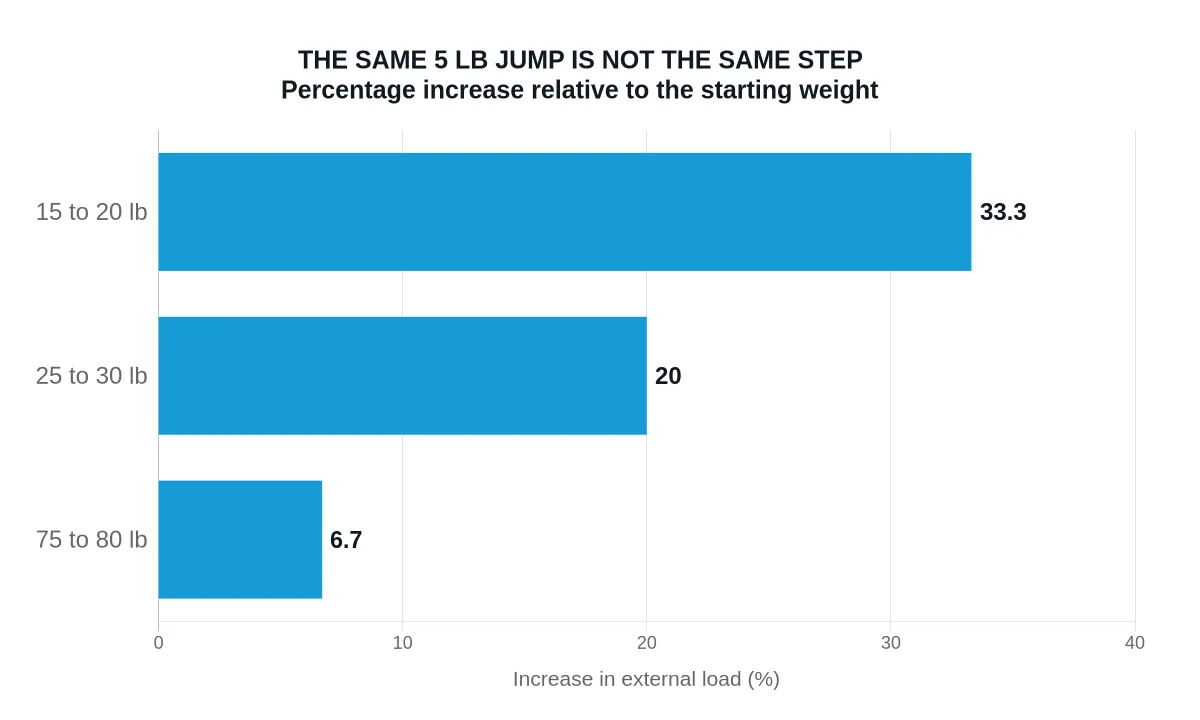
Use the same rep ladder with a wider range. Stay at 15 lb until every set reaches the top of a range such as 12 to 25, then move to 20 lb and start back near 12. A cable with 1 lb steps makes 15 to 16 lb the same 6.7% jump as 75 to 80. The increment trade-offs between machine types are in plate-loaded vs weight stack cable machines.
Which lever should you pull first?
Put together, the ladder gives each reader a clear first move. If you’re still adding reps at 80 lb every week or two, keep doing exactly that and change nothing else. If reps have stalled short of 20, slow the rep to 3-2-1 and make every rep reach full depth.
If tempo and depth no longer bring you close to failure, move the lift to one leg and start the ladder again. If a split squat with two 80s still gives you 15 clean reps per leg, add outside resistance. If your problem is 5 lb steps on small lifts, use a wide rep range and jump only when you own the top of it.
If you’re about to add cable load, run your setup through the Cable Pulley Ratio Calculator to see how much resistance reaches the handle before you plan the next block.