
We participate in the Bulletproof Fitness Equipment affiliate program and may earn a commission from qualifying purchases made through links on this page.
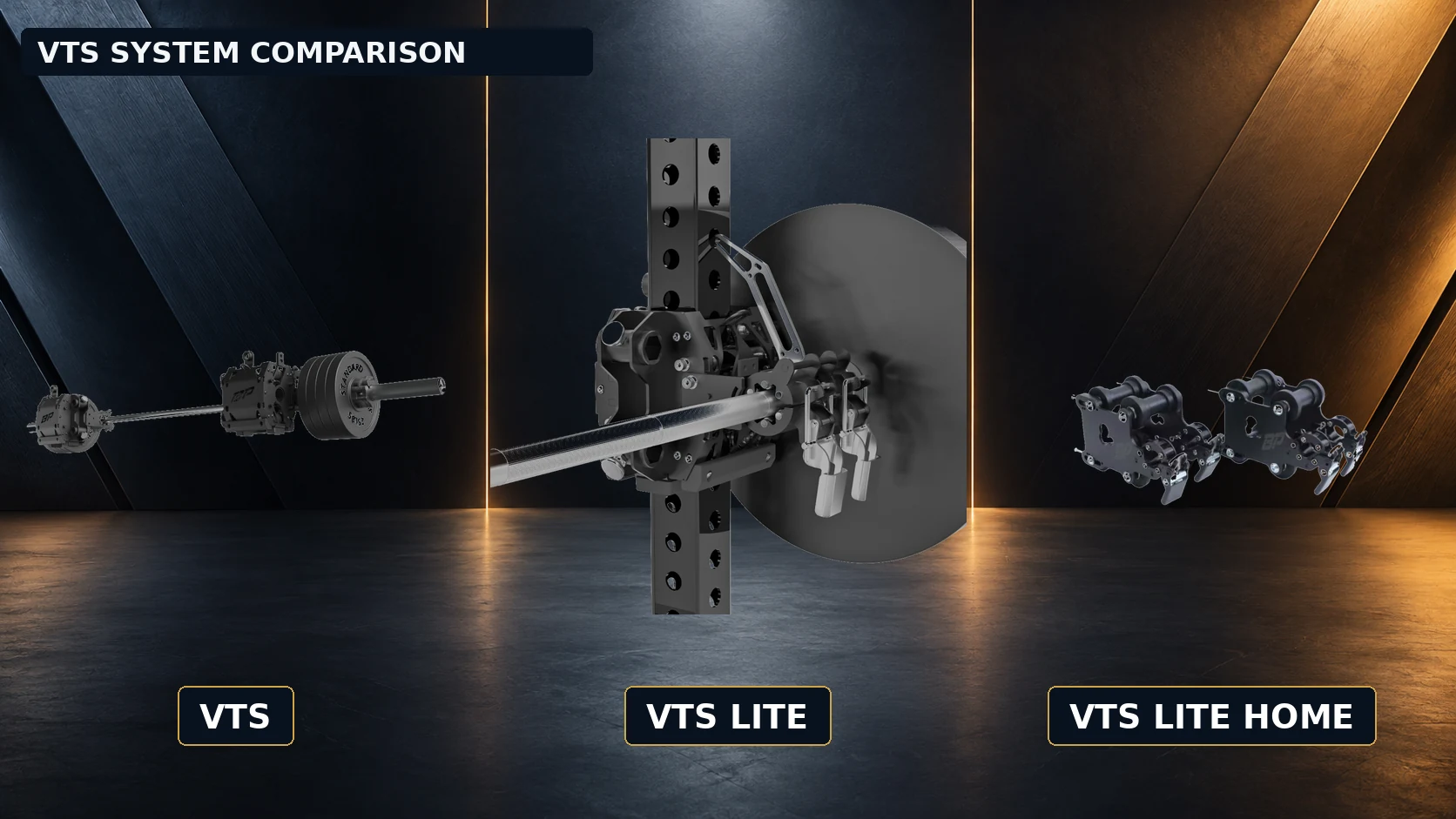
Bulletproof currently sells three different VTS paths, and the important question is not “which one is best?” It is: what do you want the trolley to become later?
All three products solve the same basic problem: guided vertical movement on rack uprights. The differences are in roller architecture, starting weight, attachment support, unilateral capability and future expansion.
I run two full VTS setups in my own gym. The specs and compatibility statements below come from Bulletproof’s current product pages.
The 30-second decision
Choose by what you want the trolley to do later, not just by the Smith-style lift you want today.
Full VTS
For the broadest expansion. Pick this if you want direct barbell-latch ISO Handles or a more modular trolley. It also supports the High/Low cable path.
Trade-off: the heaviest trolley, about 24 lb each, and more involved over-the-top installation.
VTS Lite
For Smith work plus future cables. It has hex ports for the High/Low system and a lighter, roughly 15 lb trolley.
Trade-off: direct barbell-latch ISO Handles are excluded; it is a simpler carriage than full VTS.
VTS Lite HOME
For basic guided bar work. It has universal rollers and a trolley of about 10 lb.
Trade-off: no hex ports or exterior threads for the High/Low system or modular attachments. Do not buy it expecting that upgrade.
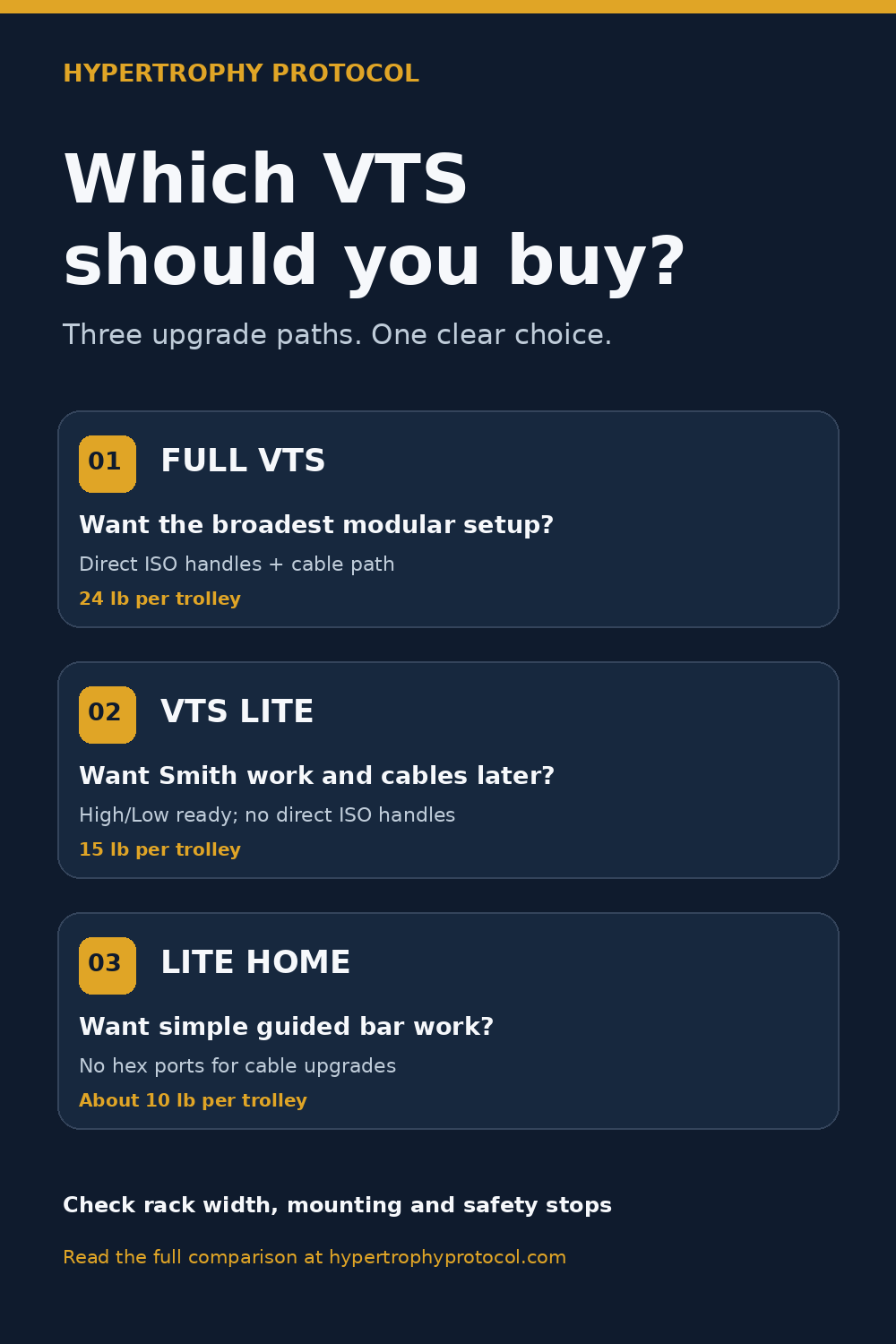
Shortcut: want direct ISO Handles or the most modular setup? Full VTS. Want cables later but no direct ISO Handles? Lite. Want only a simpler guided bar setup? HOME.
Before ordering: confirm your upright size, hook and bar choice, inside width, anchoring and safety stops for the exact configuration. Full VTS and Lite use a tested maximum 43-inch inside width with a standard 7-foot Olympic bar; do not assume HOME shares every fit condition. See the rack compatibility checker and the manufacturer’s current listing.
Browse the current VTS family on Bulletproof’s site.
Full VTS: Buy It If You Want the Trolley to Become a Platform
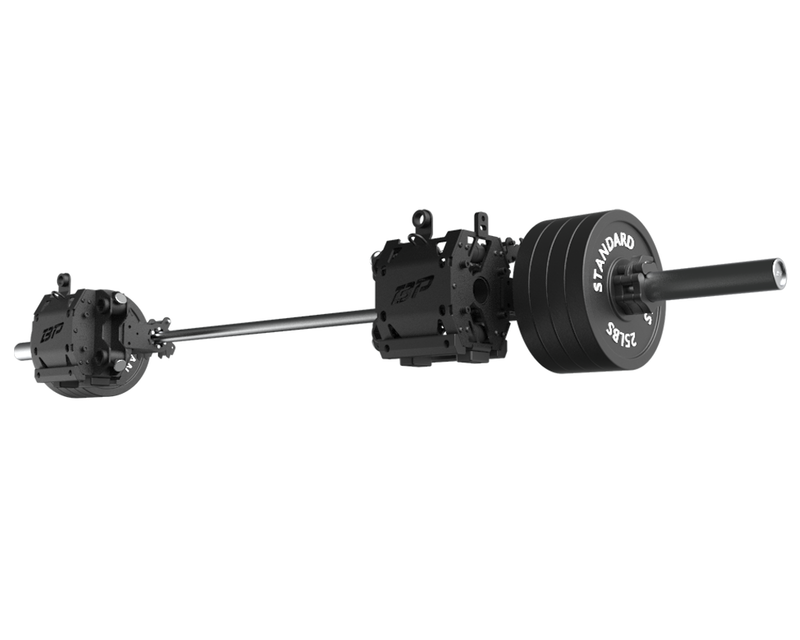
Bulletproof’s full VTS uses an all-sided roller layout around the upright. The manufacturer currently describes eight UHMW rollers distributed on all four sides and positions that design for iso-lateral movements, unilateral training and load situations where forces are not perfectly symmetrical.
That is the key reason to choose it. A Smith machine only needs to guide a bar vertically. A broader modular trolley needs to tolerate more than one clean bilateral force path.
The full VTS also carries Bulletproof’s broader attachment ecosystem, including hex-port accessories, direct barbell-latch ISO handles, weight horns and other advanced configurations. Bulletproof currently lists the full VTS at 24 pounds per trolley. That extra mass is a downside if your priority is very light Smith work, but it is part of the more substantial all-sided carriage design.
The full VTS also has to be installed over the top of the rack uprights. That means installation is more involved than VTS Lite if your rack has crossmembers or other hardware that must be removed first.
What the Full VTS Makes Possible
At the simplest level: Smith squats, bench pressing, incline pressing, overhead pressing, Romanian deadlifts, calf raises, shrugs, and guided rows.
Where full VTS separates itself is attachment-driven work. Bulletproof currently documents the full VTS as the compatible platform for its direct barbell-latch ISO Handles — those handles are specifically excluded from VTS Lite and HOME. The full VTS also supports Hexport-based handle options and broader unilateral configurations.
If your plan is “buy one trolley pair and keep finding new jobs for it,” full VTS makes the most sense.
See the current VTS Rack Attachment/Pair product page.
VTS Lite: Buy It If Smith Training Is the Core, But Cable Expansion Matters
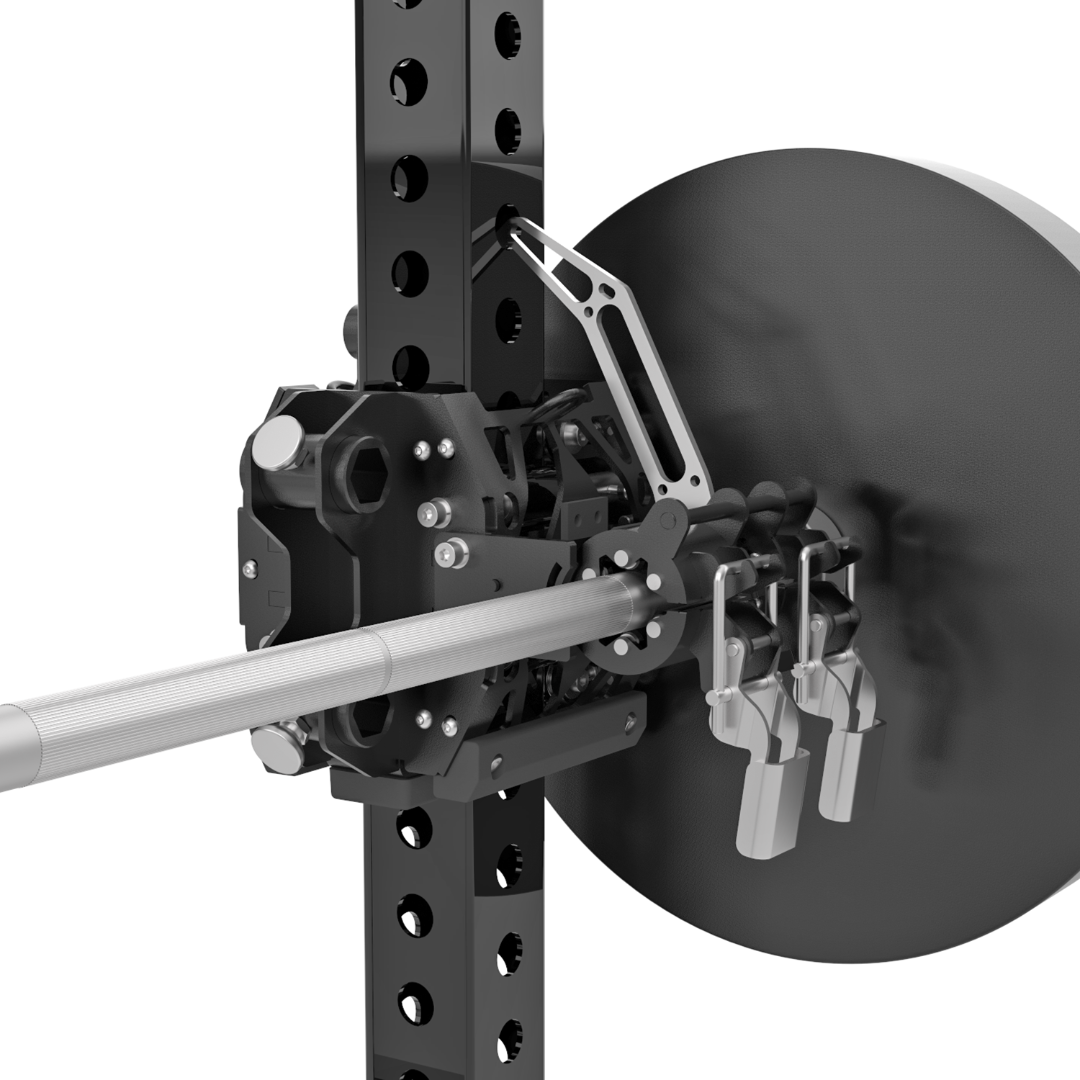
VTS Lite is the most balanced option in the lineup. Bulletproof currently lists it at 15 pounds per trolley and uses four hourglass-shaped UHMW rollers, front and back. That makes the starting trolley mass lower than full VTS. It is also designed around standard Smith-style movement rather than heavy unilateral or opposing-load configurations.
The major reason VTS Lite deserves attention is that it keeps the High/Low Pulley expansion path. Bulletproof explicitly says VTS Lite includes hex ports for High/Low integration and can turn the rack into a functional trainer when paired with that system. That gives it a very different future from VTS Lite HOME.
If you want Smith squats now, Smith pressing now, guided hinges now, and a left/right cable system later, VTS Lite is probably the most logical architecture. You are not paying for the full all-sided trolley if you do not need it, but you are also not cutting off the main cable upgrade path.
Installation Is Simpler
Bulletproof currently says VTS Lite can be installed by sliding it over the top or by building the unit around the uprights. That can matter in a finished rack where removing upper crossmembers is inconvenient. The manufacturer still requires a firmly mounted rack and safety stops, and explicitly warns that VTS Lite is not designed to be dropped.
See the current VTS Lite Rack Attachment/Pair product page.
VTS Lite HOME: Buy It If the Goal Is Guided Bar Work at the Lowest Entry Point
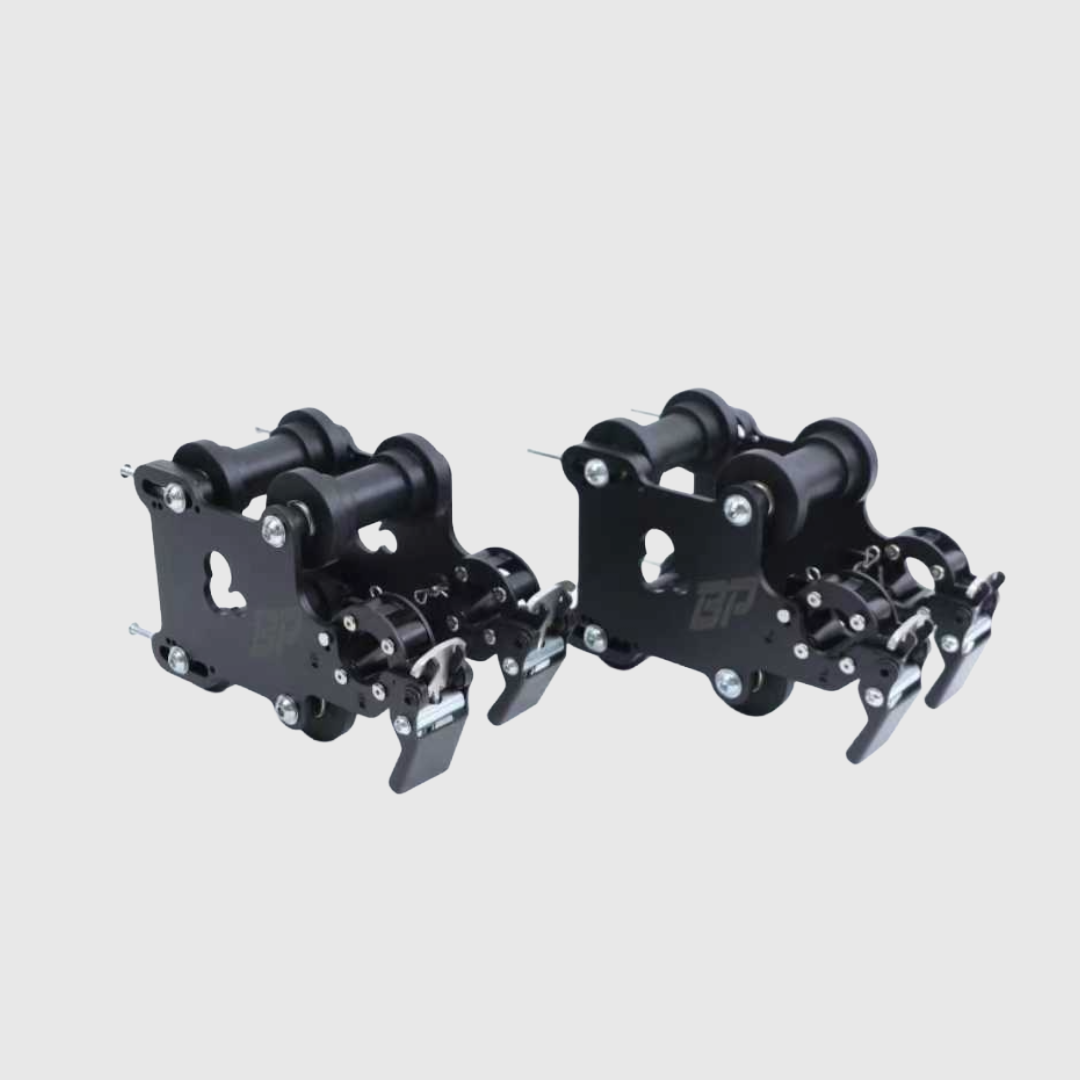
VTS Lite HOME is the stripped-down version. Bulletproof currently lists each trolley at approximately 10 pounds. The HOME design uses universal rollers that fit 3×3, 2×3 and 2×2 uprights without the same roller-swapping requirement. That simplicity is the main appeal.
If your actual wish list is guided squats, guided bench press, guided overhead press, hinges, and calf work, HOME may be enough.
The important part is understanding what you give up. Bulletproof currently says HOME does not include hex ports for the Hi-Lo cable system, exterior threading for future modular attachments, or the cross support rod used for the Smith rotation lock. The manufacturer also says HOME is not designed for the same iso-lateral, unilateral or opposing-load use as the full VTS.
This is why HOME can be either a very smart buy or a false economy. If you really only want a rack-mounted Smith function, it may be exactly right. If you already know you want a dual functional trainer later, buying HOME first and replacing it later is not a savings.
See the current VTS Lite HOME (PAIR) product page.
The 43-Inch Rack-Width Issue
Bulletproof currently says the full VTS and VTS Lite are designed around a 7-foot Olympic barbell and have been tested with a maximum 43-inch inside rack width. That is a buyer-critical number. Do not assume every “3×3 rack” is equivalent — inside width varies by brand.
If your rack exceeds the standard bar/latch geometry, Bulletproof offers other bar solutions such as the ALL BAR, but those should be checked against the exact rack rather than assumed.
Use the Rack Compatibility Builder before ordering. Also see our Power Rack Buying Guide, why 3×3 racks are the standard, and 5/8-inch vs 1-inch rack hardware.
What About the Launch Pad?
Bulletproof currently lists the VTS Launch Pad for both VTS and VTS Lite — see the full VTS Launch Pad Guide. That is important because you do not need the full VTS just to access the Launch Pad. One setup difference: Bulletproof says VTS Lite users screw their weight horns directly into the Launch Pad itself. The Launch Pad adds leg-press and calf-training patterns to the vertical trolley system.
If your main upgrade goal is “Smith + leg press,” VTS Lite may still cover it. If your main upgrade goal is “Smith + leg press + unilateral handles + broad modular attachment work,” full VTS makes more sense.
What About the High/Low Pulley?
This is where the choice gets easier. Want the High/Low system? Choose full VTS or VTS Lite — see Turn Your Rack Into a Dual Functional Trainer for the full build. Bulletproof explicitly says VTS Lite has the required hex-port integration, and explicitly says HOME does not.
What About ISO Handles?
Bulletproof’s direct barbell-latch ISO Handles are currently full-VTS only — the product page explicitly excludes VTS Lite and VTS Lite HOME. That is one of the strongest reasons to buy full VTS if independent handle-based pressing/pulling is part of the plan. Other handle families use different interfaces, so “I want Bulletproof handles later” is not specific enough on its own — see the full Handle Compatibility Guide.
Who Should Buy Each?
Buy full VTS if: you want the broadest future expansion, unilateral and iso-lateral work matters, advanced handles matter, the trolley itself will be more than a Smith carriage, and you are comfortable with heavier trolleys and over-the-top installation.
Buy VTS Lite if: Smith-style training is the main use, you want a lighter starting trolley, you want High/Low cable expansion, you want easier installation, and you do not need the full system’s opposing-load/unilateral capability.
Buy VTS Lite HOME if: cost matters more than expansion, you mainly want guided barbell work, you do not plan to add the High/Low system, advanced handle ecosystems are not part of the plan, and a simple universal fit matters more than modularity.
Safety
Bulletproof currently requires VTS and VTS Lite to be used on firmly mounted racks with safety stops. The company also explicitly warns that the trolleys are not designed to be dropped. Do not treat them like a commercial Smith machine designed for uncontrolled impact into hard stops.
Final Decision
The easiest way to choose is to stop asking which trolley is “better.” Ask what the trolley needs to become. If it only needs to guide a bar, HOME is the focused option. If it needs to guide a bar and later drive a cable system, Lite is the middle path. If it needs to become a modular training platform, full VTS is the broadest foundation.
Keep or share the comparison
Save this quick visual for later, then use the full guide to check fit and safety conditions before ordering.
Save to Pinterest · Share on X
Back to the main Bulletproof Fitness Equipment Ecosystem Guide.