
You have a cable column, a rack, some dumbbells and a bench, and every training video now tells you to chase the stretch. Training at long muscle lengths has real support: in several controlled trials, the version of an exercise that loads a muscle in its stretched position grew that muscle more. The payoff for your program is smaller than the hype suggests, because the newest trials in trained lifters show full range of motion with a deep bottom position matching lengthened partials.
So the useful change is modest. Choose exercise variations that keep tension on the muscle while it is stretched, use the full range, and treat partials as an option. Every study below was checked on PubMed on September 28, 2026.
Why would the stretched position matter for growth?
That modest answer starts with how a muscle is loaded. Growth tracks the tension a muscle fiber experiences, and at long lengths a working muscle carries both its own contractile force and passive tension from being stretched. The mechanical tension guide covers that idea in more depth.
Stretch alone is not enough, though. A 2026 review by Pedrosa, Pereira and Kassiano concluded that the extra growth shows up when there is relevant external torque in the lengthened position. In plain terms, the weight has to be hard to hold at the bottom of the rep.
The exact cell-level reason is still unsettled. Animal work points to force at long fiber lengths as a trigger for adding sarcomeres in series, but a 2025 systematic review judged the human data too thin to draw conclusions. Treat mechanisms as plausible and the training outcomes as the evidence that counts.
Which studies show the stretch paying off?
The outcome data come from a small set of trials, most of them run on one muscle at a time. The table groups the studies that favor long lengths with the ones that do not, along with who was trained and how growth was measured.
| Study | Comparison | Who and how long | Measure | Result |
|---|---|---|---|---|
| Maeo 2021 | Seated vs prone leg curl, same knee range | 20 untrained adults, 12 wk | MRI volume | Whole hamstrings +14% vs +9%; biceps femoris long head +14.4% vs +6.5%; single-joint short head similar (+10% vs +9%) |
| Maeo 2023 | Overhead vs neutral-arm cable elbow extension | 21 adults, 12 wk | MRI volume | Overhead grew more (chart below); loads lifted overhead were 34–39% lower |
| Kinoshita 2023 | Standing vs seated calf raise | 14 untrained adults, 12 wk | MRI volume | Lateral gastrocnemius +12.4% vs +1.7%; soleus similar (+2.1% vs +2.9%) |
| Kassiano 2023 | Calf raise bottom-half partials vs full vs top-half | 42 young women, 8 wk | Ultrasound thickness | Medial gastrocnemius +15.2% vs +6.7% vs +3.4% |
| Pedrosa 2022, Pedrosa 2025 | Knee extension in the bent-knee range (100–65°) vs full vs straight-knee range | 45 and 50 untrained women | Ultrasound cross-section | Bent-knee range beat straight-knee range in both; in 2025, bent-knee, full and alternating groups grew 13.2–17% |
| Pedrosa 2023 | Preacher curl bottom half vs top half | 19 young women, 8 wk | Ultrasound cross-section | More growth near the elbow (70% site); summed growth similar |
| Vendruscolo 2024 | Curls with shoulder extended vs flexed, light load with occlusion | 21 trained men, 3 wk | MRI cross-section | No significant difference at any site |
| Wolf 2025 | Lengthened partials vs full range, both pausing in the stretch, 8 upper-body exercises | 25 trained completers, 8 wk | Ultrasound thickness | Elbow flexors and extensors similar; Bayes factors 0.16–0.39 favored no difference |
| Havers 2025 | Preacher curl bottom half vs full | 13 trained, 8 wk | Ultrasound thickness | Similar mid-arm; trivial edge for partials near the elbow (SMD 0.10) |
| Gschneidner 2025 | Lengthened partials vs full range, 15 sites | 297 participants, 12 wk | Estimated arm and thigh area | Differences small and practically equivalent |
| McMahon 2026 | Knee extension: lengthened partial at 55% 1RM vs full at 80% vs shortened partial | 45 participants, 8 wk | Ultrasound thickness | Lengthened partial and full similar; both beat shortened partial at the 75% site |
| Larsen 2025 | Calf sets to failure plus stretched-range partials vs failure only | 23 untrained men, 10 wk | Ultrasound thickness | +9.6% vs +6.7%, with extra work in the partials leg |
| Goli 2026 | Same idea with total volume-load equated | 16 untrained men, 10 wk | Ultrasound thickness | Both +8% |
| Varovic 2025 (meta-analysis) | Longer vs shorter mean muscle length, regional growth | 12 studies, young adults | Pooled SMD | Trivial differences (SMD 0.05–0.09 across sites) |
| Oranchuk 2019 (review) | Isometrics at long vs short lengths | 26 research outputs | Growth per week | 0.86–1.69%/wk long vs 0.08–0.83%/wk short |
| Warneke 2024 (meta-analysis) | Static stretching alone vs control | 42 studies, 1,318 participants | Pooled effect | Small hypertrophy effect (d = 0.20) |
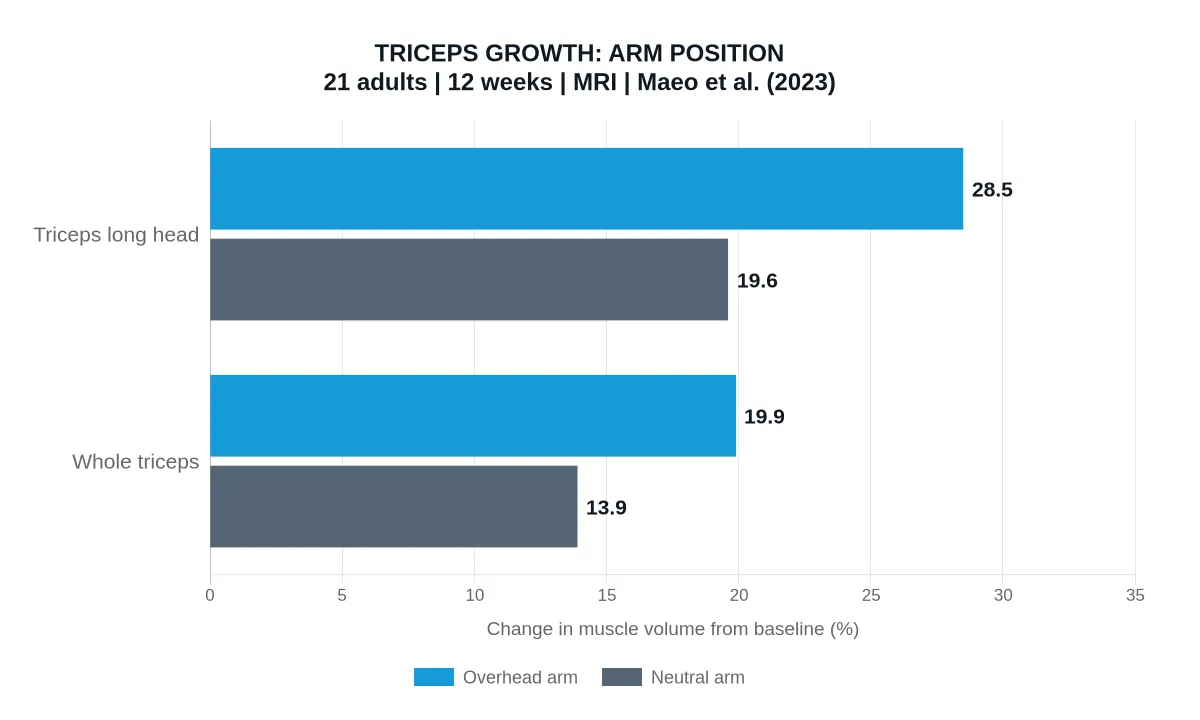
The pattern is consistent where a muscle crosses two joints. Hamstrings, gastrocnemius and the triceps long head all grew more when the other joint put them on stretch, while the single-joint neighbors (the hamstring short head, the soleus) did not care. That points to muscle length as the likely driver.
The limits matter just as much. Most positive trials used untrained people, samples of 14 to 50, one exercise per muscle, and ultrasound at a few sites. Only the triceps, hamstring and standing-calf trials measured whole-muscle volume with MRI.
Do lengthened partials beat full range of motion?
Those early wins compared a long-length option against a short-length one, which is a different question from the one most lifters are asking. When the comparison is lengthened partials against a full range that already reaches a deep stretch, the edge mostly disappears. The Wolf trial in trained lifters, the 297-person Gschneidner trial and the McMahon knee extension trial all landed on roughly equal growth.
The Varovic meta-analysis points the same way. Pooled across 12 studies, training at longer mean lengths produced only trivial regional differences, though the authors caution that the “long” and “short” conditions in those studies were not far apart. The Wolf team proposed a ceiling: once a muscle is trained at a sufficiently long length, going even longer may add little.
Partials also are not one thing. An earlier meta-analysis by Palláres and colleagues favored full range over partials for lower-limb growth. A systematic review by Kassiano and colleagues sorted partials by position and showed bottom-range partials and full range both outgrowing top-range partials, so the two ends of the movement sit on opposite sides of this evidence.
Past-failure partials in the stretch are the one tempting add-on. The calf data suggest they help mainly by adding work: the leg that did extra partials grew more, but once total volume-load was matched, both legs grew the same.
Is stretch-mediated hypertrophy the same as lifting in the stretch?
That volume point carries over to the phrase you see everywhere online. In the research, stretch-mediated hypertrophy mostly refers to long bouts of static stretching with no weight lifted. The Warneke meta-analysis shows the effect is real but small, and it grew with longer durations and more sessions.
The dose is the problem for a home lifter. Human studies with measurable growth commonly used more than 30 minutes of stretching per session for the calves, per a 2023 review of the physiology, which judged resistance training more time-efficient. A 30-second stretch between sets is not a proven growth tool.
Loaded holds at long lengths are a better-supported middle ground. Isometrics at long lengths outgrew short-length isometrics in the Oranchuk review, and a 2025 trial in trained lifters saw long-length isometric knee extension roughly match full-range reps for quad growth. If your cable unit has an isometric or hold mode, the VOLTRA training modes guide shows how that kind of setting works.
How do you bias training at long muscle lengths with home equipment?
Holds and partials are optional; exercise choice is where the tested gains live. The table separates what a trial tested directly from what is an inference to home gear, since a cable or dumbbell version was usually not the exact movement studied.
| Muscle | Home option that biases the stretch | What was tested vs inferred |
|---|---|---|
| Triceps | Overhead cable extension facing away from a low or mid pulley; overhead dumbbell extension | Tested: cable overhead vs neutral arm (Maeo 2023). Dumbbell version used in both arms of Wolf 2025, not compared to a pushdown. |
| Hamstrings | Seated cable leg curl with an ankle strap, sitting upright on a bench facing a low pulley; Romanian deadlift | Tested: machine seated vs prone curl (Maeo 2021). Cable seated curl and Romanian deadlift are inferred. |
| Calves | Standing dumbbell or loaded calf raise off a step or plate, pausing at the bottom | Tested: standing beats seated (Kinoshita 2023); bottom-half partials on a machine (Kassiano 2023). Dumbbell version inferred. |
| Quadriceps | Seated cable or attachment knee extension emphasizing the bent-knee half; deep squat variations | Tested: machine knee extension range (Pedrosa 2022, 2025; McMahon 2026). Cable version and squats inferred. |
| Biceps | Cable curl with the arm behind the torso; incline dumbbell curl; preacher curl on a bench | Tested: preacher range (Pedrosa 2023, Havers 2025), modest regional effect. Shoulder position showed no difference under light occluded loads (Vendruscolo 2024). |
| Chest and back | Deep dumbbell press or fly; single-arm cable pulldown from a full overhead reach | Not tested long vs short in the trials above. Inferred only. |
Expect lighter weights on the stretched versions. The overhead triceps arm in Maeo 2023 moved clearly less load and still grew more, so a smaller number on the stack is not a sign the exercise is worse.
Resistance profile matters here too. A cable set at the right angle keeps tension on the muscle at the bottom, where a dumbbell pointed straight down can go slack. The cable attachments guide matches handles and straps to each of these movements.
Who should change their program, and who can leave it alone?
With that evidence mapped, the verdict depends on how you train now. Find the line that matches your current program.
- You mostly do shortened-range variations (prone curls, seated calf raises, pushdowns only): swap at least one exercise per muscle for its lengthened version. This is where the MRI data are strongest.
- You already train full range with a controlled, deep bottom position: you are already doing most of what the evidence supports. Adding lengthened partials is optional, and the trained-lifter trials show no clear extra growth.
- You want to add partials anyway: put them in the stretched half and count them as extra volume. Avoid top-range partials if growth is the goal.
- You were planning long static stretches for size: the dose needed is large and the effect small, so your lifting time is better spent on loaded sets.
Your next step: set up an overhead cable triceps extension and a seated cable leg curl using the cable attachments guide. Give the swap a full training block before judging it, since the trials that showed differences ran 8 to 12 weeks.
Sources
- Maeo S, et al. Greater hamstrings muscle hypertrophy but similar damage protection after training at long versus short muscle lengths. Med Sci Sports Exerc. 2021. doi:10.1249/MSS.0000000000002523
- Maeo S, et al. Triceps brachii hypertrophy is substantially greater after elbow extension training performed in the overhead versus neutral arm position. Eur J Sport Sci. 2023. doi:10.1080/17461391.2022.2100279
- Kinoshita M, et al. Triceps surae muscle hypertrophy is greater after standing versus seated calf-raise training. Front Physiol. 2023. doi:10.3389/fphys.2023.1272106
- Kassiano W, et al. Greater gastrocnemius muscle hypertrophy after partial range of motion training performed at long muscle lengths. J Strength Cond Res. 2023. doi:10.1519/JSC.0000000000004460
- Pedrosa GF, et al. Partial range of motion training elicits favorable improvements in muscular adaptations when carried out at long muscle lengths. Eur J Sport Sci. 2022. doi:10.1080/17461391.2021.1927199
- Pedrosa GF, et al. From full to partials: range of motion training, isometric action and hypertrophy in young women. J Sports Sci. 2025. doi:10.1080/02640414.2025.2502895
- Pedrosa GF, et al. Training in the initial range of motion promotes greater muscle adaptations than at final in the arm curl. Sports. 2023. doi:10.3390/sports11020039
- Vendruscolo L, et al. Similar regional hypertrophy of the elbow flexor muscles in response to low-load training with vascular occlusion at short versus long muscle lengths. Sports Health. 2024. doi:10.1177/19417381241287522
- Wolf M, et al. Lengthened partial repetitions elicit similar muscular adaptations as full range of motion repetitions during resistance training in trained individuals. PeerJ. 2025. doi:10.7717/peerj.18904
- Havers T, et al. Partial range, full gains? Partial range of motion training at long muscle lengths in trained individuals. Eur J Sport Sci. 2025. doi:10.1002/ejsc.70087
- Gschneidner D, et al. The effects of lengthened-partial range of motion resistance training of the limbs on arm and thigh muscle area: a multi-site randomised trial. J Sports Sci. 2025. doi:10.1080/02640414.2025.2567805
- McMahon G, et al. Moderate intensity resistance training with partial range-of-motion at long muscle lengths elicits similar hypertrophy as high intensity full range-of-motion training. J Strength Cond Res. 2026. doi:10.1519/JSC.0000000000005561
- Larsen S, et al. Resistance training beyond momentary failure: past-failure partials and gastrocnemius hypertrophy. Front Psychol. 2025. doi:10.3389/fpsyg.2025.1494323
- Goli A, et al. Does performing partial repetitions beyond momentary failure enhance muscle hypertrophy in volume-load-equated calf-raise training? Int J Exerc Sci. 2026. doi:10.70252/IJES2026403
- Varovic D, et al. Does muscle length influence regional hypertrophy? A systematic review and meta-analysis. Int J Sports Med. 2025. doi:10.1055/a-2615-4935
- Varovic D, et al. Long muscle length isometric versus full range of motion isotonic training on regional quadriceps hypertrophy in resistance-trained individuals. Appl Physiol Nutr Metab. 2025. doi:10.1139/apnm-2025-0238
- Oranchuk DJ, et al. Isometric training and long-term adaptations: effects of muscle length, intensity, and intent. Scand J Med Sci Sports. 2019. doi:10.1111/sms.13375
- Palláres JG, et al. Effects of range of motion on resistance training adaptations: a systematic review and meta-analysis. Scand J Med Sci Sports. 2021. doi:10.1111/sms.14006
- Kassiano W, et al. Which ROMs lead to Rome? A systematic review of the effects of range of motion on muscle hypertrophy. J Strength Cond Res. 2023. doi:10.1519/JSC.0000000000004415
- Warneke K, et al. Effects of chronic static stretching on maximal strength and muscle hypertrophy: a systematic review and meta-analysis with meta-regression. Sports Med Open. 2024. doi:10.1186/s40798-024-00706-8
- Warneke K, et al. Physiology of stretch-mediated hypertrophy and strength increases: a narrative review. Sports Med. 2023. doi:10.1007/s40279-023-01898-x
- Pedrosa GF, Pereira MR, Kassiano W. The interplay between muscle length, range of motion, and exercise selection: a review. Sports Med Int Open. 2026. doi:10.1055/a-2733-7605
- Blazevich AJ, Herzog W, Nunes JP. Triggering sarcomerogenesis: examining key stimuli and the role attributed to eccentric training. J Sport Health Sci. 2025. doi:10.1016/j.jshs.2025.101073
Sources checked September 28, 2026. Research summaries describe the cited studies; individual results vary.