
As an Amazon Associate I earn from qualifying purchases.
Your cable stack runs out before your rows do, or the jump from one plate to the next is too big to hit your reps. A weight stack pin extender replaces the selector pin and gives you a 2-inch post for Olympic plates, while add-on weights sit on or stick to the stack for small jumps. Both work mechanically, and whether either is safe comes down to one question: does your machine’s maker allow added load?
Two large commercial makers forbid it in their manuals. One home-gym brand sells its own extender for specific trainers, and another confirms its lat machine takes standard add-ons. The product pages and manuals in this guide were checked on September 28, 2026.
What does a weight stack pin extender change on your machine?
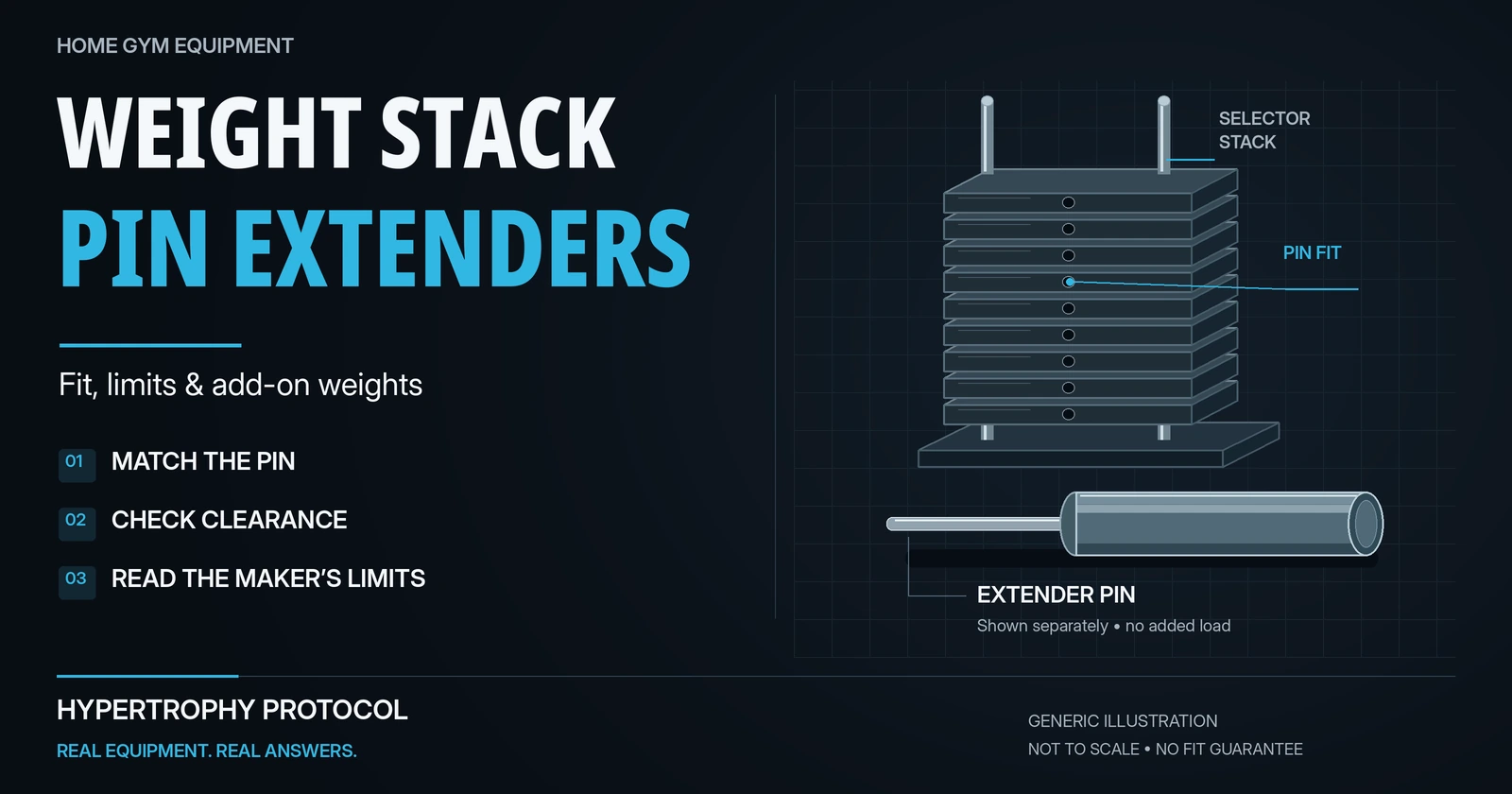
Both products solve the same problem from opposite ends. An extender is a stepped pin: the thin end goes through the stack like your stock selector pin, and the thick end sticks out to hold plates. Everything you hang there rides with the stack, so the pin, top plate, selector rod, cable and frame all carry it.
Add-on weights take the smaller route. They rest on the top plate, slip over the selector rod, or cling magnetically to a steel plate, and they add a few pounds instead of dozens. The table groups the products checked for this guide with the limit each seller attaches.
| Type | What it does | Typical attachment | Load or increment | Key limit | Source |
|---|---|---|---|---|---|
| Extender pin (GymPin Original) | Holds Olympic plates on the stack | 8 mm or 10 mm small end in the stack; 49.5 mm × 155 mm plate post | 60 kg maximum load | Confirm with the gym or machine maker first | GymPin |
| Extender pin (GymPin KingPin) | Holds Olympic plates on the stack | 10 mm small end only; 49.5 mm × 200 mm plate post | 60 kg recommended maximum | 10 mm stacks only | GymPin |
| Pin adapter (Power Pin) | Holds fractional or Olympic plates | One body with interchangeable 8 mm and 10 mm pins; ridges hold the plate | 0.125 kg up to 60 kg | Stack hole must be 8 mm or 10 mm | Power Pin |
| Maker’s own extender (Major Fitness) | Holds Olympic plates on its own trainers | Inserts in the selector stack; parks on top of the guide rod | Up to 130 lb per extender | Fits B52 PRO, F22 PRO and B52 EVO only | Major Fitness |
| Extender pin (BodyKore) | Holds Olympic plates on the stack | Case-hardened steel pin; post for 2-inch (50.8 mm) holes | Up to two 45 lb plates | No pin diameter published | BodyKore |
| Magnetic add-on (PlateMate Brick) | Small increments | Magnet on bare steel or cast iron | 2.5 lb per brick | Won’t hold on coated plates; one per end of the weight | PlateMate |
| Top-plate adapter (Body-Solid WSA5, WSA2-5) | Small increments | Rubber over a steel core, set on the stack | 5 lb or 2.5 lb | No fit limits published | Body-Solid |
| Interlocking add-on (Bodycraft AW5) | Small increments on Bodycraft machines | Interlocks, with rubber strips against slipping | 5 lb (2.5 lb on its functional trainers) | Listed Bodycraft models | Bodycraft |
| Add-on weight (Power Systems) | Small increments | Rubber-coated cast iron that fits between the guide rods | 5 lb | Guide rods no more than 3 1/4″ apart | Power Systems |
Every load figure in that table rates the accessory. None of them rates the machine it plugs into. And BodyKore’s “Universal fit for all pin loaded machines” claim runs straight into the pin sizes in the next section.
Will a weight stack pin extender fit your stack’s pin hole?
Fit is where “universal” breaks down first. The extenders above come in 8 mm or 10 mm, and Power Pin bases its design on the idea that “Most weight stacks have 10mm or 8mm holes.” Life Fitness is a clear exception: its Cable Motion manual specifies a 7/16-inch selector pin that passes all the way through the weight plate.
That 7/16 inch works out to about 11.1 mm, so a 10 mm extender would be roughly 1.1 mm thinner than the pin that stack was built for. That leaves more play in the hole than the stock pin allows. Pins also wear from ordinary use; Skelcore traces bent pins to users who “force it against the edge of the plate hole instead of straight through it.”
Selector pin diameters, drawn to scale
So measure before you buy. GymPin tells buyers to “Measure your machine’s existing stack pin diameter,” and calipers on your stock pin give you the number. Then think about width: plates on the post sit beside the stack, where guide rods or frame parts may be in the way.
What do machine makers allow when you add weight to the stack?
A pin that fits still leaves the question of permission, and makers disagree. Cybex’s VR3 Cable Column manual reads: “DO NOT increase weight resistance on equipment by any means other than those provided by Cybex.” The Life Fitness Cable Motion manual goes further: “Never use dumbbells or other means to incrementally increase the weight resistance. Use only those means provided by LIFE FITNESS.”
Those two sentences rule out third-party extenders and third-party add-ons alike on those machines. Life Fitness does ship its own answer, with a “5# add-on weight included” on several stations in the same manual.
Home-gym makers are more open. The Rogue Lat Pulldown / Low Row guide answers the question directly: “Yes. The unit is compatible with most 5 LB and 2.5 LB ‘add-on’ or ‘donut’ weights that fit over the top of the selector rod.” It also ships with a Rogue Loading Pin “for optional micro-loading.” Major Fitness goes a step further and sells an Olympic-plate extender, with the warning “Only fits B52PRO/F22PRO/B52EVO.”
Commercial gyms add their own layer. The University of Georgia’s rec sports facility handbook is one example of a blanket rule: “Modification of Recreational Sports Facilities and Equipment is not permitted.” Even GymPin’s page tells you to “Always confirm with the gym owner, facility manager or equipment manufacturer.”
Does a 60 kg extender rating make a big overload safe?
Permission matters most when the goal is a big jump. Say you want 205 lb from a single 85 lb stack, a question that comes up in home-gym forums. Hitting 205 means hanging 120 lb of plates, about 54.4 kg, on the pin.
On paper, that passes the accessory ratings. It sits under GymPin’s 60 kg and under Major Fitness’s 130 lb. But the total is about 2.4 times the stack’s own weight, and nobody in this chain has rated that machine for it. GymPin’s own guidance points the same way: “Do not slam the stack or exceed the intended capacity of the machine.”
The cable is the part most people think of, and it is only one link. Body-Solid rates its Pro Dual Cable Column cables “to over 2500 lb,” a figure that covers the cable only. None of the product pages or manuals checked for this guide publishes a rating for selector pins or top plates, so the safety data here is thin.
When the maker’s documentation doesn’t cover added load, treat the stack weight as your ceiling. If your machine’s maker does publish a limit, that number beats any accessory rating.
When do add-on weights for a cable machine beat a bigger jump?
If the stack weight is the ceiling, smaller steps below it keep progress going without asking the machine to carry more than it was sold with. Add-on weights fill the gap between stack plates. The progressive overload guide for small home gyms covers how to plan those steps.
Pulley ratio shrinks the jump further. REP’s Arcadia stack page (the Arcadia is also sold on Amazon) describes moving between “10lbs (feels like 5lbs) weight increments” on its 2:1 trainer. By the same arithmetic, a 2.5 lb add-on changes the load at the handle by 1.25 lb. The cable pulley ratio calculator runs that math for your machine.
Each add-on style has one condition to check. Magnetic bricks need bare metal, and PlateMate’s FAQ adds that “you should not use more than one at each end of the weight.” Top-plate blocks need room between the guide rods, and interlocking plates like Bodycraft’s are sold for named models.
How should you check the setup before your first set?
Whichever route you choose, run the same checks before you load anything heavy. Most need nothing more than the manual and a caliper.
- Read your machine’s manual and placards for any line about added resistance. If it forbids it, stop there.
- Measure your stock selector pin and buy an extender that matches it exactly.
- Push the pin all the way in. Life Fitness warns: “Partial insertion can cause weights to fall unexpectedly.”
- Move through the full range with light plates on the post and watch for contact with the guide rods or frame.
- Put magnetic add-ons only on bare steel or cast iron, one per end.
- Inspect cables for wear, and lower the stack under control instead of letting it drop.
Cybex tells owners to “Inspect all cables and belts for wear or damage and proper tension” weekly, which is a sound habit whether or not you add weight. If you find damage, the same manual’s instruction is to “keep the equipment out of use until repair is completed.”
Which route fits your machine?
Those checks sort most lifters into one of four groups. Find the one that matches your machine and your gym.
Your maker sells or approves an extender for your model. Use that one, within its published rating. Major Fitness owners with a B52 PRO, F22 PRO or B52 EVO are in this group. If you’re shopping for one of those trainers, Major Fitness sells on Amazon.
You train on a Cybex or Life Fitness stack. Skip third-party extenders and add-ons, because both manuals rule them out. Use the maker’s own add-on where the machine includes one, and follow your gym’s rules everywhere else.
Your home machine has no published guidance. Microload with add-ons that sit on the top plate or over the selector rod, and email the maker for a written answer before you try any extender.
You keep hitting the top of the stack. An extender only postpones the problem, since the stack’s weight is still the ceiling you can document. A plate-loaded setup is designed around adding plates.
Next step: read plate-loaded vs weight stack cable machines to see whether switching fits your space and your lifts.
Sources checked September 28, 2026. Manufacturers change specs; confirm on the product page before ordering.