
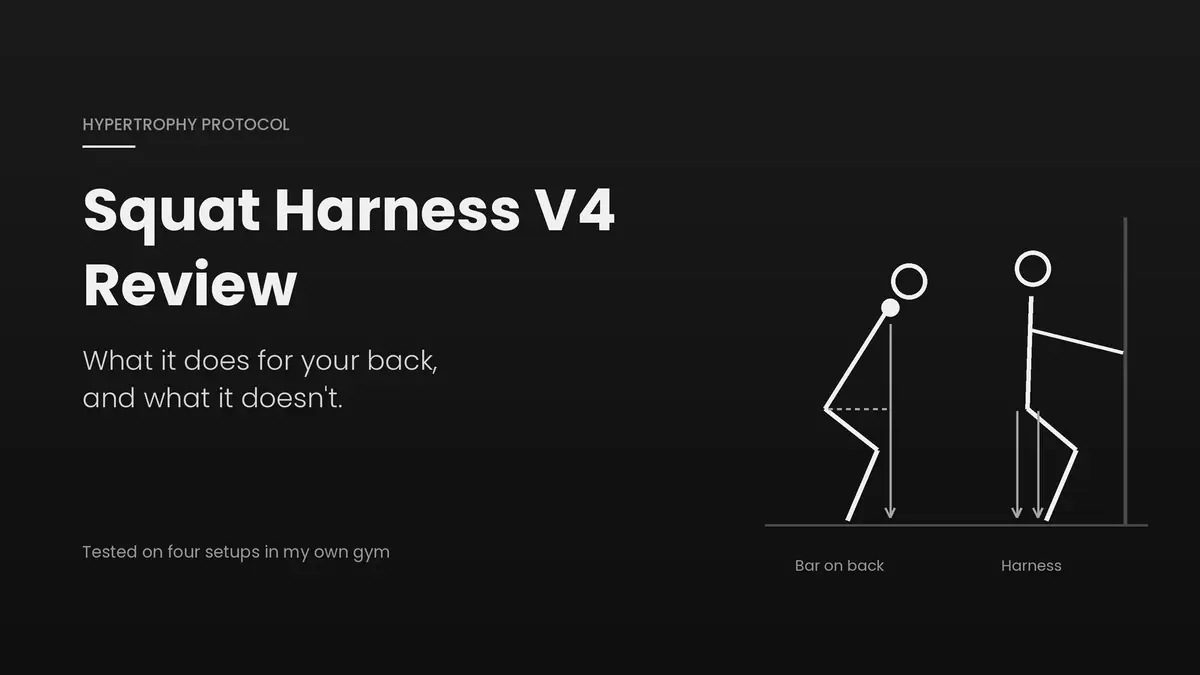
Affiliate disclosure: Hypertrophy Protocol may earn a commission if you buy through links on this page, at no extra cost to you. I bought and use the Squat Harness V4 in my own gym. As an Amazon Associate and Titan Fitness affiliate I earn from qualifying purchases.
Stock note: when this review was last checked on September 28, 2026, the Squat Harness V4 and Ripped Ramp 2.0 product pages showed “Sold out” with a notify-me option, while the store’s main product listing showed both as available. Check the product page for current availability before you plan a setup around either one.
Most squat harness reviews repeat the same promise: squat heavy with zero spinal load. If a bar on your back is what stops you training legs hard, that’s exactly what you want to hear, and it isn’t quite what the Squat Harness V4 delivers. The load still runs through your torso. What changes is where it sits, what it frees up, and which equipment you can load it with. Those three things decide whether the V4 belongs in your gym, and I’ve tested them on four setups.
How the V4 loads your body
The V4 is a padded vest. The main straps are 3 inches wide, there’s padding over the shoulders and around the ribcage, and the buckles sit across the chest. Resistance clips to loops at your sides and pulls down through the vest.
Here is the force path. The load hangs from your shoulders and ribs, so it still travels down your spine to your legs. A harness does not remove spinal compression. What it changes is where the load sits relative to your body:
- No bar on your back or neck. Nothing presses on your traps, cervical spine, or shoulders in an externally rotated position. That can make it a useful option if bar placement is uncomfortable for you. If you have an injury, get clearance from a clinician first.
- A vertical line of pull. With cables or bands anchored below you, the load pulls straight down through your center of mass instead of sitting behind it. You can stay upright, which shortens the lever arm on your lower back compared to a back squat, where you must lean forward to keep the bar over your midfoot.
- Your hands are free. You can hold a rack upright for balance. Balance and upper-back endurance stop limiting the set, so your quads can be taken closer to failure.
That last point matters most for hypertrophy. In high-rep barbell squats, the set often ends because your upper back or trunk gives out, not your quads. Removing that bottleneck is the real case for the harness. It also means harder leg sessions, so recovery windows after heavy leg days are worth planning.
How it performed in my gym
I’ve used the V4 on four different setups. I’ve dealt with back issues myself, so the question I cared about was whether it let me load my legs hard without my back becoming the limit.
InnoDigym P1 Max (squats and good mornings). This is where it impressed me most. At higher loads, the harness split the resistance evenly across both sides, so neither hip took more than the other. Good mornings off the harness felt stable, with no bar to balance.
Titan rack-mounted SquatMax-MD. I clipped the harness to the machine instead of the standard belt, and it made heavy loads easier to handle. Spreading the load through the vest took away the concentrated hip pressure I get with a belt. A rack-mounted belt squat station puts real off-axis load on the frame, so if you’re setting one up, it’s worth checking your rack in the Rack Attachment Fit Checker first.
Rogue trap bar. Hands-free trap bar squats work, but you need a small platform to stand on. Without one, the bar hits the floor before you reach full depth.
Beyond Power VOLTRA I. The harness felt great, but a single unit didn’t feel heavy enough for squats. If you’re strong, plan on either two units or a pulley setup that multiplies the load. A pulley that doubles the force at the harness also halves the cable travel, so check your range of motion before you commit to it.
On my back: you still feel some weight through your torso. It isn’t zero, and it isn’t a belt squat. But compared to a loaded bar sitting on your back, it’s close to nothing. For me, that difference is what made heavy lower-body training possible again.
Harness vs. belt squat vs. barbell
| Barbell back squat | Hip belt / belt squat | Squat Harness V4 | |
|---|---|---|---|
| Spinal compression | High | Very low | Moderate (load passes through the torso) |
| Lower-back lever arm | Largest | Small | Small (upright torso) |
| Bar on shoulders/neck | Yes | No | No |
| Hands free for balance | No | Yes | Yes |
| Hip-crease pressure | No | Can be significant | No |
| Setup speed | Moderate | Fast | Slower (vest + buckles) |
The spinal compression row is a qualitative comparison based on where each method places the load. No published study has measured spinal load in a squat harness.
If the goal is truly minimal spinal loading alongside heavy jumping or deadlifting volume, a hip belt squat is the better tool, because the load never passes through your torso. In one study, belt squats cut lumbar erector activity by roughly half compared with back squats (Joseph et al., 2020). If you have a diagnosed back condition, follow your clinician’s advice.
The harness wins when the belt is the problem. Some people find a hip belt digs in, limits depth at the hip crease, or pulls their pelvis around at the bottom. The harness puts nothing at the hips, so depth isn’t limited by a belt. It also works with equipment a belt squat station can’t use, like bands, a functional trainer, a digital cable, or a trap bar.
What’s in the lineup
For how it fits into a broader setup, the best power rack attachments for building muscle at home covers the rest of the lineup.
Squat Harness V4. 6 lb of heavy-duty webbing with 3-inch main straps, rib padding, and chest-only buckles. It has D-rings at the top and bottom for reverse-band squats and accessory work, and a pair of band hook straps comes included. Squat Harness lists an estimated load capacity of 950 lb, determined on a plate-loaded functional trainer. For barbells or hex bars, the manufacturer recommends testing carefully past 500 lb, because free weight is less stable than cable or band resistance. It carries a 90-day replacement warranty.
Ripped Ramp 2.0. A 21 lb solid steel squat wedge, 24″ × 17″ × 5″, rated to 1,000 lb. It has a rounded calf-raise edge and built-in resistance-band integration with a protective sleeve. Heel elevation reduces the ankle mobility a deep, upright squat demands, which can let you squat deeper with a more upright torso.
Accessories. These include barbell and trap bar hook straps, 8-inch hook straps for tight functional trainers, loading straps, and band sets. If you plan to use the harness with a barbell or trap bar, the hook straps are what you need.
Four ways to set it up
1. Functional trainer or cable stack. Set both low pulleys narrow and clip one to each side of the harness. It’s easiest to sit on a low bench, clip in, then stand up. This setup gives constant tension through the whole range, which bands can’t. The same handle-selection logic as any cable exercise applies here, and matching cable attachments to target tissue covers it.
2. Digital cable (Beyond Power VOLTRA I). Mount the unit at floor level and clip the cable to the harness. Beyond Power sells a band-free V4, created in collaboration with Squat Harness and optimized for the VOLTRA I. It includes two strap hooks; resistance band hooks are not included. Eccentric mode, which applies heavier resistance on the way down, pairs well with a harness because you can hold the rack for balance through the descent. Stay within the unit’s load limit, or run two units if you need more. Beyond Power lists a 200 lb maximum per unit, and in my experience a single unit runs out of resistance for squats quickly. Budget for a second unit or a pulley multiplier if you’re already squatting heavy.
3. Bands and the Ripped Ramp. Run loop bands under the ramp and hook them to the harness. Bands are lightest at the bottom and heaviest at lockout. That’s easier on the knees in deep flexion, but it also means the deep position is underloaded. That matters, because in one 10-week training study full squats grew the gluteus maximus (6.7% vs. 2.2%) and adductors (6.2% vs. 2.7%) more than half squats, while quad growth was similar at both depths (Kubo et al., 2019). Use bands for accessory volume, not as your main squat stimulus, especially if glute and adductor growth matter to you.
4. Barbell or trap bar, hands-free. Clip the barbell and trap bar hook straps (sold separately) to the harness. Squat Harness says a straight barbell setup is mainly for deadlifts, while a trap bar allows both squats and deadlifts. With a trap bar, stand on a small platform so the bar doesn’t bottom out before you reach full depth. Squat Harness advises testing carefully once free-weight loads pass 500 lb, because free weight is less stable than cable or band resistance. Inspect the straps and hardware before each use and build up gradually.
Exercises the harness opens up
- Hands-free Bulgarian split squats. No dumbbells means no grip fatigue. Hold an upright and take the working leg close to failure. Adding depth is one way to progress here, alongside load and reps, and progressive overload in small training spaces covers the other options.
- Heel-elevated cable squats on the ramp. Upright torso, knees well forward, heavy quad bias. It’s a pendulum-style pattern, not a pendulum machine replacement, but a solid home-gym version.
- Cable good mornings and RDLs off the rear D-ring, loading the hamstrings in their stretched position without holding a bar.
- Loaded calf raises off the ramp edge with cables or bands, with nothing pressing on your shoulders.
- Assisted Nordic curls. Attach a band from the top D-ring to an overhead anchor to take some load off the lowering phase.
Who should buy it
Buy the V4 if:
- a bar on your back aggravates your shoulders, elbows, or neck;
- a hip belt digs in or limits your depth;
- you train legs on a functional trainer, VOLTRA, or bands and want a proper squat attachment;
- floor space is tight. The harness stores compactly, unlike a hack squat or leg press, and building a home gym in a 10×10 space helps if footprint is driving your equipment decisions.
Skip it, or buy a hip belt instead, if:
- your main goal is minimizing spinal compression, for example to add heavy lower-body volume alongside other spinal loading. A belt squat does that job better;
- you want the fastest possible setup between sets. A belt cinches in seconds, while the vest takes longer.
Verdict: The Squat Harness V4 is well made and versatile, and it’s one of the better ways to load squats in a home gym without a bar on your back. Treat it as a way to remove the bar and free your hands, not as a spinal-decompression device, and it earns its price.