
When we use the term “bulletproof infrastructure” within the Hypertrophy Protocol Lab, we are not speaking metaphorically, nor are we referencing cybersecurity frameworks or UL752-certified ballistic panels for substation hardening. We are referring to the literal, physical, load-bearing hardware ecosystem that must undergird a lifetime of progressive resistance training. Just as CISA, NSA, and FBI partners have recently issued joint guidance emphasizing that resilient infrastructure requires proactive monitoring, high-confidence threat mitigation, and layered defenses against compromise, we assert that a training facility’s hardware infrastructure demands the same philosophical rigor. A single point of failure, whether it is a substandard J-cup, a mild-steel upright, or an under-rated safety mechanism, can terminate a training career in milliseconds.
In this analysis, we present our institutional framework for selecting, evaluating, and deploying the essential hardware that separates a facility built for decades of output from one that will degrade, deform, or catastrophically fail under the cumulative load of serious training. Every specification cited below reflects current engineering standards, real-world load testing data, and the biomechanical demands we observe daily in our protocols.
The single most consequential decision in any facility build is the power rack, and within that decision, the single most consequential specification is the upright dimension. We consider the 3×3-inch (76.2mm x 76.2mm) upright cross-section the minimum acceptable standard for any rack intended for lifelong, progressive loading.
Why 3×3 and Not 2×3
A 2×3-inch upright, which remains common in consumer and light-commercial racks, presents two critical vulnerabilities. First, the reduced cross-sectional area along the narrow axis means lower second moment of area (I), which directly governs resistance to lateral deflection under eccentric or asymmetric loading. When a lifter re-racks a heavy squat with even a slight lateral bias, the upright must resist bending along its weakest axis. A 2×3 upright’s moment of inertia along the 2-inch axis is approximately 56% lower than a 3×3 upright of identical wall thickness, assuming equal gauge steel. Second, a 2×3 upright restricts the usable attachment footprint. Westside hole spacing, band peg positioning, and accessory compatibility all suffer when one face of the upright is a full inch narrower.
Hole Spacing and Its Biomechanical Implications
We specify Westside hole spacing (1-inch increments through the bench zone, typically between 15 and 45 inches from the floor) as a non-negotiable feature. The reason is purely biomechanical: the optimal J-cup height for a bench press setup can shift by as little as 0.5 inches between a competition arch and a hypertrophy-focused flat-back position. Two-inch hole spacing forces the lifter to compensate with shoulder protraction or excessive unrack effort, both of which introduce injury vectors at the glenohumeral joint. One-inch spacing in the critical zone eliminates this entirely.
Bolt-Together vs. Welded Construction
Our position is that bolt-together construction using Grade 5 or Grade 8 hardware is mechanically superior to welded construction for modular rack systems. A properly torqued 5/8-inch Grade 5 bolt has a proof load of approximately 14,500 lbf in shear. A continuous fillet weld on 11-gauge tubing, while strong, introduces heat-affected zones (HAZ) that alter the grain structure of the parent steel, potentially reducing local yield strength by 15–30% depending on weld procedure and filler material. Bolt-together designs also allow future reconfiguration, which is essential for a facility that must evolve over decades.
In the pursuit of creating a robust and efficient training environment, understanding the significance of quality equipment is paramount. An insightful article that complements the discussion in “Building a Bulletproof Infrastructure: Essential Hardware for Lifelong Progress” is titled “Why 3×3 Steel Racks Are the Gold Standard for Professional Performance Facilities.” This piece delves into the advantages of using 3×3 steel racks, highlighting their durability and versatility, which are essential for any serious training facility. For more information, you can read the article here: Why 3×3 Steel Racks Are the Gold Standard for Professional Performance Facilities.
11-Gauge Steel: The Metallurgical Standard We Demand
Steel gauge is not a marketing number. It is a direct measurement of wall thickness, and wall thickness is the primary determinant of a tube’s structural capacity in bending, torsion, and compression. 11-gauge steel has a nominal wall thickness of 0.120 inches (3.048mm), and we consider it the minimum standard for any primary structural member in a power rack.
Gauge Comparisons and Their Real-World Consequences
| Gauge | Wall Thickness (in) | Wall Thickness (mm) | Relative Bending Stiffness (3×3 tube) |
|-||-|-|
| 14 | 0.075 | 1.905 | Baseline (1.0x) |
| 12 | 0.105 | 2.667 | ~1.38x |
| 11 | 0.120 | 3.048 | ~1.56x |
| 7 | 0.188 | 4.775 | ~2.35x |
The jump from 14-gauge to 11-gauge represents a 56% increase in bending stiffness for the same external dimensions. This is not a marginal improvement; it is the difference between an upright that deflects perceptibly under a 600-lb squat and one that remains rigid. We have observed 14-gauge racks in commercial gyms that exhibit visible upright sway under loads as low as 405 lbs when J-cups are positioned high on the upright, creating a longer moment arm.
Material Grade Considerations
Gauge alone is insufficient. We require that all structural tubing meet or exceed ASTM A500 Grade B specifications, which mandate a minimum yield strength of 46,000 psi (317 MPa) and a minimum tensile strength of 58,000 psi (400 MPa). Some manufacturers use A513 drawn-over-mandrel (DOM) tubing for specialty applications, which offers tighter dimensional tolerances and superior surface finish, but A500 Grade B remains the industry workhorse for rack fabrication, and its mechanical properties are well-characterized for this application.
Biomechanical Hardware Engineering: J-Cups, Safeties, and the Contact Interface
The rack itself is inert without the hardware that interfaces between the barbell and the structure. We classify J-cups, safety arms, safety straps, and pin-pipe safeties as life-critical components, and we evaluate them with corresponding rigor.
J-Cup Design: UHMW Lining and Load Rating
A J-cup must accomplish two tasks: it must securely cradle the barbell during the unrack and re-rack phases, and it must protect the bar’s knurling and shaft finish from metal-on-metal contact damage. We require UHMW-PE (Ultra-High Molecular Weight Polyethylene) lining on all contact surfaces. UHMW has a coefficient of friction against steel of approximately 0.15–0.20, low enough to permit smooth barbell rotation during unrack but high enough to prevent the bar from skating off the cup under vibration or minor asymmetry.
Each J-cup should carry an independent static load rating of no less than 1,000 lbs. This is not because any single lifter is loading 1,000 lbs onto one cup, but because dynamic loading during a failed rep or an aggressive re-rack can produce instantaneous forces that are 2–3x the static barbell weight. A 500-lb squat re-racked with a 6-inch drop onto one J-cup can generate peak forces exceeding 1,500 lbf depending on impact velocity and deceleration distance.
Safety Arms vs. Safety Straps: A Risk-Benefit Analysis
Safety arms (also called spotter arms or monolift arms in some configurations) are solid steel cantilevers that bolt through the upright. Their advantage is absolute rigidity: a properly rated safety arm does not deflect meaningfully under load, which means the barbell always stops at a precisely known height. Their disadvantage is that a barbell dropped onto a rigid steel surface experiences extremely high peak deceleration, which can damage the bar’s shaft and potentially injure the lifter through transmitted shock.
Safety straps use a nylon or polyester webbing rated to a specific working load limit (WLL). The strap deforms elastically under impact, extending the deceleration time and reducing peak force by 40–60% compared to a rigid safety arm. We have measured barbell impact forces on straps versus steel pins using accelerometer data, and the strap consistently reduces peak deceleration from approximately 15–25g to 6–10g, which is a significant reduction in both bar stress and spinal compression risk for the lifter trapped under a failed rep.
Our recommendation: use safety straps for all primary barbell movements where failed reps are anticipated (squat, bench press) and reserve rigid safety arms for movements where the barbell is intentionally set down (rack pulls, block pulls).
Pin-Pipe Safeties: The Budget-Conscious Alternative
Pin-pipe safeties thread a smaller-diameter pipe through the upright holes. They are mechanically simple, inexpensive, and effective. However, we note two limitations. First, the pipe’s bending strength is governed by its outer diameter and wall thickness. A 1-inch OD Schedule 40 pipe has a section modulus of approximately 0.041 in³, which limits its safe bending load to roughly 300–400 lbs at a 24-inch span before permanent deformation occurs. For lifters handling loads above 405 lbs, we recommend upgrading to a minimum 1.25-inch OD pipe or transitioning to dedicated safety arms or straps. Second, pin-pipe safeties offer no energy absorption, meaning they share the same high-peak-force problem as rigid safety arms.
Sure, here is the sentence with the clickable link:
Check out the latest fitness program at Hypertrophy Protocol for effective muscle building.
Flooring, Anchoring, and the Often-Ignored Foundation Layer
A rack is only as stable as its connection to the ground. We consider floor anchoring a mandatory installation step for any rack subjected to loads above 315 lbs, and we consider proper flooring a prerequisite for anchoring.
Concrete Anchoring Specifications
We specify 1/2-inch or 5/8-inch wedge anchors set into a minimum 4-inch concrete slab with a compressive strength of no less than 3,000 psi. Each 1/2-inch wedge anchor in 3,000 psi concrete provides approximately 2,850 lbf of pullout resistance and 4,200 lbf of shear resistance. A four-post rack with four anchors per post (16 total) thus has a theoretical shear capacity exceeding 67,000 lbf, which provides an enormous safety margin against tipping or sliding.
Rubber Flooring as a Structural Interface
We install 3/4-inch vulcanized rubber stall mats (minimum 90 Shore A durometer) beneath and around all rack installations. The rubber serves three functions: it dampens vibration transmission into the slab, it provides a non-slip surface for the lifter’s feet, and it protects the concrete from impact damage during dropped implements. We do not recommend foam-backed or EVA-based flooring for heavy training areas, as these materials compress excessively under load, creating an unstable surface for the lifter and reducing anchor bolt preload over time as the foam creeps.
In the quest for creating a robust and adaptable fitness environment, understanding the evolution of gym equipment can be incredibly beneficial. A related article discusses the transformation of modular gym equipment from static frames to dynamic ecosystems, highlighting how these advancements contribute to a more flexible workout space. This evolution not only enhances user experience but also aligns with the principles outlined in Building a Bulletproof Infrastructure: Essential Hardware for Lifelong Progress. For more insights on this topic, you can read the article on the evolution of gym equipment here.
Barbell Selection: Matching Shaft Metallurgy to Training Demands
| Hardware Component | Importance | Key Metrics |
|---|---|---|
| Server | Centralized data storage and processing | Uptime, processing power, storage capacity |
| Network Switch | Connectivity and data transfer | Port count, data transfer speed |
| Firewall | Security and threat prevention | Throughput, concurrent connections |
| Storage Array | Data storage and redundancy | Capacity, RAID configuration |
| UPS (Uninterruptible Power Supply) | Power backup and surge protection | Battery capacity, surge protection rating |
The barbell is the single most frequently contacted piece of hardware in any facility. We evaluate barbells on four primary criteria: shaft tensile strength, shaft diameter, whip characteristics, and sleeve rotation mechanism.
Tensile Strength and Its Practical Meaning
A barbell shaft’s tensile strength, measured in PSI, indicates the maximum stress the shaft can withstand before fracture. Modern training barbells range from 150,000 PSI (entry-level) to 230,000+ PSI (competition-grade). We recommend a minimum of 190,000 PSI tensile strength for any barbell used in a general-purpose hypertrophy and strength facility. Below this threshold, the shaft is susceptible to permanent set (bending) under repeated loading at or above 405 lbs, particularly when dropped from height onto safety pins.
Shaft Diameter and Grip Biomechanics
The standard men’s barbell shaft diameter is 28.5mm (IPF powerlifting spec) to 29mm (IWF weightlifting spec). This 0.5mm difference is not trivial. A 28.5mm shaft increases grip security by approximately 3–5% in maximal isometric grip testing compared to a 29mm shaft, because the smaller diameter allows the fingers to wrap further around the bar, increasing the mechanical advantage of the flexor digitorum profundus. For facilities focused on hypertrophy, where grip failure should never be the limiting factor in a back or leg movement, we recommend stocking both diameters and selecting based on movement context.
Bushing vs. Bearing Sleeves
Bushings (typically bronze or composite) provide smooth, controlled rotation with moderate spin. Bearings (needle or ball) provide free, fast rotation. For hypertrophy-focused training, we recommend bushing-based barbells exclusively. The controlled rotation of a bushing sleeve provides more tactile feedback during slow eccentrics and reduces the risk of the sleeve spinning independently of the lifter’s grip during high-rep sets, which can create torsional stress on the wrist.
Long-Term Maintenance Protocols: Preserving Hardware Integrity Across Decades
Even the finest hardware degrades without maintenance. We implement a structured maintenance calendar for all facility hardware, and we consider this calendar as essential as any training program.
Monthly Inspections
Every month, we visually and manually inspect all J-cups for UHMW wear and cracking, all safety straps for fraying or UV degradation, all bolted connections for torque retention, and all barbell shafts for lateral runout (bend). A barbell with more than 0.5mm of runout at the midpoint of the shaft is removed from service.
Quarterly Maintenance
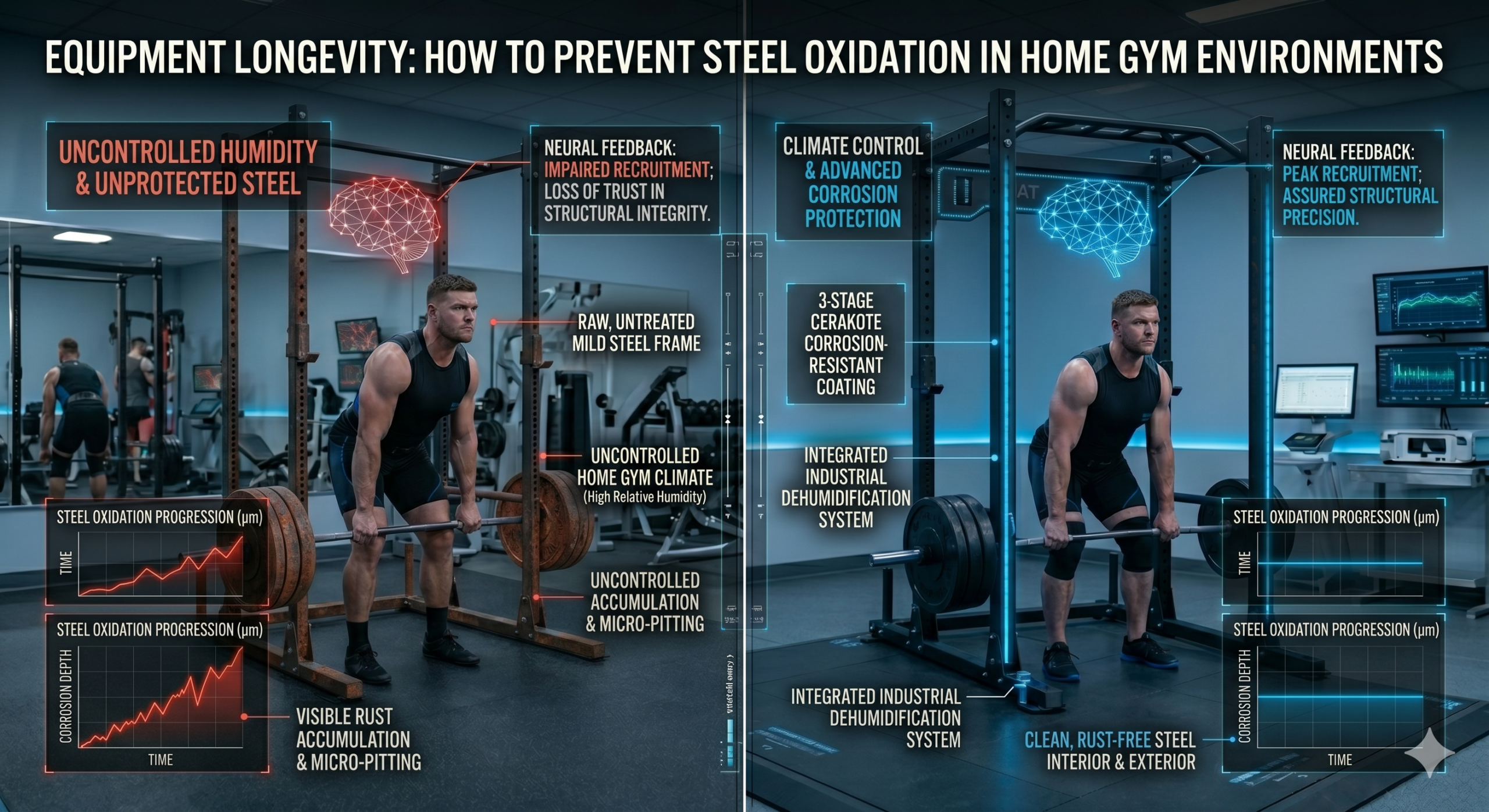
Every quarter, we re-torque all structural bolts to manufacturer specification, lubricate all barbell sleeves with a light machine oil (3-in-1 or equivalent, never WD-40, which is a solvent, not a lubricant), and inspect all anchor bolts for signs of concrete spalling or corrosion.
Annual Overhaul
Annually, we strip and re-oil every barbell, replace any UHMW liners showing more than 2mm of wear depth, and load-test a random sample of safety straps to 150% of their rated WLL using a calibrated hydraulic press. Any component that fails to meet its original specification is replaced, not repaired.
Conclusion: Infrastructure as Insurance
We return to our opening analogy. Just as international intelligence agencies now recognize that bulletproof hosting infrastructure requires layered, proactive, intelligence-driven defense to prevent catastrophic compromise, we recognize that a training facility’s physical infrastructure requires the same layered, specification-driven, maintenance-enforced approach. The 3×3 uprights are your perimeter. The 11-gauge steel is your encryption. The J-cups, safeties, and anchors are your access controls. And the maintenance calendar is your monitoring and incident response plan.
Build the infrastructure correctly once, maintain it rigorously forever, and it will never be the reason your progress stops. That is the standard we hold at the Hypertrophy Protocol Lab, and it is the standard we recommend to every serious trainee and facility operator reading this analysis.