
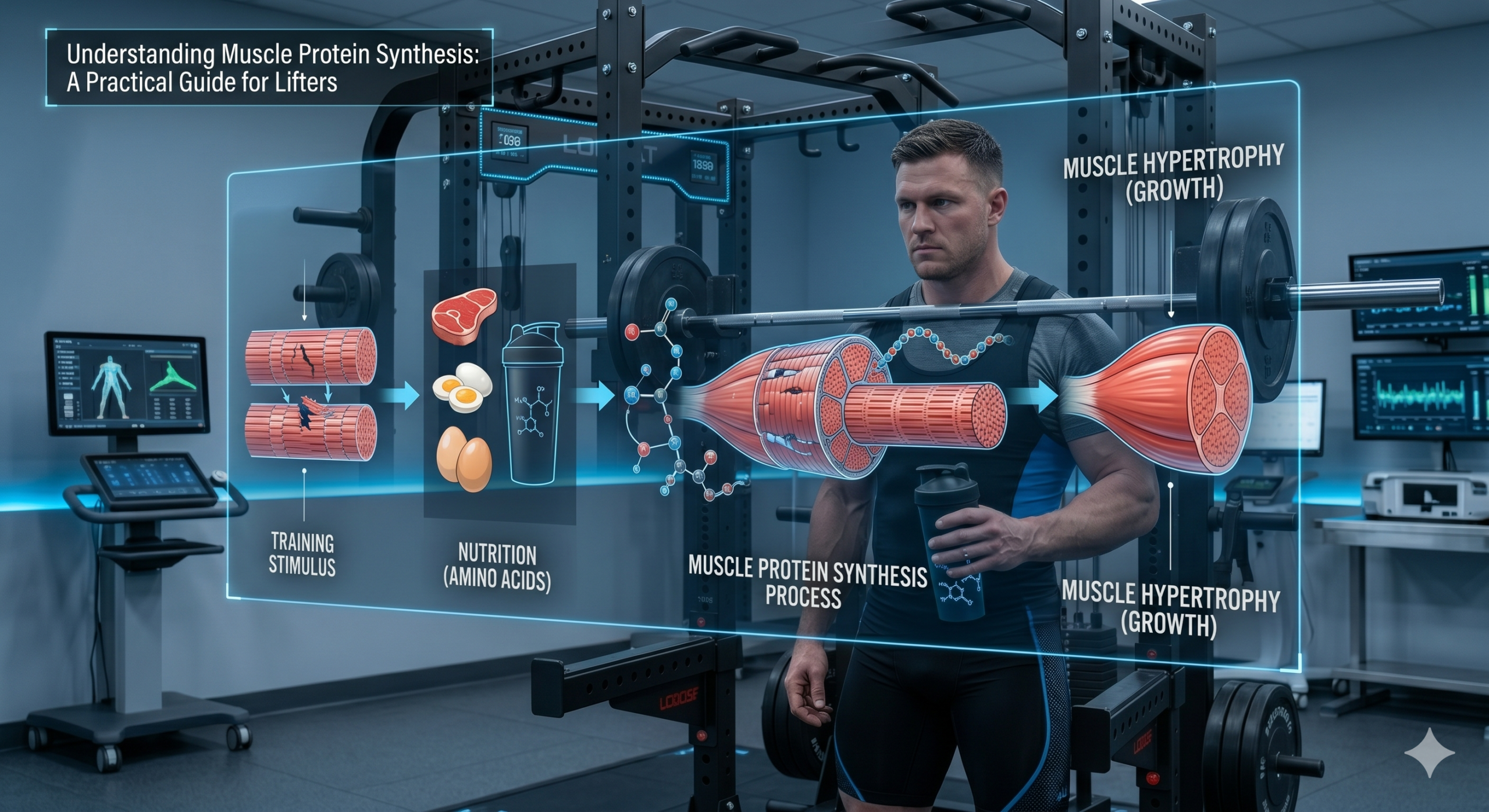
At the Hypertrophy Protocol Lab, we consider muscle protein synthesis (MPS) the single most consequential molecular event for anyone pursuing skeletal muscle hypertrophy. Yet despite its centrality, MPS remains widely misunderstood—reduced to oversimplified “anabolic window” dogma or buried under impenetrable biochemistry. In this guide, we bridge the gap between molecular signaling research and practical training-floor application. Every recommendation below is grounded in current mechanistic evidence, and we explain each technical concept with the precision it demands.
Key Definition: Muscle protein synthesis (MPS) refers to the biological process by which ribosomes assemble amino acids into new myofibrillar proteins—primarily actin and myosin—thereby increasing the contractile protein content of skeletal muscle fibers. Net muscle accretion occurs only when MPS rate chronically exceeds muscle protein breakdown (MPB) rate.
What mTOR Actually Does
The mechanistic target of rapamycin complex 1 (mTORC1) is a serine/threonine kinase that functions as the primary intracellular nutrient-and-mechanical-stress sensor governing anabolic activity in skeletal muscle. When activated, mTORC1 phosphorylates two downstream effectors that directly initiate translation:
- p70S6K (S6 kinase 1): Phosphorylates the ribosomal protein S6, increasing translational capacity and ribosome biogenesis.
- 4E-BP1 (eukaryotic translation initiation factor 4E-binding protein 1): When phosphorylated by mTORC1, it releases eIF4E, permitting cap-dependent mRNA translation to commence.
Critical finding: Research published through the Gatorade Sports Science Institute (SSE-123) demonstrates that the magnitude of mTOR and S6K phosphorylation measured in the hours following a strength training bout is the strongest molecular predictor of subsequent muscle mass and strength gains over weeks to months. This is not a correlational curiosity—it reflects the direct mechanistic link between signaling intensity and contractile protein accumulation.
How to Maximize mTOR Activation Practically
We have identified three convergent inputs that maximize mTORC1 activity post-training:
- Mechanical tension at sufficient magnitude (70–90% of one-repetition maximum, or low-load training taken to volitional failure, which recruits high-threshold motor units via Henneman’s size principle).
- Leucine availability in the intracellular amino acid pool, which activates mTORC1 via the Rag GTPase–Ragulator complex on the lysosomal surface.
- Insulin signaling sufficient to suppress the TSC1/TSC2 complex (tuberous sclerosis complex), thereby removing its inhibitory GAP activity on Rheb—the direct mTORC1 activator.
Practical takeaway: Consuming a leucine-rich protein source immediately after training exploits the convergence of mechanical and nutritional mTORC1 inputs, producing a synergistic anabolic signal that neither stimulus achieves alone.
For those looking to deepen their understanding of muscle protein synthesis and its implications for strength training, a related article that may be of interest is “The Benefits of Westside Hole Spacing for Precision Bench Press Safety.” This article explores how specific bench press techniques can enhance safety and performance, which is crucial for lifters aiming to optimize their training results. You can read more about it by following this link: The Benefits of Westside Hole Spacing for Precision Bench Press Safety.
Post-Exercise Protein Timing: The LAT1 Transporter Window
The Biological Basis of Nutrient Timing
We must be precise about why timing matters at the molecular level—it is not simply about “feeding the muscle while it’s hungry.” Resistance exercise upregulates the expression and translocation of the L-type amino acid transporter 1 (LAT1) to the sarcolemma (muscle cell membrane). LAT1 is the primary transporter responsible for shuttling branched-chain amino acids (BCAAs)—particularly leucine—into the myocyte.
Research indicates that LAT1 activity peaks approximately 90 minutes post-exercise and remains elevated for a period thereafter. This transporter spike means that amino acids consumed within this window achieve higher intracellular concentrations per unit of ingested protein than at any other time.
Whey Protein as the Optimal Vehicle
Whey protein’s rapid digestion kinetics (gastric emptying and aminoacidemia occurring within 20–40 minutes of ingestion) align precisely with this LAT1 upregulation window. The result: a steep, transient leucinemia that saturates the mTORC1 activation threshold (approximately 2.5–3.0 grams of leucine per feeding in young adults).
We emphasize: This is not about whey being “better” in some vague qualitative sense. It is about pharmacokinetic matching—the rate of amino acid appearance in plasma synchronized with the rate of enhanced sarcolemmal transport capacity.
The Extended Sensitivity Period
While the LAT1 spike is acute, we now understand that muscle sensitivity to amino acid–driven MPS elevation persists for approximately 48 hours post-exercise. This means that a single resistance training bout opens a prolonged anabolic window—not the mythical 30-minute panic zone popularized in early fitness culture, but a genuine two-day period during which protein feedings exert amplified effects on net protein balance.
Clinical implication: For lifters training each muscle group twice per week, this 48-hour sensitivity essentially means trained muscles remain in a perpetually elevated state of amino acid responsiveness—provided protein intake is strategically distributed.
Dose-Response Kinetics: How Much Protein, How Fast, How Often
The Acute MPS Response Curve
When we examine MPS rate following protein ingestion, the temporal kinetics follow a characteristic pattern:
- Onset: MPS begins rising approximately 45 minutes post-ingestion, coinciding with peak aminoacidemia.
- Peak: Maximal fractional synthetic rate (FSR) occurs between 45 and 150 minutes post-ingestion.
- Duration: Elevated MPS persists for approximately 1.5 to 4 hours before returning to baseline—a phenomenon termed the “muscle-full effect,” wherein continued aminoacidemia no longer stimulates further synthesis.
This muscle-full set point explains why distributing protein across multiple feedings (typically 4–5 per day) outperforms consuming the same total in one or two large boluses. Each feeding re-triggers the MPS response once the refractory period has elapsed.
Daily Protein Targets
Based on the convergence of nitrogen balance studies, tracer kinetics research, and applied hypertrophy outcomes, we recommend:
- General hypertrophy goal: 1.4–2.0 g protein per kilogram of body mass per day, distributed across 4–5 feedings of 0.3–0.5 g/kg each.
- During caloric restriction (fat loss phases): Up to 3.0 g/kg/day or beyond may be warranted to preserve lean mass, as energy deficit attenuates MPS responsiveness and elevates MPB.
- Per-meal leucine threshold: Each feeding should deliver approximately 2.5–3.0 g of leucine in young adults (higher—up to 3.5–4.0 g—in adults over 50, due to anabolic resistance).
Leucine’s Dual Mechanism
We note that leucine operates via two distinct mechanisms relevant to net protein balance:
- MPS stimulation via direct mTORC1 activation (as described above).
- MPB suppression at higher doses, likely through insulin-mediated inhibition of the ubiquitin-proteasome pathway and autophagy suppression via ULK1 phosphorylation.
This dual action means that leucine-rich feedings simultaneously increase the numerator (synthesis) and decrease the denominator (breakdown) of the net protein balance equation—a compounding anabolic effect.
Sure, here is the sentence with the clickable link:
Check out the latest fitness program at Hypertrophy Protocol.
MPS Peaks at 24 Hours: Implications for Training Frequency and Recovery
The Delayed Peak Phenomenon
A finding we consider under-appreciated in practical programming: following a single resistance exercise bout, MPS does not peak immediately. The fractional synthetic rate reaches its maximum approximately 24 hours post-exercise, with elevated rates persisting through the 48-hour mark before gradually returning to baseline.
This has direct programming implications:
- Training a muscle group every 48–72 hours allows lifters to re-stimulate MPS before it fully returns to baseline, maintaining a chronically elevated synthetic rate.
- Excessive training frequency (e.g., same muscle group daily) may interrupt the recovery-synthesis curve before peak accretion occurs.
- Insufficient frequency (once per week) allows MPS to return fully to baseline for 3–4 days before re-stimulation—leaving potential hypertrophy unrealized.
Flexible Daily Timing vs. Rigid Per-Workout Windows
Given the 48-hour sensitivity window, we advise lifters to deprioritize anxiety about the immediate post-workout feeding and instead focus on total daily protein distribution quality. The evidence supports that achieving adequate leucine-threshold feedings every 3–5 waking hours across the full 48-hour post-exercise period contributes more to cumulative MPS than any single peri-workout shake.
This does not negate post-workout nutrition—it contextualizes it. The immediate post-exercise feeding exploits the LAT1 spike and is therefore advantageous. But it is one node in a 48-hour nutritional strategy, not the entire architecture.
For those looking to deepen their understanding of muscle protein synthesis, a practical guide for lifters can be incredibly beneficial. Additionally, exploring the engineering behind equipment safety can enhance your lifting experience. A related article that delves into this topic is available at the engineering behind rack safety, which discusses the importance of using reliable equipment to support your training efforts.
Whole Food Protein Sources: Why Food Matrix Matters
| Topic | Details |
|---|---|
| Protein Synthesis | The process of building new proteins in the body, including muscle proteins |
| Importance for Lifters | Essential for muscle growth, repair, and recovery after resistance training |
| Key Factors | Protein intake, resistance training, and amino acid availability |
| Protein Timing | Consuming protein-rich meals or supplements around workouts can optimize muscle protein synthesis |
| Protein Sources | High-quality sources like lean meats, dairy, eggs, and plant-based options like soy and quinoa |
The Food Matrix Effect
Research from the University of Illinois has demonstrated that high-protein whole animal foods—such as pork, beef, eggs, and dairy—stimulate post-workout MPS more effectively than processed or isolated protein sources delivering equivalent amino acid profiles on paper.
We attribute this to the food matrix effect: the complex interaction between a food’s protein, fat, micronutrient, and bioactive compound content that influences digestion kinetics, hormonal milieu, and amino acid bioavailability in ways that isolated supplements cannot replicate.
The Role of Dietary Fat in MPS
Counterintuitively, the presence of fat in a protein-containing meal may enhance rather than impair MPS. While fat slows gastric emptying (reducing peak aminoacidemia rate), it:
- Prolongs the duration of amino acid availability in plasma, potentially extending the MPS response window.
- Supports the absorption of fat-soluble vitamins (D, K2) involved in muscle cell signaling.
- May modulate the inflammatory environment post-exercise in ways that favor anabolic over catabolic signaling.
Practical recommendation: We advise lifters to build the majority of their daily protein intake around minimally processed, high-quality animal foods—reserving fast-digesting whey isolate primarily for the immediate post-exercise window where rapid aminoacidemia is specifically advantageous.
For those looking to optimize their training and recovery, understanding muscle protein synthesis is crucial. A related article that provides valuable insights into creating an effective training environment can be found here. This resource discusses how to design an elite performance environment in a limited space, which can significantly enhance your lifting experience and outcomes. By combining the principles of muscle protein synthesis with an optimal training setup, lifters can maximize their gains and overall performance. You can read more about it in this informative article.
Special Considerations: Low-Dose EAA Efficacy and Aging Populations
Overcoming Anabolic Resistance
Aging muscle exhibits “anabolic resistance”—a blunted MPS response to both exercise and amino acid ingestion, driven by impaired mTORC1 sensitivity, reduced LAT1 expression, and chronic low-grade inflammation (inflammaging). This necessitates modified strategies.
The High-Leucine EAA + Arginine Protocol
A 2024 study published in Frontiers in Nutrition demonstrated that a remarkably low dose of essential amino acids (3.6 grams) enriched with leucine and combined with arginine stimulated MPS at a rate of 0.058%/hour in older adults. Critically, this formulation achieved approximately 80% amino acid retention into muscle protein—substantially outperforming equivalent amounts of dietary protein from mixed meals.
We interpret this finding as evidence that:
- Amino acid composition matters more than total protein quantity in anabolic-resistant populations.
- Leucine enrichment compensates for the elevated leucine threshold in aging muscle.
- Arginine co-ingestion likely enhances MPS via nitric oxide–mediated increases in muscle blood flow, improving amino acid delivery to the sarcolemma.
Application for Masters Athletes and Older Lifters
For lifters over 50, we recommend:
- Higher per-meal leucine targets (3.5–4.0 g minimum).
- Consideration of EAA supplementation between meals to maintain elevated MPS without excessive caloric load.
- Training with sufficient intensity to activate high-threshold motor units, which may require low-load-to-failure protocols if joint integrity limits heavy loading.
Synthesis: Constructing a Complete MPS Optimization Protocol
We consolidate our recommendations into an integrated framework:
| Variable | Recommendation | Mechanistic Rationale |
|-||-|
| Training intensity | 70–90% 1RM or low-load to failure | High-threshold motor unit recruitment maximizes mechanotransduction signaling to mTORC1 |
| Training frequency | Each muscle group 2–3×/week | Re-stimulates MPS before return to baseline; exploits 48h sensitivity window |
| Post-workout protein | 25–40g whey within 90 min | Matches rapid aminoacidemia to peak LAT1 transporter activity |
| Daily protein | 1.6–2.2 g/kg (up to 3.0+ g/kg in deficit) | Sustains positive net protein balance across full recovery period |
| Meal distribution | 4–5 feedings, each meeting leucine threshold | Repeatedly triggers MPS, respecting muscle-full refractory periods |
| Protein sources | Prioritize whole animal foods; supplement with whey peri-workout | Exploits food matrix effect for sustained aminoacidemia; whey for acute peak |
| Leucine per feeding | 2.5–3.0g (young); 3.5–4.0g (>50 years) | Ensures mTORC1 activation threshold is met regardless of anabolic resistance status |
Final position from our laboratory: MPS optimization is not about any single intervention—it is about the disciplined orchestration of mechanical loading, nutrient timing, protein quality, and recovery architecture across days and weeks. The lifter who masters this orchestration does not leave hypertrophy to chance. They engineer it.