
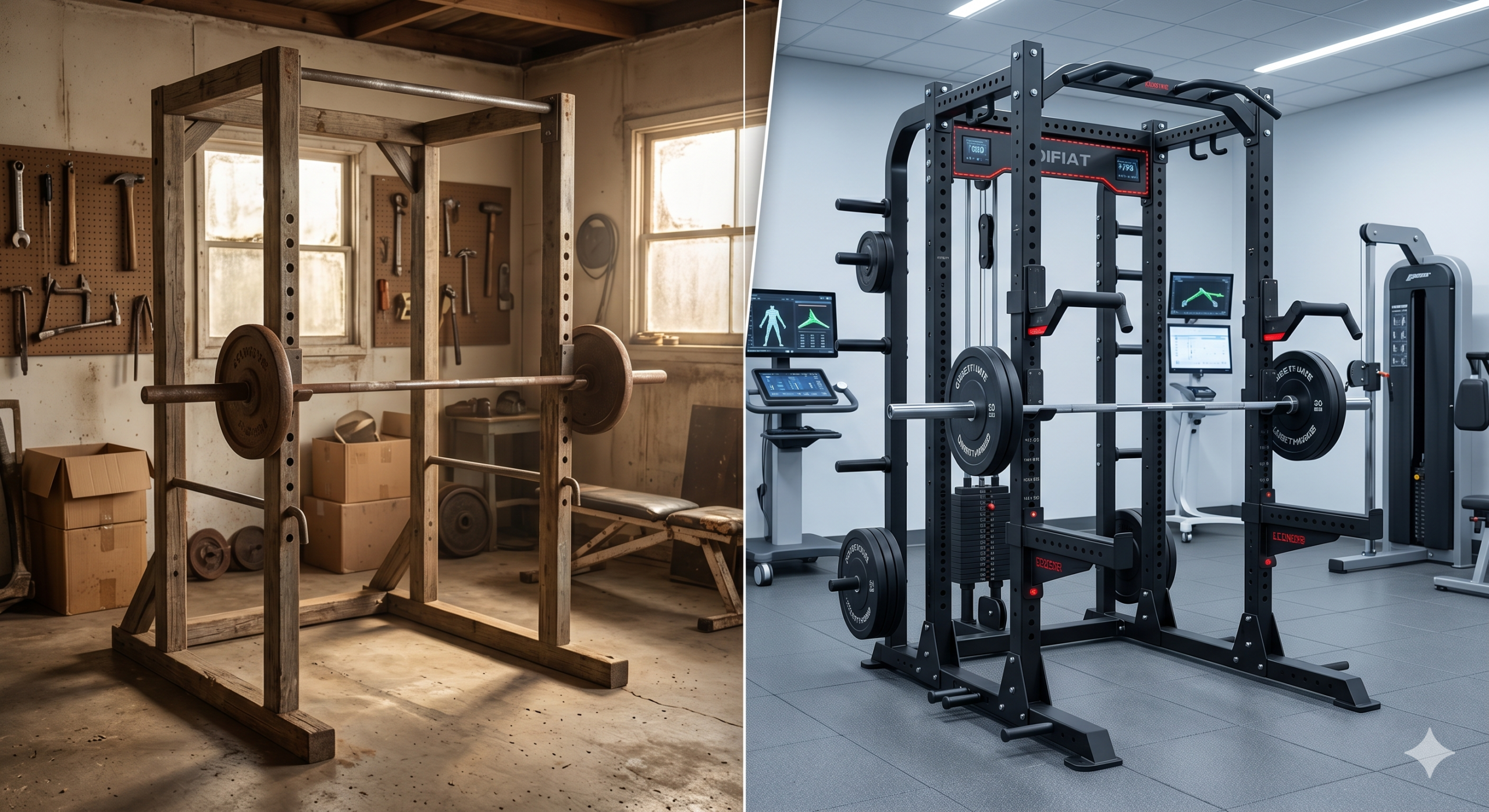
The power rack stands as perhaps the single most consequential piece of resistance training equipment ever engineered. We at the Hypertrophy Protocol Lab consider it the foundational architecture upon which modern strength science has been built—a structure that has evolved from hand-welded farm implements to precision-manufactured, 11-gauge steel platforms capable of supporting multi-axis loading in excess of 1,000 pounds. In this article, we trace the full arc of that evolution, from its crude origins on a Tennessee farm to the high-tech laboratory environments where we now conduct biomechanical research within its uprights.
Understanding this history is not merely an exercise in nostalgia. The engineering decisions made at each stage of the power rack’s development directly inform the specifications we rely on today—the gauge of steel, the hole spacing, the Westside hole pattern, the J-cup tolerances, and the safety mechanisms that allow us to push human physiology to its limits without catastrophic failure.
Before the power rack existed as a discrete apparatus, lifters trained with rudimentary squat stands—simple vertical posts, often wooden, with fixed-height hooks. These devices offered no failsafe mechanism. A missed lift meant either dumping the barbell rearward (risking spinal hyperextension injury) or collapsing under load with no mechanical arrest system.
Early Prototypes and the 1932 Squat Rack
Historical records indicate that basic squat rack prototypes appeared as early as 1932, primarily in Olympic weightlifting contexts. These were open-frame structures—two uprights without connecting crossmembers—offering barbell placement at a fixed height but zero lateral stability and no horizontal safety pins.
The Fundamental Engineering Problem
The core problem these early structures failed to solve was eccentric failure containment—the ability to safely arrest a descending load when the lifter reaches muscular failure during the eccentric (lowering) phase of a repetition. Without horizontal safety members spanning between uprights, any missed squat, bench press, or overhead movement posed an unmitigated injury risk. This single engineering gap would drive the invention of the power rack.
In exploring the evolution of strength training equipment, particularly the power rack, it’s fascinating to consider its impact on modern training methodologies. A related article that delves into the scientific principles behind muscle growth is “The Role of Mechanical Tension in Modern Hypertrophy Protocols.” This piece highlights how understanding mechanical tension can enhance training effectiveness and recovery, paralleling the advancements seen in power rack design and functionality. For more insights, you can read the article here: The Role of Mechanical Tension in Modern Hypertrophy Protocols.
Bob Peoples and the Birth of the Power Rack
We trace the origin of the modern power rack to Bob Peoples, a remarkably innovative farmer and self-taught strength athlete from Johnson City, Tennessee. Working in the basement of his rural farm in the early 1940s, Peoples constructed what we now recognize as the first true power rack—a four-post, enclosed steel frame with adjustable horizontal pin supports.
The Farm-Basement Laboratory
Peoples was not operating within an institutional framework. He learned training methodology primarily through mail-order magazines and correspondence with other lifters. His engineering approach was purely functional: he needed a structure that would allow him to train heavy deadlifts and partial-range movements alone, without a spotter, and without risk of being pinned under a failed repetition.
What he built was, in biomechanical terms, a self-spotting enclosure—four vertical posts connected by horizontal crossmembers, with adjustable pins that could be set at any height to catch the barbell if the lifter failed to complete a repetition. This design solved the eccentric failure containment problem definitively.
Peoples’ Deadlift Innovation
Peoples is historically recognized for his extraordinary deadlift—pulling over 700 pounds at a bodyweight of approximately 180 pounds, numbers that remained exceptional for decades. His rack allowed him to perform pin pulls (partial-range deadlifts from elevated starting positions), which we now understand as a method for overloading specific portions of the strength curve. The rack was not merely a safety device; it was a training tool that enabled novel loading strategies.
Institutional Preservation
In 2010, Peoples’ original rack was acquired by the Stark Center for Physical Culture and Sports at the University of Texas at Austin, where it is preserved as a historical artifact. We consider this acquisition significant—it represents the formal recognition of a garage-built apparatus as a cornerstone of strength training history.
Popularization and the Peary Rader Era
The power rack remained relatively obscure through the 1940s and 1950s, known primarily within small networks of competitive lifters. Its broader dissemination began in the 1960s through strength training publications.
The 1964 IronMan Article
Peary Rader, editor of IronMan magazine, published material in 1964 that brought the power rack concept to a wider training audience. Rader’s editorial influence cannot be overstated—IronMan was the primary information conduit for serious lifters in an era before digital media. His coverage legitimized the power rack as essential equipment rather than a regional curiosity.
Isometric and Partial-Range Training Advocacy
The 1960s also saw significant interest in isometric training protocols—pushing or pulling against immovable resistance at specific joint angles. The power rack was ideally suited for this application: lifters could set the safety pins at a specific height and press the barbell into the pins with maximal isometric effort. This dual functionality—as both a safety enclosure and an isometric training station—accelerated adoption among serious trainees.
Commercial Manufacturing Begins
By the late 1960s and 1970s, commercial manufacturers began producing power racks for gym installations. These early commercial units were typically constructed from 12-gauge or thicker mild steel tubing, welded into rectangular frames with drilled holes at 1-inch or 2-inch vertical spacing for pin adjustment. While functional, they lacked the precision engineering and material specifications we now consider standard.
Sure, here is the sentence with the clickable link:
Check out the latest fitness program at Hypertrophy Protocol for effective muscle building.
Westside Barbell and the Conjugate Method Revolution
No discussion of power rack history is complete without addressing the influence of Westside Barbell in Columbus, Ohio, under the direction of Louie Simmons. Beginning in the 1980s and reaching peak influence in the 1990s and 2000s, Westside fundamentally altered how the power rack was used as a training tool.
Band and Chain Accommodating Resistance
Simmons popularized the use of accommodating resistance—attaching elastic bands or chains to the barbell within the rack to alter the force curve throughout the range of motion. This demanded racks with specific attachment points, band pegs at the base, and sufficient structural rigidity to handle dynamic, oscillating loads rather than purely static ones.
The Westside Hole Pattern
One of the most significant engineering legacies of this era is the Westside hole pattern—a hole spacing configuration that provides holes at 1-inch intervals through the bench press zone (approximately 13 to 24 inches from the base) and 2-inch intervals elsewhere on the upright. This allows precise J-cup and safety pin placement at the critical heights where bench press bar path terminates, while reducing manufacturing cost and maintaining structural integrity in less critical zones.
We consider the Westside hole pattern a non-negotiable specification for any rack intended for serious hypertrophy or strength research. The ability to adjust safety height in 1-inch increments through the pressing zone allows us to set mechanical stops within millimeters of the lifter’s chest at failure depth—maximizing range of motion while maintaining absolute safety.
Shift Toward All-in-One Versatility
By the late 1990s and into the 2000s, the market began shifting toward multi-functional rack systems—units that integrated cable pulley stacks, lat pulldown stations, dip attachments, and landmine posts into the rack frame. This reflected a broader industry movement toward space-efficient, versatile training stations suitable for both commercial gyms and increasingly sophisticated home gym setups.
In exploring the evolution of strength training equipment, one can also delve into the intricacies of creating an effective workout space, as discussed in a related article on designing an elite performance environment in a compact area. This resource provides valuable insights into optimizing limited space for maximum training efficiency, which complements the historical journey of the power rack from humble garage gyms to sophisticated high-tech labs. For more information on this topic, you can read the article here.
The 11-Gauge Steel Standard and Modern 3×3 Rack Engineering
| Decade | Development |
|---|---|
| 1950s | Power racks were first developed for weightlifters to safely perform heavy lifts |
| 1960s | Power racks became popular in garage gyms and home setups |
| 1970s | Commercial gyms started incorporating power racks into their equipment offerings |
| 1980s | Advancements in materials and design led to more durable and versatile power racks |
| 1990s | High-tech features such as electronic monitoring and adjustable settings were introduced |
| 2000s | Power racks became a staple in professional sports training facilities and research labs |
We now arrive at the current era of power rack engineering—an era defined by material science precision, standardized dimensional specifications, and hardware tolerances borrowed from structural and mechanical engineering disciplines.
Understanding Steel Gauge in Rack Construction
Steel gauge is an inverse measurement system: lower gauge numbers indicate thicker material. The critical specifications we encounter in modern rack manufacturing are:
- 14-gauge steel (0.0747 inches / 1.897 mm wall thickness): Budget-tier residential racks. Adequate for loads under 600 pounds with minimal dynamic stress.
- 12-gauge steel (0.1046 inches / 2.657 mm): Mid-tier commercial racks. Acceptable for most training applications.
- 11-gauge steel (0.1196 inches / 3.038 mm): The professional and institutional standard. This is the minimum specification we accept for any rack used in our laboratory protocols.
The difference between 12-gauge and 11-gauge represents a 14.3% increase in wall thickness, which translates to substantially greater resistance to lateral deflection under load, improved weld-joint integrity, and superior long-term fatigue resistance under repeated cyclical loading.
The 3×3 Upright Specification
The 3×3 designation refers to the cross-sectional dimensions of the rack’s vertical uprights: 3 inches by 3 inches (76.2 mm × 76.2 mm) square steel tubing. Combined with 11-gauge wall thickness, this produces an upright with exceptional moment of inertia—the geometric property that determines resistance to bending under transverse load.
A 3×3, 11-gauge upright represents the biomechanical standard for racks subjected to loads exceeding 800 pounds, accommodating resistance systems (bands generating additional dynamic force vectors), and repeated high-velocity impacts from re-racking loaded barbells.
Hole Diameter and Hardware Tolerances
Modern precision racks feature laser-cut or CNC-machined holes at consistent diameters—typically 5/8 inch (15.875 mm) or 1 inch (25.4 mm)—with tolerances of ±0.005 inches. This precision ensures:
- Zero J-cup play: The J-cup pin seats flush within the hole without lateral wobble, preventing barbell migration during lift-off.
- Consistent safety pin engagement: Pins insert and lock without binding, enabling rapid height adjustment between sets.
- Attachment compatibility: Standardized hole sizing allows cross-manufacturer accessory compatibility within the 3×3 ecosystem.
Laser-Cut vs. Drilled Holes
We distinguish between laser-cut and mechanically drilled holes as a quality indicator. Laser cutting produces cleaner edges, more consistent diameters, and eliminates the burring and slight ovalization that mechanical drilling can introduce. For research environments where we require absolute repeatability of bar height positioning, laser-cut holes are the minimum acceptable standard.
The evolution of gym equipment has been a fascinating journey, and a related article that delves into this transformation is available for those interested in learning more about the advancements in modular gym systems. This piece explores how equipment has shifted from static frames to dynamic ecosystems, highlighting the innovations that have shaped modern fitness environments. You can read more about this evolution in the article on modular gym equipment, which complements the discussion on the history of the power rack and its impact on both personal and professional training spaces.
The Modern High-Tech Lab: Integration of the Power Rack Into Research Environments
Today, the power rack has transcended its origins as a standalone safety structure. In our laboratory and in peer institutions worldwide, it functions as the central architecture for integrated biomechanical measurement systems.
Force Plate Integration
Modern rack installations frequently incorporate embedded force plates within the platform area—piezoelectric or strain-gauge-based sensors that measure ground reaction forces in three axes (vertical, anterior-posterior, medial-lateral) at sampling rates of 1,000 Hz or greater. The rack provides the fixed spatial reference frame against which these force measurements are contextualized.
Linear Position Transducers and Velocity-Based Training
Linear position transducers (LPTs) and accelerometers attached to the barbell within the rack allow real-time measurement of bar velocity, displacement, and acceleration. This data enables velocity-based training protocols—autoregulating load based on concentric bar speed rather than percentage of one-repetition maximum. The rack’s fixed geometry provides the stable mounting points these instruments require.
Motion Capture Compatibility
High-speed optical motion capture systems (e.g., Vicon, OptiTrack) require unobstructed sight lines to reflective markers placed on the lifter’s body. Modern rack designs account for this by minimizing crossmember obstruction in the lateral plane and providing standardized dimensions that can be digitally modeled within capture software for occlusion prediction.
The University of Nebraska Model
Institutions such as the University of Nebraska have implemented half-rack and full-rack configurations integrated directly into athletic performance laboratories, where racks serve simultaneously as training apparatus, measurement platforms, and safety systems during maximal-effort testing protocols. This represents the full evolution from Peoples’ basement to institutional research infrastructure.
Conclusion: From Welded Farm Steel to Precision-Engineered Research Architecture
The power rack’s trajectory—from Bob Peoples’ hand-fabricated basement structure in rural Tennessee to the 11-gauge, 3×3, laser-cut, force-plate-integrated systems we operate within today—represents one of the clearest examples of iterative engineering refinement in the strength sciences.
Every specification we now treat as standard—the gauge, the hole pattern, the upright dimensions, the hardware tolerances—exists because a previous generation of lifters, coaches, or engineers identified a failure mode and solved it. Peoples solved eccentric failure containment. Simmons demanded band-peg integration and precise hole spacing. Modern manufacturers solved deflection and fatigue through material science.
We consider it our responsibility to understand this lineage—not as historical curiosity, but as engineering rationale. Every decision embedded in a modern rack’s design carries a biomechanical justification, and understanding that justification allows us to select, configure, and deploy these structures with the clinical precision our research demands.