
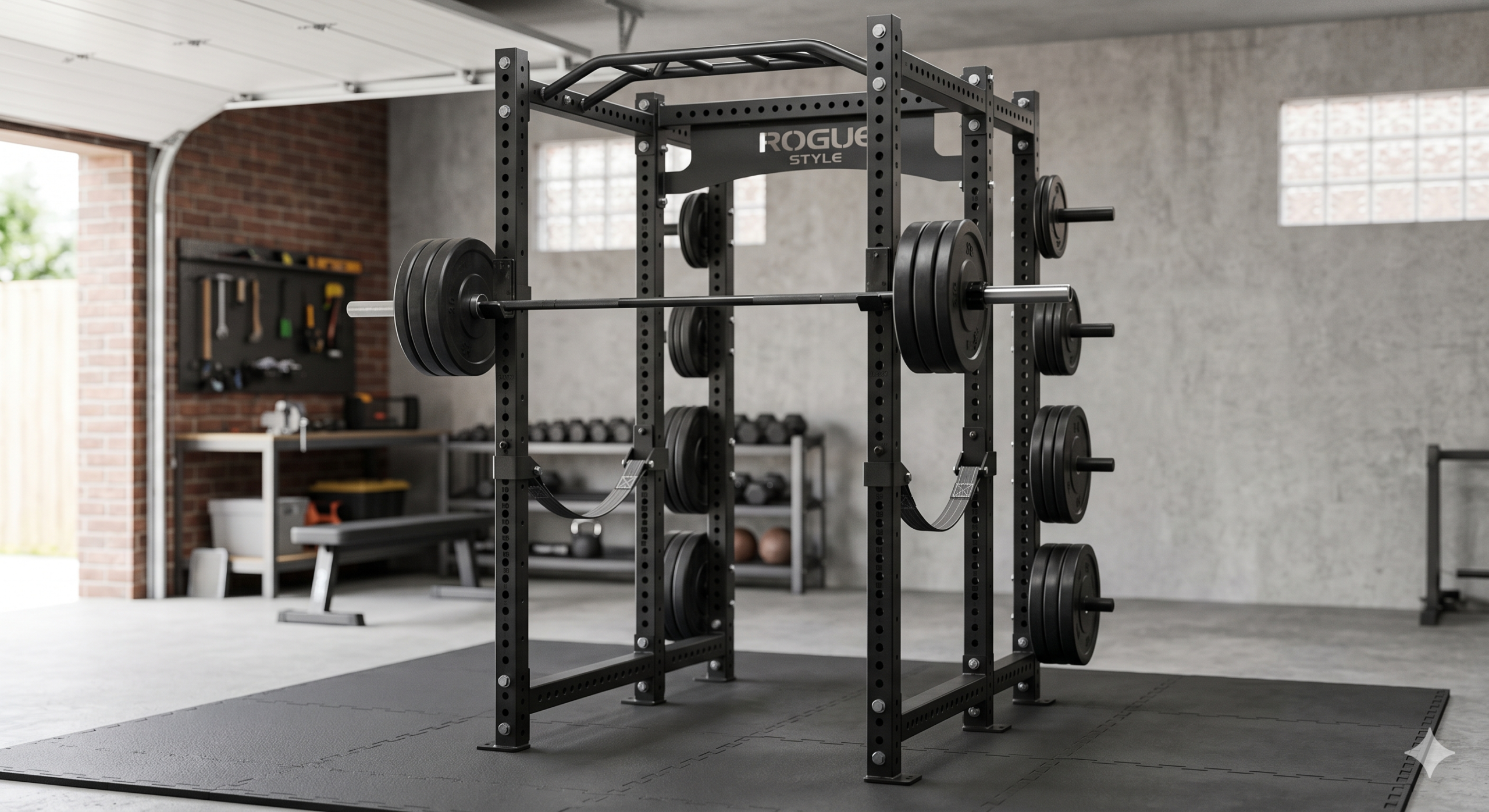
In our decades of evaluating strength training infrastructure, we have observed a clear and consistent pattern across elite performance facilities worldwide. Whether we examine Division I athletic departments, professional sports complexes, military tactical strength programs, or high-volume commercial training centers, the 3×3 steel rack system emerges repeatedly as the foundational hardware upon which serious programming is built. This is not coincidence, nor is it the result of marketing momentum. It is the product of engineering principles, biomechanical demands, and institutional-grade durability requirements converging on a single structural standard.
In this analysis, we break down precisely why our laboratory considers the 3×3 steel rack the definitive benchmark for professional performance environments — examining the metallurgy, the geometry, the modularity, and the long-term economic rationale that separates this standard from inferior alternatives.
When we refer to a “3×3” rack, we are describing the cross-sectional profile of the vertical uprights: 3 inches by 3 inches of square steel tubing. This is not an arbitrary measurement. It represents a carefully optimized balance between structural rigidity, material efficiency, and functional compatibility.
Moment of Inertia and Load Distribution
The moment of inertia — a measure of a structural member’s resistance to bending under load — scales with the fourth power of the cross-sectional dimension. This means that even modest increases in upright size produce disproportionately large gains in rigidity. A 3×3 upright offers approximately 185% greater moment of inertia compared to a 2×3 upright of identical wall thickness when loaded along the narrower axis. In practical terms, this translates directly to reduced deflection under heavy eccentric loading, fewer micro-vibrations during dynamic movements, and superior long-term resistance to fatigue-induced deformation.
Hole Spacing and J-Cup Engagement
The 3×3 profile provides sufficient surface area for standardized hole patterns — typically drilled at 1-inch or 2-inch intervals through the center of each face. This spacing allows precise J-cup height adjustment for athletes of varying anthropometry. The wider bearing surface of the 3×3 face ensures that J-cups, safety arms, and band pegs engage with maximum contact area, reducing point-loading stress concentrations that accelerate wear on both the upright and the attachment hardware.
Torsional Resistance During Asymmetric Loading
Professional environments demand equipment that can tolerate asymmetric loading without compromise. Single-arm landmine presses, unilateral rack pulls, and offset band setups all generate torsional forces that smaller uprights absorb poorly. The 3×3 profile’s torsional stiffness provides the mechanical confidence necessary for coaches to program aggressively without concern for equipment limitations constraining movement selection.
In exploring the advantages of 3×3 steel racks in professional performance facilities, it’s also beneficial to consider related insights on optimizing training environments. For instance, the article found at Hypertrophy Protocol delves into various equipment choices and their impact on athletic performance, providing a comprehensive overview that complements the discussion on the superiority of steel racks. This resource can enhance your understanding of how the right equipment contributes to effective training regimens.
11-Gauge Steel: The Metallurgical Standard for Institutional Use
The gauge of steel tubing defines its wall thickness, and consequently its load-bearing capacity, weld integrity, and resistance to impact damage. 11-gauge steel specifies a wall thickness of 0.120 inches (approximately 3.048 mm), and we consider this the minimum acceptable standard for any rack deployed in a professional or high-volume setting.
Why Not 12-Gauge or 14-Gauge?
We frequently encounter facilities that have attempted cost savings by specifying 12-gauge (0.105″) or 14-gauge (0.075″) wall thickness in their rack systems. The consequences are predictable and well-documented in our facility audits:
- Accelerated hole elongation: Thinner walls deform more rapidly at J-cup and safety arm contact points, creating progressive slop that introduces safety hazards under maximal loading
- Weld fatigue: Thinner parent material provides less substrate for weld penetration, reducing the fatigue life of critical joint connections
- Impact vulnerability: Dropped barbells, re-racking with aggressive force, and incidental contact from plates all generate impulse loads that thinner gauges absorb less gracefully, leading to denting, cosmetic degradation, and eventual structural compromise
The 11-Gauge Advantage in Weld Engineering
When we examine the welded joints of a properly fabricated 3×3 11-gauge rack, we observe full-penetration welds with adequate heat-affected zone (HAZ) characteristics. The 0.120″ wall provides sufficient thermal mass to prevent burn-through during MIG or TIG welding processes, while also offering adequate material for post-weld grinding without compromising structural integrity. This is the threshold at which industrial welding practices produce joints that exceed the yield strength of the parent material — a critical criterion for equipment expected to endure decades of daily use.
Corrosion and Longevity Considerations
Thicker gauge material inherently provides a greater corrosion allowance. In high-humidity environments — common in facilities without climate control, or in tactical training contexts — surface oxidation progressively reduces effective wall thickness. Beginning with 11-gauge material provides a meaningful safety margin that thinner alternatives cannot match, extending functional service life by years or even decades under identical environmental conditions.
Modularity and the Attachment Ecosystem
One of the most compelling arguments for the 3×3 standard extends beyond the rack itself and into the ecosystem of attachments, accessories, and expansion options that this platform supports.
Industry-Wide Compatibility
The 3×3 format with standardized hole patterns (typically 5/8″ diameter holes on Western-style racks) has achieved what we consider de facto universal compatibility across multiple manufacturers. This means that facilities are not locked into a single vendor’s proprietary ecosystem. J-cups, safety straps, monolift attachments, belt squat levers, lat pulldown stations, cable crossover assemblies, and dozens of other accessories from numerous manufacturers will interface correctly with any properly manufactured 3×3 rack.
Expanding the Training Menu Without Expanding the Footprint
Recent developments in the 3×3 attachment market — including specialized hardware such as leg holder/footplate combinations, knurled dip handles with enhanced grip geometry, and swivel seats for supported rowing variations — demonstrate the ongoing expansion of training possibilities within a fixed equipment footprint. Force USA’s 2026 expansion of their 3×3 product line exemplifies this trajectory, adding functional training stations to existing rack infrastructure without requiring additional floor space or separate equipment purchases.
Future-Proofing Facility Investment
We advise every facility we consult with to consider a 10-to-20-year equipment lifecycle when specifying rack systems. The 3×3 standard’s dominance ensures that future attachment innovations will be engineered for this platform first. Facilities that invest in 3×3 infrastructure today are purchasing compatibility with accessories and expansions that have not yet been designed. This is not true of proprietary or non-standard rack dimensions, which may face accessory discontinuation as manufacturers consolidate around the 3×3 format.
Sure, here is the sentence with the clickable link:
Check out the latest fitness program at Hypertrophy Protocol for effective muscle building.
Biomechanical Demands of Professional Training Environments
Professional performance facilities are not commercial gyms. The loading profiles, usage patterns, and athlete populations they serve create engineering demands that exceed standard fitness equipment specifications by substantial margins.
Peak Force Magnitudes
Elite athletes routinely generate forces that dwarf general population norms. A 150kg back squat performed with compensatory acceleration may generate peak barbell forces exceeding 400kg during the deceleration phase of re-racking. When bands or chains are added, these impulse loads increase further. The 3×3 11-gauge platform is engineered to absorb these forces with minimal elastic deformation, ensuring that safety hardware remains securely positioned even under worst-case loading scenarios.
High-Volume Utilization Cycles
A Division I football program may cycle 120+ athletes through a rack room in a single training session. Each rack may experience 200+ individual set contacts per day, 5-6 days per week, 48+ weeks per year. Over a 15-year expected service life, this translates to hundreds of thousands of loading cycles per rack. Only the 3×3 11-gauge standard demonstrates the fatigue resistance necessary to maintain structural certification over this utilization volume without requiring major component replacement.
Dynamic and Ballistic Loading Profiles
Professional training extends well beyond static barbell work. Accommodating resistance (bands and chains), ballistic throws against safety pins, forced eccentric overloads, and plyometric box interactions all generate dynamic force profiles characterized by high rate-of-force-development and sharp impulse peaks. The mass and stiffness of 3×3 11-gauge uprights provide superior damping characteristics, reducing transmitted vibration and maintaining positional stability of safety hardware during these demanding applications.
In exploring the benefits of 3×3 steel racks for professional performance facilities, it’s also insightful to consider how these structures enhance overall training efficiency and safety. For a deeper understanding of strength training methodologies and equipment, you might find the article on hypertrophy training particularly useful. This resource delves into the science behind muscle growth and how the right equipment, like 3×3 steel racks, can optimize your workouts. You can read more about it in this related article.
Economic Analysis: Total Cost of Ownership
| Reasons | Benefits |
|---|---|
| Durability | 3×3 steel racks are extremely durable and can withstand heavy loads, making them ideal for professional performance facilities. |
| Stability | These racks provide excellent stability, ensuring safety during heavy lifting and intense workouts. |
| Customization | They can be easily customized with various attachments and accessories to meet specific training needs. |
| Space Efficiency | 3×3 steel racks are designed to maximize space efficiency, making them suitable for facilities with limited space. |
| Professional Appearance | These racks have a sleek and professional appearance, enhancing the overall look of the facility. |
We recognize that 3×3 11-gauge rack systems carry a higher initial acquisition cost compared to lighter-gauge alternatives. However, our facility lifecycle analyses consistently demonstrate that the total cost of ownership (TCO) favors the heavier standard when all factors are properly accounted.
Replacement and Repair Frequency
Lighter-gauge racks in high-volume environments typically require component replacement (J-cups, safety arms, pin hardware) at 3-5 year intervals due to wear-induced slop and deformation. They frequently require full replacement at 7-10 years. The 3×3 11-gauge standard routinely exceeds 15 years of service with minimal maintenance and no structural component replacement, representing a 50-100% extension in functional service life.
Liability and Risk Management
Equipment failure in a professional setting carries catastrophic liability exposure. A single J-cup failure under a 200kg squat represents not only an athlete injury risk but a potential multi-million-dollar institutional liability event. We consider the marginal cost difference between 11-gauge and lighter alternatives to be trivially small compared to the actuarial liability reduction that the heavier standard provides.
Resale Value and Institutional Asset Management
Well-maintained 3×3 11-gauge racks retain substantial resale value on the secondary market, typically commanding 40-60% of original purchase price even after a decade of institutional use. Lighter-gauge equipment depreciates far more aggressively, often reaching near-zero residual value within 5-7 years due to visible wear and reduced functional confidence.
Facility Design Integration and Space Optimization
Consistent Mounting and Anchoring Standards
The 3×3 platform’s standardized base plate dimensions and bolt patterns simplify facility design and concrete anchor specification. Structural engineers can specify anchor bolt patterns with confidence, knowing that future rack replacements or expansions will utilize identical mounting geometry. This eliminates costly concrete work during equipment refreshes — a hidden expense that facilities with non-standard equipment frequently discover during renovation cycles.
Modular Bay Expansion
Most 3×3 systems are designed with bolt-together modular bay architecture, allowing facilities to add training stations incrementally as programming demands or budgets evolve. A facility may begin with four single-bay racks and expand to an eight-bay connected structure without any structural modification — simply by adding connecting crossmembers and additional uprights using standardized hardware.
Vertical Space Utilization
The 3×3 standard is available in upright heights ranging from 90 inches to 108+ inches, with pull-up bar and storage options that maximize vertical space utilization. In facilities with ceiling height constraints, the predictable geometry of 3×3 systems allows architects to specify minimum clearances with confidence during the design phase.
Our Institutional Recommendation
After rigorous evaluation of structural engineering data, facility lifecycle performance metrics, biomechanical loading requirements, and total economic analysis, we affirm without reservation that the 3×3 11-gauge steel rack represents the only appropriate standard for professional performance facilities. Facilities that specify lighter, smaller, or proprietary alternatives are accepting compromises in safety margin, service life, modularity, and long-term economic efficiency that no credible performance program should tolerate.
The 3×3 standard earned its position not through marketing — but through physics, metallurgy, and the unforgiving demands of athletes who push equipment to its absolute operational limits, day after day, year after year. It is the standard because nothing else has proven adequate to the task.
1 thought on “Why 3×3 Steel Racks are the Gold Standard for Professional Performance Facilities”
Comments are closed.