
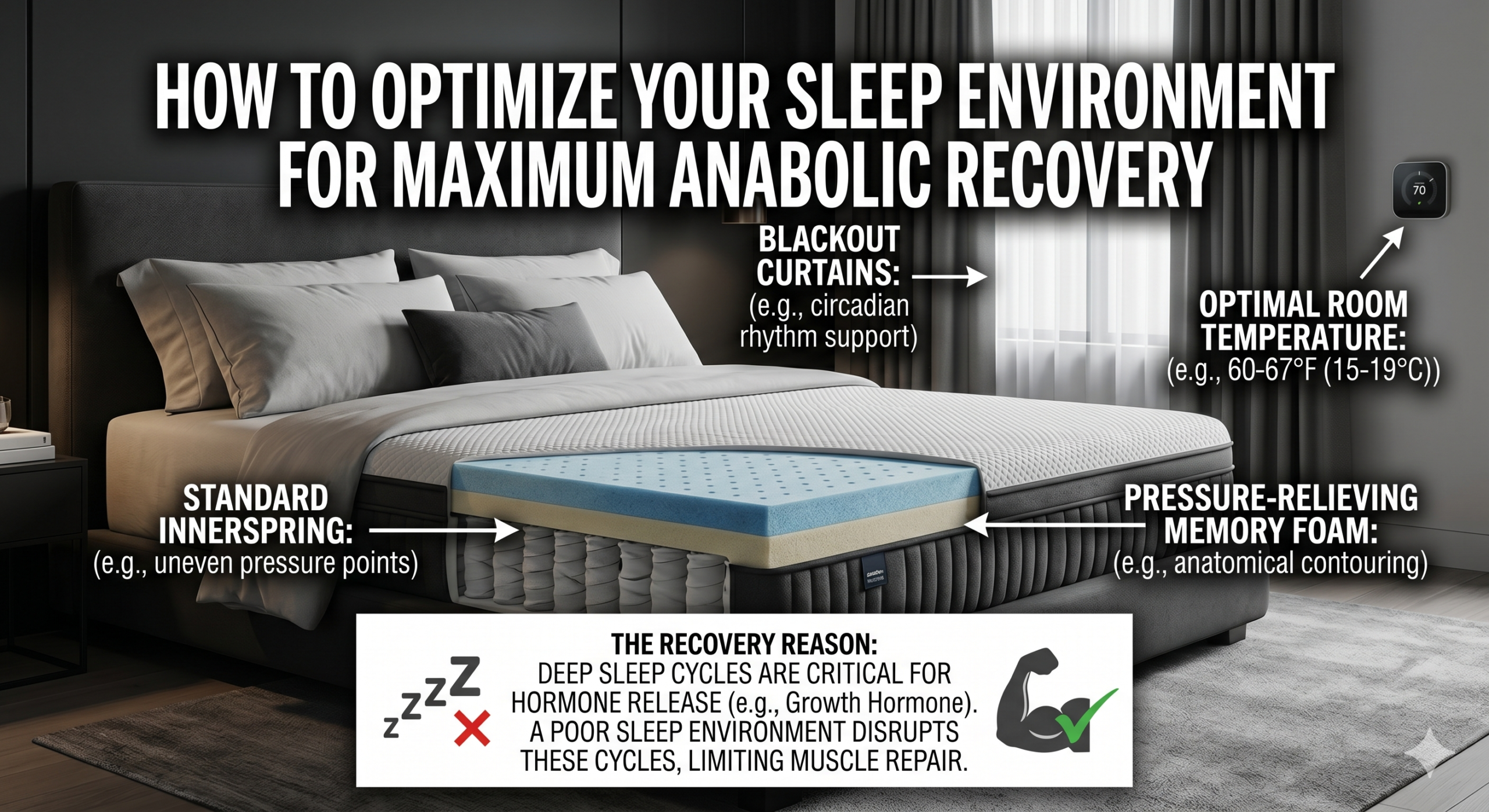
At the Hypertrophy Protocol Lab, we regard sleep environment optimization as a non-negotiable variable in the anabolic recovery equation. While most practitioners fixate on training volume, nutrient timing, and supplementation protocols, we consistently observe that the physical sleep environment—the measurable conditions under which nocturnal recovery occurs—represents one of the most underleveraged interventions available to resistance-trained individuals.
Key institutional position: Sleep is not merely “rest.” It is the primary physiological window during which muscle protein synthesis (MPS) peaks, growth hormone (GH) pulses occur, and the hypothalamic-pituitary-gonadal (HPG) axis restores testosterone to baseline concentrations. A compromised sleep environment directly attenuates these processes, regardless of how well-designed the training or nutrition program may be.
In this protocol brief, we present our evidence-based framework for engineering a sleep environment that maximizes anabolic output. Each recommendation is grounded in peer-reviewed research and translated into actionable environmental modifications.
Before we address specific environmental variables, we must establish the mechanistic rationale. Sleep architecture—the cyclical progression through NREM stages 1–3 and REM sleep—is not merely a passive state. It is an actively regulated neuroendocrine process during which the following anabolic events occur:
- Growth Hormone (GH) secretion: Approximately 70% of daily GH output occurs during slow-wave sleep (SWS), also designated as NREM Stage 3 (Van Cauter et al., 2000). GH is the primary driver of tissue repair, lipolysis, and collagen synthesis.
- Testosterone restoration: Serum testosterone concentrations rise during sleep and peak in early morning hours. Sleep fragmentation or reduction to fewer than 5 hours per night has been shown to reduce testosterone by 10–15% in young males (Leproult & Van Cauter, 2011).
- Cortisol regulation: The hypothalamic-pituitary-adrenal (HPA) axis is suppressed during early sleep, creating an anabolic-dominant hormonal milieu. Environmental disruptions that cause micro-arousals elevate nocturnal cortisol, shifting the anabolic-catabolic ratio toward net protein degradation.
The critical insight: Any environmental stimulus that fragments sleep architecture—light intrusion, thermal discomfort, acoustic disturbance—directly reduces the duration and depth of slow-wave sleep, thereby truncating GH pulses and impairing the hormonal cascade required for muscle repair.
To further enhance your understanding of optimizing recovery, you may find it beneficial to explore the article on mitochondrial health, which discusses its crucial role in achieving consistent strength gains. This resource complements the insights provided in “How to Optimize Your Sleep Environment for Maximum Anabolic Recovery” by highlighting the importance of cellular energy production in the recovery process. For more information, visit the article here: Mitochondrial Health: The Hidden Key to Consistent Strength Gains.
Photonic Control: Engineering Complete Darkness
The Melatonin-GH Axis
Light is the dominant zeitgeber (time-giver) for the suprachiasmatic nucleus (SCN), the master circadian pacemaker located in the anterior hypothalamus. Even low-level ambient light exposure during sleep suppresses melatonin secretion from the pineal gland (Gooley et al., 2011). Melatonin does not directly stimulate muscle growth, but it serves as the biochemical signal that initiates sleep onset and facilitates the transition into deep NREM stages where GH secretion occurs.
Our protocol recommendation:
- Install true blackout curtains (not “room-darkening” variants). We specify curtains with a minimum opacity rating that blocks 99.9% of external photonic input. Hirshkowitz et al. (2015) and Lunsford-Avery et al. (2019) have documented that even minimal light intrusion—from streetlamps, LED indicators on electronics, or hallway light under doors—measurably reduces sleep efficiency scores.
- Eliminate all internal light sources. Cover standby LEDs on devices with opaque tape. Remove digital clocks with illuminated displays from the line of sight.
- Target a lux reading of 0–1 lux at eye level during sleep. We recommend using a lux meter application during initial setup to verify environmental darkness.
Pre-Sleep Blue Light Restriction
The melanopsin-containing intrinsically photosensitive retinal ganglion cells (ipRGCs) are maximally sensitive to short-wavelength light in the 460–480nm range—precisely the spectral output of smartphones, tablets, and LED monitors. Chang et al. (2015) demonstrated that evening iPad use suppressed melatonin by over 50%, delayed melatonin onset by approximately 1.5 hours, and reduced next-morning alertness.
Our protocol recommendation:
- Enforce a hard electronics curfew of 60–90 minutes before target sleep onset. This is not a suggestion; it is a physiological requirement for normal melatonin kinetics.
- If screen use is unavoidable, we specify hardware-level blue light filters (amber-tinted glasses with verified spectral blocking at 450–500nm) rather than software “night mode,” which typically reduces but does not eliminate blue-spectrum emission.
- The downstream effect on the anabolic environment is measurable: Preserved melatonin onset → earlier SWS entry → larger GH pulse amplitude → enhanced overnight MPS rates.
Thermal Engineering: The 60–67°F Recovery Window
Core Temperature and Sleep Stage Progression
Sleep onset is thermoregulatorily gated. The preoptic area of the hypothalamus initiates sleep when core body temperature drops by approximately 1–1.5°C. This decline is facilitated by peripheral vasodilation—blood flow to the extremities increases, radiating heat away from the core. An ambient environment that is too warm impedes this heat dissipation and delays or prevents entry into deep sleep stages.
The clinically validated thermal window for optimal sleep architecture is 60–67°F (15.5–19.4°C). This range facilitates:
- Efficient core temperature decline at sleep onset
- Sustained time in SWS (where GH pulses are maximally concentrated)
- Reduced nocturnal awakenings due to thermal discomfort
Practical Thermal Protocol
We specify the following layered approach:
- Room ambient temperature: Set HVAC or climate control to 65°F (18.3°C) as the default starting point. Individual variation exists; we recommend titrating by 1°F increments based on subjective sleep quality and, where available, wearable-derived deep sleep duration data.
- Bedding thermal load: Use breathable, moisture-wicking materials (e.g., Tencel, bamboo-viscose, or high-thread-count percale cotton). Avoid synthetic polyester blends that trap metabolic heat.
- Mattress thermal conductivity: Memory foam variants retain heat. If using memory foam, we recommend gel-infused variants or supplemental cooling mattress toppers with phase-change material technology.
- For individuals training in the evening: Post-exercise thermogenesis can elevate core temperature for 2–4 hours. If evening training is unavoidable, a warm shower 60–90 minutes before bed paradoxically accelerates core cooling via post-shower peripheral vasodilation (the “warm bath effect” documented by Haghayegh et al., 2019).
Key takeaway: A room that feels “slightly cool” upon entering is correctly calibrated. If you require heavy blankets to feel comfortable, the ambient temperature is likely within the optimal range—the blanket provides perceived comfort while the cool air facilitates core temperature regulation.
Sure, here is the sentence with the clickable link:
Check out the latest fitness program at Hypertrophy Protocol for effective muscle building.
Acoustic Environment: Eliminating Micro-Arousal Events
The Neuroscience of Noise-Induced Sleep Fragmentation
The auditory cortex does not fully deactivate during sleep. Environmental noise—particularly intermittent, unpredictable sounds (traffic, neighbors, appliance cycling)—triggers cortical micro-arousals. These are brief (3–15 second) shifts from deeper to lighter sleep stages that the sleeper typically does not consciously perceive or recall. However, their cumulative effect is devastating to anabolic recovery:
- Each micro-arousal resets the SWS cycle progression
- Fragmented SWS reduces integrated GH output proportionally to the number of disruptions
- Elevated sympathetic nervous system activation during micro-arousals increases nocturnal cortisol, promoting a catabolic state
Our Acoustic Protocol
- White noise generators: We recommend dedicated hardware units (not phone applications, which reintroduce the screen-in-bedroom problem) producing broadband noise at 40–50 dB. White noise functions by elevating the arousal threshold—the difference between background noise and intrusive sound spikes is reduced, preventing the auditory cortex from triggering an arousal response.
- Pink noise consideration: Some evidence suggests pink noise (which has greater power in lower frequencies) may actively enhance SWS consolidation (Ngo et al., 2013). We consider this a viable alternative.
- Earplugs: For individuals in high-noise environments (urban settings, shared housing), we specify foam earplugs with an NRR (Noise Reduction Rating) of 30+ dB as an adjunctive measure. Custom-molded silicone variants provide superior comfort for side-sleepers.
- Structural modifications: Where budget permits, acoustic weatherstripping on bedroom doors and double-pane windows represent permanent solutions that eliminate the noise variable entirely.
The protein synthesis implication is direct: Uninterrupted sleep cycles allow MPS rates to remain elevated throughout the full 7–9 hour sleep window. Fragmented sleep truncates this window, reducing overnight net protein balance—the very metric that determines whether today’s training stimulus results in hypertrophy or merely damage.
Creating an optimal sleep environment is crucial for maximizing anabolic recovery, and understanding the role of mechanical tension in your training can further enhance your results. For those interested in diving deeper into how different factors influence muscle growth and recovery, you may find this article on the role of mechanical tension particularly insightful. By combining effective sleep strategies with knowledge about training techniques, you can significantly improve your overall performance and recovery.
Sleep Surface Biomechanics: Mattress and Pillow Selection
| Factors | Optimal Conditions |
|---|---|
| Temperature | Around 65-70°F (18-21°C) for most people |
| Light | Dark room or use blackout curtains |
| Noise | Quiet environment or use white noise machine |
| Mattress and Pillow | Supportive and comfortable for your body |
| Air Quality | Well-ventilated room with clean air |
| Electronic Devices | Avoid screens at least an hour before bed |
Spinal Alignment and Muscular Recovery
We approach bedding selection not as a comfort preference but as a biomechanical intervention. During sleep, the musculoskeletal system must be positioned to allow:
- Neutral spinal alignment (maintenance of natural cervical lordosis, thoracic kyphosis, and lumbar lordosis)
- Pressure distribution across the greatest possible surface area to prevent localized ischemia
- Minimal positional shifting (excessive tossing indicates pressure point discomfort, which triggers micro-arousals)
Our Specification Framework
Mattress selection:
- Medium-firm surfaces consistently demonstrate the best outcomes for spinal alignment and pain reduction in controlled studies (Jacobson et al., 2010). We define “medium-firm” as approximately 5–7 on the industry-standard 10-point firmness scale.
- The mattress must accommodate the individual’s body composition. Higher-mass individuals (which describes most serious resistance-trained athletes) require firmer support to prevent excessive sinkage at the hips, which creates lumbar flexion and associated paraspinal tension.
- Replacement interval: We specify mattress replacement every 7–8 years, or sooner if visible sagging or asymmetric wear patterns develop.
Pillow selection:
- Pillow height (loft) must maintain cervical spine neutrality relative to sleeping position. Side sleepers require higher loft to bridge the shoulder-to-ear distance. Back sleepers require moderate loft. Stomach sleeping is biomechanically contraindicated due to forced cervical rotation.
- Materials that contour (shredded memory foam, buckwheat hull, or molded latex) provide superior cervical support versus down or polyester fill, which compress unevenly.
The recovery rationale: Suboptimal sleep posture creates sustained low-grade muscular tension in paraspinal, cervical, and hip musculature throughout the night. This tension maintains sympathetic tone, reduces blood flow to recovering tissues, and can produce morning stiffness that interferes with subsequent training sessions—creating a compounding recovery deficit.
Psychological Conditioning: The Sleep-Only Zone Principle
Stimulus Control Theory Applied to the Sleep Environment
We implement the stimulus control model originally developed by Bootzin (1972) and validated extensively in cognitive behavioral therapy for insomnia (CBT-I). The principle is straightforward: the brain forms associative pairings between environmental contexts and behavioral states. When the bed is used for work, screen consumption, eating, or extended wakefulness, the bedroom becomes neurologically associated with arousal states rather than sleep.
Implementation Protocol
- The bed is used exclusively for sleep and sexual activity. No exceptions. No reading in bed, no television, no phone scrolling, no laptop work.
- If unable to fall asleep within 15–20 minutes, we instruct individuals to leave the bed and engage in a low-stimulation activity (reading in dim light in another room) until genuine drowsiness returns. This prevents the formation of bed-wakefulness associations.
- Consistent sleep-wake timing: The SCN requires temporal consistency to properly calibrate circadian phase. We specify a fixed wake time (±30 minutes) seven days per week, including weekends. “Sleep debt repayment” via weekend oversleeping disrupts Monday-night sleep onset and perpetuates circadian misalignment.
- Pre-sleep ritual standardization: A consistent 20–30 minute wind-down sequence (dim lighting, light stretching, controlled breathing) performed in the same order each night creates a Pavlovian sleep-onset association that accelerates the transition from wakefulness to NREM Stage 1.
The anabolic implication: Faster sleep onset means more total sleep time within a fixed schedule. An individual who falls asleep in 8 minutes versus 45 minutes gains an additional 37 minutes of potential SWS and REM exposure per night—extrapolated across a training mesocycle, this represents hours of additional anabolic hormone exposure.
Integration: The Compounding Effect of Environmental Optimization
We must emphasize that these variables are not independent—they interact multiplicatively. A cool, dark, quiet room with proper spinal support in which the occupant has strong sleep-onset conditioning produces a fundamentally different physiological outcome than optimizing only one or two variables in isolation.
Our summary protocol for immediate implementation:
| Variable | Target Specification | Primary Anabolic Mechanism |
|-|||
| Light | 0–1 lux; no blue light 60–90 min pre-sleep | Melatonin preservation → SWS entry → GH pulse amplitude |
| Temperature | 60–67°F (15.5–19.4°C) | Core temp decline → SWS duration → GH output |
| Noise | <30 dB or masked with 40–50 dB white/pink noise | Micro-arousal elimination → uninterrupted MPS window |
| Sleep surface | Medium-firm; neutral spinal alignment | Reduced sympathetic tone → tissue perfusion → recovery |
| Behavioral conditioning | Bed = sleep only; consistent timing | Faster onset → more total restorative sleep time |
We have observed repeatedly in our applied practice that athletes who implement this complete environmental protocol report measurable improvements in training readiness within 7–14 days—often before any modification to training load, caloric intake, or supplementation. The sleep environment is not a luxury optimization. It is the foundation upon which every other recovery variable depends.
Our final position: You cannot out-supplement, out-eat, or out-train a compromised sleep environment. Engineer the environment correctly, and the endocrine system will do what it evolved to do—repair, rebuild, and adapt.