
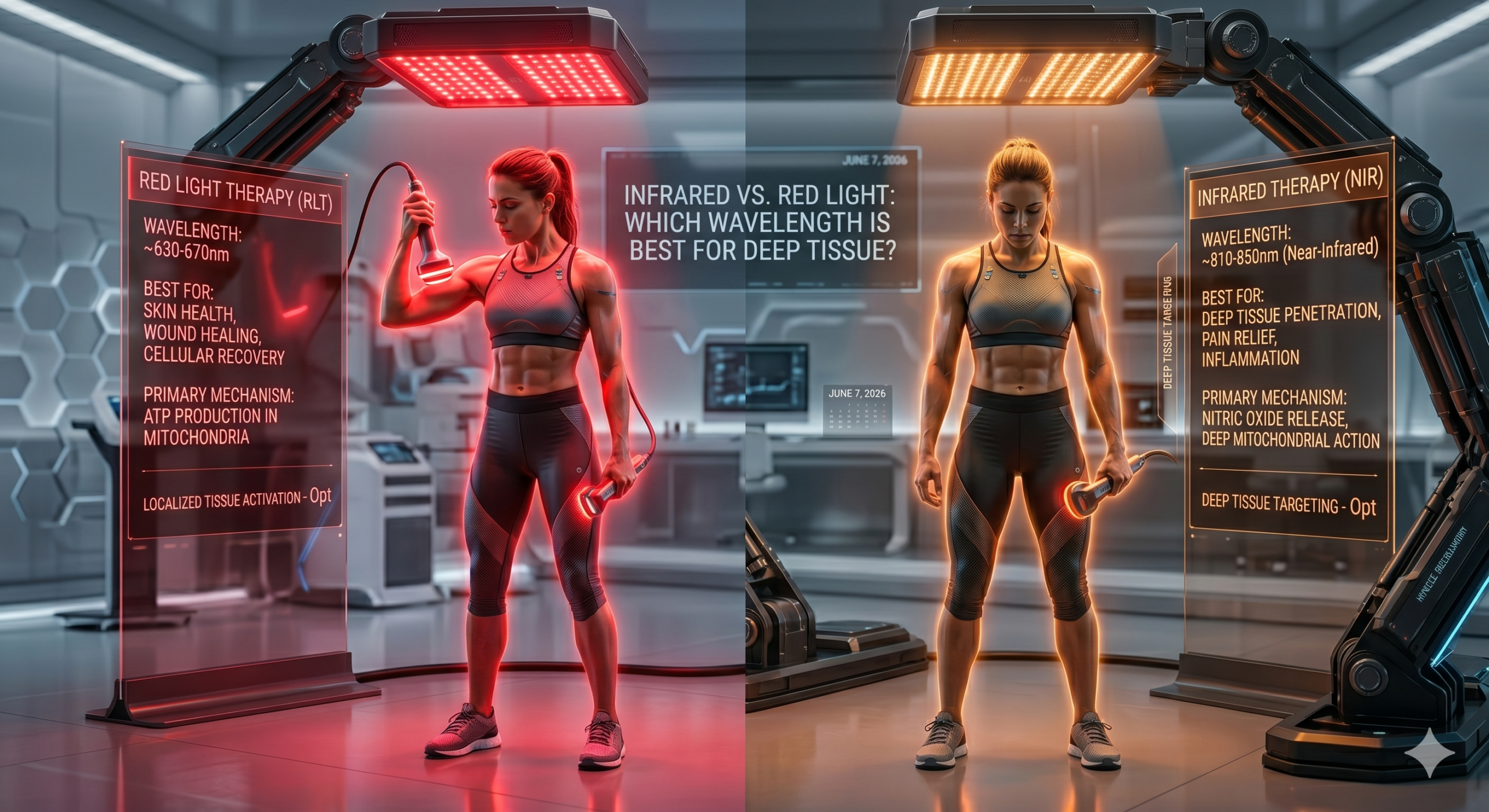
At the Hypertrophy Protocol Lab, we encounter this question with increasing frequency from athletes, clinicians, and performance coaches alike: when the therapeutic goal is deep tissue penetration—reaching muscle bellies, joint capsules, and periosteal layers—which photobiomodulation (PBM) wavelength actually delivers? The answer is not a matter of brand preference or marketing narrative. It is a matter of physics, specifically the optical properties of human tissue and the absorption spectra of chromophores within our cells.
In this analysis, we will dissect the mechanistic differences between red light and infrared light, clarify the clinical evidence for each wavelength range, and provide our protocol-level recommendations for practitioners who need to make precise decisions about their recovery and tissue-remodeling environments.
Before we compare wavelengths, we need to establish a shared vocabulary. Photobiomodulation (PBM) refers to the use of non-ionizing photonic energy—light—to trigger photochemical changes within cellular structures. This is not thermal therapy. The mechanism is photochemical, not photothermal, at least within the dosimetry parameters we are discussing.
The wavelengths relevant to PBM fall within what researchers call the “optical window” of biological tissue, approximately 600nm to 1100nm. Within this window, two distinct zones matter most:
- Red light: approximately 620–700nm
- Near-infrared (NIR) light: approximately 700–1100nm
Both zones interact with cytochrome c oxidase (CCO), a key enzyme in the mitochondrial electron transport chain (Complex IV). When photons at these wavelengths are absorbed by CCO, they dissociate inhibitory nitric oxide (NO) from the enzyme’s binding site, thereby restoring and enhancing mitochondrial respiration, increasing adenosine triphosphate (ATP) output, and modulating reactive oxygen species (ROS) signaling.
Why the “Optical Window” Matters
Human tissue is not uniformly transparent. Hemoglobin, water, melanin, and lipid content all influence how deeply a photon can travel before it is absorbed or scattered. Below 600nm, hemoglobin absorbs most incoming light. Above approximately 1100nm, water absorption becomes dominant. Between these boundaries—the optical window—light has its greatest chance of reaching subsurface structures.
Key takeaway: Not all “light therapy” is photobiomodulation. The therapeutic mechanism depends on delivering photons within the optical window at sufficient irradiance to the target chromophore.
In exploring the differences between infrared and red light therapy for deep tissue treatment, it’s also beneficial to consider the broader implications of light therapy on overall health and performance. A related article that delves into the importance of mitochondrial health and its impact on strength gains can provide valuable insights. You can read more about this topic in the article titled “Mitochondrial Health: The Hidden Key to Consistent Strength Gains” available at this link.
Red Light (630–660nm): Surface-Level Precision
Red light in the 630–660nm range has robust evidence for superficial tissue applications. At our lab, we categorize these as targets within approximately 1–4 millimeters of the skin surface, though effective penetration can extend slightly deeper depending on tissue type, skin pigmentation, and device irradiance.
Primary Tissue Targets for Red Light
- Dermis and epidermis: Fibroblast stimulation, collagen synthesis upregulation, elastin remodeling
- Superficial capillary beds: Enhanced microcirculation, reduced localized inflammation
- Wound margins: Accelerated epithelialization and granulation tissue formation
- Sebaceous glands and hair follicles: Modulation of inflammatory acne pathways; stimulation of follicular stem cells in androgenetic alopecia protocols
The 660nm Benchmark
Within the red spectrum, 660nm has emerged as the most frequently validated wavelength in peer-reviewed PBM literature for surface tissue outcomes. This is not arbitrary. At 660nm, the absorption coefficient of cytochrome c oxidase is near a local peak, meaning a high proportion of photons at this wavelength are productively absorbed rather than simply scattered.
Key takeaway: For skin-level goals—collagen support, wound healing, skin tone normalization, and superficial inflammatory conditions—660nm is our standard protocol wavelength. It is not designed for, nor optimally suited to, deep tissue penetration.
Near-Infrared Light (810–850nm): The Deep Tissue Workhorse
When the clinical target sits beneath the skin—skeletal muscle, tendons, ligaments, joint capsules, periosteum, or even superficial bone cortex—we need wavelengths that can survive the scattering and absorption gauntlet of overlying tissue. This is where near-infrared light, specifically the 810–850nm range, becomes the primary tool.
Why NIR Penetrates Deeper
Two factors explain the superior penetration of NIR over red light:
- Reduced scattering coefficient. As wavelength increases within the optical window, the Mie scattering effect (scattering caused by cellular structures of similar size to the wavelength) decreases. Longer wavelengths are deflected less by dermal collagen fibers and cellular organelles.
- Lower absorption by superficial chromophores. Melanin and oxyhemoglobin absorb less aggressively in the NIR range compared to the red range, allowing a greater proportion of photons to transit through the dermal and subdermal layers.
The result: NIR photons at 810–850nm can reach effective therapeutic depths of approximately 20–40mm in soft tissue, depending on anatomical location, adipose thickness, and device parameters. Some researchers have documented measurable photon flux at depths exceeding 50mm in lean tissue, though the irradiance at that depth is substantially attenuated.
The 850nm Standard
In our protocols, 850nm is the default wavelength for deep tissue applications in home-use and clinical-grade devices. It sits in a favorable zone where:
- Cytochrome c oxidase still has meaningful absorption
- Tissue penetration is substantially deeper than red light
- Water absorption has not yet become a limiting factor (water absorption begins climbing steeply above approximately 950nm)
- There is a large body of clinical literature supporting efficacy for musculoskeletal targets
810nm vs. 850nm: Is There a Meaningful Difference?
We are frequently asked whether 810nm or 850nm is “better.” The honest answer is that the clinical difference between these two wavelengths is marginal for most musculoskeletal applications. Both fall within the same absorption and penetration profile. Some earlier landmark studies—particularly those by Hashmi et al. and Hamblin’s group—used 810nm diodes, which has led to its frequent citation. More recent commercial devices have converged on 850nm, partly because LED manufacturing at this wavelength has become cost-effective without sacrificing efficacy.
Key takeaway: For deep tissue targets—muscle recovery, joint inflammation, tendon repair, delayed-onset muscle soreness (DOMS) mitigation—810–850nm NIR is the evidence-based choice. We default to 850nm for standardization across our protocols.
Sure, here is the sentence with the clickable link:
Check out the latest fitness program at Hypertrophy Protocol for effective muscle building.
Dual-Wavelength Protocols: Why We Recommend 660nm + 850nm
In practice, the body does not present purely “surface” or purely “deep” problems. A post-training recovery session, for example, involves both dermal-level inflammatory signaling and deep intramuscular metabolic stress. A tendinopathy involves superficial paratenon inflammation alongside deep intratendinous degeneration.
For this reason, we standardly recommend dual-wavelength devices that combine 660nm and 850nm output. This is not a marketing compromise—it is a protocol-level decision based on the principle of multi-depth chromophore engagement.
How Dual-Wavelength Delivery Works
Most quality devices alternate or simultaneously emit both wavelengths from the same panel. The 660nm photons address superficial layers—skin, fascia, superficial vasculature—while the 850nm photons penetrate to deeper muscular and articular targets. The combined effect creates a therapeutic gradient across the full depth of the treatment area.
When to Isolate Wavelengths
There are scenarios where we isolate a single wavelength:
- Pure dermatological applications (acne, photoaging, post-procedure healing): 660nm only, to maximize surface irradiance without wasting photon budget on unnecessary deep penetration
- Deep joint protocols (knee osteoarthritis, hip capsule inflammation, lumbar facet joint irritation): 850nm only, particularly when using focused or collimated beam devices where every photon must reach the target depth
Key takeaway: A 660nm + 850nm dual-wavelength device covers the broadest range of clinical scenarios. Wavelength isolation is reserved for targeted, single-depth protocols.
When exploring the benefits of different light therapies, understanding the distinctions between infrared and red light can be crucial for optimizing deep tissue treatments. For those interested in a comprehensive analysis of how these wavelengths affect muscle recovery and overall health, a related article can be found at Hypertrophy Protocol. This resource delves into the science behind light therapy and offers insights that can enhance your approach to wellness.
Wavelengths Beyond 900nm: Deeper Penetration with Increased Risk
| Wavelength | Penetration Depth | Therapeutic Effects |
|---|---|---|
| Infrared | Deeper penetration into tissues | Promotes tissue repair, reduces inflammation |
| Red Light | Shallower penetration | Stimulates collagen production, improves skin health |
Some manufacturers have begun offering devices with wavelengths above 900nm—950nm, 980nm, even 1064nm—claiming superior deep tissue access. We must address this trend with clinical rigor.
The Physics of Very Long Wavelengths
It is true that certain wavelengths above 900nm can achieve deeper absolute penetration in specific tissue types. However, the absorption spectrum of water rises sharply in this range. Human soft tissue is approximately 60–70% water by mass. As water absorption increases, two consequences emerge:
- Photothermal conversion increases. Energy that was photochemical at 850nm becomes increasingly thermal above 950nm. This shifts the mechanism away from PBM and toward infrared heating, which is a fundamentally different modality with different risk profiles.
- Effective photochemical dose at depth may paradoxically decrease. Even if photons penetrate deeply, if they are being absorbed by water rather than by cytochrome c oxidase, the therapeutic PBM effect is diminished.
Our Position on Wavelengths Above 900nm
We do not dismiss these wavelengths categorically. Thermal modalities have legitimate applications—increased local blood flow, muscle relaxation, pain gating via thermoreceptor activation. However, we insist on terminological precision: this is infrared thermal therapy, not photobiomodulation. The mechanisms differ. The dosimetry differs. The safety considerations differ.
For practitioners using wavelengths above 950nm, we recommend:
- Continuous skin temperature monitoring to prevent burns, particularly over bony prominences and areas of reduced sensation
- Reduced session duration compared to standard PBM protocols
- Clear clinical documentation distinguishing the thermal intervention from photochemical PBM
Key takeaway: Wavelengths above 900nm enter a zone of increasing thermal risk and decreasing photochemical specificity. They are not “better PBM”—they are a different modality, and we must treat them as such.
Best Wavelength by Clinical Goal: Our Protocol Reference
To consolidate our analysis into an actionable reference, we present the following wavelength-by-goal framework that we use internally at the Hypertrophy Protocol Lab:
| Clinical Goal | Recommended Wavelength | Rationale |
||||
| Skin rejuvenation, collagen synthesis | 660nm | Peak CCO absorption at surface depth; fibroblast activation |
| Superficial wound healing | 630–660nm | Epithelialization and granulation tissue support |
| Acne and inflammatory skin conditions | 630–660nm | Modulation of superficial inflammatory mediators |
| Muscle recovery (post-training) | 850nm | Deep penetration to muscle bellies; mitochondrial support |
| DOMS reduction | 810–850nm | Intramuscular metabolic waste clearance; ROS modulation |
| Joint inflammation (OA, capsulitis) | 850nm | Penetration to articular and periarticular structures |
| Tendinopathy | 660nm + 850nm | Multi-depth engagement of paratenon and intratendinous tissue |
| General recovery session | 660nm + 850nm | Full-depth therapeutic gradient |
| Deep thermal therapy (not PBM) | 950nm+ | Photothermal mechanism; requires separate safety protocol |
Dosimetry Considerations: Wavelength Is Necessary but Not Sufficient
We must close with an essential caveat. Selecting the correct wavelength is a necessary but not sufficient condition for therapeutic effect. Irradiance (power density at the tissue surface, measured in mW/cm²), total fluence (energy density, measured in J/cm²), treatment duration, pulsing parameters, and distance from the source all modulate whether a given session achieves a therapeutic dose, a sub-threshold dose, or—in rare cases of gross over-dosing—an inhibitory biphasic response (the Arndt-Schulz principle applied to PBM).
Our standard deep tissue protocol parameters for 850nm, as a reference:
- Irradiance at tissue surface: 30–60 mW/cm²
- Target fluence: 10–40 J/cm² depending on tissue depth and treatment area
- Session duration: 8–20 minutes depending on device output and treatment area size
- Frequency: 3–5 sessions per week for active recovery phases
Key takeaway: Wavelength determines which tissue depth you can reach. Dosimetry determines whether you reach it with a therapeutically relevant photon load. Both must be specified in any serious protocol.
Our Final Assessment
The question of “infrared vs. red light” for deep tissue is not a matter of debate—it is a matter of physics. Near-infrared light at 810–850nm penetrates deeper, engages subsurface chromophores more effectively, and carries the strongest evidence base for musculoskeletal applications. Red light at 630–660nm excels at surface-level tissue targets and should not be dismissed—it simply serves a different depth profile.
For the vast majority of practitioners and athletes we work with, a dual-wavelength 660nm + 850nm device, paired with disciplined dosimetry, represents the most versatile and evidence-supported investment. Wavelength selection is not a preference. It is a prescription, and it must be matched to the tissue depth of the clinical target.