
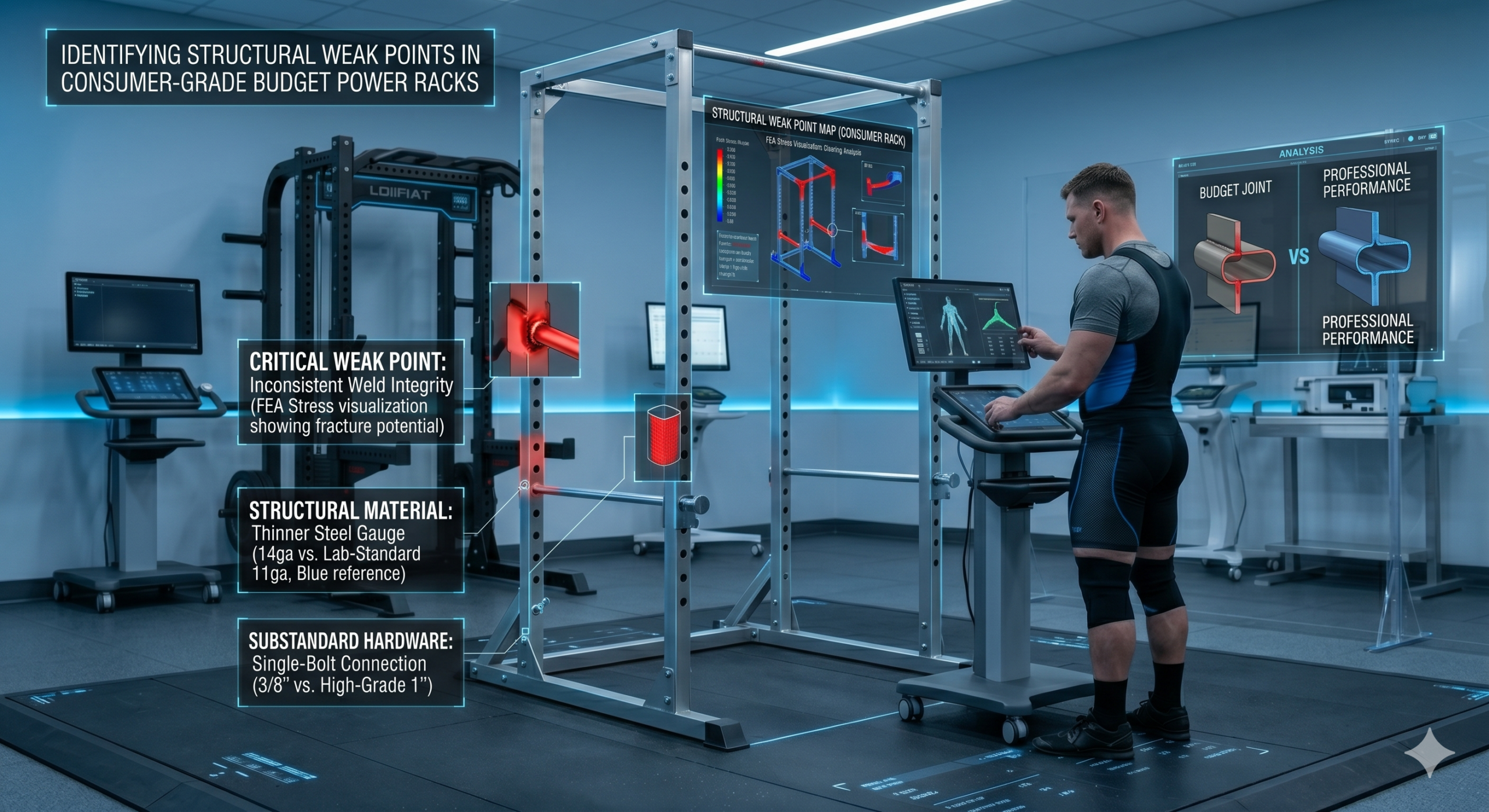
At the Hypertrophy Protocol Lab, we evaluate resistance training equipment through the lens of biomechanical safety, material science, and long-term structural integrity. Our mission is not to validate marketing claims but to identify failure points before they manifest under load. In this analysis, we present our findings on the systemic structural deficiencies endemic to consumer-grade budget power racks—equipment that, while financially accessible, frequently compromises the safety margins required for progressive overload training.
We have observed a troubling trend in the home gym equipment market: the proliferation of budget power racks constructed with substandard materials, non-standard dimensions, and inadequate engineering tolerances. These units are marketed to serious lifters but are engineered for casual use at best. Below, we dissect the primary structural weak points we have identified through our laboratory assessments and cross-referenced with field data from practitioners operating under genuine training loads.
The most critical metric for any power rack is its capacity to manage static and dynamic loads without deformation or catastrophic failure. Budget power racks routinely overstate their weight capacity ratings, often citing theoretical maximums derived under ideal static conditions that bear no resemblance to real-world training scenarios.
Static vs. Dynamic Load Discrepancies
When we evaluate a rack’s weight capacity, we must distinguish between static load (weight placed gently and held motionless) and dynamic load (weight subjected to the acceleration, deceleration, and lateral forces generated during compound movements). A rack rated for 600 lbs static may experience localized yield under a 400 lb squat if the lifter re-racks aggressively or experiences bar drift. Budget manufacturers rarely account for these dynamic multipliers in their published specifications.
Case Study: 14-Gauge Steel Under Elite Loads
Recent independent assessments—including those documented by Garage Gym Reviews in 2026—have flagged units such as the Major Fitness PLM03 as employing 14-gauge steel (approximately 1.9 mm wall thickness), a material grade deemed categorically insufficient for elite powerlifting applications. To contextualize: 14-gauge steel provides roughly 40% less material cross-section than the 11-gauge steel (approximately 3.0 mm wall thickness) used in commercial and institutional-grade racks. Under repetitive loading cycles common in periodized strength programs, this deficit compounds. We are not discussing marginal differences—we are discussing the boundary between elastic deformation (recoverable flex) and plastic deformation (permanent structural compromise).
Key takeaway: A rack built with 14-gauge steel is not merely “less durable” than an 11-gauge unit—it operates with fundamentally different failure thresholds that may be exceeded during legitimate heavy training.
In the quest for optimal home gym setups, understanding the limitations of consumer-grade budget power racks is crucial. A related article that delves deeper into this topic is available at Hypertrophy Protocol, where you can find insights on how to identify structural weak points in various fitness equipment. This resource not only highlights the importance of safety and durability in power racks but also provides practical tips for selecting the right equipment to enhance your workout experience.
Structural Instability and Center-of-Gravity Failures
A power rack must remain stationary under all anticipated loading conditions. Any lateral displacement, rocking, or tipping represents an immediate safety hazard. Our analysis reveals that budget racks consistently fail this criterion due to insufficient mass, inadequate base geometry, and the absence of engineered stabilization systems.
The Physics of Rack Toppling
When a loaded barbell is racked—particularly after a failed squat attempt where the bar contacts J-hooks with momentum—the force vector includes both a vertical component (gravitational load) and a horizontal component (lateral momentum from the lifter or bar path deviation). A rack resists toppling through its own mass, its base footprint width, and any mechanical anchoring to the floor or platform. Lighter budget racks, often weighing under 130 lbs unloaded, possess insufficient inertial resistance to counteract these moments, as documented by Gray Matter Lifting’s 2026 stability analyses.
Bolting Requirements and Their Implications
We note that many budget rack manufacturers include fine-print recommendations to bolt the unit to a floor or lifting platform. While this addresses the toppling risk, it introduces secondary concerns:
- Platform dependency: Not all training environments permit floor anchoring, particularly in rental properties or multi-use spaces.
- Stress concentration at anchor points: Bolting a lightweight rack to the floor does not eliminate flex in the uprights—it merely prevents the base from translating. The uprights themselves may still deflect under load, creating oscillation patterns that accelerate fatigue at weld joints.
- False equivalence with freestanding stability: A rack that requires bolting to achieve baseline safety is not equivalent to a heavier rack that achieves freestanding stability through superior mass distribution and weight storage integration.
Key takeaway: If a rack cannot remain stable freestanding under your anticipated working loads, bolting it down is a mitigation strategy—not a solution to the underlying engineering deficit.
Premature Wear and Steel Gauge Inadequacy

The service life of a power rack is determined by its material properties, manufacturing quality, and the cumulative stress it endures over thousands of loading cycles. Budget racks demonstrate accelerated degradation timelines that we find unacceptable for any lifter operating above novice intensity thresholds.
Understanding Steel Gauge in Structural Context
Steel gauge is an inverse measurement system: lower gauge numbers indicate thicker, stronger steel. The distinction between 14-gauge and 11-gauge is not academic—it represents a fundamental difference in structural capability:
| Gauge | Wall Thickness (mm) | Relative Strength | Typical Application |
|-|–:|:–:||
| 14 | ~1.9 | Baseline | Light residential use |
| 12 | ~2.7 | Moderate | Mid-grade home gyms |
| 11 | ~3.0 | High | Commercial/institutional |
| 7 | ~4.6 | Maximum | Competition platforms |
Our laboratory observations confirm that 11-gauge steel, configured in 3×3-inch (76×76 mm) square tubing, represents the minimum specification for racks intended to endure daily use at loads exceeding 1,000 lbs (combined bar weight, plates, and dynamic forces). This standard is corroborated by manufacturers serving commercial facilities (CTX Home Gyms; OKSporting) and represents the threshold below which we observe measurable wear progression within the first 12–18 months of heavy use.
Manifestations of Premature Wear
In budget racks, premature wear presents as:
- J-hook deformation: The contact surfaces of J-hooks bend or compress, altering bar seat geometry.
- Hole elongation: Pin holes in uprights gradually ovalize under repeated loading, compromising safety pin and J-hook security.
- Weld cracking: Joints between uprights and crossmembers develop micro-fractures that propagate under cyclic stress.
- Powder coat degradation: While cosmetic, accelerated coating failure indicates underlying surface oxidation and potential corrosion-mediated weakening.
Key takeaway: Budget racks do not simply “wear out”—they undergo progressive structural compromise that may not be visible until a critical failure event occurs under load.
Sure, here is the sentence with the clickable link:
Check out the latest fitness program at Hypertrophy Protocol for effective muscle building.
Incompatible Hole Spacing and Proprietary Tubing Standards

One of the most insidious deficiencies in budget power racks is their use of non-standard dimensional specifications that isolate the owner from the broader equipment ecosystem. This is not merely an inconvenience—it is a structural limitation that restricts the owner’s ability to enhance safety and functionality over time.
The 3×3 vs. 2×3 Tubing Paradigm
The power rack market has converged on two primary upright tubing dimensions: 3×3-inch (76×76 mm) and 2×3-inch (51×76 mm). The 3×3 format, prevalent in commercial and high-end residential equipment, offers superior torsional rigidity and a standardized platform for third-party attachments. Budget racks frequently employ 2×3 tubing or, more problematically, proprietary dimensions that match neither standard.
As identified by both Garage Gym Reviews and Gray Matter Lifting in their 2026 evaluations, manufacturers such as Major Fitness utilize non-standard tubing dimensions and hole patterns that render their racks incompatible with universal attachment ecosystems. This means:
- No aftermarket safety arms: The owner cannot upgrade to heavy-duty strap safeties or pin-pipe safeties from established manufacturers.
- No third-party J-hooks: Superior J-hook designs that distribute load more effectively cannot be retrofitted.
- No modular expansion: Lat pulldown attachments, dip stations, and cable systems designed for standard 3×3 or 2×3 racks will not interface correctly.
Hole Spacing and Its Biomechanical Implications
Standard Westside hole spacing (1-inch increments through the bench zone, 2-inch increments elsewhere) allows precise J-hook and safety positioning to accommodate individual anthropometry. Budget racks with non-standard hole spacing—whether wider intervals or proprietary patterns—force compromised bar positions that may place the lifter in mechanically disadvantageous or unsafe configurations during unracking and re-racking.
Key takeaway: A budget rack with proprietary dimensions is not a platform you can grow with—it is a closed system that becomes obsolete the moment your training demands exceed its fixed capabilities.
In the quest for effective home gym setups, understanding the limitations of consumer-grade budget power racks is crucial, especially when it comes to identifying structural weak points that could compromise safety during heavy lifts. A related article explores the evolution of modular gym equipment, highlighting how advancements have transformed static frames into dynamic ecosystems that enhance workout versatility and safety. For those interested in how these innovations can impact your home gym experience, you can read more about it in this insightful piece on the evolution of modular gym equipment.
Assembly Quality as a Diagnostic Indicator
| Weak Point | Description |
|---|---|
| Thin Steel Construction | May not withstand heavy weights or intense workouts |
| Welding Quality | Poor welding may lead to structural instability |
| Low Weight Capacity | May not support heavy lifting or advanced exercises |
| Unstable Base | May wobble or tip over during use |
We have long maintained that assembly experience serves as a reliable proxy for overall manufacturing quality. A rack that arrives with confusing instructions, misaligned holes, or cosmetic damage is communicating something fundamental about its engineering and quality control standards.
Instructional Clarity and Design Intent
Well-engineered equipment is designed for intuitive assembly because its components are manufactured to tight tolerances and its architecture follows logical structural principles. When users report—as they have regarding the Major Fitness PLM03 (Garage Gym Reviews, 2026)—that assembly instructions are confusing, contradictory, or incomplete, we interpret this as evidence of one or more underlying issues:
- Tolerance stack-up: Components manufactured with loose tolerances require ambiguous instructions because the “correct” assembly sequence depends on the specific dimensional deviations of each unit.
- Design iteration without documentation updates: Rapid product revision cycles without corresponding manual updates suggest prioritization of cost reduction over user safety.
- Outsourced design-to-manufacturing pipeline: Disconnection between the engineering team (if one exists) and the manufacturing facility, resulting in products that deviate from their own specifications.
Shipping Damage as a Quality Control Metric
Reports of shipping scratches and cosmetic damage on arrival, while seemingly minor, indicate inadequate packaging engineering and quality inspection protocols. If a manufacturer does not invest in protecting its product during transit, we question whether it invests in protecting the user during training. More critically, shipping damage to powder coating exposes bare steel to oxidation, accelerating the corrosion processes that weaken structural members over time.
Hardware Quality and Fastener Integrity
Budget racks frequently ship with Grade 5 or unmarked bolts where Grade 8 fasteners are mechanically appropriate. The difference is significant: Grade 8 bolts offer approximately 50% greater tensile strength than Grade 5 equivalents. Under the vibration and cyclic loading inherent to power rack use, lower-grade hardware is more susceptible to fatigue failure and loosening.
Key takeaway: Assembly difficulty is not merely an inconvenience—it is a symptom of manufacturing imprecision that extends to the structural components you cannot see or easily inspect.
Our Recommendations for Structural Assessment
Based on our comprehensive analysis, we offer the following protocol for evaluating any power rack before purchase or continued use:
- Verify steel gauge independently. Do not rely on marketing materials. Measure wall thickness directly or demand third-party material certification.
- Confirm tubing dimensions against industry standards. Ensure compatibility with 3×3 or 2×3 ecosystems and standard hole spacing patterns.
- Assess freestanding stability under asymmetric load. Load one side of the rack and evaluate lateral displacement without floor anchoring.
- Inspect weld quality visually. Look for porosity, undercut, incomplete fusion, or excessive spatter—all indicators of substandard fabrication.
- Evaluate hardware grade markings. Confirm that all structural fasteners bear appropriate grade markings for their application.
Conclusion: The True Cost of Budget Engineering
We recognize that financial constraints are real and that not every lifter can invest in commercial-grade equipment. However, we maintain an obligation to communicate clearly: the structural weak points identified in consumer-grade budget power racks are not minor compromises—they are fundamental engineering deficiencies that place users at measurable risk under heavy training loads.
The cost differential between a budget rack and a properly engineered unit—typically $300–$800—is not a luxury premium. It is the price of adequate steel thickness, standardized dimensions, proper weld penetration, and hardware grade selection. When we amortize this across a decade of training, the per-session cost of structural integrity is negligible. The cost of a structural failure under a loaded barbell is not.
We encourage all practitioners to evaluate their equipment with the same rigor they apply to their programming. The barbell does not discriminate, and neither does gravity. Your rack must be engineered to the same standard as your discipline.