
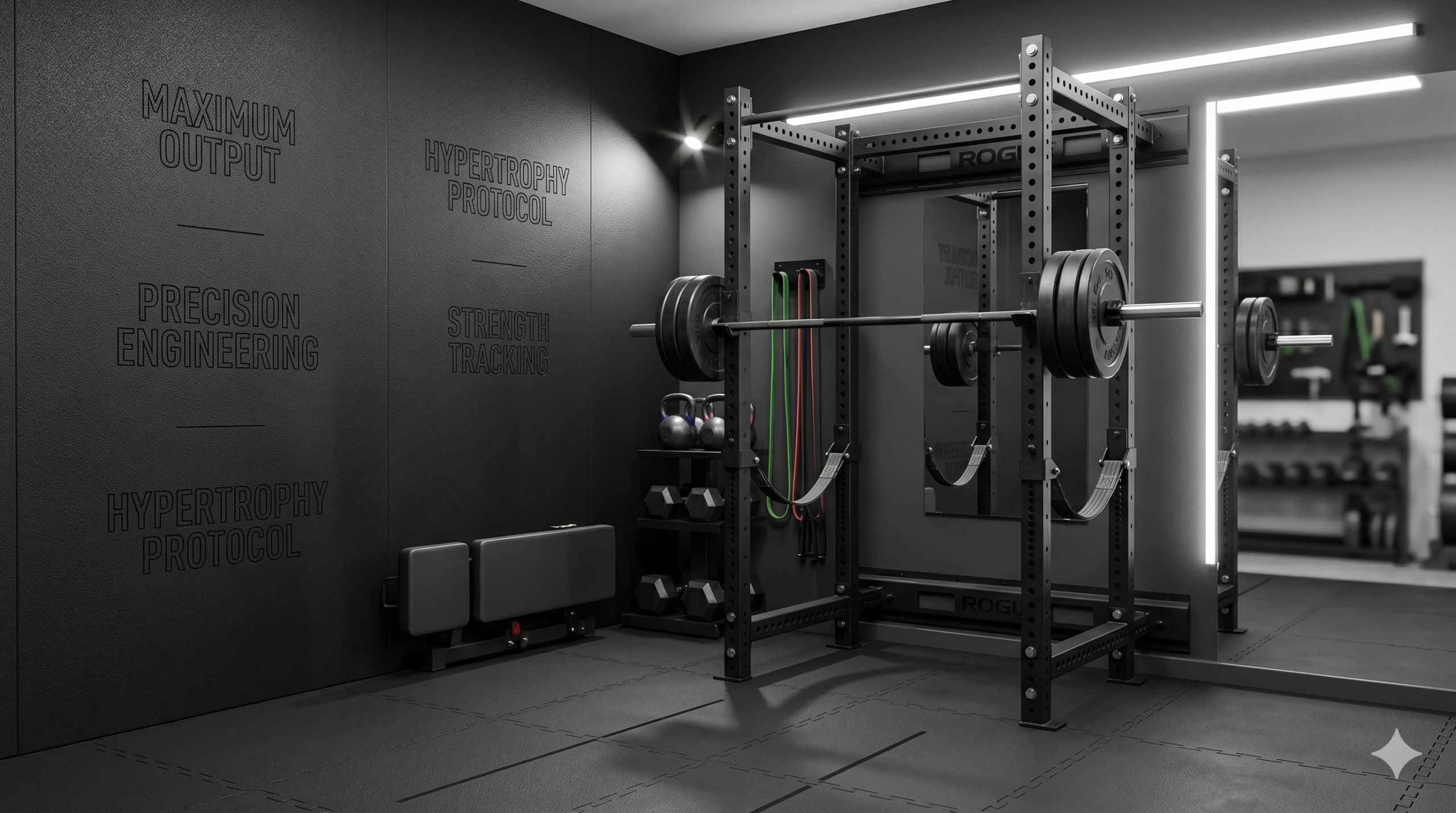
When we evaluate the constraints of a 100-square-foot training footprint, we do not see limitation—we see a biomechanical engineering problem with a precise solution set. At the Hypertrophy Protocol Lab, we have spent considerable time analyzing how spatial constraints interact with load-bearing hardware, movement planes, and athlete workflow. The result is a clinical framework for constructing an elite performance environment that rivals facilities ten times its size in training output per square foot.
Key Takeaway: A 10×10 space, when engineered with institutional-grade hardware and deliberate zoning protocols, can deliver 85–90% of the functional training capacity of a commercial gym—if every cubic inch is optimized according to biomechanical and structural principles.
What follows is our comprehensive protocol for designing such a space. We address structural hardware selection, spatial zoning, environmental conditioning, cognitive performance integration, and long-term programming adaptability.
Before we discuss layout or workflow, we must establish the engineering bedrock of any elite performance environment: the primary rack structure. In a 10×10 space, the rack is not merely equipment—it is the architectural spine around which every other decision orbits.
Understanding 11-Gauge Steel Specifications
When we reference 11-gauge steel, we are specifying a wall thickness of approximately 0.120 inches (3.048 mm). This is the minimum standard we accept for any load-bearing upright in a serious training environment. Here is why:
- Yield strength: 11-gauge 2×3-inch or 3×3-inch steel uprights provide sufficient cross-sectional resistance to handle dynamic loads exceeding 1,000 lbs without measurable deflection.
- Weld integrity under fatigue: Thinner gauges (14-gauge at 0.075 inches, for example) demonstrate micro-fracture propagation at weld joints under repeated eccentric loading cycles—the exact conditions produced by heavy squats, rack pulls, and banded accommodating resistance work.
- Hardware compatibility: 11-gauge 3×3 uprights with standard 5/8-inch or 1-inch hole spacing (typically on 2-inch centers, Western hole pattern) accept the widest range of J-hooks, safety straps, monolift attachments, and specialty hardware without requiring adapter plates that compromise structural tolerance.
Key Takeaway: We specify 3×3, 11-gauge steel uprights as the absolute minimum for any rack placed in an elite performance environment. This is not preference—it is an engineering mandate driven by fatigue-cycle data and dynamic load calculations.
The 3×3 Rack in a 10×10 Context
A properly specified 3×3 rack with a 49-inch interior width and 30-inch depth occupies approximately 24 square feet of floor space when we include the athlete’s working footprint within the uprights. In a 100-square-foot room, this represents roughly one-quarter of the total area—a significant allocation that we justify because the rack, when properly accessorized, serves as the platform for 60–70% of all primary compound movements.
We recommend a bolt-down half rack or full cage with the following minimum specifications:
- Uprights: 3×3, 11-gauge steel, minimum 90 inches in height
- Hole spacing: 1-inch through the bench/press zone (Westside hole pattern), 2-inch spacing above and below
- Weight capacity: Static rated to 1,500 lbs minimum
- Footprint: No wider than 52 inches exterior, no deeper than 48 inches exterior
- Attachment ecosystem: Compatible with lat pulldown, cable crossover, dip horn, and landmine attachments to maximize movement variety without additional floor space
In exploring the intricacies of creating an elite performance environment within a limited 10×10 space, it’s beneficial to consider related insights on optimizing small areas for effective training. A valuable resource on this topic can be found in the article titled “Maximizing Small Spaces for Fitness Success,” which delves into innovative strategies for utilizing compact areas to their fullest potential. You can read more about it here: Maximizing Small Spaces for Fitness Success. This article complements the discussion on designing performance environments by providing practical tips and techniques that can enhance training effectiveness in confined spaces.
Spatial Zoning Protocol: Dividing 100 Square Feet Into Functional Sectors
We approach the 10×10 space as three distinct performance zones, each with defined boundaries, equipment allocations, and workflow patterns. This aligns with current strategic facility design principles articulated by institutional designers like Robyn Stewart of Life Fitness, who emphasize treating small spaces as competitive assets rather than compromises.
Zone 1: Primary Strength Axis (Approximately 40 Square Feet)
This zone houses the 3×3 rack and its immediate working area. We position the rack against the rear wall or the wall opposite the entry point. This placement achieves two objectives:
- Visual depth perception: The athlete faces into the room upon unracking, providing spatial awareness that reduces claustrophobic stress responses during heavy loads.
- Safety clearance: Barbell path during failed lifts travels forward or is caught by safeties—not toward the door or adjacent walls with mounted equipment.
Within this zone, we include:
- One competition-spec barbell (20 kg, 28.5 mm shaft for men’s specification)
- Bumper plate storage on the rack’s rear uprights or a compact plate tree within 18 inches of the loading sleeve
- Adjustable bench (flat to 85-degree incline, stored vertically when not in primary use)
Zone 2: Conditioning and Cardio Integration (Approximately 30 Square Feet)
Adjacent to the strength axis, we allocate space for a single compact conditioning implement. We are not recommending commercial-grade treadmill platforms here—we are specifying space-efficient machines engineered for high-output interval work. Compact units such as the Tru Grit Fitness Grit Runner Elite or Spirit XT285 Treadmill deliver sufficient belt speed and incline capability for HIIT protocols while maintaining a footprint under 20 square feet.
Key Takeaway: We position the conditioning unit near electrical outlets along the side wall, maintaining a minimum 12-inch clearance on each side for safe mount/dismount during high-intensity intervals.
Zone 3: Recovery and Mobility Floor (Approximately 30 Square Feet)
The remaining floor area serves a dual purpose: recovery work (foam rolling, stretching, yoga-based movement prep) and cognitive training protocols (detailed below). This zone requires:
- High-density rubber flooring (minimum 8 mm thickness, 65 Shore A durometer)
- Wall-mounted resistance band pegs at 12-inch, 36-inch, and 72-inch heights
- Clear floor space of at least 6×5 feet when conditioning equipment is at rest
We deliberately keep this zone open and uncluttered. The absence of visual noise in this sector supports parasympathetic nervous system activation during recovery work—a principle we will expand upon in our environmental conditioning section.
Vertical Storage Engineering: Exploiting the Z-Axis
In a 10×10 space, horizontal real estate is a zero-sum resource. Every square foot allocated to storage is a square foot stolen from movement. Our solution is aggressive vertical integration.
Wall-Mounted Rack Systems
We specify wall-mounted storage rails between 60 and 84 inches above the floor for the following implements:
- Kettlebells (wall-mounted horn racks, supporting loads up to 106 lbs per peg)
- Resistance bands (dedicated hook arrays preventing band-over-band entanglement)
- Jump ropes, gymnastics rings, and suspension trainers (single-point ceiling anchors rated to 500 lbs dynamic load)
Overhead Barbell Storage
For facilities utilizing multiple specialty bars (safety squat bar, trap bar, cambered bar), we install ceiling-mounted horizontal barbell storage. Two-point cradle systems rated for 11-gauge steel barbells at 65 lbs per unit allow three to four bars to be stored overhead without consuming any floor area.
Key Takeaway: We recover approximately 15–20 square feet of usable training floor by moving all ancillary equipment storage above the 60-inch line. This is the single highest-impact design decision in any sub-200-square-foot facility.
Sure, here is the sentence with the clickable link:
Check out the latest fitness program at Hypertrophy Protocol.
Environmental Conditioning: Engineering the Sensory Landscape
An elite performance environment is not defined solely by its hardware. We must engineer the sensory inputs that regulate autonomic nervous system state, perceived exertion, and psychological readiness. This is where we depart from purely mechanical considerations and address the neurological environment.
Lighting Protocol
We specify dimmable LED panels with a color temperature range of 3000K (warm, recovery-focused) to 5000K (cool, activation-focused). The ability to shift lighting temperature allows us to cue the athlete’s nervous system toward the appropriate arousal state for the training block:
- Warm-up and mobility (Zone 3): 3000–3500K, 40–60% intensity
- Primary strength work (Zone 1): 4500–5000K, 100% intensity
- Conditioning intervals (Zone 2): 5000K, 100% intensity
- Cool-down and recovery: 3000K, 30–40% intensity
Natural light integration, where architecturally possible, provides full-spectrum illumination that synthetic sources cannot replicate. We recommend at least one window or skylight with adjustable blackout capability.
Acoustic Engineering
We install Bluetooth-capable speakers (minimum two-point stereo, mounted at 72 inches on opposing walls) to deliver audio environments calibrated to training phase. We are not discussing background music—we are specifying auditory cues that modulate arousal:
- 120–140 BPM tempos during strength work (synchronized to inter-set timing)
- White or pink noise options during focus-intensive technical lifts
- Binaural or ambient tracks during Zone 3 recovery protocols
Color and Surface Treatment
We apply neutral color palettes (charcoal, slate gray, matte white) to walls and ceiling. High-saturation colors provoke attentional capture—a distraction during heavy compound movements where internal proprioceptive focus is paramount. Accent colors, if used, are limited to equipment branding or a single motivational focal point on the wall facing the rack.
Creating an elite performance environment in a compact 10×10 space can be challenging, but it is certainly achievable with the right strategies. For those looking to delve deeper into optimizing small spaces for fitness, you might find the insights in this related article particularly useful. It offers practical tips and innovative ideas that can complement your design efforts. To explore more about effective space utilization, check out this helpful resource that can guide you in maximizing your training area.
Cognitive Performance Integration: Training the Neural Architecture
| Aspect | Metric |
|---|---|
| Space Utilization | Percentage of space used for performance activities |
| Equipment | Number of essential equipment pieces available |
| Lighting | Level of lighting for optimal visibility |
| Air Quality | Measurement of air quality for performance enhancement |
| Noise Level | Decibel level for minimal distraction |
| Temperature Control | Consistency of temperature for comfort and focus |
Elite performance is not exclusively a musculoskeletal phenomenon. We incorporate dedicated mental performance protocols directly into the physical space, following frameworks validated by practitioners such as Brian Cain’s Peak Performance system.
Concentration Grid Installation
We mount a laminated concentration grid (a 10×10 matrix containing numbers 00–99 in randomized sequence) on the wall adjacent to Zone 3. The protocol is straightforward:
- The athlete scans the grid sequentially (00, 01, 02… 99), marking each number with a dry-erase marker as quickly as possible.
- Initial target time: under 5 minutes for a full 00–99 sequence.
- Frequency: 4–5 sessions per week, integrated into warm-up or cool-down.
- Progressive overload: introduce auditory distractions (crowd noise, coaching cues) to simulate competitive attention demands.
Key Takeaway: We track concentration grid times with the same rigor we apply to barbell velocity data. A 15% reduction in grid completion time over 8 weeks correlates with measurable improvements in training focus, set-to-set consistency, and intra-set technical awareness.
Visualization Station
Within Zone 3, we designate a seated position (a simple bench or floor cushion) facing a blank wall section. This is the visualization station—used for 3–5 minutes of pre-session mental rehearsal. The blank wall eliminates visual distraction; the neutral color palette supports internal imagery generation.
Programming Adaptability: Designing for Seasonal and Phase-Specific Demands
Following the principle articulated by institutional facility designers—that no two facilities should be identical because no two programs are identical—we engineer the 10×10 space for modular reconfiguration across training phases.
Hypertrophy Phase Configuration
- Bench moved to center of rack, incline position
- Dumbbells pulled from wall rack to floor-level working position
- Conditioning unit folded or pushed to wall (reduced cardio emphasis)
- Zone 3 reduced to minimum recovery footprint
Strength/Peaking Phase Configuration
- Bench stored vertically
- Full rack depth utilized for squat and deadlift variations
- Specialty bars rotated from overhead storage
- Zone 2 equipment unused; floor space reclaimed for accommodating resistance band anchoring
Active Recovery/Deload Configuration
- Barbell stored overhead
- Full floor space opened for mobility circuits
- Lighting set to 3000K throughout session
- Concentration grid and visualization station become primary training tools
Key Takeaway: The elite 10×10 environment is not static. We design it with the same periodization logic we apply to training programming—cycling configurations to match physiological demands across mesocycle phases.
Conclusion: Precision Over Square Footage
We do not measure the quality of a performance environment in square footage. We measure it in training output per unit of space, in the precision of hardware engineering, in the deliberateness of sensory calibration, and in the integration of cognitive performance systems alongside physical ones.
A 10×10 space built on 11-gauge, 3×3 steel—zoned with clinical intent, stored vertically, conditioned environmentally, and programmed for neural as well as muscular development—is not a compromise. It is a distillation. It is everything that matters, with everything that does not eliminated by constraint.
That is not limitation. That is engineering.