Last updated October 9, 2026. This guide is based on published research, and each claim links to the study behind it. General information, not medical advice.
If you’re thinking about buying a PEMF device to recover faster between sessions or to add muscle, the human research doesn’t justify the purchase yet. The case for PEMF therapy for bodybuilders rests on a handful of small trials, where soreness eased a little in some but strength recovery didn’t improve in the ones that measured it. The only controlled trial showing muscle growth used students who had been told not to lift. Nobody has tested PEMF in people running a real hypertrophy program.
That doesn’t make the idea nonsense. Cell and mouse studies show real biological effects, and one sham-controlled human trial is worth watching. The sections below show what each study measured and who might still reasonably try PEMF.
What does a PEMF device actually do to muscle?
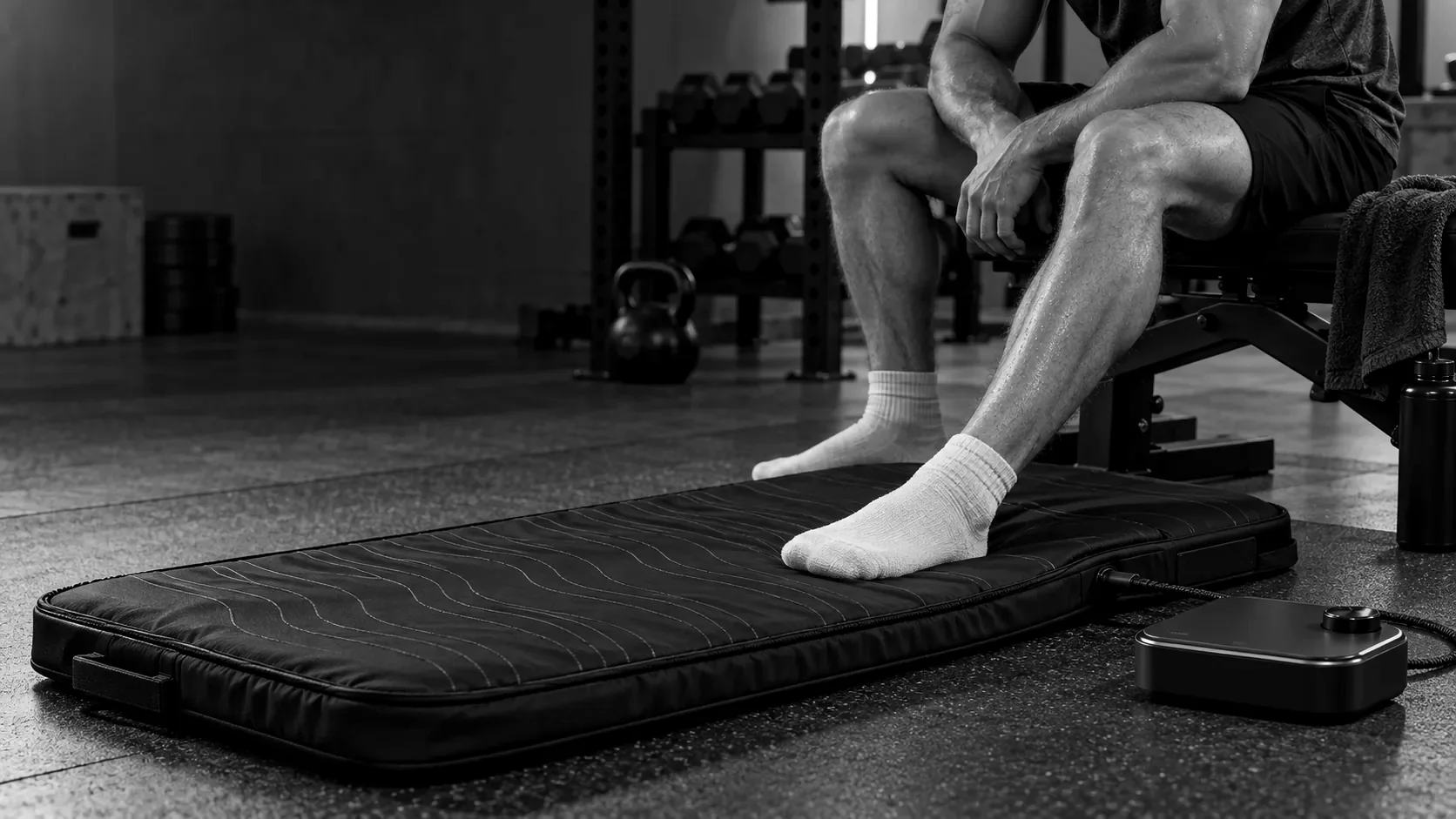
Start with the physics, because it’s the solid part. A PEMF coil makes a pulsing magnetic field, and a changing field induces tiny electrical currents in nearby tissue. Whether those currents change anything a lifter would notice is the open question.
In cell culture, a single 10-minute exposure at 1.5 mT made mouse muscle precursor cells multiply faster and build more mitochondria, working through a calcium channel called TRPC1 (Yap et al., 2019). In mice, weekly exposure combined with running raised PGC-1α, a master switch for mitochondrial growth, and improved running performance (Tai et al., 2020).
Those results point toward endurance-style adaptation rather than size, and in the same group’s PEMF-treated mice, oxidative fibers actually got smaller (Stephenson et al., 2022, discussion section).
One more distinction matters before you shop. The muscle-size trials below used low-intensity fields of 1 to 1.5 mT that you can’t feel. Clinic-grade peripheral magnetic stimulation is far stronger: one sarcopenia study ran at up to 5.2 tesla and made the muscles contract (Leonardo et al., 2025). Results from one class don’t transfer to the other.
Does PEMF reduce soreness after a hard session?
Mechanisms only matter if they show up in people, and three randomized trials have tested PEMF after workouts designed to make muscles sore.
In the best-known one, 30 healthy male college students did biceps work meant to make them sore, then got PEMF or a sham treatment, with neither they nor the testers knowing which (Jeon et al., 2015). Soreness and two electrical measures of muscle function recovered faster with PEMF. Peak strength recovered no faster than with sham.
A 20-person biceps trial saw nerve conduction slow only in the control group, while strength, range of motion and soreness showed only a trend toward faster recovery with PEMF (Kouzaki and Nakazato, 2025). In 45 professional soccer players, a high-intensity magnetic device raised the pressure needed to trigger thigh pain, a medium effect (partial η² = 0.069). Strength, squat speed, fatigue and creatine kinase matched the sham group (Keriven et al., 2023).
Put together, soreness and pain sensitivity may ease a little, while strength recovery hasn’t moved in the trials that measured it carefully. For a lifter, strength recovery is what decides when you can train a muscle hard again.
Can PEMF add muscle or strength?
Soreness fades within days either way. What would justify the price is extra muscle, and on that question the sham-controlled trials point in opposite directions.
The most striking result comes from 71 healthy students averaging 20 years old, mostly women, who were told to avoid resistance training (Li et al., 2025). One group got 15 minutes of PEMF on one arm three times a week for four weeks; the other used an identical device with the field switched off. Biceps strength rose 13% with PEMF versus 2.5% with sham, and ultrasound cross-sectional area rose 8% versus a 3% drop.
Read the fine print before treating that as proof. These were young non-lifters, the device was designed and patented by the research team, and the sham group’s muscles shrank during four weeks of restricted activity, which widens the gap. An effect that large from 45 minutes a week needs independent replication, and none exists yet.
The other sham-controlled trial found no muscle effect. Twenty patients recovering from ACL surgery got 10 minutes of PEMF or sham each week for 16 weeks (Stephenson et al., 2022). Markers of muscle energy metabolism improved, but strength and MRI muscle volume didn’t differ between groups. Several authors hold a PEMF patent or contribute to a PEMF device company (disclosed in the paper).
Two more studies lean positive but can’t rule out placebo: a knee-arthritis trial that added PEMF to home exercise with no sham group (Wang et al., 2024), and a study run at a device company’s demo center with no control group at all (Venugobal et al., 2023).
How strong is the evidence, study by study?
Lined up side by side, the gap is easy to see: every trial is small, and none added PEMF to a real training program.
| Study | Who | Comparison | Improved with PEMF | No difference |
|---|---|---|---|---|
| Jeon 2015 | 30 healthy men, induced biceps soreness | Sham, double-blind | Soreness, EMG-based function measures | Peak strength |
| Kouzaki 2025 | 20 adults, induced biceps soreness | Control group | Nerve conduction | Strength, range of motion, soreness (trend only) |
| Keriven 2023 | 45 professional soccer players | Sham | Pain pressure threshold (partial η² = 0.069) | Strength, squat speed, fatigue, creatine kinase |
| Li 2025 | 71 students told not to lift | Sham, double-blind | Biceps strength +13% vs +2.5%; cross-sectional area +8% vs −3% | Not yet replicated |
| Stephenson 2022 | 20 patients after ACL surgery | Sham, double-blind | Muscle energy metabolism markers | Strength, MRI muscle volume |
| Wang 2024 | 60 adults with end-stage knee arthritis | Exercise alone, no sham | Knee strength, pain | Placebo effect not excluded |
| Venugobal 2023 | 101 adults aged 38 to 91 | None | Mobility tests, bioimpedance muscle mass | No control group |
A registered trial is now testing PEMF against sham for eight weeks in 30 competitive athletes who resistance train, with fatigue, power and muscle mass among its outcomes (NCT07288892). A device company is a collaborator, and the registry still listed it as recruiting at its April 2026 update.
Where do the 70% and 75% claims come from?
Two numbers common in PEMF marketing, and in earlier versions of this page, appear nowhere in that table. The claim that protein synthesis rises “up to 70%” traced back to a device seller and a day spa. The claim that over 75% of patients felt less pain came from a clinic’s own patient series, which isn’t in PubMed.
Even a measured spike in protein synthesis after one session wouldn’t prove more growth over months, and a PubMed search turns up no human study of PEMF and muscle protein synthesis at all. The earlier frequency and timing advice went too, because no trial tested it.
Is PEMF safe, and is there any case for trying it?
If the muscle case is thin, the safety record is reassuring. Across the foot and ankle trials in a 2026 review, the only side effect was minor skin redness (Chia et al., 2026). Some of these trials excluded people with pacemakers or other implants, or pregnant people, so check with your doctor first if either applies.
The strongest PEMF evidence isn’t about muscle at all. In placebo-controlled osteoarthritis trials, PEMF reduced pain with a large pooled effect, a standardized mean difference of 1.06 (Yang et al., 2020). Yet an umbrella review rated most of the underlying osteoarthritis reviews low or medium quality, leaving efficacy unproven (Markovic et al., 2022). Persistent joint pain is a medical question, so take it to a clinician before buying hardware for it.
Should you buy a PEMF device for recovery or growth?
Weighing all of that, most lifters will get more from spending the money elsewhere, though the details depend on why you were looking.
If you want more muscle, skip it. The one controlled human trial showing growth used non-lifters who weren’t training, and the one trial with MRI volume showed no difference. Progressive overload, protein and sleep have the evidence PEMF lacks, and progressive overload in a small home gym covers the first.
If soreness is slowing you down, PEMF might take the edge off, but it hasn’t brought strength back sooner in any trial. Adjusting volume and session spacing addresses the real limit. If you’re comparing recovery gadgets, cold plunges and muscle growth covers the other popular one.
If you have chronic joint pain, see a clinician first. Some clinics offer PEMF, which lets you find out whether it helps you before you own a device.
If you’re simply curious, wait for the registered athlete trial to report. A sham-controlled result in people who train will tell you more than any product page.
Your next step: plan your rest between hard sessions with the recovery window guide for heavy leg days, since recovery time is the lever with evidence behind it.