

Research note: This guide compares yeast-derived protein with whey using published trials and primary nutrition references. It is not a hands-on review of a particular protein powder. Research and source pages checked October 13, 2026, and rechecked October 17, 2026.
You want a protein powder that helps you build muscle, but dairy leaves you uncomfortable or you would rather avoid animal ingredients. Yeast protein is a plausible alternative: it can provide all nine essential amino acids, and two human studies have now compared yeast protein with whey. The main buying question is whether those findings justify a switch, not whether a manufacturer can print the same protein number on a bag.
Short answer: Purified yeast protein looks capable of supporting strength training when it helps someone meet their protein needs. The human evidence is encouraging but limited, and it has not demonstrated that yeast protein builds more muscle than whey or that every yeast protein powder is clinically interchangeable with whey.
At a glance
| Verdict | Yeast protein can support training if it helps you meet protein needs; not shown to beat whey. |
|---|---|
| Effect size / key numbers | 2024 trial, 8 weeks, lean mass: +828 g yeast, +741 g whey, +448 g placebo; no significant full-sample difference. |
| Evidence strength | Limited: 2 human trials (79 completers; 92 older adults), funded by Angel Yeast Company and the Angel Nutritional Fund. |
| What to do | Meet your daily protein first. Use whey if dairy suits you; consider yeast if you want dairy-free. |
| Main caveat | The “85% more” claim divides two averages. DEXA lean mass is not directly measured muscle tissue. |
Research and sources checked October 13, 2026, and rechecked October 17, 2026.
What exactly is yeast protein, and is it really vegan?
Whey is a protein fraction from milk. Food-grade yeast protein is extracted from cultivated yeast, commonly Saccharomyces cerevisiae, after a controlled fermentation process. Yeast is a fungus rather than a plant or animal. When a finished product contains no animal-derived ingredients, it can be suitable for a vegan diet without being a conventional pea, rice or soy protein.
That distinction matters for buyers avoiding dairy, but the label still decides what else is in the bag. A pure unflavored isolate may contain only the yeast-derived protein. A flavored powder may add lecithin, sweetener, fiber or other ingredients. If you have a yeast allergy, an unusual immune reaction or a food-allergen concern, “vegan” alone is not a sufficient safety test.
Nor should the word fermented imply that you are drinking live yeast. A purified yeast protein isolate is processed to separate the protein from the culture. Check the manufacturer’s ingredient description and independently documented process rather than assuming all nutritional yeast products are equivalent.
Does its amino acid profile match whey where it matters?
Muscle tissue needs essential amino acids, particularly adequate leucine, alongside the stimulus provided by resistance training. A good protein powder helps supply those raw materials. Whey is a well-studied source; purified yeast protein can also deliver the full essential-amino-acid spectrum, though exact amounts vary by the isolate and serving size.
Yeast protein ingredient producers and SpaceMilk publish a PDCAAS of 1.0. This is a favorable protein-quality score that incorporates digestibility and amino-acid adequacy, but a score of 1.0 is capped at 1.0. It does not mean the protein has been proven to produce identical muscle growth in all populations or that it has a higher clinical benefit than any food scoring 0.9.
The FAO’s protein-quality assessment recommends looking at digestible indispensable amino acids rather than relying solely on capped PDCAAS. For a real purchase, compare protein grams, essential amino acids where independently available, taste, tolerance, cost and how easily the serving fits into your day. The strength-training foundation still matters more than chasing a particular score.
What did the 2024 yeast-versus-whey muscle trial actually show?
A 2024 randomized, double-blind trial compared AnPro yeast protein, whey and maltodextrin placebo during an eight-week at-home resistance program. It enrolled 116 otherwise healthy men aged 40 and older; 79 completed it (27 yeast, 24 whey, 28 placebo), and 11 withdrew because of adverse events (5 yeast, 4 whey, 2 placebo). The methods say participants took 40 grams of supplement per day, split into 20 grams in the morning and 20 grams at lunch, while doing three at-home bodyweight sessions a week. The abstract says 40 grams twice daily, which conflicts with the methods; this guide follows the methods.
Both protein groups increased whole-body and trunk lean mass from their own starting measurements. The key caution is statistical: an improvement within one group is not the same as proving that group improved more than another. In the full sample, the paper’s lean-mass table marks no significant difference between groups, even though the abstract and discussion describe both protein groups as beating placebo. The between-group result came in a smaller subgroup of 48 men who were eating less than 1.2 g of protein per kg of body weight a day: there, the yeast group gained 867 g of total lean mass against a 99 g loss with placebo, a significant difference, while the whey group’s 440 g gain was not marked as different from placebo. That subgroup had only 20 yeast, 12 whey and 16 placebo participants. Whey also beat yeast on one strength measure, reps at 80% of maximum on the leg press.
The paper’s own table shows average full-sample lean-mass changes of +828 grams for yeast, +741 grams for whey and +448 grams for placebo, with a wide spread between individuals (the placebo group’s standard deviation was about 1,782 grams). Those are DEXA lean-mass changes, not directly measured new contractile muscle tissue. The company’s “85% more” marketing figure comes from dividing two averages (828 ÷ 448 is about 1.85); the full-sample between-group result does not justify advertising an 85% superiority effect.
The study is meaningful evidence that purified yeast protein can be useful, particularly for people undershooting protein intake. It is not a formally demonstrated non-inferiority trial establishing perfect equivalence with whey, nor is it a clinical study of every ingredient in a finished branded powder. The tested ingredient was AnPro, and the study disclosed funding from Angel Yeast Company.
Does the newer six-month study strengthen the case?
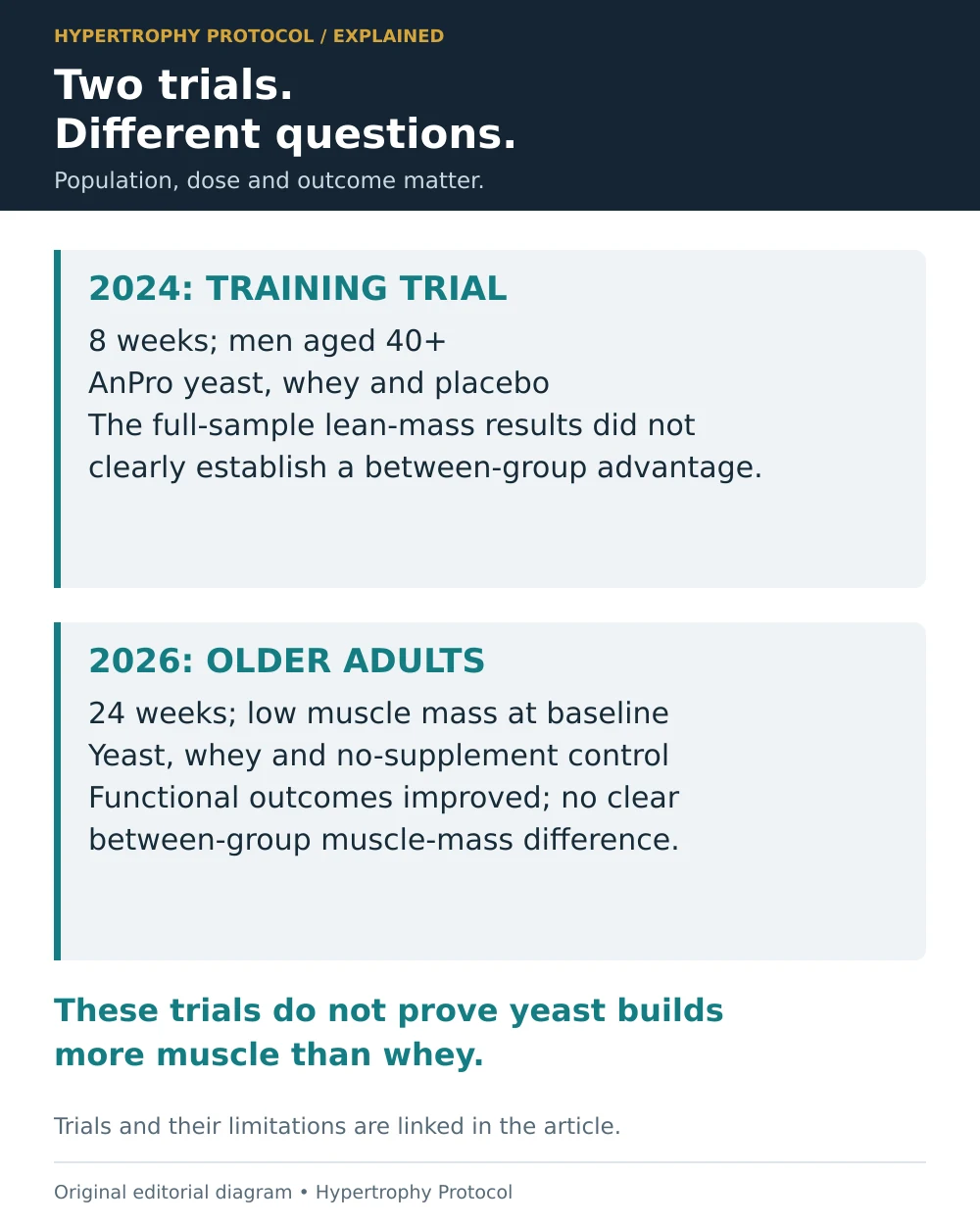
A 2026 randomized controlled trial assigned 92 community-dwelling Chinese older adults, averaging about 73 years of age and with low muscle mass at the start (65% were women), to yeast protein, whey protein or a no-supplement control for 24 weeks. The protein groups received 20 grams of supplement powder per day, corresponding to roughly 15–16 grams of actual protein according to reported product analysis.
Compared with the unsupplemented control, both protein groups improved walking speed and scores on the Short Physical Performance Battery (SPPB, scored 0 to 12). The yeast group’s score rose about 0.9 points and the whey group’s 0.3, while the control group’s fell 1.7, so much of the gap reflects the control group getting worse. The yeast group also started with a lower average score (7.6, against 8.8 for whey), and the paper compares all three groups together rather than testing yeast against whey directly. However, the groups did not show statistically significant differences in changes in appendicular muscle mass or handgrip strength.
That distinction is important for lifters. A better walking test in relatively older adults does not demonstrate superior hypertrophy in trained adults. The comparison group received no supplement instead of a disguised placebo, and the study was not an eight-week heavy-lifting program. It adds confidence that yeast can serve as a nutritional alternative, while leaving long-term muscle-growth superiority unanswered. The study was funded by the Angel Nutritional Fund (grant AF2021001), and the protein powders’ nutrient analysis was done at the Hubei Provincial Key Laboratory of Yeast Function, a lab within Angel Yeast, which makes AnPro.
Does yeast protein digest better or cause less bloating?
There are reasons a dairy-free formula may be more comfortable for someone who does poorly with milk-based powders. But that does not establish that yeast protein prevents bloating. Lactose content, dose, sweeteners, fiber, total drink volume and an individual’s gastrointestinal response all matter.
A 2025 laboratory digestion study compared yeast-based protein with whey and casein under simulated human digestive conditions. Its abstract reports that the yeast-based protein, whey and casein were comparable in digestibility in that model. Most of the authors work for Lesaffre, which makes the yeast protein tested, a different ingredient from AnPro. A simulated gut is still not a measured human absorption rate after a shake.
A separate 2026 ex-vivo study used gut microbial samples from six male donors aged 50 to 65. When gas was normalized to short-chain-fatty-acid production, yeast protein produced 27% less gas than whey and 19% less than soy in that laboratory system. That is interesting mechanistic evidence, but it did not enroll people to drink shakes and rate their symptoms. The yeast protein was supplied by Angel Yeast, and three of the eight authors work there. The same paper notes that, in earlier measurements, this yeast protein’s true protein digestibility was about 85%, against about 96% for whey isolate and 95% for soy isolate, which suggests more of it may reach the colon to be fermented in the first place.
A product seller can accurately describe what a model found without turning it into “no bloating for everyone.” If gastrointestinal comfort is your deciding issue, compare the actual finished formulas and your own tolerance rather than relying on an unconditional advertisement.
What about allergies, contaminant testing and sustainability?
Yeast protein avoids dairy as an ingredient when properly formulated, but a finished product must be checked for cross-contact and other ingredients. A manufacturer’s “free from all nine major allergens” description is different from documenting a laboratory panel covering each major allergen at specific detection limits. People with severe allergies should obtain the correct lot-specific information rather than assuming an entire category is risk-free.
Fermentation can reduce dependence on animal husbandry and certain crop inputs. Nevertheless, broad environmental superiority requires a life-cycle assessment comparing energy, fermentation inputs, downstream drying, transportation and packaging. “Not grown in soil” does not by itself prove zero pesticide residue, zero heavy metals or a zero-footprint product.
For any new protein brand, a lot-matched certificate of analysis is more useful than “clean” branding. Check the tested item, manufacturing lot, analytical method, reporting units, actual detected values and lab identity. A non-detect is specific to the method’s detection limit; it does not literally mean an element cannot exist in the sample.
When is whey still the straightforward answer?
Whey has a larger body of long-term sports-nutrition evidence, many independent brands and a wide range of prices and formats. If you already tolerate it and can reach your daily protein target conveniently, the published yeast studies do not supply a compelling muscle-growth reason to abandon it. You may be better served improving your training progression or regular food intake.
Yeast protein may be more attractive if you avoid dairy and soy, prefer a fungi-derived vegan source, or like a particular product’s ingredient and serving profile. Pea/soy/rice alternatives remain viable too; a lower PDCAAS for one isolated ingredient does not make a well-formulated blend incapable of supporting muscle growth.
Which protein should a home-gym lifter choose?
For muscle growth, choose the product you can tolerate, afford and use consistently to meet a sensible total daily protein intake. A 2018 meta-analysis of 49 trials found that protein supplements added about 0.3 kg of fat-free mass (95% CI 0.09 to 0.52 kg) and about 2.5 kg to one-rep-max strength over training programs of six weeks or more, with the gain leveling off around 1.6 g/kg/day of total protein (a loose estimate: the 95% confidence interval ran from about 1.0 to 2.2 g/kg/day). That makes meeting your needs more important than buying a novel ingredient merely because it is novel.
Use whey when dairy is acceptable and price plus established track record matter most. Consider yeast protein when a dairy-free complete protein fits your values or digestion preferences and its actual cost makes sense. Skip a change if your current protein already works and a new product offers no practical advantage.
This guide is independent of any particular brand. If you are weighing a finished yeast protein product, our SpaceMilk review covers one brand’s ingredients, lab reports and pricing. To set your daily target first, use the Protein Calculator.
Study and standards sources
- Briskey et al., 2024, yeast vs whey vs placebo during resistance training.
- Bai et al., 2026, six-month supplementation in older adults.
- Van den Abbeele et al., 2026, ex-vivo gastrointestinal model.
- Caron et al., 2025, simulated digestion of yeast, whey and casein.
- FAO protein quality report; PDCAAS and DIAAS.
- Morton et al., 2018, protein intake and resistance-training outcomes.