
Research note: A practical guide to protein-quality scores, Nutrition Facts labels and product testing. This is general nutrition education, not a personal dietary prescription. Primary regulations and research reviewed October 13, 2026.
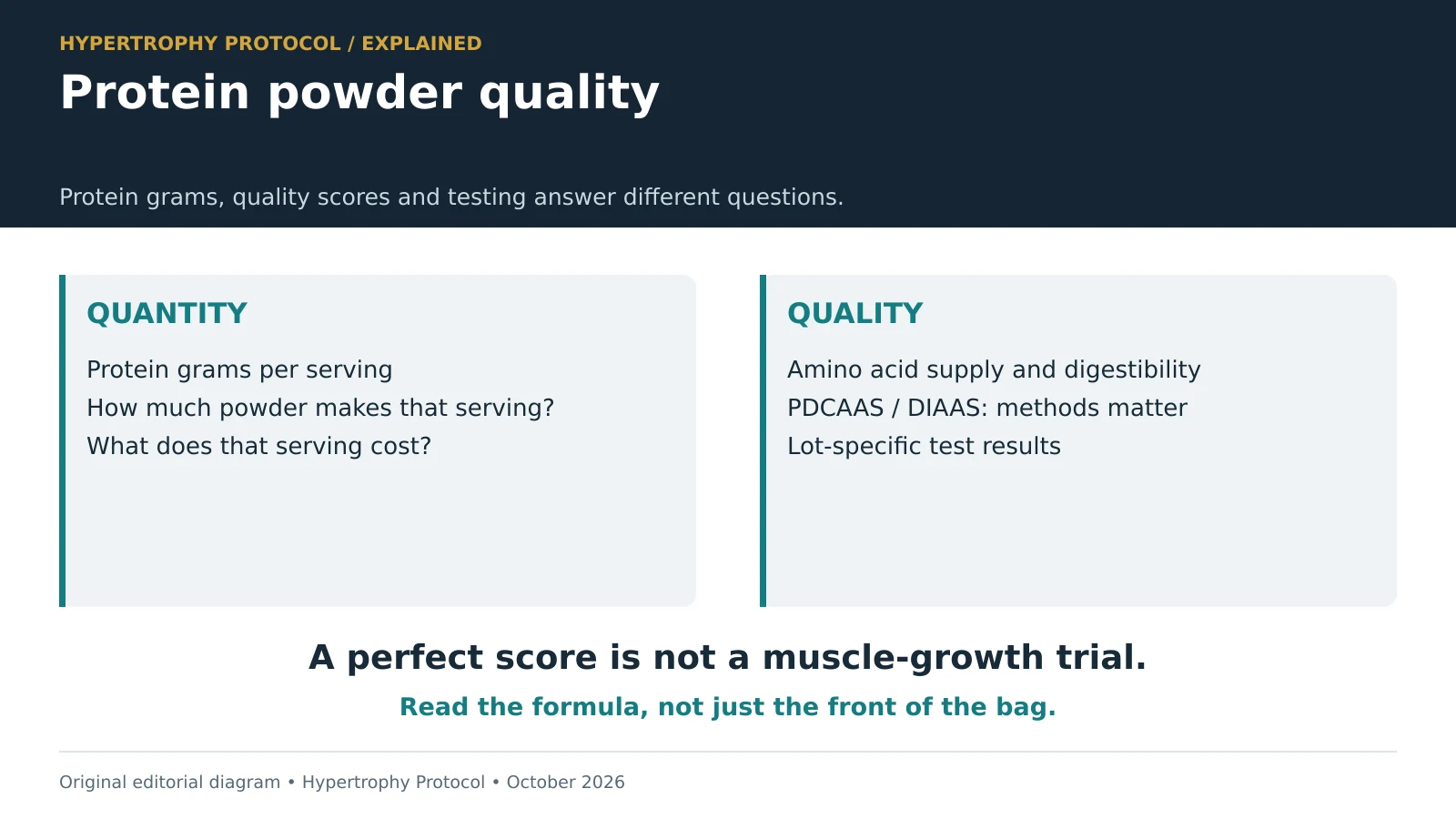
Three powders each advertise 20 grams of protein. One is whey, one is pea and one is made from yeast. Do they actually deliver the same useful amino acids? The answer cannot be read from the front of the bag alone, but the quality of the protein also cannot be reduced to a single “perfect” score.
Short answer: Read protein grams first, then the ingredient source, amino acid and digestibility evidence, serving cost and lot-specific testing. PDCAAS and DIAAS can help you interpret nutritional quality. Neither score predicts how much muscle a particular person will gain from a product, and a missing protein % Daily Value is not proof the powder is incomplete.
At a glance
| Label item | What it tells you | What it doesn’t |
|---|---|---|
| Protein grams | How much protein is in a serving | How much of each essential amino acid you get |
| PDCAAS | Amino-acid score corrected for digestibility, capped at 1.0 | Which of two 1.0-scoring proteins is better, or muscle gain |
| DIAAS | Digestible individual essential amino acids, with finer resolution | A raw-ingredient score may not match the finished powder |
| Protein % Daily Value | Share of the 50 g adult value, corrected by PDCAAS | Often optional: a missing %DV doesn’t prove incomplete protein |
| Lab certificate | Tested analytes for a named product and lot | Non-detect means below the limit; ppm is concentration, not dose |
Regulations and research reviewed October 13, 2026. See the full sections below for sources.
Start with what the protein number actually tells you
Nutrition Facts panels declare the grams of protein in a serving, generally rounded as required by labeling rules. That number measures protein quantity. The body still needs usable indispensable amino acids, and food preparation, digestion and the rest of your diet influence how the declared protein contributes to nutritional needs.
Imagine a 20-gram serving of a complete protein and a 20-gram serving with relatively little of one essential amino acid. Both can declare 20 grams of protein under the applicable regulations. The difference is the amino acid supply per gram and its measured digestibility, not necessarily a deceptive gram count.
For a lifter who eats a mixed diet, the other proteins eaten that day also supply amino acids. That is why a plant protein with a modest isolated score is not automatically a useless muscle-building food.
PDCAAS: why so many powders advertise a perfect 1.0
Protein Digestibility Corrected Amino Acid Score, or PDCAAS, adjusts an amino-acid adequacy score using protein digestibility. A score of 1.0 represents meeting the comparison standard after correction. Some whey, soy, yeast and other high-quality proteins can reach the top of that scale.
But the method caps values at 1.0. Two proteins with underlying differences can both end up displayed as 1.0, so it is not a ranking of which produces more hypertrophy. A brand’s score is also only as strong as the sampling, testing method and matching of the tested ingredient to what is actually sold.
Here’s a real example of what the cap can hide. Yeast protein is marketed with a PDCAAS of 1.0, like whey. Yet a 2026 gut-model study using an Angel Yeast yeast protein notes that earlier measurements put that ingredient’s true protein digestibility at about 85%, against about 96% for whey isolate and 95% for soy isolate. PDCAAS multiplies the amino-acid score by digestibility and then caps the result, so two proteins with different digestibility can both display 1.0 if the amino-acid score is high enough. The label number alone won’t show you that difference.
The Food and Agriculture Organization’s protein-quality expert report describes limitations of the capped score and recommends improved amino-acid-specific digestibility analysis. For consumers, the score is a useful clue, not the entire verdict.
What does DIAAS add that PDCAAS misses?
Digestible Indispensable Amino Acid Score, or DIAAS, is designed to assess digestible individual essential amino acids more directly. It can distinguish proteins that receive the same capped PDCAAS score and can provide greater resolution in comparisons.
DIAAS has its own requirements. Test preparation, reference populations, real ingredient processing and digestibility sampling matter, and not every consumer product has a credible finished-product DIAAS report. A seller citing a DIAAS for a raw ingredient does not necessarily document the final flavored formula or preparation method.
Neither DIAAS nor PDCAAS is a randomized muscle-growth trial. A scientifically strong decision combines nutritional composition with controlled outcome studies, cost, practical tolerability and the buyer’s full diet.
Is the protein % Daily Value a five-second completeness test?
No. A popular email-marketing shortcut says that 20 grams of “complete” protein must show 40% Daily Value, and anything less proves the product is incomplete. That misuses a useful labeling rule.
Under 21 CFR §101.9(c)(7), the adult protein Daily Reference Value is 50 grams. When protein %DV is displayed, its underlying quantity is corrected by the protein digestibility-adjusted amino-acid score, subject to the regulation’s rounding and population rules. In many adult foods the percent is optional unless a protein claim is made; other exceptions apply. Consequently, no printed %DV is not a reliable sign that the product is “hiding” incomplete protein.
A 20-gram powder scoring 1.0 could mathematically provide 40% of the 50-gram adult Daily Value under these labeling conditions. Another with a corrected score of 0.85 would calculate to 34% (20 × 0.85 = 17 grams, and 17 ÷ 50 = 34%). But label rounding, applicable claims and the rest of the regulatory requirements still matter. This calculation is a label-quality method, not a declaration that only 17 grams of the protein “count” for muscle growth.
If you are comparing supplements, do not call one fake or ineffective because its printed %DV differs. Check the actual composition and how the value was calculated.
Why leucine and essential amino acids deserve attention
Leucine participates in initiating muscle protein synthesis signaling, and the other essential amino acids are also necessary to build muscle proteins. Comparing equal labeled protein grams can be informative when one source delivers less leucine or certain indispensable amino acids than another.
Yet a leucine label does not guarantee a clinical advantage. The total daily intake, resistance-training stimulus, number of meals and protein quality across the full diet matter. Someone who already consumes enough high-quality protein may see little practical advantage from paying for a slightly different amino acid ratio.
If a manufacturer provides full profiles, compare essential amino acids in grams per serving rather than percentages of concentrate or an unspecified protein isolate. Never assume the amino acid profile of one yeast isolate applies to every product made with fermentation.
Does a clinical study on an ingredient validate every brand using it?
A human trial can establish something useful about the studied ingredient at the exact tested dose in the actual study population. A finished retail product can have different flavors, excipients, protein amount or processing. Ingredient-level evidence transfers only as far as the ingredient and conditions are demonstrably comparable.
For example, a 2024 yeast-versus-whey study tested AnPro yeast protein during an eight-week home resistance program in men aged 40 and over. It supports yeast protein as a legitimate candidate. It does not establish that every product with “yeast protein” on the label has a measured superior muscle-building effect. In that trial, the biggest clear differences versus placebo appeared in a subgroup with lower baseline protein intake.
Look for the manufacturer’s identification of the raw ingredient, isolate specifications, batch composition and outcome-study methods, including sponsor funding. A link to a publication is not a substitute for reading what the researchers actually measured.
How do you know a third-party certificate is actually useful?
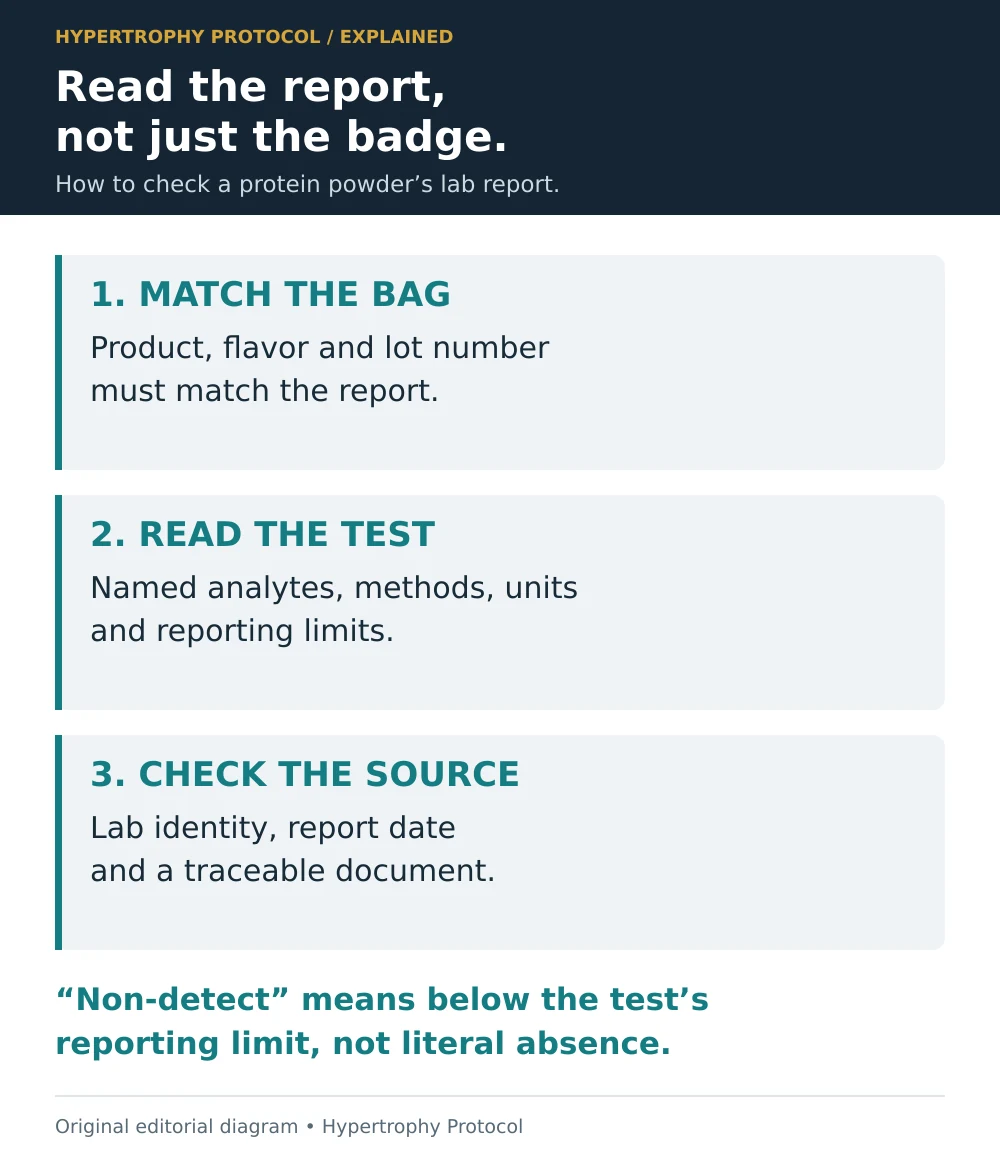
Commercial protein powders may be tested for lead, cadmium, arsenic, mercury, microbes, pesticides or allergens. Testing is an advantage only when you can see which product and lot was tested, what panel was covered, the method, the independent laboratory and the actual report date.
| Question | What to look for |
|---|---|
| Is it my bag? | Matching SKU or flavor and lot or batch number |
| Who performed the test? | Named lab and signed or traceable report |
| What was measured? | Named analytes, not just “purity passed” |
| Can I interpret the result? | Units, reporting limit, per-serving mass and applicable threshold |
| Is it current? | Date, lot and relevant manufacturing revision |
Parts-per-million numbers in a lab report express concentration. They are not automatically the dose consumed in a serving. To estimate intake, you must know the mass of the specific serving and convert units correctly. Also remember that “non-detect” means below a specified analytical detection/reporting limit, not the total absence of an element.
California Proposition 65 warnings are an additional legal reporting issue, not a simple safe-versus-dangerous score. Do not compare one brand’s selective marketing graphic with a laboratory certificate for another brand as if both are standardized independent surveys.
For a worked example using one brand’s published lot reports, see how we read SpaceMilk’s certificates in our SpaceMilk review.
What do food-allergy labels tell you?
The United States recognizes nine major food-allergen categories, including milk, peanuts, soy, wheat and sesame. The FDA’s allergen guidance explains their labeling requirements. “Vegan” and “dairy-free” are useful descriptions but do not, by themselves, certify safety for every food allergy.
If a supplement says it is free of all nine, examine whether the claim is about intentionally added ingredients or specific tested residual allergens. A laboratory panel naming gluten, milk, soy and peanut has not thereby documented individual laboratory tests for every other allergen. Severe allergies deserve particularly careful label and manufacturer verification.
Which powder should you buy?
If two powders provide adequate, usable protein for your diet, begin with the product you can reliably afford and tolerate. Use scores to eliminate clear nutritional problems, then compare ingredients, desired allergen avoidance, taste or mixability if personally established, and cost per serving of actual protein.
Whey remains a well-studied mainstream choice when dairy is tolerated. Yeast protein is a real alternative with promising human outcome evidence and the possibility of dairy-free formulations. Pea, soy and blends can also be useful with appropriate overall nutrition; the single-ingredient score alone is not a complete verdict.
To set how much protein you need each day, use our Protein Calculator rather than treating a label score as a substitute for a diet. For source-specific outcomes, the separate human yeast-protein trial and broader resistance-training meta-analysis answer different questions.