
Some links below are affiliate links, and as an Amazon Associate I earn from qualifying purchases. I may earn a commission at no extra cost to you. It doesn’t change what I recommend. See the affiliate disclosure.
The adjustable weight bench that matters for muscle growth is the one with notches near 30 and 45 degrees, a seat that tilts so you don’t slide at incline, a small gap between seat and back pad, and a flat height your feet can drive from. Capacity, decline and extras come after that. A flat-incline bench covers almost every hypertrophy press and row; buy an FID (flat, incline, decline) bench only if you will actually use the decline.
Below are the specs that change how a bench trains, then eight current benches from Titan, REP, Rogue and Bells of Steel compared on those specs. Every number comes from the maker’s own product page, checked October 2026. Where a page doesn’t list a spec, the table says so.
At a glance
| Bench | Best for | Key specs | Price on maker page, checked November 3, 2026 | Main catch |
|---|---|---|---|---|
| Titan Performance Series Adjustable | Lowest-cost flat-incline | 7 notches, 0 to 85°, incl. 30 and 45; 650 lb at any angle | $207.97 on sale | No decline; gap not listed |
| Bells of Steel Adjustable Utility | Budget bench with a decline | Decline, flat, 5 inclines; 575 lb | $299.99 (unavailable) | Angles, height and gap not listed |
| REP AB-3000 2.0 FID | Mid-price FID with leg rollers built in | -12 to 85°; 2.1″ gap; 1,000 lb | $349.99 (unavailable) | Widest published gap (2.1″) |
| TITAN Series Adjustable FID | Deepest decline | 10 back positions to -20°; gap pad; 600 lb | $510.97 on sale (regular $639.99) | Angles not given; 70″ long |
| Bells of Steel Buzz-Saw | 1,000 lb rating at every angle, with decline | -10 to 88°; 2.4″ pad | $516.99 (unavailable) | About 18″ high; no 15° notch |
| TITAN Series Adjustable | Fine incline steps for less | 30, 38, 45° notches; 1,000 lb flat, 600 incline | $549.97 | No decline listed |
| REP AB-5200 2.0 or Rogue Adjustable Bench 3.0 | Premium flat-incline | Both 10 back positions with 37.5° and 52.5°; 1.4″ and about 1″ gaps | $539.99 (REP, pre-order) or $535 (Rogue deal price) | Heavy (115 and 125 lb); no built-in decline |
Prices and specs from the makers’ pages, checked October 2026. Titan list prices shown; sale prices change often. Confirm before ordering.
Which incline angles does an adjustable weight bench need for hypertrophy?
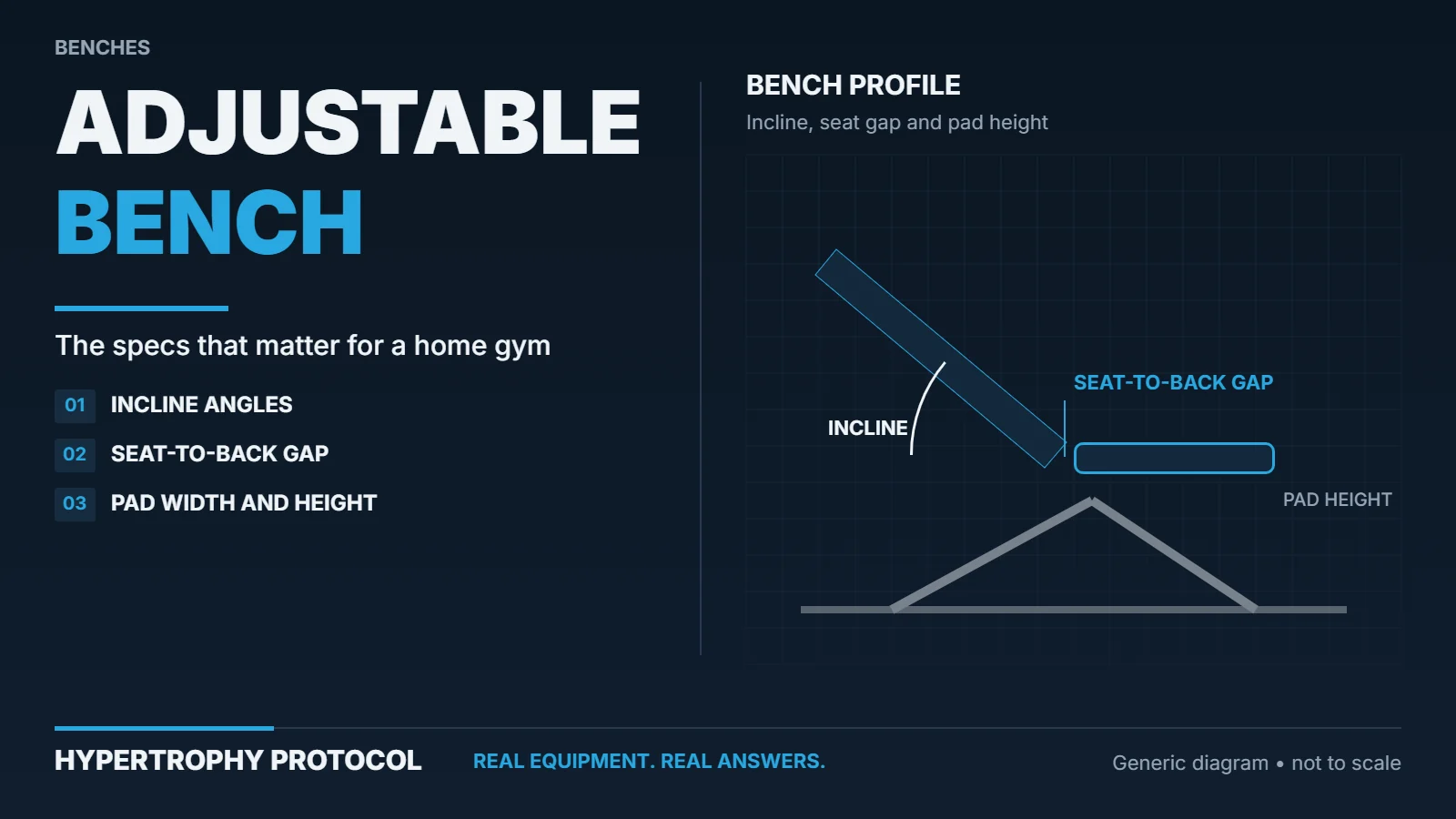
The incline press is the main reason to buy an adjustable bench over a flat one, so the back pad’s notches are the first spec to read. The studies point to a band, not a single angle. In 30 trained adults pressing at 60% of max, upper-chest activity was numerically highest at 30 degrees, front-delt activity was highest at 60, and angles past 45 shifted work toward the front delts (Rodríguez-Ridao et al., 2020). In 15 men at 70% of max, upper-chest activity was significantly higher at 44 degrees than at flat or 28 degrees (Trebs et al., 2010).
Both are single-session EMG studies, and EMG shows muscle activity, not growth. The incline bench angle guide goes through the research and lands on 30 to 45 degrees, leaning toward 45. For a bench, that means you want a notch close to 30, one close to 45, and ideally one in between.
Published notches vary more than you’d expect:
- Mostly 15-degree steps: Titan’s Performance Series lists 0, 15, 30, 45, 60, 75 and 85 degrees. REP’s AB-3000 2.0 lists -12, 0, 15, 30, 45, 60, 70 and 85.
- Finer steps between 30 and 60: the TITAN Series Adjustable adds 38 and 55. REP’s AB-5200 2.0 and Rogue’s Adjustable Bench 3.0 both run 30, 37.5, 45, 52.5 and 60.
- Bigger jumps at the top: the Bells of Steel Buzz-Saw goes 0, 30, 45, 55, 65, 75 and 88, plus a -10 decline, so there is no 15-degree setting.
- Angles not published: the TITAN Series Adjustable FID lists ten back pad positions, and the Bells of Steel Adjustable Utility lists decline, flat and five inclines, without a degree value for each.
A 37.5 or 38-degree notch is a real advantage if 45 bothers your shoulders and 30 feels too flat. If a page doesn’t give the angles, read them yourself with a phone inclinometer app laid on the back pad. Rogue doesn’t publish each notch angle for the AB-2 in my garage either, so this is a common gap.
The top notch matters too. Every bench here that publishes its angles tops out at 85 degrees or more, which is upright enough for seated dumbbell presses and seated curls.
Does seat adjustment matter on an adjustable bench?
Yes, once you press at an incline. With the back pad raised and the seat flat, your hips slide down the pad as you press, and you spend effort holding position instead of pressing. Tilting the seat up a notch or two stops that.
Seat ranges on these pages run from 0 to 20 degrees (Titan Performance Series and REP AB-3000 2.0) to 0 to 30 degrees (TITAN Series Adjustable, REP AB-5200 2.0 and Rogue 3.0). REP’s AB-3000 2.0 has five seat angles, and the AB-5200 2.0 lists 0, 8, 20 and 30. Bells of Steel gives three seat angles for the Buzz-Saw and five positions for the Utility bench without the degrees.
More seat positions also help on chest-supported rows and incline curls, where you want the seat set so your chest meets the pad at the right height.
How big a gap between seat and back pad is too big?
On a flat press, the gap sits under your lower back or glutes. A wide gap is something you feel when you set an arch and drive with your legs, and it can make a narrow-hipped lifter sink between the pads. The makers publish very different numbers:
- Rogue Adjustable Bench 3.0: about 1 inch.
- REP AB-5200 2.0: 1.4 inches.
- REP AB-3000 2.0: 2.1 inches.
- TITAN Series Adjustable FID: fills the gap with a separate gap pad, 5.5 inches long and 11 inches wide.
- TITAN Series Adjustable: says its back pad extends to avoid a gap when flat, with no measurement.
- Bells of Steel Buzz-Saw: “a minimal pad gap,” with no measurement. Titan’s Performance Series and Bells of Steel’s Utility bench don’t mention the gap.
So-called zero gap benches, such as REP’s AB-5000 Zero Gap, are built around this one spec. Its maker page couldn’t be loaded for this check, so it isn’t in the table. If you mostly flat press heavy and arch, put gap near the top of your list. If you mostly press dumbbells on an incline, it matters less, because at incline the gap sits below your hips.
What pad width and height off the floor work for bench press and leg drive?
Pad width decides how much of your upper back is supported. The IPF’s competition rules set a bench width of 29 to 32 cm, about 11.4 to 12.6 inches, and a height of 42 to 45 cm, about 16.5 to 17.7 inches, measured to the top of the uncompressed pad (IPF Technical Rules). You don’t need to meet that at home, but it is a useful reference.
Most back pads here sit at or just under that range: 11 inches on the TITAN Series FID and Rogue’s textured pad, 11.25 inches on Rogue’s vinyl pad, 11.8 inches on the AB-3000 2.0, 12 inches on the TITAN Series Adjustable and 12.25 inches on the Performance Series. REP’s AB-5200 2.0 also comes with a 14-inch wide back pad, which gives broad lifters more support under the shoulders but sits outside the competition width. Whether wide or standard feels better is personal; no study picks one.
Height affects leg drive. Published flat heights run from 17 inches (TITAN Series Adjustable) to 17.1 (AB-3000 2.0), 17.25 (Titan Performance and FID), 17.5 (AB-5200 2.0 and Rogue 3.0) and about 18 inches (Buzz-Saw). If you are shorter and your heels lift off the floor on an 18-inch bench, a lower bench or plates under your feet gives you a planted base. If you are tall, a lower bench puts your knees high.
Height also moves your rack settings. A one-inch difference in bench height can decide which safety hole works on a rack with 2-inch spacing. The weight bench height guide shows how to measure your own chest and lockout heights and match them to J-cup and safety holes.
How much weight capacity does an adjustable bench really need?
Less than the biggest number on the box, but more than you might think. A bench carries your body plus whatever you’re holding. A 200 lb lifter pressing two 100 lb dumbbells puts about 400 lb on the pad. The same lifter benching 315 lb puts up to 515 lb through the bench and their feet, depending on how much the legs take.
Published ratings:
- 1,000 lb: REP AB-3000 2.0, REP AB-5200 2.0, and the Bells of Steel Buzz-Saw, which says 1,000 lb “at every angle.”
- 1,000 lb flat and 600 lb inclined: TITAN Series Adjustable.
- 650 lb at any angle: Titan Performance Series.
- 600 lb: TITAN Series Adjustable FID.
- 575 lb: Bells of Steel Adjustable Utility.
- Not published: Rogue Adjustable Bench 3.0.
None of these pages explains how its rating was tested, so treat them as the maker’s figures rather than a common standard. Read the incline number if there is one, because some benches are rated lower inclined than flat. For most home lifters, a 575 to 650 lb bench covers dumbbell work; a heavy barbell bencher is better served by a 1,000 lb rating with margin left over.
How do stability, footprint, wheels and handle compare?
Bench weight is a rough proxy for how planted it feels. The lightest here are the Titan Performance Series at 52 lb and the Bells of Steel Utility at 55 lb. The AB-3000 2.0 weighs 89.3 lb, the TITAN Series FID 92 lb, the Buzz-Saw 94.3 lb (its FAQ says about 98), the AB-5200 2.0 115 lb, the TITAN Series Adjustable 120 lb, and Rogue lists 125 lb for the 3.0.
Footprints are similar except one. Most are about 56 to 58 inches long and 23 to 26 inches wide: 56 x 25 inches (Performance Series), 56.6 x 25.8 (AB-3000 2.0), 56.5 x 24.75 (TITAN Series Adjustable and Rogue 3.0, Rogue’s figure being rear foot width) and 57.6 x 25.8 (AB-5200 2.0). The TITAN Series FID is 70 inches long overall. Bells of Steel lists neither bench’s footprint. To check one in your room before you order, use the Home Gym Room Planner.
Every bench here lists a handle, and all but the AB-5200 2.0 list wheels; its page mentions only a knurled stainless front handle. Several store upright: Titan’s Performance Series and TITAN Series Adjustable, the AB-5200 2.0 (3.1 sq ft stored) and Rogue’s 3.0. Bells of Steel warns that its benches need a level floor to stand vertically.
Do you need a decline, and is a flat-only bench enough?
A decline setting is for decline presses and decline sit-ups. It needs somewhere to lock your legs, and that’s where FID benches differ:
- REP AB-3000 2.0: built-in leg rollers with six positions, down to -12 degrees.
- TITAN Series Adjustable FID: removable foot roller, down to -20 degrees.
- Bells of Steel Buzz-Saw: -10 degrees; the leg roller is an optional attachment that needs an adapter.
- REP AB-5200 2.0: optional adjustable post gives -4, -6 and -8 degrees, and the bench isn’t compatible with REP’s Leg Roller Attachment.
- Bells of Steel Utility: has a decline position, no leg holder listed.
Most hypertrophy programs can train the chest fully with flat and incline work, so a decline is optional. It also adds length and weight. Buy one if you already know you’ll use it.
A flat-only bench is cheaper, has no gap, and is often built to competition height. It can’t do incline presses, seated presses, chest-supported rows or incline curls, which are core hypertrophy movements. If you have room for one bench, get an adjustable one. If you have room for two, a flat bench for heavy pressing plus an adjustable bench for everything else is a solid pair.
Adjustable weight bench comparison: 9 benches by spec
All specs are from each maker’s product page, checked October 2026. “Not listed” means the page didn’t give it. REP’s AB-3000 2.0 and AB-5200 2.0 specs were read from REP’s own regional store pages, and Rogue’s 3.0 specs from Rogue’s Canadian page and support guide, because the US pages didn’t load in full. Titan prices are list prices; Titan’s sale prices change often.
| Bench | Back pad angles | Seat | Gap | Back pad width / height | Capacity | Weight / footprint | Price on maker page, checked November 3, 2026 |
|---|---|---|---|---|---|---|---|
| Titan Performance Series Adjustable (also on Amazon, affiliate) | 0, 15, 30, 45, 60, 75, 85°; no decline | 0, 10, 20° | Not listed | 12.25″ wide, 2.5″ thick / 17.25″ | 650 lb at any angle | 52 lb / 56 x 25″ | $207.97 on sale (regular $259.99) |
| Bells of Steel Adjustable Utility Bench | Decline, flat, 5 inclines (degrees not listed) | 5 positions | Not listed | Not listed; 2.3″ thick / not listed | 575 lb | 55 lb / not listed | $299.99 (shown unavailable) |
| REP AB-3000 2.0 FID | -12, 0, 15, 30, 45, 60, 70, 85° | 0, 5, 10, 15, 20° | 2.1″ | 11.8″ (seat 15″) / 17.1″ | 1,000 lb | 89.3 lb / 56.6 x 25.8″ | $349.99 (shown unavailable) |
| TITAN Series Adjustable FID | 10 positions to -20° (degrees not listed) | 7 head/seat positions | Gap pad, 5.5 x 11″ | 11″ / 17.25″ overall | 600 lb | 92 lb / 70 x 23.5″ | $510.97 on sale (regular $639.99) |
| Bells of Steel Buzz-Saw | -10, 0, 30, 45, 55, 65, 75, 88° | 3 angles (degrees not listed) | “Minimal,” not measured | Not listed; 2.4″ thick / about 18″ | 1,000 lb at every angle | 94.3 lb (FAQ: about 98) / not listed | $516.99 (shown unavailable) |
| TITAN Series Adjustable (also on Amazon, affiliate) | 0, 15, 30, 38, 45, 55, 60, 70, 85°; no decline listed | 0, 15, 30° | Back pad extends when flat; not measured | 12″ wide, 2.5″ thick / 17″ | 1,000 lb flat, 600 lb inclined | 120 lb / 56.5 x 24.75″ | $549.97 |
| REP AB-5200 2.0 | 0, 20, 30, 37.5, 45, 52.5, 60, 67.5, 75, 85°; optional -4, -6, -8° | 0, 8, 20, 30° | 1.4″ | 12″ or 14″ / 17.5″ with pad | 1,000 lb | 115 lb / 57.6 x 25.8″ | $539.99 (pre-order) |
| Rogue Adjustable Bench 3.0 | 0, 15, 30, 37.5, 45, 52.5, 60, 67.5, 75, 85° | 0, 15, 30° | About 1″ | 11.25″ vinyl or 11″ textured / 17.5″ flat | Not listed | 125 lb / 56.5 x 24.75″ (rear feet) | $535 deal price (normal $595) |
| FED Fitness Flybird Series WB6 (foldable) | 8 positions, -30 to 90° | 3 positions (the page also lists 4 seat angles: flat, 15, 25, 30°) | Not listed | 9.4 to 11.8" tapered, 2.4" thick / seat 19.3" from floor | 880 lb | 30.1 lb / 46.5 x 13.8" | $149.99 (out of stock on the maker store, Nov 3, 2026) |
Two patterns stand out. The lower-priced benches leave out some of the specs that matter most for training: neither the Titan Performance Series nor the Bells of Steel Utility lists its gap, and the Utility lists no angles or height, so you are buying partly blind. The finest incline steps, 37.5 and 52.5 degrees, come on the REP AB-5200 2.0 and Rogue 3.0, while Titan’s TITAN Series Adjustable gets close with 38 and 55.
What about Flybird (FED Fitness) benches?
Flybird is one of the most searched budget bench brands. The benches are now sold as the FED Fitness Flybird Series. The two adjustable models on the maker’s store, checked November 3, 2026:
- WB6 Foldable Adjustable Weight Bench: $149.99, 8 back pad positions from -30 to 90 degrees, 3 seat positions (the page also lists 4 seat angles: flat, 15, 25 and 30 degrees), 880 lb rated capacity, 30.1 lb, folds for storage, 1-year warranty. The seat sits 19.3 inches off the floor and the back pad tapers from 11.8 to 9.4 inches wide.
- WB8 Heavy Duty Adjustable Weight Bench: $249, 12 back angles, 3 seat angles, 1,200 lb rated capacity, 12-inch-wide back pad, 1-year warranty. The page does not list the bench weight, dimensions, angles in degrees or the seat-to-pad gap.
Both showed as out of stock on the maker’s store when we checked. The WB6 costs less than any bench in the table above, and the trade-offs show in the specs: it weighs about a third as much as REP’s AB-3000 2.0 (89.3 lb), its 19.3-inch seat height sits above the 16.5 to 17.7-inch IPF bench range covered earlier, and its back pad narrows to 9.4 inches, less than any listed pad width in the table. That makes it a reasonable pick for dumbbell work, a small room or a bench you fold away. For heavy barbell pressing in a rack, a heavier bench with a wider pad will be steadier.
Which adjustable weight bench should you buy?
- You want the cheapest bench that still trains incline well: the Titan Performance Series. It has true 30 and 45-degree notches, a tilting seat and a 650 lb rating at any angle. Its gap isn’t published, so check reviews or ask Titan if you flat press heavy.
- You want a decline on a budget: the Bells of Steel Adjustable Utility, if you can accept unlisted angles and height. Plan to measure the notches with a phone once it arrives.
- You want a full FID bench with the leg holder included: REP’s AB-3000 2.0 for its 1,000 lb rating and built-in rollers, accepting a 2.1-inch gap. Choose the TITAN Series FID instead if you want the deepest decline and a gap pad, and have room for a 70-inch bench.
- You want 1,000 lb at every angle and a decline: the Buzz-Saw. Check that its about-18-inch height suits your leg drive and your rack holes.
- You care most about incline precision and flat comfort: the AB-5200 2.0 or Rogue’s 3.0, both with 37.5 and 52.5-degree notches and small published gaps. The TITAN Series Adjustable is the lower-priced alternative with 38 and 55.
- You only bench flat and heavy: skip the adjustable and buy a flat bench; add an adjustable later for incline and seated work.
Pair the bench with the rest of the setup. The adjustable dumbbells guide covers the weights you’ll press on it, and the home gym in phases plan shows where a bench fits in the buying order.
FAQ
What is the best adjustable weight bench for a home gym?
For most people training for muscle growth, one with notches near 30 and 45 degrees, a tilting seat, a small seat-to-back gap and a rating that covers your body weight plus your heaviest dumbbells. In this comparison, the Titan Performance Series is the budget pick and the REP AB-5200 2.0 or Rogue Adjustable Bench 3.0 the premium picks.
Is a Flybird bench good for a home gym?
For dumbbell training and moderate loads, yes. The Flybird WB6 folds, weighs about 30 lb and lists an 880 lb capacity for $149.99, but its seat is taller and its back pad narrower than the heavier benches in our table, so it is less steady for heavy barbell bench press.
What is a zero gap bench?
A bench designed so the seat and back pad meet with little or no space between them when flat. The published gaps here range from about 1 inch (Rogue 3.0) to 2.1 inches (REP AB-3000 2.0), and Titan’s FID fills its gap with a separate pad.
Is an FID bench better than a flat-incline bench?
Only if you’ll use the decline. FID benches add decline presses and sit-ups but usually need a leg holder, which adds length and weight. For hypertrophy, flat and incline settings cover the main pressing and rowing work.
How much weight should an adjustable bench hold?
At least your body weight plus the heaviest load you’ll hold on it, with margin. A 200 lb lifter with two 100 lb dumbbells puts about 400 lb on the pad. Check the incline rating when a maker lists one, since some benches rate lower inclined than flat.
Related guides
- Incline Bench Angle for Upper Chest: What the Research Shows
- Weight Bench Height: Setting J-Cups and Safeties in a Rack
- Adjustable Dumbbells for Home Gym Hypertrophy: The Specs
- Power Rack J-Cups: Standard, Sandwich, Roller, Lowered
- Power Rack Buying Guide: The Specs That Affect Hypertrophy
- Garage Gym Layout Ideas
- Home Gym Room Planner
Specs checked October 2026 on each maker’s product page. Manufacturers change specs, prices and stock; confirm on the product page before ordering.