
Horse stall mats are the cheapest way to put thick rubber under a home gym. The standard mat is 4 x 6 feet and 3/4 inch thick, covers 24 square feet and weighs about 94 to 100 pounds. A single-rack lifting area usually takes 4 to 6 mats, a one-car garage about 10. Air them out outdoors before they come inside, and don’t mix mat sizes or brands in one floor.
The two jobs that catch people out are the smell and the weight. Both are manageable if you plan for them before the mats arrive. Specs below come from the retailer and maker pages linked beside them, checked October 20, 2026.
What size and weight is a standard horse stall mat?
Greatmats describes the standard stall mat as 4 x 6 feet and 3/4 inch thick, at about 100 pounds per mat. Its thinner 1/2-inch mats run closer to 75 pounds and give less cushion. Tractor Supply’s own 4 x 6 ft x 3/4 in stall mat lists 94 pounds and 100% recycled vulcanized rubber.
Big-box “gym mats” in the same aisle are often a different size. The TrafficMaster heavy-duty mat at Home Depot is 42 x 72 inches and 18 mm thick, covering 21 square feet. The listing’s specifications don’t give a weight. In the listing’s questions section, TrafficMaster’s support team puts it at about 69.3 pounds per piece.
| Mat | Size | Thickness | Coverage | Weight per mat | Weight per sq ft |
|---|---|---|---|---|---|
| Tractor Supply stall mat (item 2219003) | 4 x 6 ft | 3/4 in | 24 sq ft | 94 lb | About 3.9 lb |
| Typical 3/4 in stall mat (Greatmats) | 4 x 6 ft | 3/4 in | 24 sq ft | About 100 lb | About 4.2 lb |
| Typical 1/2 in stall mat (Greatmats) | 4 x 6 ft | 1/2 in | 24 sq ft | About 75 lb | About 3.1 lb |
| TrafficMaster heavy-duty mat (W-RBLKMAT42X72) | 42 x 72 in (3.5 x 6 ft) | 18 mm (about 0.71 in) | 21 sq ft | Not in specs; about 69.3 lb per brand answer in Q&A | About 3.3 lb |
Weight per square foot is the mat weight divided by its coverage. The TrafficMaster weight comes from the brand’s answer in the listing’s Q&A, not its spec sheet. Checked October 20, 2026; check current price on each page.
I use three of those TrafficMaster mats in my garage. They’re sturdy and very heavy, which makes them hard to move around, and they had a strong rubber smell at first that faded. The two things I’d buy with them are mat clips, so you can drag them instead of wrestling them, and tape to keep them in place.
Don’t mix the two sizes in one floor. A 42-inch mat next to a 48-inch mat leaves seams that never line up, and 18 mm against 3/4 inch (about 19 mm) leaves a small lip at every joint. Pick one product and buy enough of it in one trip.
How many stall mats do you need for a home gym?
Divide the area by 24 square feet for a lower bound, then lay it out as a grid of whole mats. Rooms whose sides divide evenly by 4 and 6 feet use whole mats with no cutting. The counts below use whole 4 x 6 ft mats in whichever direction needs fewer, with weights from Tractor Supply’s 94-pound mat.
| Area to cover | Square feet | 4 x 6 mats, whole-mat grid | Weight to haul | Cutting needed? |
|---|---|---|---|---|
| 8 x 8 ft (rack and bar only) | 64 | 4 | 376 lb | Yes, trims 4 ft off one side |
| 8 x 12 ft | 96 | 4 | 376 lb | No |
| 10 x 10 ft | 100 | 6 | 564 lb | Yes |
| 12 x 12 ft | 144 | 6 | 564 lb | No |
| 12 x 20 ft (typical one-car bay) | 240 | 10 | 940 lb | No |
| 20 x 20 ft (two-car) | 400 | 20 (17 is the area minimum) | 1,880 lb | Yes, on the 20 ft side |
Notice that a 12 x 12 area takes the same six mats as 10 x 10, with no cutting. If your space allows it, round the covered area up to the next size that fits whole mats instead of cutting six mats down.
For your own room, the flooring calculator counts pieces, cost and haul weight for stall mats and several other products. If you’re still placing the rack, the Home Gym Room Planner checks the rack against your floor and ceiling and counts the stall mats for that layout, including the height the mats add under the rack.
Weight matters if the gym isn’t on a slab. At about 3.9 pounds per square foot, the six mats for a 12 x 12 area add 564 pounds of rubber before any equipment goes on. Ask a structural engineer before putting a heavy gym on a framed floor.
How do you cut a stall mat cleanly?
Score it rather than slice it: a sharp utility knife with a hook blade, a long straightedge, and several light passes. The flooring guide lists the tools for moving and cutting mats.
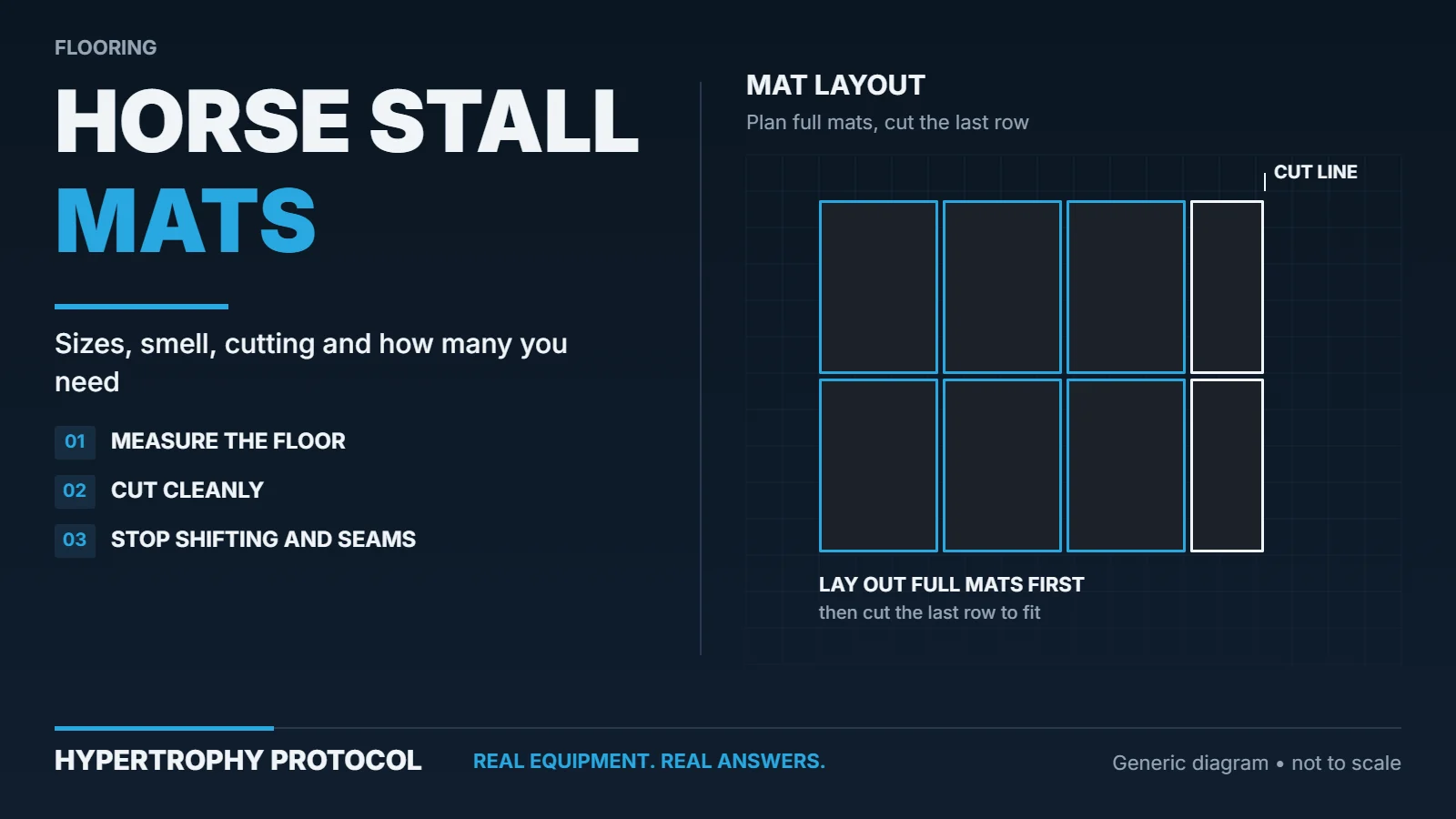
Plan which edges get cut before you start. Put cut edges against the walls and keep the factory edges where mats meet each other, so the seams you walk on are the straightest edges you have. Greatmats advises taking the time to cut carefully so the mats fit together securely. Lay the full mats first, then measure the gaps for the cut pieces from the floor, not from your sketch.
Why do stall mats smell, and how do you get rid of it?
The smell is volatile organic compounds coming out of the rubber. Greatmats says mats made from vulcanized recycled rubber can smell very strong when new, and the compounds stay trapped while the mats are stacked. In a barn the smell usually fades within a few weeks. Indoors, in a home gym, Greatmats says it can linger for months.
Greatmats’ fix is to deal with it outside, before installation:
- Unstack the mats. Stacking traps the odor.
- Mop both sides with a neutral pH cleaner, such as Simple Green, and let each side dry.
- Lay them in direct sun for at least a few days, propped up so air moves underneath, and flip them now and then.
- Smell-test them before they come inside. Once installed, run fans that push air out a door or window.
Tractor Supply’s own answer for its mat is to air them out for several hours or days before using them indoors, and one reviewer on that page said the smell was still there weeks later. On the TrafficMaster listing, one buyer reported a bad smell five months after installation; the answer suggested more ventilation and mild soap and warm water, and warned against harsh chemicals, bleach and abrasive cleaners. Mine smelled strongly at first and faded, but I can’t promise yours will fade on any schedule.
If smell is a dealbreaker, REP says its fitness-specific rubber mats generally smell less than agricultural stall mats. That’s REP’s claim, not a test. Ask any seller for a sample if your gym shares air with the house.
How do you stop stall mats from shifting and seams from opening?
Heavy 3/4-inch mats mostly stay put on their own, according to Greatmats, and thinner mats are more prone to curling and shifting. The usual cause of movement is loose seams: once there’s a gap, the mats start to buckle and creep. REP says most customers dry-lay their mats on concrete or plywood and that adhesive generally isn’t needed in a home gym.
- Butt the seams tight as you lay each mat, and start from the wall you care most about.
- Tape the seams or corners if they keep opening. Tape is what I’d use; try a corner first if you might lift the mats later.
- Use mat clips to reposition a 70- to 100-pound mat without bending over and wrestling it.
- Choose a side. Tractor Supply says to put the raised-button side down for cushioning and drainage, or face it up for more traction. Keep every mat the same way up.
Are stall mats OK on a garage slab with moisture?
Usually, but check the slab first. Vulcanized rubber is fully waterproof, per Greatmats, which is good for spills but also means moisture rising through the concrete can’t escape through the mat.
A simple check is the plastic sheet test. Under ASTM D4263, it indicates whether moisture is present in concrete. Coatings maker Tnemec describes taping down an 18 x 18 inch plastic sheet for at least 24 hours and looking for darkened concrete underneath. It tells you whether moisture is present, not how much.
If the slab shows moisture, put the button side down so there are channels underneath, and lift a corner of a few mats after the first weeks to look for damp or mildew. Garage slabs also usually slope toward the door; the flooring guide’s slope section shows how to measure it before you lay anything that needs to sit flat.
Can you deadlift on horse stall mats?
Yes, for most home lifting. One layer of 3/4-inch stall mat is the usual starting point for a lifting area, and thickness guidance for heavy drops is covered in the flooring guide. If you pull heavy or drop the bar often, stall mats become the top layer of a platform rather than the whole floor.
The common DIY version, such as Bells of Steel’s platform plan, uses plywood layers with a wood standing surface in the middle and strips of 3/4-inch stall mat on each side where the plates land.
Stall mats vs interlocking tiles vs rubber rolls
| Option | Best for | Main drawback |
|---|---|---|
| 3/4 in stall mats | Garage lifting areas, heavy weights, lowest cost per square foot of thick rubber | 94 to 100 lb each, smell, no interlock |
| Interlocking rubber tiles | Finished rooms, odd shapes, replacing one damaged piece | Often thinner; edge pieces cost extra |
| Rolled rubber | Large areas with few seams | Heavy rolls, harder to cut accurately |
Stall mats win when the floor is concrete and the weights are heavy. Tiles win when you need to fit around a room’s shape or carry pieces up stairs. Current prices, thicknesses and a product-by-product comparison are in the home gym flooring guide.
Frequently asked questions
Which side of a horse stall mat goes up?
Tractor Supply says to put the raised-button side down for cushioning and drainage, or up if you want more traction. Whichever you choose, lay every mat the same way so the surface stays even.
How much does a 4 x 6 stall mat weigh?
Tractor Supply lists its 3/4-inch mat at 94 pounds, and Greatmats says 3/4-inch mats typically run about 100 pounds. A 1/2-inch mat is closer to 75. Plan on two people or mat clips to move them.
How long does the rubber smell last?
It’s strongest when new. Greatmats says it can fade in a few weeks in a barn but linger for months indoors. Washing, unstacking and sunning the mats outside first is the best way to shorten it.
Can I put stall mats over carpet?
Not over thick carpet. REP advises a flat, firm surface such as concrete or plywood and says to avoid thick carpet underneath.
Related guides
- Home gym flooring guide: how much you need, how thick and what it costs
- Flooring and fit calculator
- Home Gym Room Planner
- How to set up a home gym in a 10×10 space
- Power Rack Comparison Tool
- All free tools
Sources checked October 20, 2026. Retailers change products and specs; confirm on the listing before ordering.