
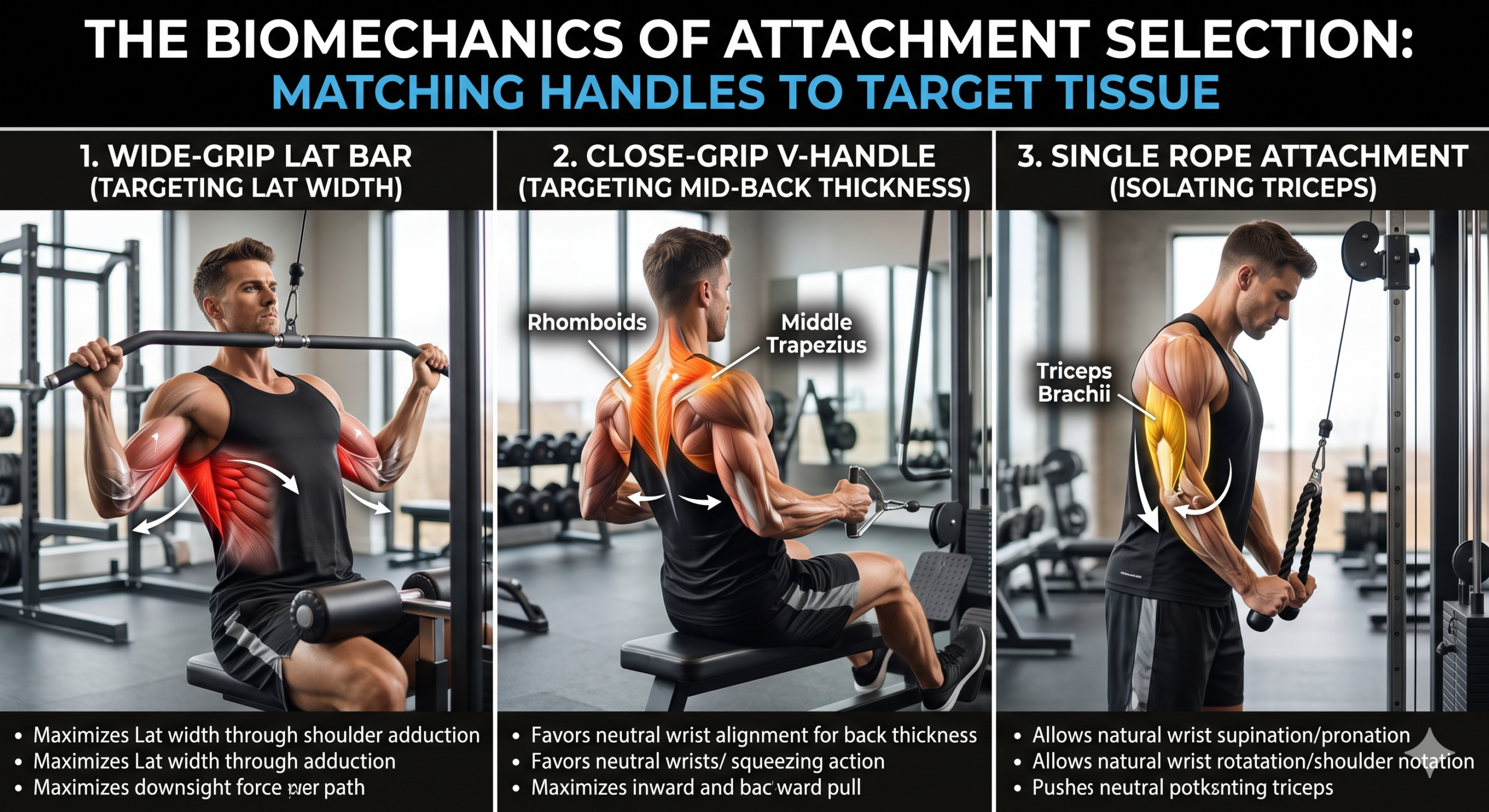
At the Hypertrophy Protocol Lab, we have long maintained that the weakest link in any resistance training system is not the cable, the weight stack, or even the user’s musculature — it is the interface between the human hand and the implement. The attachment you select determines the biomechanical pathway through which force is transmitted, and that pathway dictates which tissue receives the training stimulus. This is not a matter of preference or convenience. It is a matter of mechanical engineering applied to human anatomy. In this analysis, we present our institutional framework for understanding attachment selection as a precision tool for targeted tissue loading, grounded in 11-gauge steel hardware standards, 3×3 rack compatibility, and the latest advances in biomechanical handle design through June 2026.
Before we discuss soft tissue, we must establish the rigid framework upon which every attachment ultimately depends. In our lab, all cable-based and rack-mounted training systems are standardized around the 3×3 rack specification — that is, upright tubes measuring 3 inches by 3 inches with 5/8-inch or 1-inch hole spacing. This is not arbitrary. The 3×3 profile provides the torsional rigidity necessary to maintain positional integrity under asymmetric loading, which is precisely what occurs when a user pulls a cable attachment from an off-axis angle.
11-Gauge Steel as the Structural Baseline
11-gauge steel (approximately 0.1196 inches or 3.038 mm wall thickness) is the minimum standard we endorse for any rack or accessory mount involved in attachment-based training. Thinner gauges — 12-gauge (2.657 mm) or 14-gauge (1.897 mm) — introduce measurable deflection at the point of cable redirection, which creates micro-variations in the force curve that the user cannot consciously perceive but that the target tissue absolutely registers. When a j-hook or cable pulley bracket flexes even 2–3 mm under load, the effective moment arm at the user’s wrist, elbow, or shoulder shifts. Over thousands of repetitions, this inconsistency degrades the precision of tissue targeting. We therefore consider 11-gauge steel the biomechanical floor, not the ceiling, for any serious hypertrophy-focused training installation.
The Carabiner and Swivel Junction
The point where the cable meets the attachment — typically a carabiner clipped to a swivel — is a critically underexamined node. We specify forged steel carabiners rated to a minimum of 5,000 lbs and 360-degree ball-bearing swivels for all attachment connections. The swivel is not a luxury; it is a biomechanical necessity. Without free rotation, the cable introduces a torsional vector into the handle that the user’s forearm must counteract. This parasitic torque recruits wrist extensors and pronators that are not the intended targets, contaminating the training stimulus. A locked or corroded swivel transforms every pulling exercise into a partial forearm exercise, whether the user intends it or not.
In exploring the intricate relationship between biomechanics and attachment selection, it is beneficial to consider how the design of a performance environment can influence training outcomes. A related article, which discusses the optimal strategies for creating an elite performance environment within a limited space, can provide valuable insights into how to effectively utilize equipment and attachments. For more information, you can read the article here: How to Design an Elite Performance Environment in a 10×10 Space.
The Biomimetic Revolution: How Handle Material Science Has Changed Attachment Design
The most significant development in attachment biomechanics through 2026 is the application of biomimetic handle design using gyroid-based cellular metamaterials. This research, which we have been tracking since its initial publication, confirms what we hypothesized for years: the ideal handle does not behave like a rigid object. It behaves like an extension of the user’s own tissue.
Gyroid Metamaterials and the Soft Tissue Analogy
A gyroid is a triply periodic minimal surface — a complex, continuously curving lattice structure that can be fabricated via additive manufacturing (3D printing) in various polymers and composites. When used as the core structure of a handle, a gyroid lattice exhibits a mechanical response that mimics the nonlinear stiffness profile of human palmar soft tissue. Specifically, human skin and subcutaneous fat demonstrate low stiffness at small compressive strains (the tissue is compliant when you first grip something) and then stiffen rapidly at higher strains (the tissue resists further deformation as grip force increases). This is a J-shaped stress-strain curve, characteristic of biological soft tissues containing collagen fiber networks.
Handles fabricated with gyroid metamaterials replicate this curve. At light grip forces, the handle surface conforms to the hand’s geometry, increasing contact area and distributing pressure. At higher grip forces — such as those encountered during a heavy cable row or lat pulldown — the handle stiffens progressively, preventing the sensation of “bottoming out” that occurs with overly soft foam grips while avoiding the sharp pressure peaks created by rigid steel or hard plastic handles.
Medium Stiffness: The Experimentally Validated Optimum
Experimental data now clearly demonstrates that medium-stiffness handles receive the highest subjective comfort ratings across all measured domains: fit, ease of use, and grip stability. This finding is critical for hypertrophy-focused training because discomfort at the hand-handle interface is a primary limiter of effective set duration. When a handle creates localized pressure points — as rigid PLA (polylactic acid) handles invariably do — the user terminates the set due to hand pain before the target musculature reaches mechanical failure. The handle, not the muscle, becomes the failure point, and the hypertrophic stimulus is truncated.
We now recommend that all cable attachments used in tissue-targeting protocols incorporate handles with tailored mechanical compliance in the medium-stiffness range. This is not about comfort for its own sake. It is about removing a biomechanical bottleneck that limits the volume and intensity deliverable to the target tissue.
Nonlinear Deformation Principles Applied to Attachment Ergonomics

The broader principle emerging from this research is that adaptable stiffness and nonlinear deformation in handles, inspired by human soft tissue mechanics, represent a paradigm shift in attachment design. We are moving from an era of “hard handle versus soft grip” binary thinking into a regime of engineered mechanical gradients.
The Pressure Plateau Effect
When a handle exhibits nonlinear stiffness — compliant at low force, stiffening at high force — the contact pressure across the palmar surface does not rise sharply with increasing grip force. Instead, it reaches a plateau. This plateau-like mechanical response is profoundly important for two reasons:
- Tissue Protection: The skin and subcutaneous fat of the palm have finite tolerance for compressive stress. Exceeding this tolerance causes ischemia (blood flow restriction), nerve compression, and ultimately callus formation or blister injury. A pressure plateau keeps the interface stress below the tissue damage threshold even during maximal-effort sets.
- Proprioceptive Clarity: When hand pressure is evenly distributed and stable, the user’s proprioceptive system can more accurately monitor the forces generated by the target musculature. Sharp pressure points create nociceptive (pain) signals that compete with proprioceptive feedback, degrading the user’s ability to sense and control the movement. Even pressure means cleaner neural signaling, which means more precise muscle targeting.
Implications for Specific Attachment Types
We apply these principles across the full spectrum of cable attachments:
- Straight bars and lat pulldown bars: These should feature overmolded grips with graduated stiffness zones — softer at the thenar and hypothenar eminences (the fleshy pads at the base of the thumb and pinky), firmer at the finger wrap zone.
- D-handles and stirrup handles: The single-hand grip interface is where pressure concentration is most severe. Medium-stiffness gyroid-core grips are most impactful here.
- Rope attachments: The braided nylon surface already provides some compliance, but the knot ends where users grip during face pulls or triceps pushdowns are pressure hotspots that would benefit from biomimetic end caps.
Sure, here is the sentence with the clickable link:
Check out the latest fitness program at Hypertrophy Protocol for effective muscle building.
Matching Attachment Geometry to Target Tissue: A Systematic Framework

Handle material is only half the equation. The geometry of the attachment — its length, curvature, grip angle, and pivot characteristics — determines which muscles are placed in their optimal force-length relationship during the exercise.
Grip Width and Shoulder Biomechanics
On a lat pulldown bar, grip width directly modulates the shoulder adduction-to-extension ratio. A wide grip (hands outside shoulder width) biases the movement toward pure adduction in the frontal plane, preferentially loading the teres major and the upper fibers of the latissimus dorsi. A narrow grip shifts the movement toward shoulder extension in the sagittal plane, increasing the contribution of the lower latissimus fibers and the long head of the triceps as a dynamic stabilizer. The bar itself — its length, its curvature at the ends, and the angle at which the wrists are held — is the mechanical determinant of this tissue targeting.
We specify that any lat pulldown bar used in our protocols must be fabricated from 11-gauge steel tubing with knurling patterns that provide traction without excessive abrasion. Chrome or cerakote finishes are acceptable; powder coat on gripping surfaces is not, as it degrades unpredictably and creates inconsistent friction profiles.
Neutral-Grip Versus Pronated-Grip Attachments
The choice between a neutral grip (palms facing each other) and a pronated grip (palms facing down or away) is a choice about forearm rotator involvement and elbow stress distribution. A neutral-grip attachment — such as a V-bar or parallel-grip lat pulldown bar — places the radioulnar joint in its neutral rotational position, minimizing activation of the pronator teres and pronator quadratus. This is biomechanically significant because these forearm pronators, when heavily recruited, generate compressive forces at the medial elbow that can limit training intensity in users with any history of medial epicondylopathy. A neutral-grip attachment is therefore not merely a variation; it is a clinical selection that protects the elbow while redirecting mechanical demand to the target tissue.
The Role of Cable Attachment Pivot Points
Single-handle attachments that connect via a swivel allow the user’s wrist to rotate freely throughout the range of motion. Fixed-bar attachments constrain wrist rotation. This distinction determines whether the forearm musculature acts as a force transmitter or as a force producer. When the wrist is free (swivel handle), grip muscles maintain a static contraction while the target musculature — say, the posterior deltoid during a reverse cable fly — performs the dynamic work. When the wrist is fixed (rigid bar), any rotational demand at the shoulder must be absorbed by the wrist and forearm, introducing a secondary loading vector that may or may not be desirable.
In exploring the intricate relationship between biomechanics and attachment selection, one can gain further insights by examining the importance of equipment design in professional settings. A related article discusses why 3×3 steel racks are considered the gold standard for performance facilities, highlighting how the right tools can enhance training outcomes. For more information on this topic, you can read the article here. Understanding these principles can significantly impact the effectiveness of biomechanical applications in various training environments.
Lessons from Surgical Robotics: Attachment Anchors and Precision Targeting
| Handle Type | Target Tissue | Attachment Strength (N) | Shear Force (N) |
|---|---|---|---|
| Screw | Bone | 500 | 100 |
| Suture | Tendon | 300 | 80 |
| Staple | Skin | 150 | 50 |
We find it instructive to draw parallels from the surgical domain, where attachment precision is, quite literally, a matter of life and tissue integrity. A recently introduced “attachment anchor” framework in robotic surgery maps the local geometric and mechanical relationships between a grasping tool and the tissue it contacts. This framework significantly improves the prediction of optimal grasping points by integrating mechanical compliance data with visual geometry — essentially, the robot learns where and how to grip tissue based on both what it sees and what it feels.
Translating Surgical Precision to Training Attachments
We believe this conceptual framework applies directly to resistance training attachment selection. The “attachment anchor” in our context is the hand-handle interface, and the “tissue” is the target musculature. Just as the surgical robot must account for tissue stiffness, geometry, and deformation behavior to apply force without damage, the trainee must select an attachment whose geometry and compliance characteristics channel force along the intended kinetic chain without creating injurious stress concentrations at intermediate joints.
This is not metaphor. It is a direct biomechanical analog. The parameters are the same: contact geometry, interface compliance, force vector direction, and deformation tolerance of the receiving tissue.
In exploring the intricate relationship between biomechanics and tissue interaction, a related article discusses the effectiveness of PEMF therapy for bodybuilders, shedding light on recovery protocols that can enhance performance. This article provides valuable insights into how various recovery techniques can complement the findings presented in The Biomechanics of Attachment Selection: Matching Handles to Target Tissue. For more information on this topic, you can read the article on PEMF therapy here.
Bioinspired Adhesion and the Future of Attachment Interface Design
Finally, we note with considerable interest the emerging research into parasite-inspired deployable attachment mechanisms that achieve adhesion to tissue-simulating hydrogels with forces limited only by the ultimate tensile strength of the substrate itself. While this work is currently directed at surgical and diagnostic applications, the underlying principle — that an attachment interface can be engineered to match the mechanical limits of the tissue it contacts — has direct implications for training handle design.
Toward Self-Conforming Attachment Surfaces
We anticipate a near-future generation of cable attachment grips featuring deployable microstructural elements — surfaces that mechanically interlock with the user’s palmar skin texture under grip pressure, dramatically increasing friction without increasing normal force. Such an interface would allow the user to maintain a secure grip with significantly less grip force, further reducing the forearm recruitment that contaminates target tissue loading during pulling exercises. The ultimate goal is an attachment that becomes biomechanically invisible — transmitting 100% of the user’s voluntary force to the target tissue with zero parasitic loss at the interface.
Institutional Recommendations and Summary
Based on our analysis, we issue the following consolidated recommendations for attachment selection in hypertrophy-focused training:
- All rack-mounted cable systems must meet the 3×3, 11-gauge steel minimum specification to ensure force curve consistency.
- All carabiner-to-attachment junctions must include a free-rotating ball-bearing swivel unless wrist constraint is specifically intended for the exercise.
- Handle material should exhibit medium stiffness with a nonlinear (J-curve) deformation profile, ideally achieved through gyroid metamaterial core construction.
- Attachment geometry must be selected based on the target tissue’s optimal force-length relationship, not user preference or gym convention.
- Neutral-grip attachments should be the default for users with any medial elbow sensitivity, as they minimize pronator-driven compressive stress.
The attachment is not an accessory. It is the final, decisive link in the biomechanical chain that determines whether the training stimulus reaches its intended target. We urge practitioners to treat attachment selection with the same clinical rigor they apply to exercise selection, load prescription, and volume programming. The tissue does not distinguish between a poorly chosen exercise and a well-chosen exercise performed with the wrong handle. In both cases, the stimulus is misdirected, and the adaptive response is compromised.