
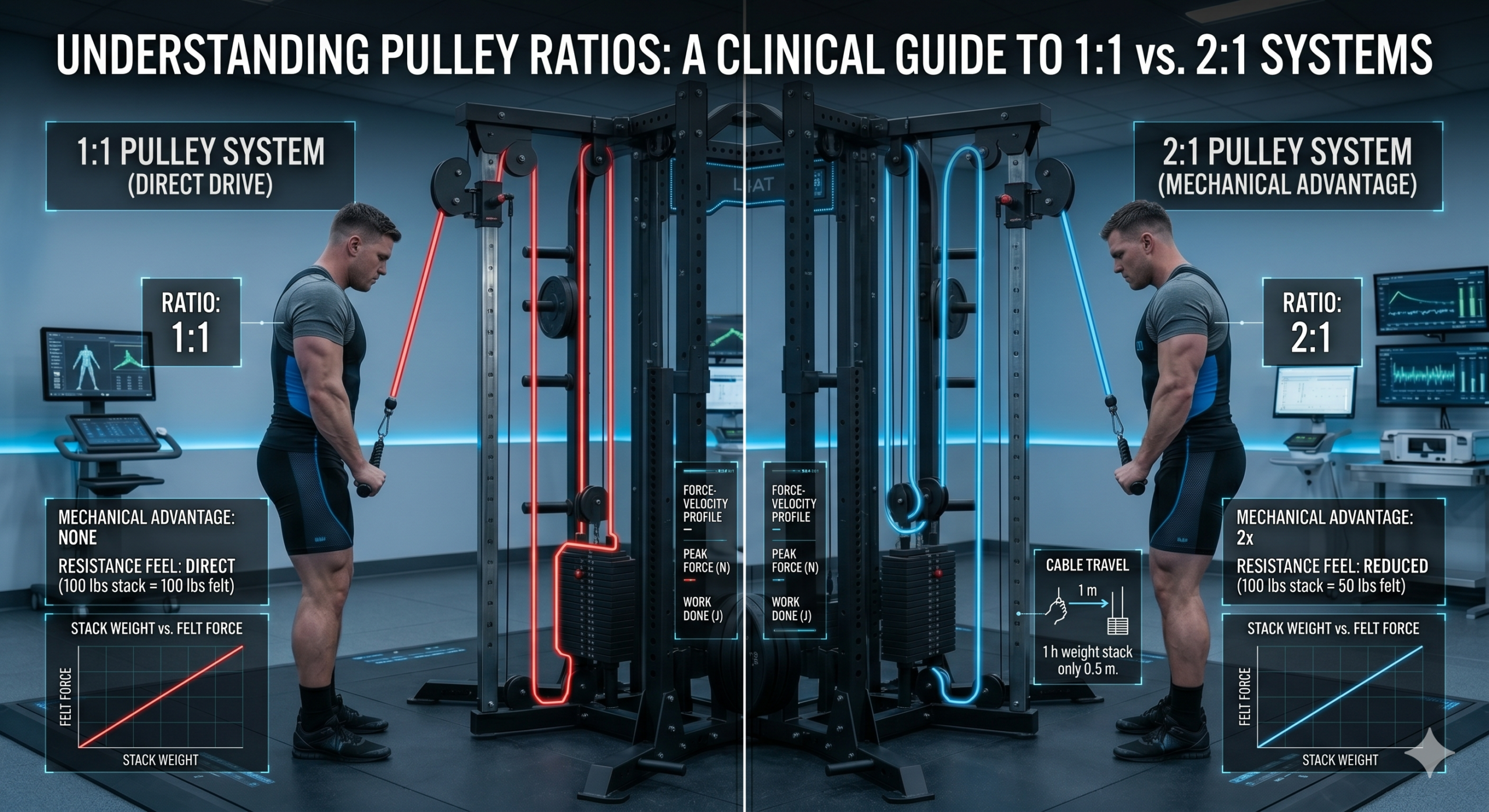
At the Hypertrophy Protocol Lab, we consider pulley system architecture one of the most misunderstood variables in resistance training equipment design. When our clients invest in a 3×3 rack ecosystem or a cable station built from 11-gauge steel, they rightly focus on structural integrity, weld quality, and load capacity. However, the pulley ratio—the mechanical relationship between the weight loaded and the force experienced at the handle—is the silent variable that determines the entire training character of a machine. A misunderstanding here leads to miscalculated progressive overload, inappropriate exercise selection, and, in clinical rehab settings, potentially dangerous loading errors.
This guide represents our institutional analysis of 1:1 and 2:1 pulley systems. We will dissect the physics, map the biomechanical implications, identify the practical tradeoffs, and provide our clinical recommendations for different training populations. We aim to give you the engineering literacy necessary to make an informed equipment decision—not a marketing-driven one.
Before we examine specific configurations, we need to establish a precise working definition. A pulley ratio describes the relationship between the force applied at the effort end (the handle or attachment point) and the resistance provided at the load end (the weight stack or plate-loaded carriage). This ratio is a direct expression of mechanical advantage (MA).
How Mechanical Advantage Works in Cable Systems
In a simple, single fixed-pulley system, the pulley changes the direction of force but does not reduce it. If you load 100 lb onto the stack, you feel 100 lb at the handle. This is a 1:1 ratio. The mechanical advantage is 1.
When we introduce a movable pulley—or route the cable through an additional redirect that effectively doubles the cable path supporting the load—we create a 2:1 ratio. Here, the mechanical advantage is 2. If the stack reads 100 lb, the effective resistance at the handle is approximately 50 lb. The trade-off, as dictated by the conservation of energy, is that the user must pull twice the cable distance to move the stack the same amount.
The Conservation of Energy Principle
We want to be clinically precise here: mechanical advantage does not create or destroy energy. It redistributes the force-distance relationship. In a 2:1 system, you exert half the force over twice the distance. The total work performed (Force × Distance) remains equivalent, minus frictional losses. This is not a “cheat”—it is a deliberate engineering decision that changes the loading profile and movement characteristics of every exercise performed on that station.
In addition to exploring the intricacies of pulley ratios in “Understanding Pulley Ratios: A Clinical Guide to 1:1 vs. 2:1 Systems,” readers may find it beneficial to delve into the article on the advantages of Westside hole spacing for enhanced bench press safety. This related piece discusses how precise adjustments in equipment can significantly improve lifting performance and safety, complementing the insights gained from understanding pulley systems. For more information, visit the article here: The Benefits of Westside Hole Spacing for Precision Bench Press Safety.
1:1 Pulley Systems: Direct Load Transfer
A 1:1 system is the simplest cable configuration. The cable attaches to the weight stack, routes over one or more fixed (non-movable) pulleys that redirect its path, and terminates at the user’s handle or attachment point. Every fixed pulley in the chain changes direction but does not alter the force ratio.
Structural and Engineering Characteristics
In our lab, we observe that 1:1 systems are mechanically simpler, requiring fewer pulleys, less total cable length, and fewer redirect points. This simplicity has engineering advantages for heavy-duty 3×3 rack-mounted cable attachments:
- Reduced cable wear: Less cable surface area contacts pulley bearings, reducing friction-induced degradation over time.
- Lower component count: Fewer pulleys mean fewer potential failure points—a meaningful consideration when we are specifying equipment for commercial or institutional environments.
- More direct force feedback: Users experience a tactile connection to the load that many advanced lifters describe as “honest.” There is no mechanical cushioning between the trainee and the iron.
Training Applications for 1:1 Systems
1:1 configurations are optimal for maximum-strength-focused training. We recommend them for:
- Heavy compound cable movements: Seated cable rows, lat pulldowns, and cable deadlift variations where the trainee needs to work with loads that correspond directly to stacked plates.
- Advanced trainees: Individuals whose strength levels demand high absolute loads. A 200 lb stack on a 1:1 system delivers 200 lb. On a 2:1 system, that same stack only delivers approximately 100 lb of effective resistance—potentially insufficient for a trained individual performing heavy rows.
- Strength testing and load standardization: In clinical or research settings where we need the displayed weight to equal the experienced resistance for data integrity.
Limitations We Observe
The primary limitation is granularity of progression. If a 1:1 stack increments in 10 lb jumps, the trainee’s minimum progression step is 10 lb. For small muscle groups—rear deltoids, rotator cuff, forearm flexors—this can represent a disproportionately large percentage increase, violating the principle of gradual overload.
2:1 Pulley Systems: Halved Resistance, Doubled Versatility
The 2:1 system is where we see the most significant divergence from user expectation. The weight displayed on the stack is not the weight experienced at the handle. We cannot overstate how frequently this creates confusion, even among experienced coaches.
How the 2:1 Cable Path Works
In a typical 2:1 functional trainer or cable crossover station, the cable runs from the user’s handle up to a pulley mounted on the frame, back down to a pulley attached to or near the weight stack carriage, and then back up to a fixed anchor point (or through additional redirects). The critical detail is that two segments of cable support the load, effectively splitting the resistance between them. The user pulls against only one of those segments.
The result: a 100 lb stack selection produces approximately 50 lb of resistance at the handle.
Why “Approximately” Matters: Real-World Ratio Deviations
We emphasize “approximately” because, in our testing across multiple commercial and home-gym-grade cable stations, the effective ratio is rarely a mathematically perfect 2:1. Several engineering variables introduce deviation:
- Pulley bearing friction: Every pulley in the system introduces rotational friction. Low-quality bushings or unsealed bearings can add 5–15% of effective resistance through frictional losses, making the cable feel heavier than the theoretical ratio predicts.
- Cable-to-pulley contact angle: Cables that wrap around pulleys at acute angles generate more friction than those that engage at wider, more tangential angles. The geometry of the frame—particularly in compact home gym designs that compress the pulley layout into a smaller vertical space—directly affects this.
- Cable sheath stiffness: Coated cables, especially newer ones that have not yet been broken in, resist bending. This stiffness acts as a parasitic resistance that is not accounted for in the ratio.
- Cable path complexity: Some machines route the cable through six, eight, or even ten redirect pulleys. Each additional pulley compounds frictional losses. A 2:1 system with eight redirects will feel meaningfully heavier than a 2:1 system with four.
Our recommendation: treat the manufacturer’s stated ratio as a guideline, not a calibrated measurement. If precise loading matters—and in rehab or research contexts, it absolutely does—we advise direct force measurement at the handle using a calibrated dynamometer.
Training Applications for 2:1 Systems
2:1 systems are the balanced default for general hypertrophy training, isolation work, and rehabilitation. We recommend them for:
- Isolation exercises: Cable flys, lateral raises, bicep curls, tricep pushdowns, and face pulls. These movements target smaller muscle groups that benefit from the finer load increments a 2:1 system provides.
- Unilateral training: Single-arm rows, single-arm presses, and rotational movements. The smoother cable travel and reduced starting resistance make unilateral loading more manageable and more consistent through the range of motion.
- Rehabilitation and return-to-training protocols: The halved effective resistance allows clinicians and coaches to start patients at very low loads and progress in smaller absolute increments. A 10 lb stack jump becomes a 5 lb effective jump—a critical advantage when working with post-surgical shoulders or deconditioned populations.
- Beginner and intermediate trainees: Individuals who are still developing movement proficiency benefit from the forgiveness of a 2:1 system. The smoother feel and lower entry-point loads reduce compensatory patterning.
Sure, here is the sentence with the clickable link:
Check out the latest fitness program at Hypertrophy Protocol for effective muscle building.
Comparative Analysis: 1:1 vs. 2:1 in Clinical Context
We find that the decision between these two systems should not be framed as “which is better” but rather “which is appropriate for the defined training objective.”
Load Ceiling and Stack Size Implications
This is a practical consideration that we see overlooked constantly. A 2:1 system requires a stack twice as heavy as a 1:1 system to achieve the same effective resistance at the handle.
If your cable station has a 200 lb weight stack:
- 1:1 system: Maximum effective resistance = ~200 lb
- 2:1 system: Maximum effective resistance = ~100 lb
For a trained individual who needs 150 lb on a cable row, the 2:1 system with a 200 lb stack is physically incapable of delivering sufficient load. This is not a flaw in the system—it is a mathematical consequence of the ratio. We advise all clients to calculate their required effective load ceiling before selecting a pulley configuration.
Cable Travel and Range of Motion
In a 2:1 system, the user must pull twice the cable length to move the stack the same distance. This means greater cable travel per unit of stack movement, which translates to smoother perceived motion and a more consistent resistance curve through extended ranges of motion. For exercises like cable crossovers or wide-arc flys—where the attachment point travels a long path—this is biomechanically advantageous.
Conversely, 1:1 systems provide a shorter cable pull per unit of stack movement. For short-stroke, heavy movements like shrugs or partial-range pulls, this is desirable because it reduces unnecessary cable slack and keeps the system taut.
Progressive Overload Granularity
| Parameter | 1:1 System | 2:1 System |
||||
| 10 lb stack increment | 10 lb effective jump | ~5 lb effective jump |
| 5 lb stack increment | 5 lb effective jump | ~2.5 lb effective jump |
| Micro-loading feasibility | Moderate | High |
For hypertrophy-oriented programming, where we typically prescribe progressive overload in the 2.5–5 lb range for upper body movements, the 2:1 system’s inherent load-halving effect provides a significant programming advantage.
For those looking to deepen their knowledge on the mechanics of pulley systems in a clinical setting, a related article titled “Exploring the Benefits of Different Pulley Configurations” offers valuable insights. This resource complements the understanding of pulley ratios by discussing how various configurations can impact rehabilitation outcomes. You can read more about it in the article here.
Hardware Considerations: Frame and Steel Specifications
| System Type | Mechanical Advantage | Effort Required | Speed of Movement |
|---|---|---|---|
| 1:1 | 1:1 | Higher | Slower |
| 2:1 | 2:1 | Lower | Faster |
Pulley ratio selection does not exist in a vacuum. It interacts directly with the structural demands placed on the rack or frame.
Why 11-Gauge Steel Matters for Pulley Systems
A 2:1 system, by definition, requires a larger weight stack to achieve equivalent effective resistance. Larger stacks mean more mass suspended within or behind the frame. The frame must be engineered to handle not just the static load of a heavier stack, but the dynamic forces generated during explosive or high-velocity cable work.
We specify 11-gauge steel (approximately 0.120 inches / 3.048 mm wall thickness) as our minimum standard for any cable-integrated 3×3 rack system. This gauge provides:
- Sufficient moment of inertia in the upright tubes to resist lateral deflection when cable forces are applied at angles off the vertical axis.
- Weld joint integrity under cyclic loading—critical because cable exercises generate repetitive, oscillating forces that stress welds differently than static barbell loads.
- Long-term dimensional stability, preventing the subtle frame warping that degrades pulley alignment and increases cable friction over thousands of use cycles.
Pulley Quality and Bearing Specification
Regardless of ratio, pulley quality is the single greatest determinant of cable feel. We look for:
- Sealed ball bearings (not bushings) in every pulley. Bushings introduce significantly more friction and degrade faster under load.
- Pulley diameter ≥ 3.5 inches (89 mm). Smaller pulleys create tighter cable bend radii, accelerating cable fatigue and increasing friction.
- Fiberglass-reinforced nylon or machined aluminum pulley wheels. Cast zinc or stamped steel pulleys are inferior in both friction characteristics and durability.
Our Clinical Recommendations
Based on our institutional testing and the biomechanical evidence, we offer the following guidance:
For general-purpose home or commercial gym cable stations intended for hypertrophy training across diverse populations, we recommend a 2:1 pulley system as the default configuration. The finer load increments, smoother cable travel, and broader exercise versatility outweigh the reduced load ceiling for the majority of trainees.
For dedicated strength training stations—particularly lat pulldown towers and seated row units intended for advanced trainees—we recommend a 1:1 system. The direct load correspondence and higher effective resistance ceiling are necessary to support progressive overload at the upper end of the strength spectrum.
For facilities that serve both populations, we recommend dual-ratio capability—either through interchangeable pulley cartridges (offered by a small number of premium manufacturers) or by maintaining separate 1:1 and 2:1 stations within the training floor layout.
Above all, we urge every coach, clinician, and trainee to know the pulley ratio of the equipment they are using. Without this knowledge, training logs become unreliable, progressive overload calculations become inaccurate, and the foundational principle of dose-response specificity in resistance training is compromised. The pulley ratio is not a footnote in equipment specifications. It is a primary training variable, and we treat it accordingly.