
You train at home against a hard stop, and the rest timer eats more of the hour than the lifting does. The research on rest between sets for muscle growth gives a clear short answer: rest longer than a minute on most sets. A 2024 meta-analysis found little detectable extra growth from resting much past 90 seconds, though that is not a hard ceiling for every lift. Shorter rest usually costs reps on the next set, and adding a set to win back that work is one fix researchers have tested.
That moves the real decision to how you spend the minutes. Pairing exercises for muscles that do not compete lets each muscle rest longer while the clock runs at short-rest pace. Every study below was checked on PubMed on September 28, 2026.
At a glance
| Verdict | Rest more than a minute on most sets; past about 90 s, extra growth is unproven. |
|---|---|
| Effect size / key numbers | Singer 2024 SMD, longer vs shorter rest: arm 0.13, thigh 0.17; both intervals cross zero. |
| Evidence strength | Limited: 9 studies, 6 in untrained people, none longer than 10 weeks. |
| What to do | About 2 min on heavy compounds, 60–90 s on isolation; add a set if reps drop. |
| Main caveat | Short rest cost growth only when it cost reps (Longo 2022). No study in the meta-analysis measured chest, back or shoulders. |
Studies checked on PubMed, September 28, 2026.
How long should you rest between sets for muscle growth?

The short answer rests on a small set of trials, most of them five to ten weeks long. The table puts the rest-length trials next to the acute studies on reps and the superset research used later in this guide.
| Study | Comparison | Who and how long | Measure | Result |
|---|---|---|---|---|
| Schoenfeld 2016 | 1 vs 3 min, full-body program, 3 sets of 8–12RM on 7 exercises | 21 trained men, 8 wk | Ultrasound thickness | 3 min grew the front thigh more; triceps trend (p = 0.06); squat and bench 1RM also rose more |
| Fink 2017 | 30 vs 150 s, 40% 1RM sets to failure | 21 untrained young adults, 8 wk | Cross-sectional area | Triceps +9.8% vs +10.6%; thigh +5.7% vs +8.3%; no rest effect |
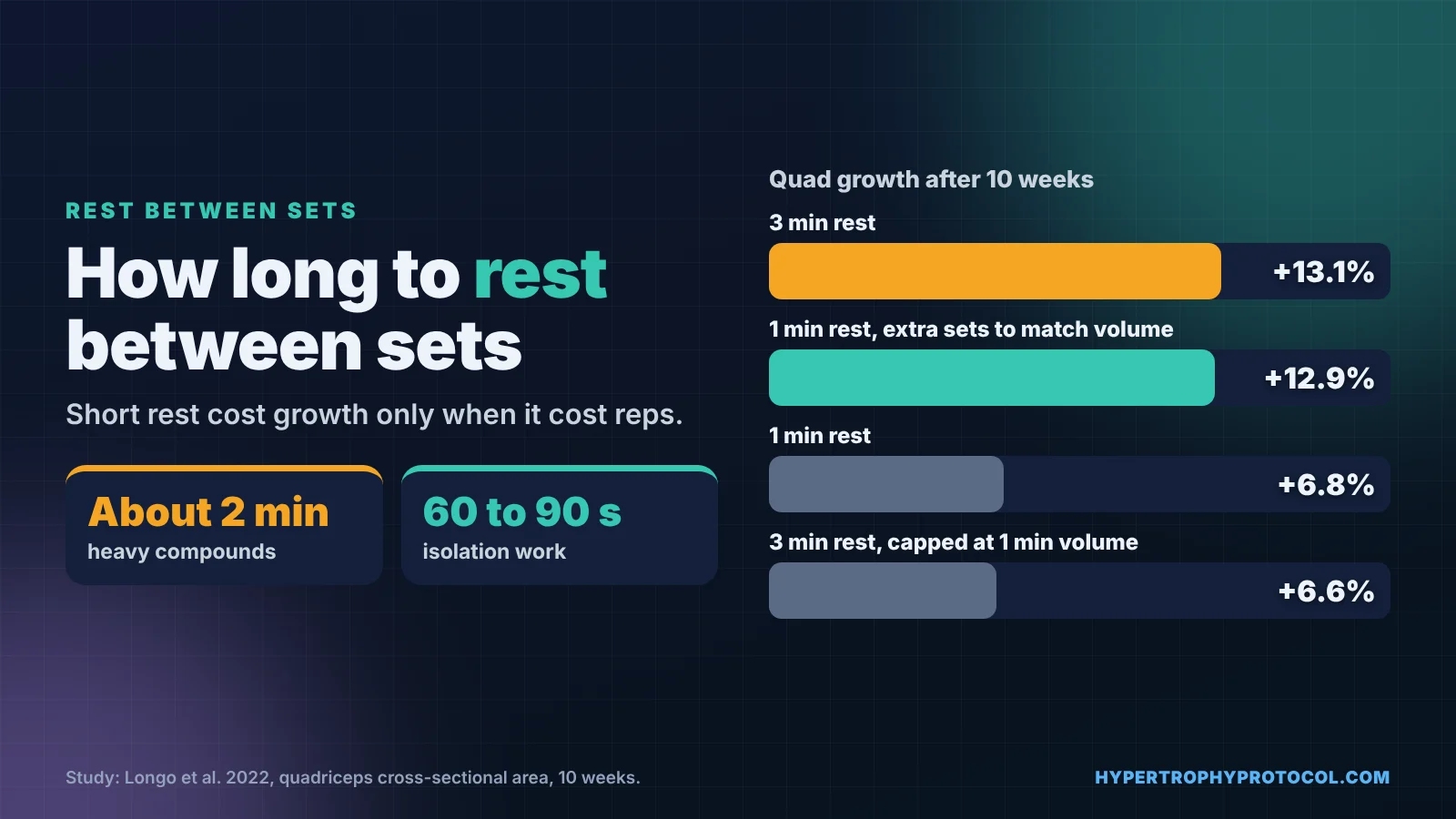
| Longo 2022 | 1 vs 3 min knee extension at 80% 1RM, with and without matched volume load | 28 adults, one condition per leg, 10 wk | Quadriceps cross-section | Growth tracked volume load, not rest (chart below) |
| Singer 2024 (Bayesian meta-analysis) | 60 s or less vs longer; four rest bands | 9 studies, 5–10 wk | Pooled SMD, longer minus shorter | Arm 0.13 (95% CrI −0.27 to 0.51); thigh 0.17 (−0.13 to 0.43); whole body −0.08 (−0.45 to 0.29) |
| Willardson 2005 | 1, 2 or 5 min, 4 sets at 8RM squat and bench | 15 college-age men, single sessions | Total reps | Each longer rest completed more reps: 5 min > 2 min > 1 min |
| Robbins 2010 | Bench pull and bench press sets alternated vs all pull sets first, both in about 10 min | 16 trained men, single sessions | Volume load per minute | Alternating moved more total volume load in the same time |
| Iversen 2024 | Supersets vs traditional sets: leg press, bench, pulldown, seated row | Randomized trial, 10 wk, 2 sessions a week | Body composition, 1RM | Similar muscle mass gains; pulldown strength gain 5.2 kg smaller with supersets |
| Zhang 2025 (meta-analysis) | Supersets vs traditional sets | 19 studies, 313 participants | Pooled SMD | Volume load similar (0.05); efficiency higher (1.74); growth similar (−0.05, 95% CI −0.63 to 0.54, 2 studies) |
The meta-analysis is the anchor. Both limb estimates lean toward resting more than 60 seconds, but both credible intervals cross zero. For the thigh, the authors put the chance of any benefit at 88% and the chance of a benefit bigger than small at only 54%.
The ceiling matters just as much for a home lifter. Singer’s team saw no appreciable growth difference once rest passed about 90 seconds, which matches the point where the rep losses from short rest tend to level off.
Why does longer rest seem to build more muscle?
That plateau hints at the mechanism. Short rest leaves you less recovered, so you complete fewer reps with the same weight on the next set. Willardson’s lifters did more total reps on squat and bench with each step up in rest, from 1 to 2 to 5 minutes.
The Longo trial tested that link directly. Each leg of each person did knee extensions under one of four conditions, and two of them adjusted the work: one short-rest leg did extra sets to match the long-rest leg’s volume load, and one long-rest leg was capped at the short-rest leg’s volume load.
Longo 2022: quadriceps cross-sectional area change after 10 weeks
Rest length made no difference once volume load was matched. The short-rest leg with extra sets grew as much as the long-rest leg, and the long-rest leg held to less work grew as little as the short-rest leg. Short rest cost growth only when it cost reps.
Light sets taken to failure fit the same picture. In the Fink trial at 40% of 1RM, 30 seconds and 150 seconds produced similar growth. Every set ended at failure regardless of rest, which likely left less room for rest to matter. For the tension side of growth, see the mechanical tension guide.
How much weight should you put on these numbers?
The volume explanation is tidy, but the evidence under it is thin. The meta-analysis pooled only nine studies, six of them in untrained people, and none lasted longer than ten weeks. Only three used trained lifters, too few to analyze on their own.
No included study measured chest, back or shoulders, and training volumes were moderate. Longo used one knee extension exercise, and the Schoenfeld abstract does not give effect sizes or volume load, so the size of the 3-minute edge in trained men is unclear. A PubMed search on September 28, 2026 turned up no newer trial comparing rest lengths for growth, so the 2024 meta-analysis is still the best summary.
Read the numbers as “more than a minute probably helps a little, and past 90 seconds the returns are unproven.” That is a firmer basis for a time-limited session than any single rest number.
How much session time does each rest choice cost?
That small, uncertain edge has to be weighed against the clock. Take a session of 16 working sets and assume each set lasts about 40 seconds. With a rest after every set except the last, total time works out like this:
- 3 minutes of rest: about 56 minutes
- 2 minutes: about 41 minutes
- 90 seconds: about 33 minutes
- 60 seconds: about 26 minutes
Cutting from 3 minutes to 90 seconds frees about 22 minutes, inside a range where the meta-analysis saw no clear growth difference. Cutting from 90 to 60 seconds saves only about 7 more minutes and moves you into the zone where reps start to drop.
Single-limb exercises double the set count, so they hit the clock hardest. The unilateral training guide covers when that time cost is worth paying and how alternating sides trims it.
Can supersets give you long rest at short-rest speed?
Alternating sides is one version of a bigger idea: let one muscle rest while another works. In the Robbins trial, alternating a bench press with a bench pull moved more total load in the same 10 minutes. Across the Zhang meta-analysis, supersets matched the volume load of traditional sets in shorter sessions.
The arithmetic shows why. Run the same 16 sets as 8 rounds of a press and a row, with 60 seconds between every set. The session still takes about 26 minutes, but each muscle now gets 160 seconds between its own sets, well past the 90-second mark.
Growth data for supersets are sparse. The meta-analysis pooled just two studies for hypertrophy, with a confidence interval running from −0.63 to 0.54, and the Iversen trial’s growth outcome was body composition. Supersets also raised perceived effort (SMD 0.77), and pairing two exercises for the same muscle cut volume load (SMD −1.08), which defeats the purpose.
In a home gym, the pair also has to be quick to switch between. A bench press next to a cable row works; two cable exercises that each need a different pulley height and handle can eat the time you meant to save.
What rest should each exercise get?
Those trade-offs translate into a rest plan by exercise type. The third and fourth columns separate what a trial tested from what is an inference for home training.
| Exercise type | Rest to use | Directly supported | Inference |
|---|---|---|---|
| Heavy compound lifts (squat, deadlift, barbell press, loaded row) | About 2 min; up to 3 if reps fall off sharply | 3 min beat 1 min for thigh growth on a mostly compound program (Schoenfeld 2016); reps drop faster with shorter rest on squat and bench (Willardson 2005) | The exact number; the meta-analysis could not separate 2 from 3 minutes |
| Cable or machine isolation at moderate to heavy loads (knee extension, curl, pushdown) | 60–90 s; add a set if reps crash | 1 min matched 3 min once extra sets restored volume load (Longo 2022) | That isolation work recovers faster than compounds; not tested head to head |
| Light, high-rep sets taken to failure | 30 s to 2.5 min | 30 s matched 150 s at 40% 1RM (Fink 2017) | Whether this holds in trained lifters |
| Supersets of non-competing muscles (press with row, upper with lower) | About 60 s between exercises, so each muscle gets 2+ min | Opposing-muscle pairs held volume load and saved time (Robbins 2010; Zhang 2025); similar growth in two trials | Growth equivalence rests on two studies; specific pairs like curl with triceps extension were not tested |
| Two exercises for the same muscle back to back | Skip as a time saver | Cut volume load (Zhang 2025) | None needed |
Your rep log is the check on all of this. If a shorter rest drops your reps by more than a couple on the next set, either rest a little longer or add a set, which is exactly the fix Longo tested.
Which rest plan fits your session?
With the rest choices mapped, pick the line that matches your week. Each one assumes you track reps, so you can see when rest starts costing you.
- You have 45 minutes or less: rest about 2 minutes on your main compound, 60 to 90 seconds on isolation work, and run press-and-row style pairs wherever your equipment allows a quick switch. Add a set when reps drop.
- You have time and you are trained: 2 to 3 minutes on heavy compounds is reasonable, and the 1-versus-3-minute trial in trained men favored 3 minutes. Longer rest on isolation work buys nothing proven.
- You also want a bigger squat or bench: keep longer rest on those lifts. Schoenfeld’s 3-minute group gained more strength on both.
- You train with light loads to failure: short rest looks fine, based on the Fink trial in untrained adults.
Your next step: log the reps for every set for the next two weeks, then compare first and last sets using the progressive overload guide for small home gyms. If the drop is small, your rest is long enough.
Sources
- Schoenfeld BJ, et al. Longer interset rest periods enhance muscle strength and hypertrophy in resistance-trained men. J Strength Cond Res. 2016. doi:10.1519/JSC.0000000000001272
- Fink JE, et al. Acute and long-term responses to different rest intervals in low-load resistance training. Int J Sports Med. 2017. doi:10.1055/s-0042-119204
- Longo AR, et al. Volume load rather than resting interval influences muscle hypertrophy during high-intensity resistance training. J Strength Cond Res. 2022. doi:10.1519/JSC.0000000000003668
- Singer A, et al. Give it a rest: a systematic review with Bayesian meta-analysis on the effect of inter-set rest interval duration on muscle hypertrophy. Front Sports Act Living. 2024. doi:10.3389/fspor.2024.1429789
- Willardson JM, Burkett LN. A comparison of 3 different rest intervals on the exercise volume completed during a workout. J Strength Cond Res. 2005. doi:10.1519/R-13853.1
- Robbins DW, Young WB, Behm DG. The effect of an upper-body agonist-antagonist resistance training protocol on volume load and efficiency. J Strength Cond Res. 2010. doi:10.1519/JSC.0b013e3181e3826e
- Iversen VM, et al. Efficacy of supersets versus traditional sets in whole-body multiple-joint resistance training: a randomized controlled trial. J Strength Cond Res. 2024. doi:10.1519/JSC.0000000000004819
- Zhang X, et al. Superset versus traditional resistance training prescriptions: a systematic review and meta-analysis exploring acute and chronic effects on mechanical, metabolic, and perceptual variables. Sports Med. 2025. doi:10.1007/s40279-025-02176-8
Sources checked September 28, 2026. Research summaries describe the cited studies; individual results vary.