
Some links below are affiliate links. I may earn a commission at no extra cost to you. It doesn’t change what I recommend. See the affiliate disclosure.
The best belt squat machine for a home gym is the one whose footprint, standing height and plate-loading height you can live with every session, not the one with the biggest capacity number. Every machine below is rated for more than most home lifters will ever load. What separates them is how they load, how much floor and headroom they take, and what they cost.
If belt squats are becoming your main heavy leg lift and you can give up the floor space, a dedicated machine earns its place. If they’re a supplement to barbell work, a squat harness and a sturdy platform, or a rack-mounted option, covers most of the benefit for far less money and space. All specs below come from each maker’s own product page, checked October 20, 2026.
At a glance
| Machine | Best for | Listed footprint | Listed price | Main catch |
|---|---|---|---|---|
| Titan SquatMax-MD | A straight vertical path in the smallest standalone footprint | 45 x 41 in; 20 in base height | On sale when checked; see current price | Plates load near the floor, and you stand 20 in up |
| Bells of Steel 2.0 | The most machine for about $1,200 | 51 x 81 in (51 x 52.5 in, horns vertical) | $1,199.99 | 13 height settings may not give full depth; blocks may be needed |
| Bulletproof VBS | Short on floor, with a wall to mount it on | 25.5 in off the wall folded, 43 in in use | On sale when checked; see current price | New, no long-term owner data; 83 lb carriage unloaded |
| Rogue Monster Rhino (stand-alone) | Rows, shrugs and deadlifts as well as squats | 53 x 60.5 in; 78.5 in tower | $2,415 | 530 lb and must be bolted to the floor |
| Pit Shark | Commercial-gym feel when budget isn’t the limit | Short frame 66 x 62 in; tall frame 94 in high | $4,680 short; $6,215 tall | Check your ceiling for the tall frame |
| Hammer Strength Plate-Loaded | Commercial benchmark | 78 x 63 in as listed | Quote only | 62 to 76 lb before plates |
Prices and specs from the makers’ pages, checked October 20, 2026. Confirm before ordering.
What does a belt squat machine do that a barbell doesn’t?
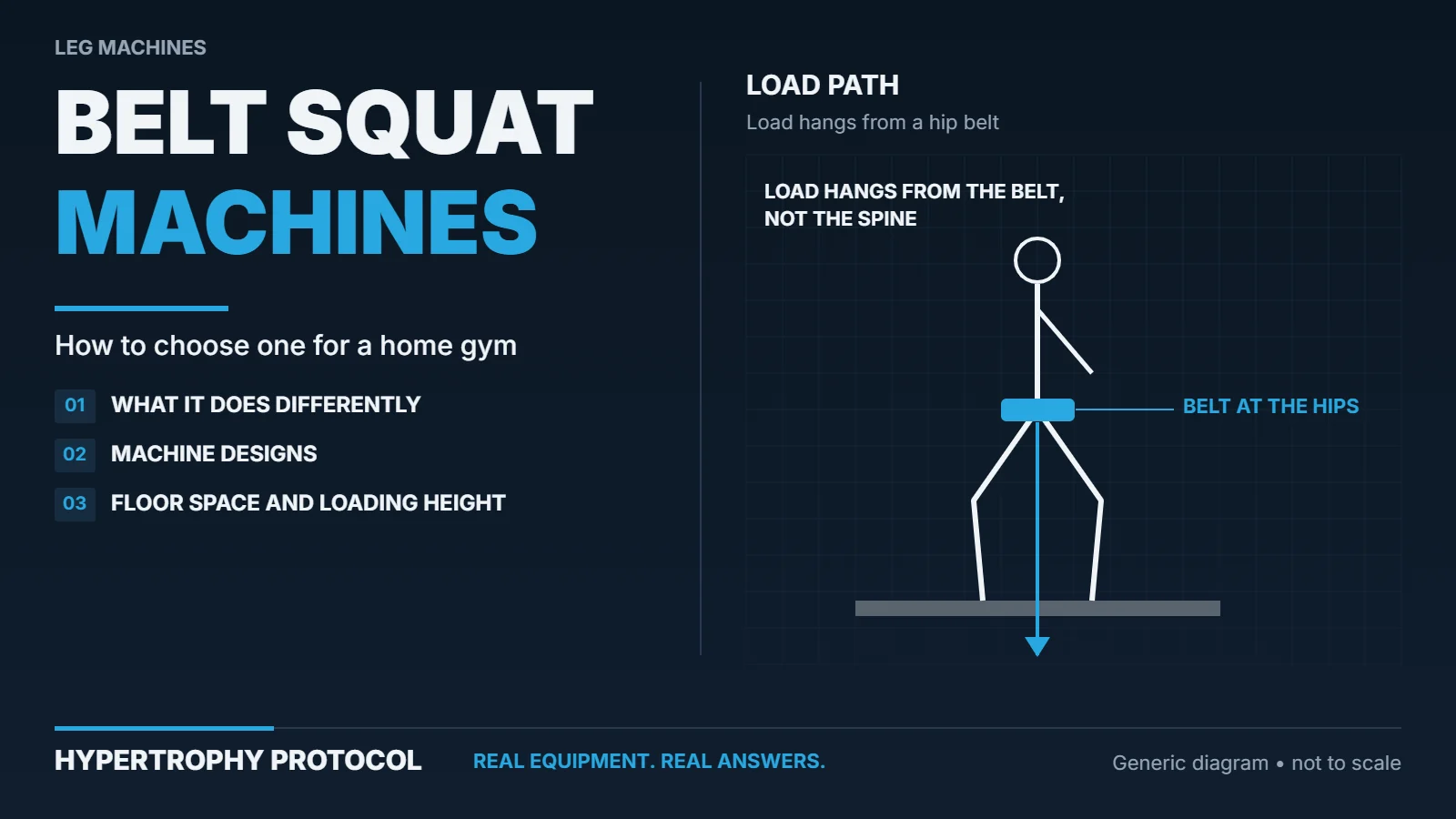
A belt squat machine hangs the load from a belt around your hips instead of putting it on your back. Your legs do the squat; your spine, shoulders and grip are mostly out of it. That’s why I moved from barbell squats to belt squats: as I’ve gotten older, I wanted to take the loaded bar off my spine.
The machine part solves three problems a loose belt and plates don’t. It gives the load a fixed path, so it doesn’t swing between your legs. It gives you a platform high enough to squat deep without the plates hitting the floor. And it gives you handles to hold, which keeps you balanced when you push a set close to failure.
If you want a deeper look at how belt squats compare with hack squats, pendulums and lever arms for what your legs actually train, the squat machine styles comparison covers that. This guide is about choosing a standalone machine.
What does the research say about belt squats?
The research is thin and almost all of it is EMG, which measures electrical activity in the muscle during a set. EMG isn’t muscle growth. Still, the pattern across the studies is consistent.
In Evans et al., 2019, 31 lifters (16 men and 15 women) did 5-rep-max tests on a belt squat machine and a back squat. Of the muscles measured (three quad heads and the glute max), only the glute max differed: normalized activity was 0.84 on the back squat versus 0.69 on the belt squat on the left side, and 0.86 versus 0.71 on the right.
A second study added the trunk. Ten lifters who already trained both lifts did three sets of five at a load equal to their bodyweight (Joseph et al., 2020). On the belt squat, integrated lower-back (lumbar erector) activity was 45.4% lower and peak activity 52.0% lower than on the back squat. Glute max activity was also lower, by 35.2% integrated and 32.1% peak, while the quads showed no significant difference. The authors note the studies that found lower glute activity used machines whose load rotated about a pivot, while one that found no difference used a load sliding on a fixed rod, so machine design may matter.
A 2025 systematic review and meta-analysis of squat variations found no significant overall differences in lower-limb muscle activation across back, front, overhead and belt squats (García-Valverde et al., 2025). Read that carefully for belt squats, though. Only one study in the review compared belt and back squats, and the abstract’s standardized mean difference of 0.09 rests on it. Treat it as one study, not a pooled finding.
The honest summary: belt squats appear to work the quads about as hard as back squats, with much less lower-back and somewhat less glute involvement. Those are short-term EMG readings in small groups. I couldn’t find a long-term study measuring muscle growth from belt squats against back squats. If you swap barbell squats for a belt squat, add a hip-extension movement for your glutes.
What are the main belt squat machine designs?
Standalone machines fall into four designs. Each one changes where the load travels, how it feels through the rep and how you stand.
- Lever arm (Pit Shark, Bells of Steel 2.0, Hammer Strength). The belt attaches to a long arm that pivots at one end, with weight horns on the arm. Your hips travel a slight arc, and resistance changes a little with the arm’s angle. Where you hang the plates matters too: Hammer Strength says plates on its longer horns, farther from the pivot, feel heavier than the same plates on the short horns. Plates load on the arm, above floor level.
- Cable and pulley (Rogue Monster Rhino). Plates ride a trolley on a separate tower, and the load reaches your belt through a cable and pulleys. The load is constant, but the cable only pulls straight down while you stay over it. Drift and it pulls you back toward the line.
- Vertical track or pin (Titan SquatMax-MD, Bulletproof VBS). Plates hang on a carriage or pin directly below your hips, so the line of pull is vertical and the load is the same top to bottom. The VBS adds horizontal linear bearings you can unlock so your hips can move forward and back.
- Platform plus loading pin. No machine at all: you stand on two boxes or a raised platform, and plates hang from a loading pin on a chain from your belt or harness. It’s the cheapest route. Depth is limited by how high you stand, and the plates can swing.
Stance is the detail people miss. Titan lists the SquatMax-MD platform at 4.75 x 33 inches with a 16.25 by 21 inch center cut-out the plates pass through, so your feet go either side of the opening. The Rhino’s platform is one 48.5 inch wide deck. Pit Shark offers an optional Close Stance platform, and the VBS has two adjustable footplates with four positions each in 5-degree steps. If you squat narrow or very wide, check the platform before you check the capacity.
How much floor space and ceiling height do you need?
I owned a Titan SquatMax-MD, and the floor space it took in my garage was the dealbreaker. It’s the main reason I preordered a Bulletproof VBS to replace it. I don’t have it yet, so everything about it here comes from Bulletproof’s spec sheet.
Listed footprints run from 45 x 41 inches (SquatMax-MD) up to 51 x 81 inches (Bells of Steel in its standard setup) and 78 x 63 inches (Hammer Strength). Add room on each side to load plates, and for the lever and cable machines, room for the arm or tower. The VBS is the outlier: it mounts to a wall upright and sits 25.5 inches off the wall folded and 43 inches deep in use.
Ceiling height catches people because you stand on the machine. Titan lists a 20-inch base height for the SquatMax-MD, and the plates hang below the platform you stand on. A 6-foot lifter on that base, over 3/4-inch mats, has the top of their head at 92.75 inches, or 7 feet 8.75 inches. Under a standard 8-foot ceiling, that leaves about 3 inches, before any beam, light or garage door track that hangs lower. Rogue’s Rhino platform sits 7 inches up, and Hammer Strength’s UK page puts its foot plates at 10.75 inches. Pit Shark’s tall frame is 94 inches high on its own.
Before you buy, run your room through the Home Gym Room Planner. It checks your rack and bench against your floor and ceiling, so you can see what’s left for a machine beside them.
Why does loading height matter so much?
You load and unload every plate twice a session. On a machine that makes that awkward, you’ll feel it long before you hit its capacity.
On my SquatMax-MD, loading and unloading plates on the low pin was hard, even with a loading add-on. On a vertical pin machine the plates live near the floor, under you, so every plate goes on and comes off from a deep bend.
The other designs move the plates up. Lever machines put the horns on the arm, above the floor. The Rhino’s trolley rests on an adjustable horn on its tower between sets, off the floor. Bulletproof says the VBS loads plates directly in front of you, within arm’s reach. If you train alone and lift heavy, loading height is worth more than an extra few hundred pounds of capacity.
How much capacity and starting resistance do you need?
Capacity is rarely the limit. Titan rates the SquatMax-MD’s loading pin and belt at 1,000 lb each. Rogue says the plate-loaded Pit Shark holds over 1,000 lb, Bells of Steel lists 700 lb, and Bulletproof gives the VBS a conservative 650 lb. Rogue lists the Rhino’s loading space (two posts of 15.75 inches) rather than a weight rating.
Starting resistance matters more for warm-ups and lighter sets. Hammer Strength lists 62 to 76 lb before you add plates, depending on which belt anchor you use. The VBS carriage weighs 83 lb unloaded, and Bulletproof’s optional Lift Assist cuts that by about 30 lb. The Rhino’s empty trolley is 27.5 lb. If you’re new to belt squats or plan high-rep sets, a heavy starting weight can be more than you want for your first sets.
What do belt squat machines cost?
Three price tiers showed up on maker pages when I checked on October 20, 2026. Titan, Bells of Steel and Bulletproof all listed their machines between about $1,200 and $1,300, two of them on sale. Rogue listed the stand-alone Rhino at $2,415, and the Pit Shark at $4,680 to $6,215. Hammer Strength’s commercial machine is quote-only. Sale prices change often, so confirm on the product page.
Belt squat machines compared
| Machine | Design | Listed size | Capacity | Loading and start weight | Listed price |
|---|---|---|---|---|---|
| Titan SquatMax-MD | Vertical pin, guide rod | 45 W x 41 D in; 59.5 in tall; 20 in base height; 197 lb | 1,000 lb pin; 1,000 lb belt | 21 in, 48 mm weight sleeve; start weight not listed | Check current price (on sale when checked October 20, 2026) |
| Bells of Steel Belt Squat Machine 2.0 | Lever arm | 51 x 81 in footprint, or 51 x 52.5 in with horns vertical; height not listed | 700 lb | Horns mount vertical or horizontal; 13 height settings; start weight not listed | $1,199.99 |
| Pit Shark (sold by Rogue) | Lever arm | Short frame 66 L x 62 W x 60 H in; tall frame 94 in high | Over 1,000 lb (plate-loaded, per Rogue) | Plates on the loading arm; storage horns; start weight not listed | $4,680 short; $6,215 tall |
| Rogue Monster Rhino, Stand Alone | Cable and trolley | 53 x 60.5 in; 78.5 in tower; platform 7 in up; 530 lb; bolt to floor | Not listed (two 15.75 in posts) | Trolley rests on an adjustable horn on the tower between sets; 27.5 lb empty trolley | $2,415 |
| Hammer Strength Plate-Loaded Belt Squat (commercial benchmark) | Lever arm | 78 x 63 x 64 in as listed; 425 lb | Eight 45s per long horn, two per short horn | 62 to 76 lb start weight, by belt anchor | Quote only |
| Bulletproof VBS (affiliate) | Vertical carriage, optional fore-aft float | Wall-mounted 72 in 3×3 upright with 1 in holes; 25.5 in off the wall folded, 43 in in use; 39 in wide with horns | 650 lb (conservative) | Plates load in front, within reach; 83 lb unloaded; optional Lift Assist about −30 lb | Check current price (on sale when checked October 20, 2026) |
Specs and prices from each maker’s product page, checked October 20, 2026. Hammer Strength’s US page lists 132 cm next to the 64 in height, which doesn’t convert to 64 in, so confirm height with Life Fitness. ATX makes belt squat machines, but I couldn’t find a maker spec page to check, so it’s left out.
A few things stand out. The three machines around $1,200 to $1,300 each take a different approach: a vertical pin (Titan), a lever arm (Bells of Steel) and a wall-mounted carriage (Bulletproof). Bells of Steel says its 13 height settings don’t guarantee full depth for every lifter and suggests standing on pull blocks or a platform if you need more range. The Rhino and Pit Shark are bigger, permanent pieces: the stand-alone Rhino weighs 530 lb and has to be bolted to the floor. Rogue also sells a rack-mounted drop-in Rhino, so if you own a Rogue rack, check whether that version fits it before buying the stand-alone.
Do you need a machine, or will a harness or platform do?
Most people don’t need a machine on day one. A harness spreads the load across your hips, and you can belt squat with one standing on two sturdy boxes with plates on a loading pin. The Squat Harness V4 review covers what that setup does well and where it falls short. I also belt squat with a Beyond Power VOLTRA I while standing on plyo boxes; the VOLTRA I guide covers the unit itself.
A dedicated machine is worth it when:
- Belt squats are your main heavy leg lift, not an accessory.
- Your working sets are heavy enough that loading plates on a pin between two boxes has become the hard part.
- You want to push sets close to failure alone, with handles and a fixed path.
- You have the floor and ceiling for it, after your rack and bench.
Stay with a harness and platform if you’re testing whether belt squats suit you, your space is already tight, or your belt squat loads are moderate. Leg presses are the other back-friendly option; leg press machines for home gyms covers that route.
Which belt squat machine should you buy?
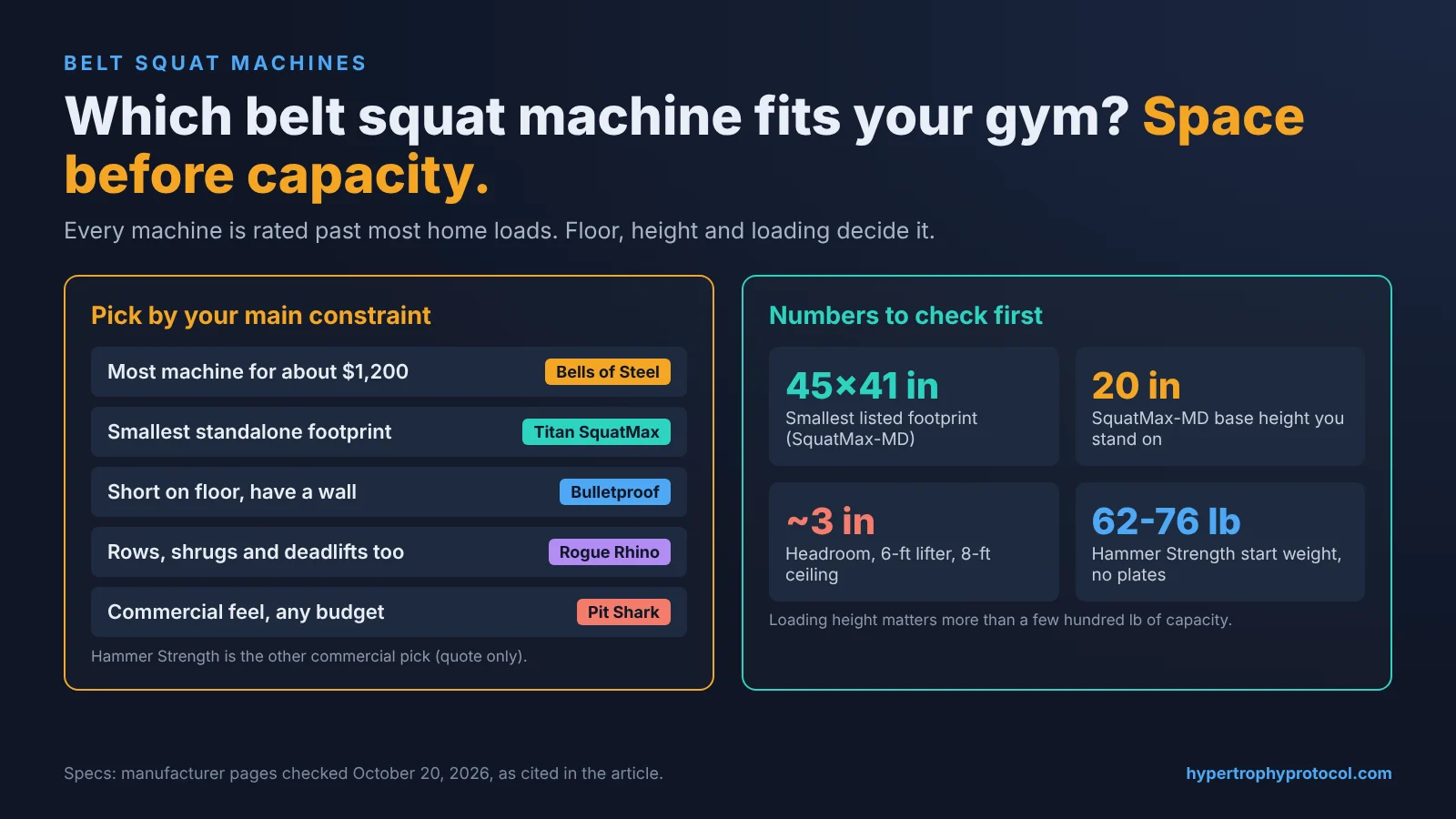
- You want the most machine for about $1,200: the Bells of Steel 2.0 if you have the floor (51 x 81 inches in its standard setup) and like plates loaded on an arm. Plan on blocks if you need more depth.
- You want a straight vertical path and can handle low loading: the Titan SquatMax-MD. Its 45 x 41 inch footprint is the smallest standalone here, but you’ll load near the floor and stand 20 inches up, so check your ceiling.
- You’re short on floor and have a wall to mount it on: the Bulletproof VBS, which comes with its own 72 in 3×3 wall upright. Bulletproof says it can also go on an existing 3×3 upright with 1-inch holes if the rack is bolted or weighed down. It’s new, with no long-term owner data yet, including mine.
- You want the machine to do more than squats: the Rogue Rhino, which Rogue says also handles rows, shrugs and deadlifts (its low row attachment is sold separately), if you have the space for a stand-alone tower.
- You want commercial-gym feel and budget isn’t the limit: the Pit Shark or Hammer Strength. Measure your ceiling first if you’re looking at the Pit Shark tall frame.
Whichever you pick, it doesn’t replace everything. Belt squats work your quads hard but your glutes less, so keep a hip thrust, deadlift or back extension in the week, and a knee extension if you have one.
Frequently asked questions
Is a belt squat machine as good as a barbell squat for legs?
For the quads, short-term EMG studies show similar activity, with much less lower-back activity and somewhat less glute activity. No long-term growth study has compared the two directly, so “about as good for quads, less for glutes and trunk” is as far as the evidence goes.
How much weight should I use on a belt squat compared with my back squat?
Evans et al. built equations that predict belt squat load from back squat load and other measures, but they come from one machine and one group of lifters. Start well below your back squat, find a 5 to 10 rep weight in your first session, and build from there.
What ceiling height do I need for a belt squat machine?
Add the platform or base height to your own height, plus your flooring, and compare it with the lowest point overhead. On a machine with a 20-inch base, a 6-foot lifter on 3/4-inch mats stands just under 7 feet 9 inches tall.
Can I belt squat without a machine?
Yes. A hip belt or harness, a loading pin and two stable boxes or a raised platform will do it. Depth is limited by how high you stand, and plates can swing, which is what a machine fixes.
Related guides
- Squat machines compared: how 8 loading styles change what your legs train
- Squat Harness V4 review
- Home Gym Room Planner
- Leg press machines for home gyms
- Beyond Power VOLTRA I guide
- Home gym flooring guide
- All free tools
Sources checked October 20, 2026. Manufacturers change specs and prices; confirm on the product page before ordering.