
You already lower the weight on every rep, and now you keep seeing lifters hang weight releasers on a bar, count five-second negatives, lower with one leg on the leg press or switch on a motorized eccentric mode. Eccentric overload for hypertrophy sounds logical, because muscles can handle more load while they lengthen. The research gives a short answer: heavier or slower lowering has not reliably built more muscle than ordinary sets.
That still leaves a real choice about which methods earn a place in a home program and which only add fatigue. Every study below was checked on PubMed on September 28, 2026.
At a glance
| Verdict | Heavier or slower lowering has not reliably built more muscle than ordinary controlled sets. |
|---|---|
| Effect size / key numbers | Accentuated vs constant load: SMD −0.06 (95% CI −0.59 to 0.48). Eccentric-only vs concentric-only: 0.25 and 0.285, both CIs cross zero. |
| Evidence strength | Low: only 3 accentuated-loading trials measured muscle size; da Silva 2025 rated its certainty very low. |
| What to do | Control every lowering (1–3 s). Use 2-up/1-down or slow eccentrics for variety, with longer rests. |
| Main caveat | Accentuated sets raise effort ratings (SMD 1.72). Flywheel vs normal lifting growth comparisons are few and mixed. |
Studies checked on PubMed, September 28, 2026.
Why would the lowering phase matter for growth?
The appeal of those methods starts with a force gap. A maximal eccentric action can produce up to 50% more force than a concentric one in testing, a figure cited in a 2026 meta-analysis of accentuated eccentric loading. The gap varies by lifter and exercise, but a weight you can barely lift is usually comparatively light on the way down. If growth follows the mechanical tension on the muscle, a heavier eccentric looks like free extra stimulus.
Heavier eccentrics do change what happens inside a set. In the pooled data, accentuated sets raised eccentric muscle activity, but electrical activity is a proxy for recruitment and does not measure growth. The question has to be settled by trials that tracked muscle size for weeks.
Is the lowering phase better for growth than the lifting phase?
The cleanest test of that theory isolates the two phases. The table collects every growth study used in this guide, grouped by method, with who was trained and how size was measured.
| Study | Comparison | Who and how long | Measure | Result |
|---|---|---|---|---|
| Schoenfeld 2017 (meta-analysis) | Eccentric-only vs concentric-only training | 15 studies, 6 wk or longer | Biopsy, imaging, impedance or densitometry | Effect size difference 0.25 (95% CI −0.03 to 0.52), p = 0.076; mean growth 10.0% vs 6.8% |
| da Silva 2025 (meta-analysis) | Eccentric-only vs concentric-only training | 26 studies, 682 participants | Direct imaging | 0.285 (95% CI −0.131 to 0.701), not significant; I² 84.4%; certainty very low |
| Zhang 2026 (meta-analysis) | Accentuated eccentric loading vs constant load | 49 studies, 773 participants; 3 trials measured muscle size | Cross-sectional area | SMD −0.06 (95% CI −0.59 to 0.48), p = 0.84 |
| Walker 2016 | Eccentric load +40% (weight releasers on leg press, hand-loaded plates on knee extension) vs traditional | 28 strength-trained men including controls, 10 wk | Ultrasound cross-section | Vastus lateralis +13% vs +11%; vastus medialis +11% vs +16%; similar muscle growth, more strength with overload |
| Yue 2025 | Eccentric overload on every rep vs on reps 1 and 4 vs traditional | 35 participants, 8 wk | Rectus femoris cross-section | Every-rep overload grew more than traditional; the two-rep version did not |
| Schoenfeld 2015 (meta-analysis) | Different repetition durations, sets to failure | 8 studies, 6 wk or longer | Biopsy, imaging or densitometry | Similar growth from 0.5 to 8 s per rep; very slow reps (over 10 s) looked inferior |
| Azevedo 2022 | 2 s vs 4 s eccentric knee extension | 10 young adults, one leg each, 8 wk | Ultrasound thickness | Similar in vastus lateralis and rectus femoris; vastus medialis favored 4 s |
| Kojić 2021 | 1 s vs 4 s eccentric biceps curls | 20 untrained students, 7 wk | Muscle thickness | +3.24 mm vs +3.57 mm, no difference; 1RM rose more with 4 s |
| Pearson 2022 | 1 s vs 3 s eccentric leg extension, volume matched | 13 trained men, one leg each, 8 wk | Ultrasound thickness | Proximal thigh similar; distal +5.5% fast vs +2.2% slow; slow sets rated harder |
| Shibata 2021 | 2 s vs 4 s eccentric back squat to failure | 22 university soccer players, 6 wk | Thigh cross-section | Similar growth; squat 1RM rose more with 2 s |
| Maroto-Izquierdo 2017 (meta-analysis) | Flywheel eccentric overload vs weight-stack training | 9 studies, 276 participants | Pooled across all outcomes | 0.63 (95% CI 0.49 to 0.76) overall; hypertrophy favored flywheel |
| Vicens-Bordas 2018 (meta-analysis) | Flywheel vs gravity-dependent training | 7 controlled trials (3 randomized) | Strength | SMD −0.05 (95% CI −0.51 to 0.40); too little data for hypertrophy |
| Petré 2018 (meta-analysis) | Flywheel training, before vs after | 20 studies (12 on growth); 16 had no passive control | Cross-section, volume or mass | Pre-post effect size 0.59; no comparison with normal lifting |
| Cowley 2026 (network meta-analysis) | Seven advanced methods vs traditional training | 17 hypertrophy studies | Imaging | 13 showed no difference; flywheel vs traditional: 2 favored flywheel in some regions (one also favored traditional for vastus medialis), 1 similar |
| Maroto-Izquierdo 2023 | Motor-driven eccentric at 90% vs 120% of 1RM, concentric at 30% | 27 active students, 10 wk | Thigh lean mass | +2.5% vs +4.2%, similar; no constant-load group |
The first two rows answer the phase question. Both meta-analyses leaned toward eccentric-only training, and neither reached statistical significance. The chart shows why: each confidence interval crosses zero.
Pooled growth effects: eccentric emphasis vs normal training
The newer da Silva analysis rated its evidence very low in certainty, with wide disagreement between studies. Its subgroups hinted at an eccentric edge in upper-limb muscles, in trials of 8 weeks or less and on isokinetic machines, which is shaky ground for a home decision. Both actions built muscle, and every normal rep already contains both.
Does eccentric overload for hypertrophy beat normal sets?
Because normal reps already include a lowering phase, the practical test is accentuated eccentric loading: more weight on the way down, normal weight on the way up. The largest pooled estimate shows no growth advantage, but only three trials in it measured muscle size, so the interval is wide enough to hide a small effect in either direction.
Single trials point both ways. The Walker group used weight releasers and hand-loaded plates in strength-trained men and got more strength with no extra quadriceps growth. The Yue trial did see more rectus femoris growth when every rep was overloaded, but it measured one muscle in 35 people over 8 weeks.
The costs are clearer than the benefits. Accentuated sets drove up ratings of perceived exertion (SMD 1.72) and blood lactate, and the Zhang authors advise longer rests between sets and between sessions when you use them. The VOLTRA training modes guide applies that same review to a digital eccentric mode.
Do slow eccentrics speed up muscle growth?
If heavier lowering does not clearly help, slower lowering is the free alternative. The 2015 repetition duration meta-analysis saw similar growth across a wide range of rep speeds, and only very slow reps looked worse. Newer trials that changed the eccentric alone landed in the same place.
Two-second and four-second eccentrics grew the thigh about equally in two trials, with one muscle favoring the slower leg in the Azevedo study. In untrained students, four-second curls matched one-second curls for elbow flexor thickness. In trained men, the Pearson trial went the other way: the faster tempo grew the distal thigh more, and the slow sets felt harder.
Reviews read this mixed picture a little differently. A 2021 tempo review by Wilk and colleagues favored a slower eccentric paired with a fast concentric, while a 2022 review by Handford and colleagues saw no clear difference between 2- and 6-second eccentrics for hypertrophy. A controlled lowering is enough; a four-second count is a fair variation with no reliable size bonus.
Is flywheel training the exception?
Flywheels are the one eccentric tool with a meta-analysis claiming superiority. The 2017 Maroto-Izquierdo analysis favored flywheel overload over weight-stack training on nearly every outcome, muscle size included. A later analysis by Vicens-Bordas and colleagues, limited to controlled comparisons, saw no strength advantage and too little data to judge hypertrophy.
Some flywheel numbers also get quoted out of context. The Petré effect size for muscle size compares before and after flywheel training, not flywheel against normal lifting, and most of its studies lacked a passive control group. The 2026 Cowley review counted only three flywheel-versus-traditional growth comparisons, with mixed results, and participants across that review averaged 1.9 years of training.
Flywheel researchers are cautious too. An expert consensus recommends calling it flywheel training rather than eccentric overload, because not every setup achieves overload. Beato and Dello Iacono suggest mixing flywheel work with traditional training rather than replacing it, and the Cowley review saw the clearest flywheel benefit in jump performance.
Which home method is worth the time and fatigue?
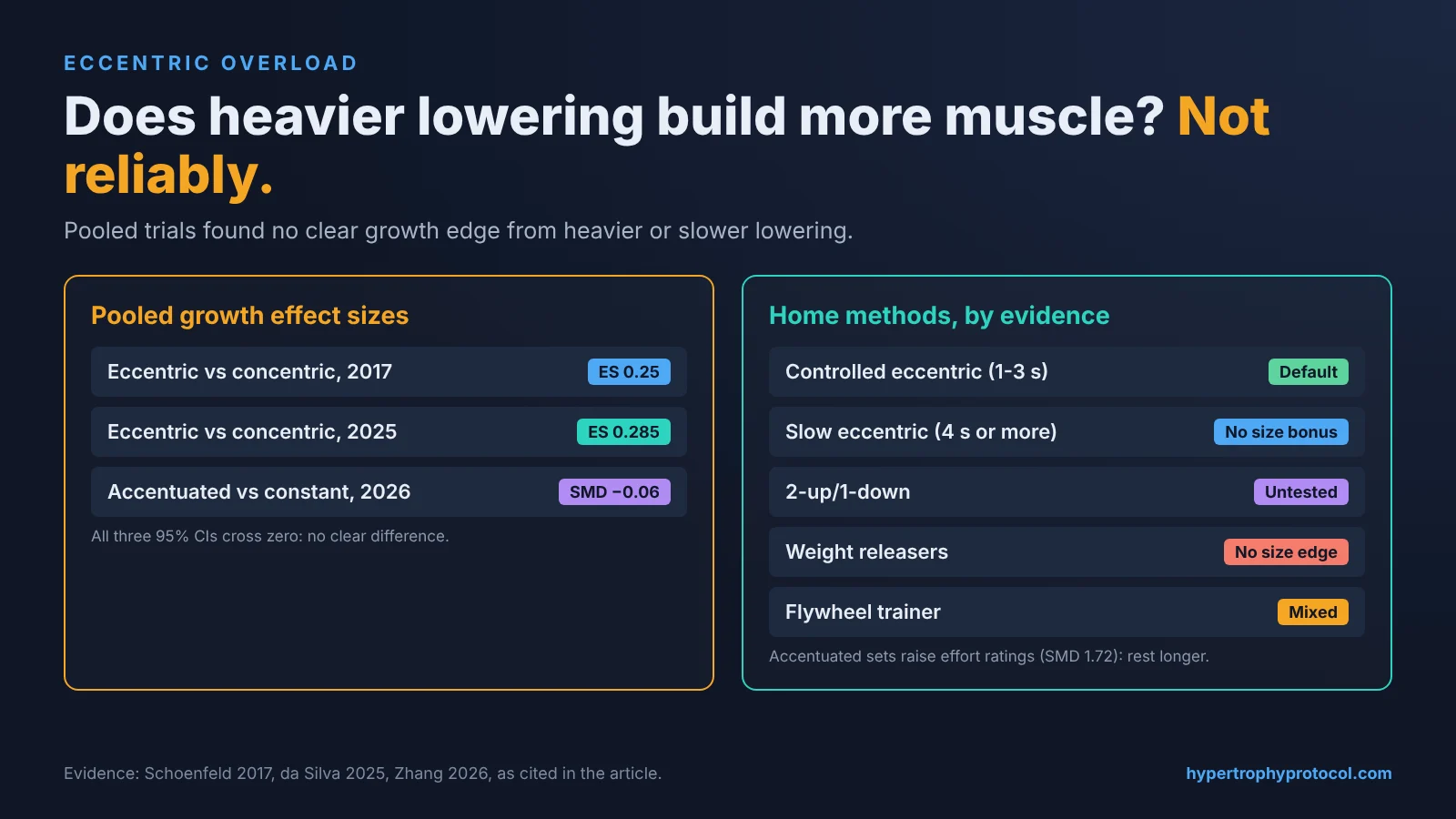
With the research mapped, the decision comes down to cost. The table separates what a trial tested directly from what is inferred, since several home methods have never been studied for growth.
| Method | Home equipment needed | What the evidence directly supports | Cost in time and fatigue |
|---|---|---|---|
| Controlled eccentric (1–3 s) | Nothing extra | Growth similar across 0.5–8 s reps (Schoenfeld 2015); every tempo arm with 1–4 s eccentrics grew muscle | None; the default for every set |
| Slow eccentric (4 s or more) | Nothing extra; a timer helps | Mostly matched faster eccentrics; one muscle favored slow, one thigh region favored fast | Longer sets and higher effort ratings; strength effects mixed |
| 2-up/1-down (lift with both limbs, lower with one) | Selectorized or plate-loaded machine, cable station with a straight bar, leg press | Not tested for hypertrophy; inferred from accentuated loading trials | Little setup; limited to machine and cable lifts |
| Weight releasers | Barbell, rack with safeties, releaser hooks | The most common tool in the accentuated loading research (23 of 49 studies); no pooled size advantage | Hooks drop off after the first lowering, so resets are needed; higher effort ratings |
| Flywheel trainer | Flywheel platform or inertial cable unit with a harness or bar | Builds muscle before vs after; comparisons with normal lifting are mixed; clearest benefit is for jumps | 2–3 familiarization sessions suggested; overload is not guaranteed; high perceived and metabolic demand |
| Digital resistance with an eccentric mode | Motorized cable unit such as the VOLTRA I | Motor-driven loading is part of the accentuated loading research, which shows no pooled size advantage | Easiest way to overload every rep; the same effort cost as other accentuated loading |
The 2-up/1-down method is a homemade form of accentuated loading, so the Zhang and Walker results are the closest evidence; no trial has tested it directly. Motorized units such as the VOLTRA I can apply eccentric overload. The one motor-driven growth trial in the table compared two eccentric loads with each other, so it cannot show an advantage over normal sets.
Who should add eccentric emphasis, and who can skip it?
Taken together, the evidence gives a different answer depending on where your training stands. Find the line that matches you.
- You let the weight drop on the way down: control it. The tempo trials that grew muscle used deliberate eccentrics of 1 to 4 seconds, and control costs nothing.
- You already train close to failure with controlled reps: you are doing what the evidence supports. Eccentric overload is optional, and the pooled trials of heavier lowering show no extra growth from it.
- You want variety for a training block: use 2-up/1-down on machine or cable movements, or slow eccentrics, and rest longer between sets. Judge the block by whether your loads and reps keep climbing.
- You are weighing a flywheel or motorized unit for eccentric work: buy it for convenience or jump training. The growth trials do not yet justify buying it for extra muscle.
Your next step: tighten the lowering phase in your current program and track load and reps with the progressive overload guide for small home gyms. If progress stalls after a full block, an eccentric method is a reasonable variation to test.
Sources
- Zhang X, Weakley J, Li H, Marcos-Frutos D, García-Ramos A. Acute and chronic effects of accentuated eccentric loading vs. constant-load resistance training: a systematic review and meta-analysis. Sports Med. 2026. doi:10.1007/s40279-026-02422-7
- Schoenfeld BJ, et al. Hypertrophic effects of concentric vs. eccentric muscle actions: a systematic review and meta-analysis. J Strength Cond Res. 2017. doi:10.1519/JSC.0000000000001983
- da Silva LSL, et al. Comparison between eccentric vs. concentric muscle actions on hypertrophy: a systematic review and meta-analysis. J Strength Cond Res. 2025. doi:10.1519/JSC.0000000000004981
- Walker S, et al. Greater strength gains after training with accentuated eccentric than traditional isoinertial loads in already strength-trained men. Front Physiol. 2016. doi:10.3389/fphys.2016.00149
- Yue C, et al. The effects of accentuated eccentric loading repetition structures on muscle strength and adaptation. J Strength Cond Res. 2025. doi:10.1519/JSC.0000000000005232
- Maroto-Izquierdo S, et al. Effects of submaximal and supramaximal accentuated eccentric loading on mass and function. Front Physiol. 2023. doi:10.3389/fphys.2023.1176835
- Schoenfeld BJ, Ogborn DI, Krieger JW. Effect of repetition duration during resistance training on muscle hypertrophy: a systematic review and meta-analysis. Sports Med. 2015. doi:10.1007/s40279-015-0304-0
- Azevedo PHSM, Oliveira MGD, Schoenfeld BJ. Effect of different eccentric tempos on hypertrophy and strength of the lower limbs. Biol Sport. 2022. doi:10.5114/biolsport.2022.105335
- Kojić F, et al. Effects of resistance training on hypertrophy, strength and tensiomyography parameters of elbow flexors: role of eccentric phase duration. Biol Sport. 2021. doi:10.5114/biolsport.2021.99323
- Pearson J, et al. Does varying repetition tempo in a single-joint lower body exercise augment muscle size and strength in resistance-trained men? J Strength Cond Res. 2022. doi:10.1519/JSC.0000000000003953
- Shibata K, et al. Effects of prolonging eccentric phase duration in parallel back-squat training to momentary failure on muscle cross-sectional area, squat one repetition maximum, and performance tests in university soccer players. J Strength Cond Res. 2021. doi:10.1519/JSC.0000000000002838
- Wilk M, Zajac A, Tufano JJ. The influence of movement tempo during resistance training on muscular strength and hypertrophy responses: a review. Sports Med. 2021. doi:10.1007/s40279-021-01465-2
- Handford MJ, et al. The need for eccentric speed: a narrative review of the effects of accelerated eccentric actions during resistance-based training. Sports Med. 2022. doi:10.1007/s40279-022-01686-z
- Maroto-Izquierdo S, et al. Skeletal muscle functional and structural adaptations after eccentric overload flywheel resistance training: a systematic review and meta-analysis. J Sci Med Sport. 2017. doi:10.1016/j.jsams.2017.03.004
- Vicens-Bordas J, et al. Is inertial flywheel resistance training superior to gravity-dependent resistance training in improving muscle strength? A systematic review with meta-analyses. J Sci Med Sport. 2018. doi:10.1016/j.jsams.2017.10.006
- Petré H, Wernstål F, Mattsson CM. Effects of flywheel training on strength-related variables: a meta-analysis. Sports Med Open. 2018. doi:10.1186/s40798-018-0169-5
- Beato M, Dello Iacono A. Implementing flywheel (isoinertial) exercise in strength training: current evidence, practical recommendations, and future directions. Front Physiol. 2020. doi:10.3389/fphys.2020.00569
- Beato M, et al. Current guidelines for the implementation of flywheel resistance training technology in sports: a consensus statement. Sports Med. 2024. doi:10.1007/s40279-023-01979-x
- Cowley N, et al. The effects of advanced resistance training prescription methods on strength, power, hypertrophy, and performance adaptations in healthy adults: a systematic review and Bayesian network meta-analysis. Sports Med. 2026. doi:10.1007/s40279-026-02428-1
Sources checked September 28, 2026. Research summaries describe the cited studies; individual results vary.