
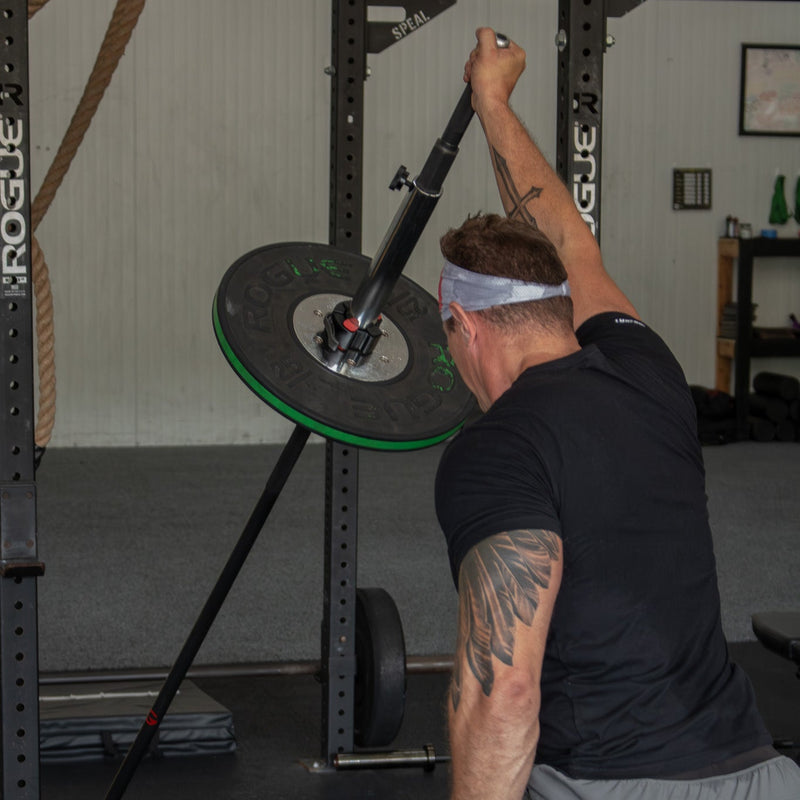
You want landmine presses and rows, and you have to choose between a landmine attachment for power rack uprights and a base that sits on the floor. If your rack maker sells a landmine for your exact rack series, the rack-mounted version is the tidy pick, because almost every one is sold for a named rack line. If your rack is a brand with no matching landmine, or you would rather keep the rack free, a standalone base does the same job anywhere you have floor room.
The choice also changes how high the pivot sits, what loads your rack takes and how much floor you give up. Every spec below was checked on September 28, 2026, on the maker’s own product page or installation sheet.
At a glance
| Your setup | Option | Capacity (published) | Main catch |
|---|---|---|---|
| Rogue Monster 3×3 | Rogue Monster Landmine 2.0 | Not listed | Monster 3×3 uprights only |
| Rogue Infinity or Monster Lite | Rogue Landmine (Single or Double Set) | 315 lb | Double Set fits Infinity only |
| REP rack | REP Landmine | Not published | Order your rack’s version; US page shows no fit list |
| Titan T-2, T-3 or X-3 | Titan Rack-Mounted Landmine | 315 lb | Not for TITAN Series racks |
| Titan TITAN Series | TITAN Series Rack-Mounted Landmine | 1,000 lb | Pivot sits at the base of the rack |
| Other brand with 5/8″ or 1″ holes | Bells of Steel Landmine Rack Attachment | 315 lb | Upright no wider or deeper than 3″ |
| No rack, or rack not bolted down | REP Free Standing Landmine or Rogue Post Landmine | 500 lb (REP); 315 lb (Rogue) | Low fixed pivot; the Rogue post needs two plates |
Specs from the makers’ pages and installation sheets, checked September 28, 2026. Confirm before ordering.
Which landmine attachment for power rack uprights fits yours?
Fit starts with brand and series, because that is how five of the six rack-mounted models here are sold. Only the Bells of Steel attachment is sold by hole size and tube size alone. The two standalone bases at the bottom of the table need no rack at all.
| Model | Mount type | Fits | Pivot / sleeve | Key requirement | Source |
|---|---|---|---|---|---|
| Rogue Monster Landmine 2.0 | Monster Knurled Knob on the upright | Rogue Monster Series 3×3 racks, rigs and stands only | 10″ DOM pivot sleeve, 2″ diameter; standard Olympic bars | Monster 3×3 only; 2×3 owners are sent to the standard Rogue Landmine | Rogue |
| Rogue Landmine (Single or Double Set) | 5/8″ x 6″ bolt on the outside face of an Infinity upright; band peg and shaft collar on Monster Lite | Rogue Infinity (2×3) and Monster Lite; Double Set is Infinity only | 10″ smooth-pivoting 7-gauge sleeve; most standard Olympic bars; 315 lb capacity | Pick the mount for your Rogue line | Rogue, instructions |
| REP Landmine | Band peg in any hole, side of the upright or side of the base | REP PR-1000, PR-1050, PR-1100, PR-4000, PR-4100, PR-5000, Omni, Apollo; SR-4000 with the 5000 option (list from REP’s EU store; the US page shows no list, so confirm with REP) | Two tubes: 2″ sleeves (11.8″ long) and 1″ sleeves (5.5″ long); capacity not published | Order the version for your rack | REP, REP US |
| Titan Rack-Mounted Landmine | 5/8″ pin with hex key collar (T-3, X-3); 1.93″ adapter tube (T-2) | Titan T-2, T-3, X-3; not TITAN Series | 9.75″ sleeve, 50 mm inside diameter; Olympic bars; 315 lb capacity | On an X-3 Flat Foot rack, as low as the 6th hole from the bottom of the front upright | Titan |
| TITAN Series Rack-Mounted Landmine | Hitch pin at the base of the rack; 1″ thread pin | Titan TITAN Series racks | 9.75″ sleeve, 51 mm inside diameter; Olympic bars; 1,000 lb capacity | TITAN Series only | Titan |
| Bells of Steel Landmine Rack Attachment | Bracket for 5/8″ holes; Manticore version uses a mag pin in 1″ holes | Any rack with 5/8″ holes, or 1″ holes for the Manticore version | Manticore version rotates in two axes; 315 lb capacity | Upright no wider or deeper than 3″ | Bells of Steel |
| Rogue Post Landmine | 7.25″ post held by a pair of stacked bumpers or 45 lb iron plates | No rack needed; also fits the Rogue Dog Sled | 10″ sleeve that pivots 360 degrees; most standard Olympic bars; 315 lb capacity | Two plates to hold the post | Rogue |
| REP Free Standing Landmine | 18.4″ x 13.8″ base plate with a weight horn; bolting optional | No rack needed | Swivel tube for 2″ bar sleeves plus a 1.3″ sleeve; 500 lb capacity | Brace against a wall; add a plate to the horn for stability | REP |
Rogue splits its rack landmines by series, while REP and Titan each sell versions matched to their own rack families. Only Rogue’s Post Landmine page gives a rotation figure, 360 degrees; the rest describe a smooth pivot or a swivel without a number.
How do you match a rack mounted landmine to your holes and uprights?
Once you know which models exist for your brand, the fit check comes down to the hole and the tube. Rogue is the clearest example of why the series name matters. The Monster Landmine 2.0 is for 3×3 Monster uprights only, while the standard Rogue Landmine covers Infinity and Monster Lite with 5/8″ hardware.
Even within that standard landmine the mount changes. On a 2×3 Infinity upright it bolts through with a 5/8″ x 6″ hex bolt on the outside face, and on Monster Lite it hangs from a band peg locked with a shaft collar. The Double Set won’t work on Monster Lite, so check the version before you order. The Rogue Monster vs Monster Lite attachment guide covers the rest of that split.
Titan and REP work the same way inside their own lines. Titan’s landmine fits T-3 and X-3 racks with a 5/8″ pin and T-2 racks with an adapter tube. It is not sold for TITAN Series racks, which get their own base-mounted model. If you are unsure what tube or hole you have, the power rack upright sizes guide shows how to measure both before you pick a version.
Where does the pivot sit, and why does swing height matter?
With fit settled, the next difference is the height of the pivot. On a rack you choose it: REP’s band peg goes in any hole at any height, and Titan’s model reaches as low as the sixth hole from the bottom on an X-3 Flat Foot rack. The TITAN Series version and both standalone bases put the pivot at or near floor level.
Pivot height sets the angle of the bar at any given hand position, and your hands always travel at right angles to the bar. A floor-level pivot keeps the bar steep, so a landmine press drives up and forward along the classic diagonal. Raise the pivot and the bar flattens, which turns the same press into a more vertical, overhead-style path.
A rack mount lets you move between those two paths by changing holes. A standalone base fixes the pivot low, which gives you the classic diagonal every time but no way to change it.
Does a rack mounted landmine change how stable your rack is?
That adjustable height comes with a trade-off, because the rack now anchors the pivot. Each rep pushes or pulls on one upright at one point, and rotational moves add sideways load. None of the landmine pages checked here sets a bolt-down rule, but Titan recommends bolting its T-3 rack down for added stability in general.
Where you mount also matters. Rogue’s instructions put the Infinity landmine on the outside face of the upright, and REP’s mounts to the side of the upright or the base. The TITAN Series version sits at the base of the rack. A pivot near the floor puts the load closer to the ground than one several holes up, which is worth considering on a rack that is not bolted down.
If your rack stands free, check its manual for anchoring guidance before adding a landmine up high. Whether a rack is bolted down is one of the seven checks in the rack attachment compatibility checklist, and it applies here as much as to any heavier attachment.
How much floor space does a standalone landmine base need?
A standalone base removes the rack from that equation and asks for floor instead. REP’s Free Standing Landmine has an 18.4″ x 13.8″ base plate, about 1.8 square feet, and reaches 26.3″ long with the sleeve pointed forward. REP suggests placing it against a wall and adding a plate to its weight horn, and it can be bolted down if you want.
Rogue’s Post Landmine skips the base plate: its short post drops into a pair of stacked bumpers or 45 lb iron plates. You supply the weight that holds it in place, so it only works if you own two suitable plates.
The base itself is rarely the real space cost. Either style needs a clear lane for the barbell plus room to stand at its end, and that lane is the same whether the pivot is on a rack or on the floor. The difference is that a base lets you put the lane anywhere, while a rack mount fixes it beside the upright you chose.
Which should you buy: rack-mounted or standalone?
Fit, pivot height, stability and floor space sort most lifters into one of three cases. If you own a Rogue, REP or Titan rack, buy that maker’s landmine for your exact series. It uses holes you already have and lets you set the pivot height, with no floor space needed beyond the bar’s lane.
If your rack is another brand with 5/8″ or 1″ holes and uprights of 3″ or less, look at the Bells of Steel attachment. It is the one model here sold by size rather than by rack line, so confirm both numbers on your own uprights first.
If your rack is not bolted down or you want the landmine lane somewhere other than beside the rack, get a standalone base. Choose REP’s weighted plate if you want a base that stands on its own, or Rogue’s Post Landmine if you already have two bumpers to spare.
Before you order a rack-mounted model, run your rack through the Rack Attachment Fit Checker. It screens your upright size and hole diameter against the version you picked; confirm the mounting hardware and clearances with the maker before ordering.
Sources checked September 28, 2026. Manufacturers change specs; confirm on the product page before ordering.