
Last updated October 31, 2026. This guide is based on published research, and each claim links to the study behind it. General information, not medical advice.
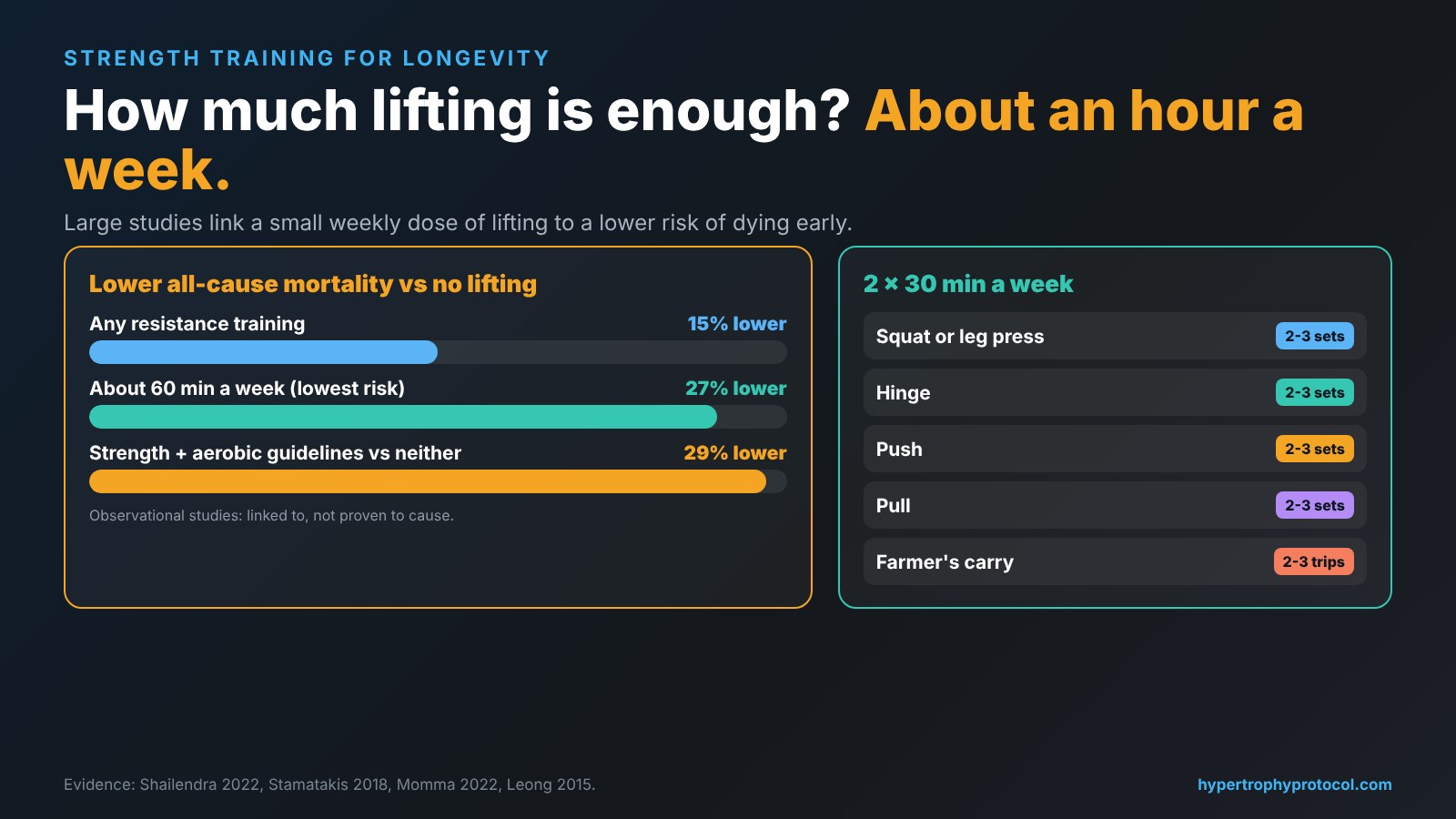
If you want to lift for a longer life, the research points to a surprisingly small dose. In the largest pooled analyses, people who did any muscle-strengthening exercise had about 15% lower risk of dying during follow-up, and the biggest reduction showed up at around 30 to 60 minutes a week. That’s two short full-body sessions.
These are observational studies, so they show a link, not proof that lifting caused the difference. No trial has randomly assigned people to lift or not and waited decades to count deaths. What trials do show is that lifting builds strength and muscle at any age, and in large cohort studies, lower strength is consistently linked to a higher risk of dying early.
At a glance
| Verdict | About 30 to 60 minutes of lifting a week, which fits in two short full-body sessions, is the amount linked to the lowest risk of early death in large observational studies. |
|---|---|
| Key numbers | Any lifting vs none: 15% lower all-cause mortality. Lowest risk around 60 minutes a week: 27% lower. |
| Evidence strength | Moderate: large, consistent cohort studies, but no randomized trial of lifting and lifespan. |
| What to do | Train all major muscle groups twice a week, and add 150 minutes of moderate cardio. |
| Main caveat | People who lift differ from people who don’t in many ways, and the effect of high volumes is still unclear. |
General information, not medical advice. See the study table below for sources.
What happens to strength as you get older?
Strength fades faster than muscle does. In the Health, Aging and Body Composition Study, 1,880 adults aged 70 to 79 lost leg strength at 2.6 to 4.1% a year, depending on sex and race, about three times faster than they lost leg muscle, which dropped about 1% a year (Goodpaster et al., 2006).
The same study found that people who gained muscle mass over those three years still lost strength. That’s why the longevity case for lifting is about getting and staying strong, not only about keeping size.
How much does lifting lower the risk of dying early?
Three large analyses point the same way.
- A 2022 meta-analysis of 10 studies found that any amount of resistance training, compared with none, was linked to 15% lower all-cause mortality, 19% lower cardiovascular mortality and 14% lower cancer mortality (Shailendra et al., 2022).
- Another 2022 meta-analysis of 16 cohort studies found muscle-strengthening activity linked to 10 to 17% lower risk of all-cause mortality, cardiovascular disease, total cancer, diabetes and lung cancer, independent of aerobic exercise (Momma et al., 2022).
- In 80,306 adults from England and Scotland, any strength exercise was linked to 23% lower all-cause mortality and 31% lower cancer mortality (Stamatakis et al., 2018). People who met both the strength and the aerobic guidelines had 29% lower all-cause mortality than people who met neither.
The size of the link is similar to what Stamatakis found for meeting the aerobic guideline, and people who did both had a bigger reduction than people who did either alone. That’s the practical point: lifting and cardio are partners here, not rivals.
Is more lifting better for a longer life?
Not in these studies. Both meta-analyses found a curve that bottoms out and then flattens or rises. In Shailendra’s dose analysis, which pooled 4 studies, the lowest risk, 27% below non-lifters, came at about 60 minutes a week, and the benefit shrank at higher volumes. Momma’s analysis put the sweet spot at roughly 30 to 60 minutes a week.
Don’t read that as “lifting more is harmful.” Both teams say the effect of higher volumes is still unclear and needs more research. What it does mean is that you don’t need long sessions for the longevity benefit. If your goal is maximum muscle, more weekly sets still help growth, and the weekly sets planner covers that side.
Why does grip strength get so much attention?
Because it’s cheap to measure and it predicts a lot. In the PURE study of about 140,000 adults in 17 countries, each 5 kg lower grip strength was linked to 16% higher all-cause mortality, and grip predicted death better than systolic blood pressure did (Leong et al., 2015).
In half a million UK Biobank participants, each 5 kg lower grip was linked to 20% higher all-cause mortality in women and 16% in men. The researchers defined muscle weakness as grip below 26 kg for men and 16 kg for women (Celis-Morales et al., 2018).
Grip works as a marker of whole-body strength. The PURE authors called for research to test whether improving strength actually lowers mortality, and there’s no evidence that training grip on its own does. So train the whole body, and let grip come along with heavy pulls and carries.
Can you still build strength later in life?
Yes, and it’s well tested. A meta-analysis of 47 studies in 1,079 adults aged 50 and over found strength gains of 24 to 33% depending on the lift, with bigger gains from higher-intensity training (Peterson et al., 2010). A companion analysis of 49 studies found an average gain of 1.1 kg of lean mass, more with higher-volume programs and somewhat less in the oldest participants (Peterson et al., 2011).
The authors suggest that starting earlier in life may give more, so there’s no reason to wait.
What does a minimum longevity routine look like in a home gym?
The US Physical Activity Guidelines ask adults for muscle-strengthening activity of moderate or greater intensity, working all major muscle groups, on 2 or more days a week, plus 150 to 300 minutes of moderate aerobic activity (Physical Activity Guidelines for Americans, 2nd edition). Older adults should add balance training.
Here’s one way to hit that with about 30 minutes, twice a week. It’s an example built from those guidelines, not a protocol tested in a study.
- Squat pattern: back squat, safety squat bar squat, leg press or belt squat. 2 to 3 hard sets.
- Hinge: trap bar deadlift or Romanian deadlift. 2 to 3 hard sets.
- Push: bench press, incline press or overhead press. 2 to 3 hard sets.
- Pull: chin-ups, lat pulldown or rows. 2 to 3 hard sets.
- Carry: farmer’s carries for 2 to 3 trips. This is where your grip gets trained.
Leave a rep or two in reserve on most sets, add weight or reps over time, and keep the sessions short enough that you’ll still be doing them in ten years. Progressive overload in a small home gym covers how to keep progressing with limited equipment.
What equipment do you actually need?
Less than you think. A rack, a barbell, a bench and some plates cover every movement above. If space is tight, adjustable dumbbells and a bench do most of it. Some lifters find a trap bar deadlift more comfortable than a straight-bar deadlift.
- Power rack buying guide
- How to choose a barbell for a home gym
- Trap bar vs safety squat bar vs cambered bar
- How to set up a home gym in a 10×10 space
How strong is the evidence, study by study?
| Study | Who | Type | Main finding |
|---|---|---|---|
| Shailendra 2022 | 10 studies, adults without major disease | Meta-analysis of cohorts | Any resistance training: 15% lower all-cause mortality; lowest risk (27% lower) at about 60 min a week |
| Momma 2022 | 16 cohort studies | Meta-analysis of cohorts | 10 to 17% lower risk of death, CVD, cancer and diabetes; sweet spot about 30 to 60 min a week |
| Stamatakis 2018 | 80,306 adults, England and Scotland | Pooled cohorts | Any strength exercise: 23% lower all-cause mortality; strength plus aerobic guidelines: 29% lower |
| Leong 2015 | About 140,000 adults, 17 countries | Cohort | Each 5 kg lower grip: 16% higher all-cause mortality |
| Celis-Morales 2018 | 502,293 UK Biobank adults | Cohort | Each 5 kg lower grip: 20% (women) and 16% (men) higher all-cause mortality |
| Goodpaster 2006 | 1,880 adults aged 70 to 79 | Cohort, 3 years | Leg strength fell 2.6 to 4.1% a year, about 3 times faster than leg muscle |
| Peterson 2010 | 47 studies, 1,079 adults aged 50+ | Meta-analysis of training studies | Strength up 24 to 33% depending on the lift |
| Peterson 2011 | 49 studies, 1,328 adults aged 50+ | Meta-analysis of training studies | Lean mass up 1.1 kg on average |
Who should check with a doctor first?
If you have heart disease, uncontrolled blood pressure, a recent surgery or a joint problem, or you’re starting after years of inactivity, talk to your doctor before you start lifting heavy. Starting light and building up over a few weeks is sensible for everyone.
Your next step: plan two short full-body sessions this week, then use the weekly sets planner if you want to build muscle on top of the longevity minimum.