

Short answer: there is no single leg press starting weight. Among the machines below whose makers publish a number, the empty sled or “starting” figure runs from 21 lb to 182 lb. Commercial plate-loaded linear and angled presses that list one sit at 100 to 167 lb (Nautilus 100 lb, Life Fitness Linear 103 lb, Hammer Strength Linear 118 lb, Precor 136 lb, Matrix Magnum 167 lb); Hammer Strength’s discontinued Plate-Loaded Leg Press is the low outlier at 21 lb. Most home leg press and hack squat combos list 38 lb to 80 lb, with the Bells of Steel 2-in-1 at 100 lb. Rogue’s ISO Leg Press 35 is the heavy outlier at 182 lb. Several big-name machines, including Cybex’s plate-loaded leg press, have no published figure at all.
Disclosure: this page has no affiliate links.
Specs checked October 17, 2026. Updated November 3, 2026 with beginner loading and foot position sections.
How much does the leg press sled weigh on common machines?
The table lists only figures a manufacturer (or its parent company) publishes. Where the maker gives no number, the row says so. Numbers that circulate on forums, in videos or on gym signage are left out on purpose, because there is no way to check which machine or which model year they came from.
Read the third column carefully. Makers use different labels: some say “carriage weight” or “sled weight,” others say “starting resistance” or “starting weight.” The product pages do not define these terms, so a “starting resistance” number and a “carriage weight” number may not describe the same thing. The wording each maker uses is kept in the table.
| Machine | Type / angle | Sled (starting) weight, maker’s wording | Source type | Source link |
|---|---|---|---|---|
| Hammer Strength Plate Loaded Linear Leg Press (HSLLP) | Plate loaded, 45-degree linear | 118 lb (53 kg) “starting resistance” | Manufacturer | Life Fitness product page |
| Life Fitness Plate Loaded Linear Leg Press | Plate loaded, linear; angle not listed | 103 lb (47 kg) “starting resistance” | Manufacturer | Life Fitness product page |
| Hammer Strength Plate-Loaded Leg Press (discontinued; a different model from the Linear) | Plate loaded; angle not listed | 21 lb (9.5 kg) “starting resistance” | Manufacturer | Life Fitness product page |
| Matrix Magnum 45 Degree Leg Press (MG-PL70) | Plate loaded, 45-degree | 167 lb (75.7 kg) “starting resistance” | Manufacturer (Johnson Fitness, Matrix’s parent company) | Johnson Fitness product page |
| Precor Discovery Plate Loaded Angled Leg Press (DPL0601) | Plate loaded, 45-degree angled carriage | 136 lb (62 kg) “starting weight” | Manufacturer sell sheet | Precor sell sheet (PDF) |
| Nautilus Plate Loaded Angled Leg Press (NPL1141) | Plate loaded, 45-degree linear | 100 lb (45 kg) “carriage weight” | Manufacturer product sheet (Core Health & Fitness) | Nautilus product sheet (PDF) |
| Cybex Plate Loaded Leg Press (discontinued) | Plate loaded; angle not listed | Not published | Manufacturer page lists no figure | Cybex product page |
| Rogue ISO Leg Press 35 | Plate loaded, 35-degree | 182 lb “sled weight” | Manufacturer | Rogue product page |
| Titan Leg Press Hack Squat Machine | Plate loaded combo, 45-degree carriage | 80 lb “carriage bar weight” | Manufacturer | Titan product page |
| Titan Stealth Leg Press | Plate loaded; angle not listed | Not published | Manufacturer page lists no figure | Titan product page |
| Bells of Steel Leg Press Hack Squat Machine | Plate loaded combo; adjustable incline, degrees not listed | 55 lb (25 kg) “empty sled weight” | Manufacturer | Bells of Steel product page |
| Bells of Steel 2-in-1 Iso Leg Press and Hack Squat Machine | Plate loaded combo; angle not listed | 100 lb “starting weight for the sled” | Manufacturer (blog article) | Bells of Steel article |
| Body-Solid GLPH1100 Leg Press and Hack Squat | Plate loaded combo; angle not listed | 60 lb “carriage weight (with no plates)” | Manufacturer | Body-Solid product page |
| Force USA Compact Leg Press and Hack Squat | Plate loaded combo, 30-degree | 38 lb (17 kg) starting sled | Manufacturer | Force USA product page |
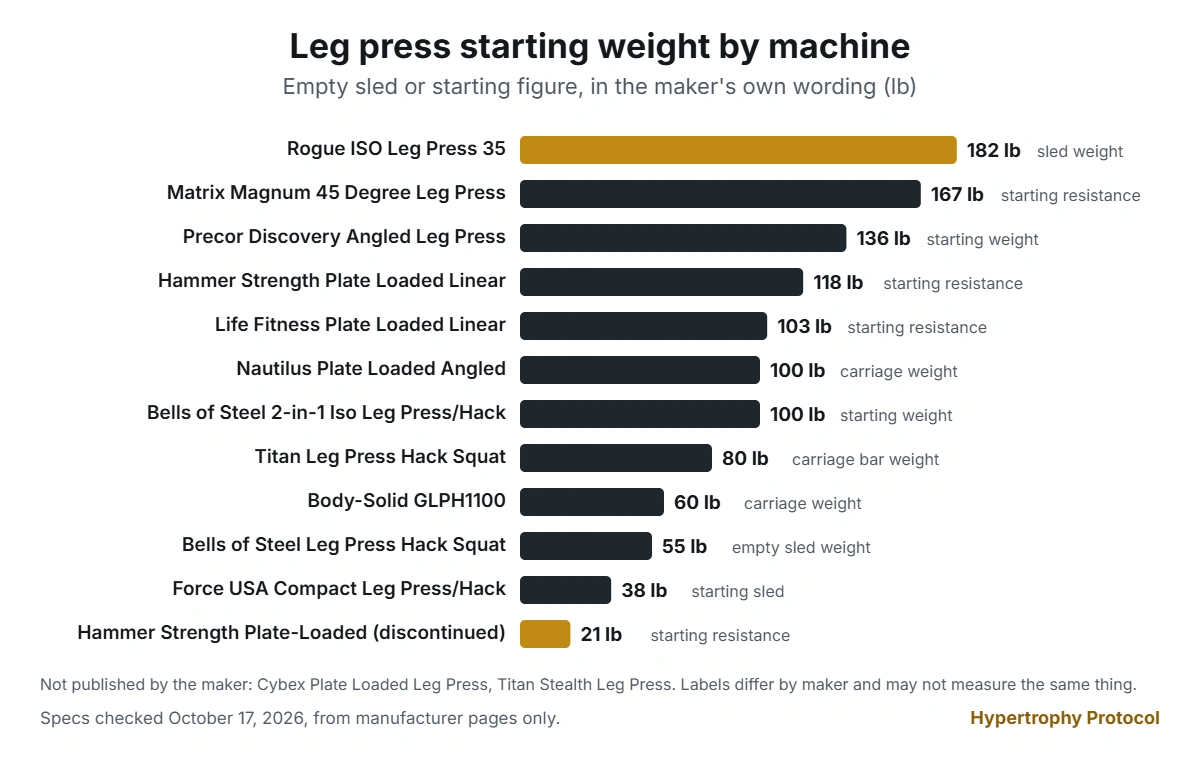
If your gym’s machine is not listed, look for a model or serial label on the frame and search the model number with “spec sheet.” Spec sheets sometimes list figures that the main product page leaves off.
Why does the starting weight vary so much from machine to machine?
The sled is just a steel structure that rides on rails, and its weight follows from how it is built. A few things push the number up or down:
- Size and steel. A wide commercial footplate with heavy-gauge tube, large plate horns and big bearing housings weighs more than a compact home sled. The commercial 45-degree machines in the table carry 1,000 lb or more of rated load (Hammer Strength lists 1,800 lb, Matrix and Precor 1,080 lb, Nautilus 1,260 lb), while the home combos list 700 to 1,000 lb. Load rating does not predict sled weight, though: the Hammer Strength Linear has the highest rating here and a lighter starting figure than the Matrix or Precor.
- What moves. On a classic 45-degree press, the footplate and plate horns move while you stay still. On some other designs the seat moves instead, or a lever arm pivots. What counts as “the sled” changes with the design.
- Angle. A steeper rail makes more of the sled’s weight press back against your feet. A 30-degree home machine and a 45-degree commercial machine with the same sled weight will not feel the same.
- Counterweighting and geometry. Lever and pivot designs set their starting load through arm geometry and balance, so they can start lighter than a sled of similar size on rails.
- Model, not brand. Hammer Strength’s discontinued Plate-Loaded Leg Press lists 21 lb of starting resistance, while the same brand’s Linear Leg Press lists 118 lb. Brand alone tells you little.
- Labeling. As noted above, one maker’s “starting resistance” may not be the same measurement as another maker’s “carriage weight,” and the pages do not explain how either was measured.
Why doesn’t the starting weight match what you feel?
On an angled sled, gravity pulls the sled straight down, but the sled can only travel along the rail. Only part of its weight acts along that rail, and that part is the sine of the rail angle times the weight. For a 45-degree press, sin(45°) is about 0.707, so roughly 71 percent of the sled and plates acts along the rail before friction is considered.
A worked example using a published figure: the Titan Leg Press Hack Squat Machine lists an 80 lb carriage bar weight and a 45-degree weight carriage. With four 45 lb plates added, the total is 80 + 180 = 260 lb. Along the rail that is 260 × 0.707, or about 184 lb. The empty carriage alone works out to 80 × 0.707, or about 57 lb.
The same simple model on other angles:
- 30 degrees: sin(30°) is 0.5. The Force USA Compact’s 38 lb sled works out to about 19 lb along the rail.
- 35 degrees: sin(35°) is about 0.574. Rogue’s 182 lb ISO Leg Press 35 sled works out to about 104 lb along the rail. Rogue separately says the machine delivers “more than 60% of true weight in average resistance,” which is a bit higher than the simple 57 percent estimate. Rogue does not explain how it measured that figure, so treat it as a manufacturer claim rather than something this page can confirm.
Three things make the real number differ from this simple estimate:
- Friction. Friction always opposes motion. When you press the sled up, rail friction adds to the force you need. When you lower it, friction works in your favor. That is why a machine can feel heavier on the way up than on the way down. How much depends on the bearings, rail condition and maintenance, and none of the makers above publish a friction figure.
- Your own legs. You also move the weight of your lower legs and feet through the range, which adds a little load that no spec sheet counts.
- Force direction. The sine estimate assumes you push straight along the rail. Foot placement and seat angle change how closely that holds.
Seated horizontal presses and lever designs do not follow the sine rule at all. On a horizontal sled the rail angle is close to zero, so gravity barely resists you along the rail, and the load usually comes from a weight stack through cables or from plates on a lever arm. On a lever, the effective load depends on how far the plates sit from the pivot compared with your feet, and it can change through the range of motion. For those machines, the maker’s starting resistance figure (when published) is more useful than any formula.
Is “leg press weight” comparable between gyms?
Not really. A 300 lb leg press on one machine and a 300 lb leg press on another can be very different efforts because of sled weight, angle, friction and design. Even the simple sine adjustment shows a 45-degree press puts about 41 percent more of the same load along the rail than a 30-degree press (0.707 versus 0.5). Compare your numbers on the same machine over time, not against someone else’s numbers on a different one.
If you are deciding between machine types for a home gym rather than decoding a gym machine, the leg press machines for home gyms guide covers 45-degree sleds, vertical presses, combos and attachments, and the squat machine styles comparison covers hack, pendulum and belt squat options.
How should you log leg press weight?
The goal of a training log is to show progress, so consistency matters more than precision. A simple system:
- Log the plates you added, and the machine. For example: “HS Linear, 4 plates per side (360 lb added).” That number is unambiguous and easy to repeat.
- Note the sled figure once, with its label. Write down the published number and the maker’s wording, such as “sled: 118 lb starting resistance (Life Fitness spec).” If the maker does not publish one, write “sled: not published” rather than guessing.
- Pick one convention and keep it. Either always log plates only, or always log plates plus the published sled figure. Switching between them makes your history look like a jump or a drop that never happened.
- Keep the setup notes. Seat position, foot placement and depth can change the effort noticeably. Record them next to the load.
- Use the sine estimate only for rough comparisons. It helps explain why a home 30-degree machine feels easier than a commercial 45-degree one, but friction and design mean it is not an exact conversion.
Leg press for beginners: how much weight should you start with?
Start with the empty sled, or one plate per side at most, and treat the first session as a setup session rather than a workout. The point is to find a seat position, foot placement and depth you can repeat, and to learn how the safety stops and release handles work on that specific machine. Once the movement feels stable, add load.
A simple first-month approach:
- Week 1: empty sled or one plate per side. Do 2 to 3 sets of 10 to 15 controlled reps, stopping 3 to 4 reps short of failure. Lower the sled until your knees are near 90 degrees or a bit deeper, as long as your lower back stays on the pad. If your hips roll up off the seat, you are going too deep for your current mobility or seat setting.
- Weeks 2 to 4: add one plate per side when you can finish every set with reps to spare. On a plate-loaded sled that is a 90 lb jump, which is large. If it feels like too much, use 25 lb or 10 lb plates and add 20 to 50 lb at a time instead.
- Log plates added, not the number on a calculator. As the sections above explain, a 45-degree sled with a published 118 lb starting weight and one plate per side (90 lb added) is nominally 208 lb, but only about 147 lb of that acts along the rails. The plates-added number is the one you can repeat on the same machine next week.
Two beginner mistakes worth avoiding: locking the knees hard at the top (keep a slight bend) and placing the feet so low on the platform that the heels lift off at the bottom. If the heels lift, move the feet higher or shorten the range.
Foot position on the leg press and hack squat: quads, hamstrings and glutes
Foot placement changes which muscles do more of the work, but the research is thinner than most gym advice suggests. According to PubMed, the clearest lab data is from Escamilla and colleagues, who measured muscle activity in experienced lifters during the squat and during high and low foot placement leg presses with wide and narrow stances and two foot angles (DOI). Three findings matter here:
- Toes straight versus toes turned out 30 degrees made no difference in muscle activity or knee forces. Pick whichever angle lets your knees track over your feet comfortably.
- A wide stance with a high foot placement produced more hamstring activity than a narrow stance with the feet high. High and wide is the setting to use when you want more of the hip extensors involved.
- The barbell squat produced more quadriceps and hamstring activity than either leg press, with higher knee forces. The leg press is the lower-stress option, not the higher-activation one.
A 2020 systematic review of leg press electromyography studies reached a similar conclusion: the leg press is a quadriceps exercise first, with the vastus lateralis and vastus medialis most active, and the review found the evidence on technique variations “still not compelling” because few studies agree with each other (DOI).
Putting that into practical settings:
| Goal | Leg press setting | Hack squat setting |
|---|---|---|
| Quads (default) | Feet shoulder width, centered or slightly low on the platform, full comfortable depth | Feet shoulder width, centered on the platform, knees travel forward over the toes |
| More hamstring and glute involvement | Feet high on the platform and wider than shoulder width, pushing through the heels | Feet higher and slightly forward on the platform so the hips sit back and the shins stay closer to vertical |
| Knee comfort | Shorter range, stopping around 50 to 90 degrees of knee bend, feet slightly higher | Feet forward, reduced depth, slower lowering |
Hack squat for glutes: what the evidence does and does not say. We could not find a published electromyography study that measured gluteus maximus activity across hack squat foot positions. The high-and-wide hamstring finding above comes from the leg press, and the hack squat is a similar fixed-path movement, so the same logic (higher feet, deeper hips, drive through the heels) is a reasonable starting point, but it is a reasonable guess rather than a measured result. If glutes are the main goal, a hip-dominant lift such as the hip thrust, or a belt squat, is a more direct choice; see our comparison of hip thrust machines, barbell and Smith hip thrusts and the best glute machines for a home gym.
If you are shopping for a leg press or hack squat combo rather than using one at a commercial gym, our home gym leg press options guide covers footprint, plate capacity and price.
Where can you find the starting weight for a machine not on this list?
Start with the manufacturer’s spec sheet or owner’s manual, not the main marketing page. Search the model number plus “spec sheet” or “starting resistance.” Some commercial brands keep discontinued models online with their spec tables, as Life Fitness does for the discontinued Hammer Strength Plate-Loaded Leg Press above. If the maker publishes nothing, gym signage or a staff answer may be all you have. Treat that as a reported figure, not a spec, and log it with that label.
Shopping for a home leg press or another squat machine? The Squat Machine Finder weighs leg presses, hack squats and belt squats against your back, rack, space and budget.
Sources
- Life Fitness: Hammer Strength Plate Loaded Linear Leg Press (HSLLP) specifications
- Life Fitness: Plate Loaded Linear Leg Press specifications
- Life Fitness: Hammer Strength Plate-Loaded Leg Press (discontinued) specifications
- Life Fitness: Cybex Plate Loaded Leg Press (discontinued)
- Johnson Fitness: Matrix Magnum 45 Degree Leg Press (MG-PL70)
- Precor: Discovery Plate Loaded Angled Leg Press DPL0601 sell sheet (PDF)
- Core Health & Fitness: Nautilus Angled Leg Press NPL1141 product sheet (PDF)
- Rogue: ISO Leg Press 35 product page and Rogue product guide
- Titan: Leg Press Hack Squat Machine
- Bells of Steel: Leg Press Hack Squat Machine and How Much Does a Hack Squat Machine Weigh?
- Body-Solid: GLPH1100 Leg Press and Hack Squat
- Force USA: Compact Leg Press and Hack Squat
- Escamilla RF et al. Effects of technique variations on knee biomechanics during the squat and leg press. Med Sci Sports Exerc 2001. DOI
- Martín-Fuentes I, Oliva-Lozano JM, Muyor JM. Evaluation of the lower limb muscles’ electromyographic activity during the leg press exercise and its variants: a systematic review. Int J Environ Res Public Health 2020. DOI