
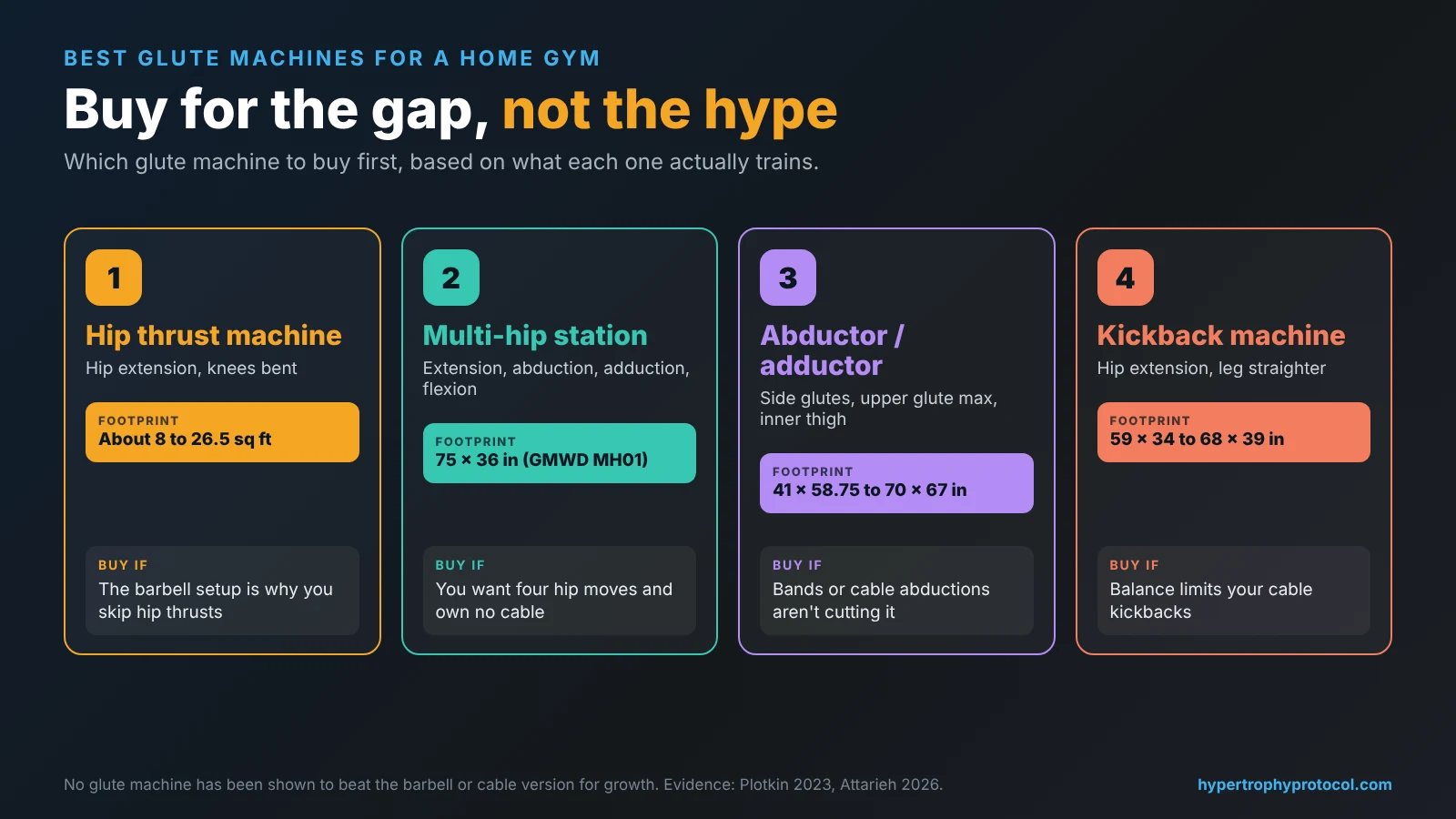
Most “best glute machine” lists rank a dozen machines as if they all do the same job. They don’t. A hip thrust machine, an abductor and a kickback station each train a different glute movement, and for most home gyms the right answer is one machine at most, chosen to fill a gap your barbell and cable can’t.
This guide sorts home glute machines by what they actually train, says which ones are worth the floor space, and points to the detailed, spec-checked guide for each type. Every spec quoted here comes from manufacturer pages, checked on October 28 and 29, 2026.
At a glance
| Verdict | If you buy one glute machine, make it a hip thrust machine, or a multi-hip station if you want several movements in one footprint. Buy an abductor second, and only if bands or a cable aren’t working for you. |
|---|---|
| Worth it when | Setup, balance or loading keeps you from doing the barbell or cable version every week. |
| Evidence strength | MRI trials support the barbell hip thrust, the squat, cable kickbacks and cable abduction. No trial has tested a dedicated glute machine against those. |
| What to do | List which glute patterns your current gear already covers, then buy for the gap. |
| Main caveat | Capacity labels differ by maker, and a plate or stack number isn’t the force at your hips. Don’t compare them across brands. |
Specs checked against manufacturer pages on October 28 and 29, 2026.
Start with what you already own
Glute growth comes from a few movement patterns, not from a particular machine. A barbell hip thrust grew the glutes about as much as a back squat in a 9-week MRI trial by Plotkin and colleagues (2023). In a 2026 MRI trial by Attarieh and colleagues, cable kickbacks grew the gluteus maximus about 9% in 10 weeks. Cable abduction in the same trial grew the upper glutes and the gluteus medius and minimus.
So a rack, barbell, bench and cable already cover the main patterns. A machine is worth buying when it makes one of those patterns easier to do consistently. The small home gym glute setup guide shows how to cover everything with the least equipment.
Home glute machines by type
| Type | Trains | Home examples (verified specs) | Worth it if | Full guide |
|---|---|---|---|---|
| Hip thrust machine | Hip extension, knees bent | BC Strength Thruster 3.0 (55 x 33 in, 96 lb), GMWD HRTQ (71 x 36.3 in), Titan Standing Hip Thrust (46.5 x 37.75 in, 440 lb plate capacity) | Barbell setup is why you skip hip thrusts | Hip thrust machines |
| Abductor / adductor | Side glutes, upper glute max, inner thigh | GMWD HA01 (65.2 x 44.1 in, 176 lb), Titan Plate-Loaded (41 x 58.75 in, 180 lb), Titan Selectorized (200 lb stack) | Bands or cable abductions aren’t cutting it | Abductor and adductor machines |
| Kickback machine | Hip extension, leg straighter | Titan Plate-Loaded Kickback (68 x 39 in, 165 lb, 330 lb plates), Booty Builder Selectorized Kick Back (110 lb stack plus bands) | Balance limits your cable kickbacks | Kickback machine vs cable |
| Multi-hip station | Extension, abduction, adduction, flexion | GMWD MH01 (75 x 36 x 80 in, 330 lb capacity, 1:1 pulley) | You want several hip movements in one footprint and have no cable | Kickback machine vs cable |
| Posterior chain machines | Glutes plus hamstrings and back | Back extension, reverse hyper, GHD | You want hinge work that’s easier on the back than heavy deadlifts | Posterior chain guide |
Which glute machine is worth buying first?
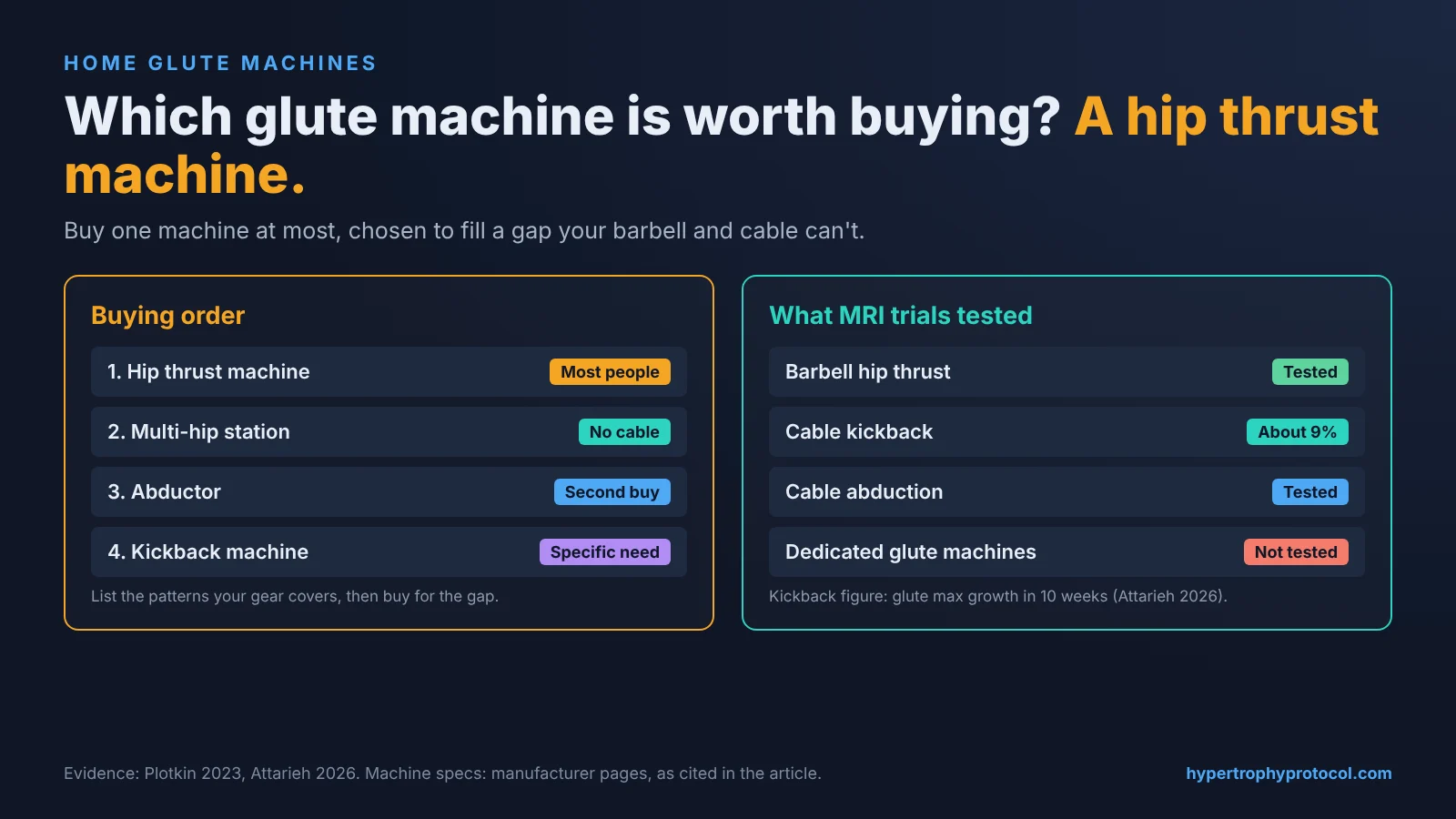
1. A hip thrust machine, for most people
The hip thrust is the most-tested glute exercise, and its barbell setup is the main reason people stop doing it at home. A machine removes that friction. Choose the type by space and loading: a barbell platform to load heaviest, a band machine to store away, or a plate-loaded station for the fastest sessions. Before you buy, check the hip thrust machine dimensions and compare barbell vs Smith vs machine.
2. A multi-hip station, if you have no cable
A multi-hip station like the GMWD MH01 trains four hip movements, so it can replace both a kickback machine and an abductor. If you already own a cable, though, an ankle strap does most of the same work for no extra space.
3. An abductor, as a second machine
Abduction trains the side glutes that extension movements mostly miss, so it’s a real addition. But bands and cables train it well. A machine makes sense when you want both abduction and adduction with quick, measurable load changes.
4. A kickback machine, only for a specific reason
The cable version has the growth evidence. A kickback machine adds a chest pad and a fixed arc, which helps if balance is your limit. For most home gyms with a cable, it’s the easiest machine to skip.
Glute machines that usually aren’t worth it at home
- Single-use commercial machines. Units built for gyms can weigh 385 lb or more, ship on a pallet and don’t list a home warranty. Check before you order.
- Anything that duplicates your cable. If a machine only does what an ankle strap already does, the floor space usually serves you better as open training room.
- Machines without published specs. If a maker won’t list dimensions or capacity, you can’t plan for it. We left those out of every guide in this series.
How to choose: a quick checklist
- Which pattern is missing? Extension, squat or lunge, hinge or abduction. Buy for the gap.
- How much floor can you give up? Measure footprint plus working space. The home gym room planner helps.
- How will you load it? Plates you own, a stack or bands. On cable machines, check the pulley ratio with the cable pulley ratio calculator.
- Does it fit your body? Check published user height ranges and pad adjustments.
- What does the capacity label measure? Plate capacity, stack weight and user weight are different numbers.
Bottom line
The best glute machine is the one that fills a gap in what you already own. For most home gyms, that’s a hip thrust machine, or a multi-hip station if you don’t have a cable. Abductors and kickback machines are worthwhile extras, not necessities, because bands and cables already train those movements well. Plan the working space, read the capacity label carefully, and remember that no machine has been shown to build more glute than the barbell and cable versions.
Specifications checked against manufacturer product pages on October 28 and 29, 2026. Manufacturers change specs and stock; confirm on the product page before ordering. Hypertrophy Protocol has not hands-on tested these machines.
Sources
- Plotkin DL, et al. Hip thrust and back squat training elicit similar gluteus muscle hypertrophy and transfer similarly to the deadlift. Front Physiol. 2023. doi:10.3389/fphys.2023.1279170
- Attarieh P, Nunes JP, et al. Regional hypertrophy of the gluteal muscles is task-specific: differential responses to 10 weeks of hip extension versus hip abduction training. J Strength Cond Res. 2026. doi:10.1519/JSC.0000000000005701
- Manufacturer pages are linked in each type’s full guide above.