
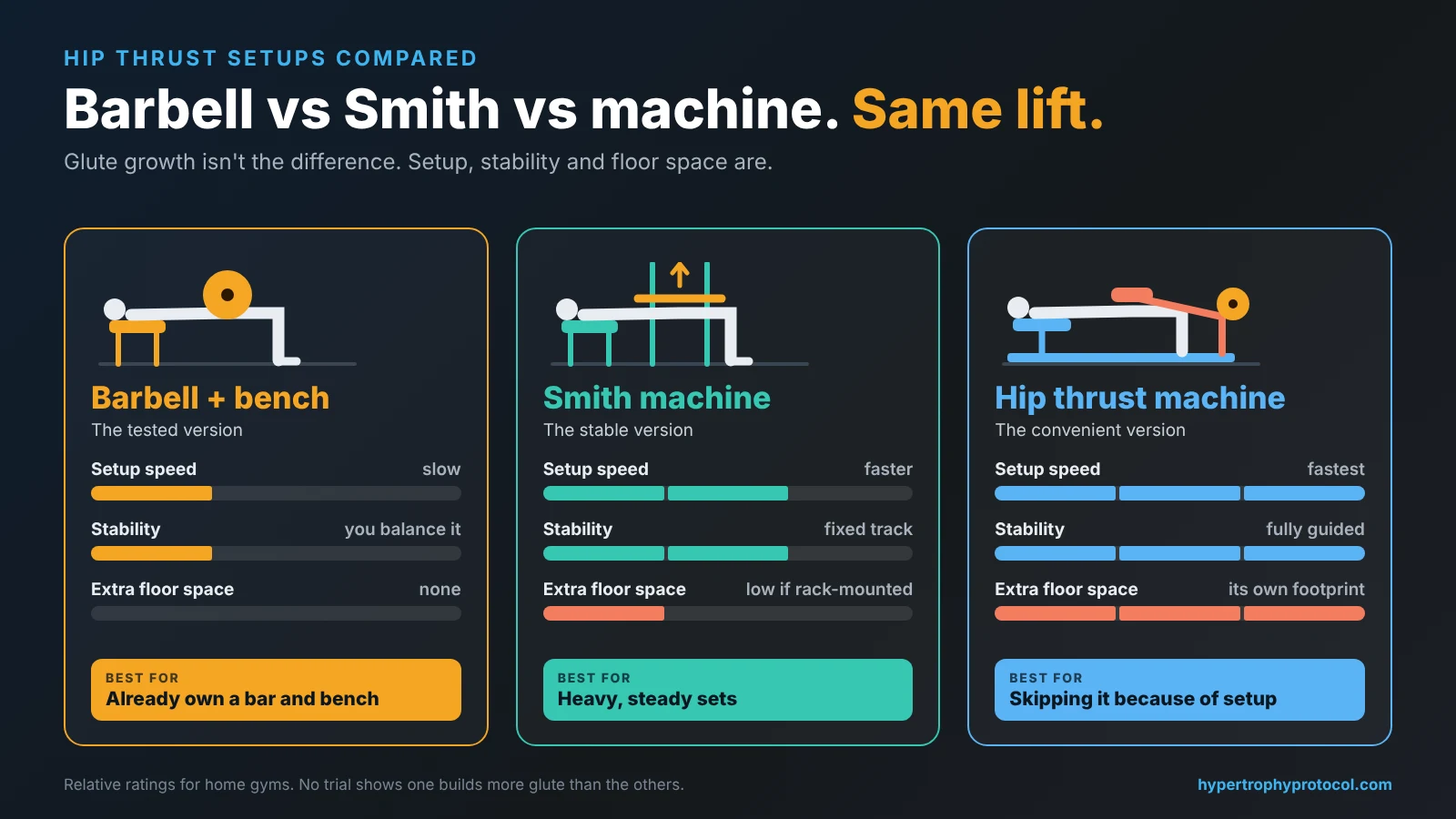
There are three common ways to hip thrust at home. You can use a barbell and a bench, a Smith machine, or a dedicated hip thrust machine. All three train the same movement: you drive your hips up from a bent position until your body is straight from shoulders to knees. The big differences are setup time, how stable the load is, how much floor space you give up and how the resistance feels from the bottom of the rep to the top.
This guide compares the three on those points and covers what the research does and doesn’t show about each. It also gives a pick for each common home gym situation. If you have already decided on a machine, the hip thrust machine buying guide compares the verified specs of each model.
At a glance
| Verdict | If you already own a barbell and bench, start there. A Smith machine makes the same lift steadier and easier to set up. A dedicated machine makes it the fastest of the three, but it costs the most floor space for a single exercise. |
|---|---|
| Key difference | Setup and stability, not glute growth. The barbell has to be balanced, the Smith bar runs on a fixed track, and a machine guides the whole movement. |
| Evidence strength | The barbell hip thrust has an MRI growth trial behind it. No study we found compares the Smith machine or a hip thrust machine against the barbell for glute growth. |
| What to do | Choose the version you will set up every week without dreading it, then add weight or reps over time. |
| Main caveat | Numbers don’t carry over between the three. 225 lb on a Smith machine or a lever machine is not the same load as 225 lb on a free barbell. |
Research and specs checked October 29, 2026.
Barbell vs Smith machine vs hip thrust machine: side by side
| Barbell + bench | Smith machine | Hip thrust machine | |
|---|---|---|---|
| Setup | Slowest. Roll a loaded bar over your legs, pad it, line up the bench. | Faster. Slide the bench in, sit under the bar, unhook it. | Fastest. Load the plates or bands and get in. |
| Stability | You balance the bar side to side and keep it from rolling. | The bar runs on a fixed track. You only push it up. | The machine guides the whole path, and the pad sits in the same place every rep. |
| Extra floor space | None if you already have a bench and bar. | None if your rack has a Smith attachment. A full Smith machine is a big piece of equipment. | A dedicated footprint for one main movement. Models in our buying guide run from a folded 25 x 30 in band platform to a 67 x 57 in plate-loaded station. |
| Loading | As heavy as your bar and plates. The plates also set the bar height off the floor. | Limited by the Smith rating, and bar weight varies by machine. | Depends on the type: plates on a lever, bands or a barbell on a platform. |
| Failing a rep | You lower the bar to the floor and roll it off. | Twist the bar onto a hook, or set the safety stops just below your bottom position. | Lower the lever or let the bands go slack. |
| Best for | Anyone who already owns the gear and doesn’t mind the setup. | Lifters who want heavy, stable sets and already own a Smith machine or a rack with a Smith attachment. | People who skip hip thrusts because of the setup, and have the floor space. |
Barbell hip thrust: the tested version
The barbell hip thrust is the version the research is built on. You sit with your upper back against a bench, roll a loaded bar into your hip crease, plant your feet and drive up. It needs gear most home gyms already have: a barbell, plates, a sturdy bench that won’t slide and a thick bar pad.
The weak points are practical:
- Setup grows with the load. Small plates leave the bar too low to roll over your thighs, so most people use full-size bumper plates or lift the bar up first. The plate calculator shows how many plates fit on your sleeves.
- The bench can slide. Push it against a wall or the rack, or put it on rubber flooring.
- The bar has to stay balanced. As sets get heavy, more of your effort goes into keeping the bar level and in place.
- Changing weight is slow. Drop sets and quick load changes are a hassle.
For most people who already own a bar and bench, those are annoyances rather than deal breakers. If you do the lift every week anyway, the barbell is hard to beat on cost.
Smith machine hip thrust: the stable version
A Smith machine holds the bar on a fixed track. For a hip thrust, that takes away most of the balancing and keeps the bar from rolling up your hips or down your thighs. You can also twist the bar onto a hook at any point in the rep. That makes heavy sets and sets close to failure less awkward, especially when you train alone.
What to check before you rely on one:
- Bench placement matters more. Your hips move in a slight arc as they rise, but the Smith bar only moves straight up and down. Set the bench so the bar sits in your hip crease at the top of the rep, then check it again at the bottom. Small moves of the bench or your feet change how the rep feels.
- The lowest hook has to be low enough. You have to be able to unhook and re-hook the bar from your bottom position. If the lowest hook is too high, you’ll have to raise the bench or skip the hooks.
- Bar weight varies. Some Smith bars are counterbalanced and some are not. For example, REP’s Smith Machine Rack Attachment for the PR-4000 and PR-5000 lists a 33 lb bar with no counterbalance and a 450 lb load capacity. Check what your bar weighs before you compare numbers with anyone else’s.
- Width. That same REP attachment is 74 in wide installed, so a rack-mounted Smith can make a rack wider. The PR-4000 vs PR-5000 guide covers which REP attachments fit each rack.
If you already have a Smith machine, it is a strong hip thrust option and costs nothing extra. Buying one only for hip thrusts is harder to justify, unless you would also use it for squats, presses and rows.
Hip thrust machine: the convenient version
A dedicated machine removes the setup completely. You load the plates or bands, get in and push. The pad sits in the same place every session, so it’s easy to repeat the exact same setup week to week. On plate-loaded models, you can also drop the weight in seconds.
The trade-offs:
- Floor space. A plate-loaded lying station can take as much floor as a power rack, and mainly for one movement.
- The plates you load are not the force at your hips. On a lever machine, the lever’s length and pivot decide how heavy the plates feel. On a band machine, the resistance rises as the bands stretch. The weight you load is useful for tracking progress on that one machine, and that’s all.
- Fit varies. Several makers publish a height range for users, and pad positions differ between models. The buying guide lists each model’s verified footprint, capacity and user range.
Does the resistance feel different through the rep?
Yes. A free barbell doesn’t load your hips evenly from the bottom of the rep to the top. In a biomechanics study by Brazil and colleagues (2021), 19 resistance-trained men did barbell hip thrusts at 70% of their one-rep max. The load on the hip extensors was highest at the start of the lift and dropped as the hips rose. It was not constant through the rep, as many lifters assume.
That is one reason people add bands. Bands stretch more as your hips rise, which adds resistance near the top, where the barbell load fades. A Smith bar should load the rep much like a free barbell, since the weight still hangs straight down. On a lever machine, the feel depends on the lever and pad design, and makers rarely publish how it changes through the rep.
Whether these different feels change how much muscle you build hasn’t been tested for the hip thrust. The broader research on training at long muscle lengths suggests the stretched position may matter for growth. Even so, a band or lever machine that is hardest at the top is not proven to build less glute.
Which one builds more glute?
The direct evidence is only for the barbell. In a 9-week trial by Plotkin and colleagues (2023), untrained young adults trained either the barbell hip thrust or the back squat. MRI showed similar glute growth in both groups. The squat grew more quadriceps and adductor muscle. A systematic review by Neto and colleagues (2019) found that the barbell hip thrust activates the hip extensors more than the squat does. Higher activation is a signal worth noting, but it doesn’t prove more growth.
We found no study that tested a Smith machine hip thrust or a dedicated hip thrust machine against the barbell for glute growth. The movement is the same, so they should train the glutes in a similar way, but that is an inference, not a tested result. The wider research on machines vs free weights points the same way: when the effort is similar, the setup rarely decides growth.
That makes the practical choice simple. The best version is the one you will do consistently, with steady progress and sets taken close to failure. The weekly sets planner helps you track glute sets alongside the rest of your leg work.
Which one should you pick?
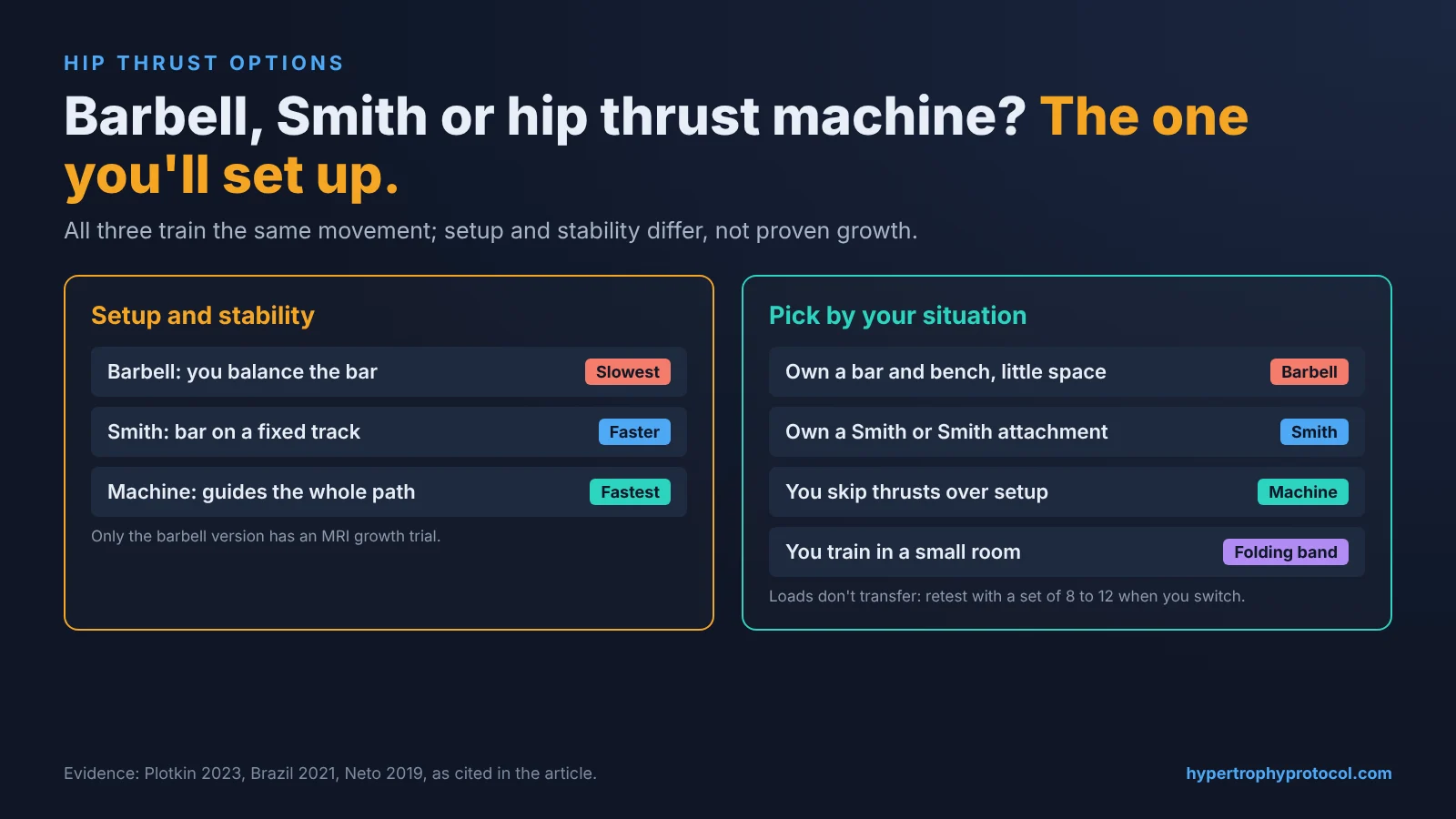
- You own a barbell and bench, and you’re short on space: barbell hip thrust. Add a thick pad and push the bench against a wall or the rack.
- You own a Smith machine or a rack with a Smith attachment: use it for your heavy sets. Check the lowest hook height and your bar’s weight first.
- You keep skipping hip thrusts because of the setup: a dedicated machine, if you have the floor space. Convenience you’ll actually use beats a cheaper setup you avoid.
- You want to load heavy with a barbell, minus the bench problems: a barbell platform or a rack-mounted thruster bench. The rack attachment fit checker tells you whether a rack bench fits your uprights.
- You train in a small room: a band machine that folds away, or the barbell version with gear you already own.
Switching between them
Your numbers won’t transfer. A Smith bar’s weight and track, a lever’s leverage and a band’s stretch all change how heavy the same plates feel. When you switch, treat the first session as a test: work up to a set of 8 to 12 that stops a rep or two short of failure, and use that as the new starting point. After that, track progress on that version only.
Bottom line
The barbell hip thrust is the tested version and the cheapest if you already own the gear. A Smith machine makes it steadier and easier to set up, at no extra cost if you already have one. A dedicated machine is the most convenient and the biggest commitment of floor space. None of them has been shown to build more glute than the others, so pick the one you will set up every week.
Research and manufacturer specs checked October 29, 2026. Hypertrophy Protocol has not hands-on tested these setups. Confirm current specs on the maker’s product page before ordering.
Sources
- Plotkin DL, et al. Hip thrust and back squat training elicit similar gluteus muscle hypertrophy and transfer similarly to the deadlift. Front Physiol. 2023. doi:10.3389/fphys.2023.1279170
- Brazil A, et al. A comprehensive biomechanical analysis of the barbell hip thrust. PLoS One. 2021. doi:10.1371/journal.pone.0249307
- Neto WK, Vieira TL, Gama EF. Barbell hip thrust, muscular activation and performance: a systematic review. J Sports Sci Med. 2019. PubMed 31191088
- REP Smith Machine Rack Attachment product page.