
You have a daily protein number, and now you are wondering whether the way you split it matters. Maybe breakfast is coffee and dinner is a big steak, or you suspect half of a 60 g shake gets wasted. The research on protein per meal for muscle growth gives a clear short answer: your daily total matters far more than the split, and the old 20 to 25 g per-meal cap does not hold up.
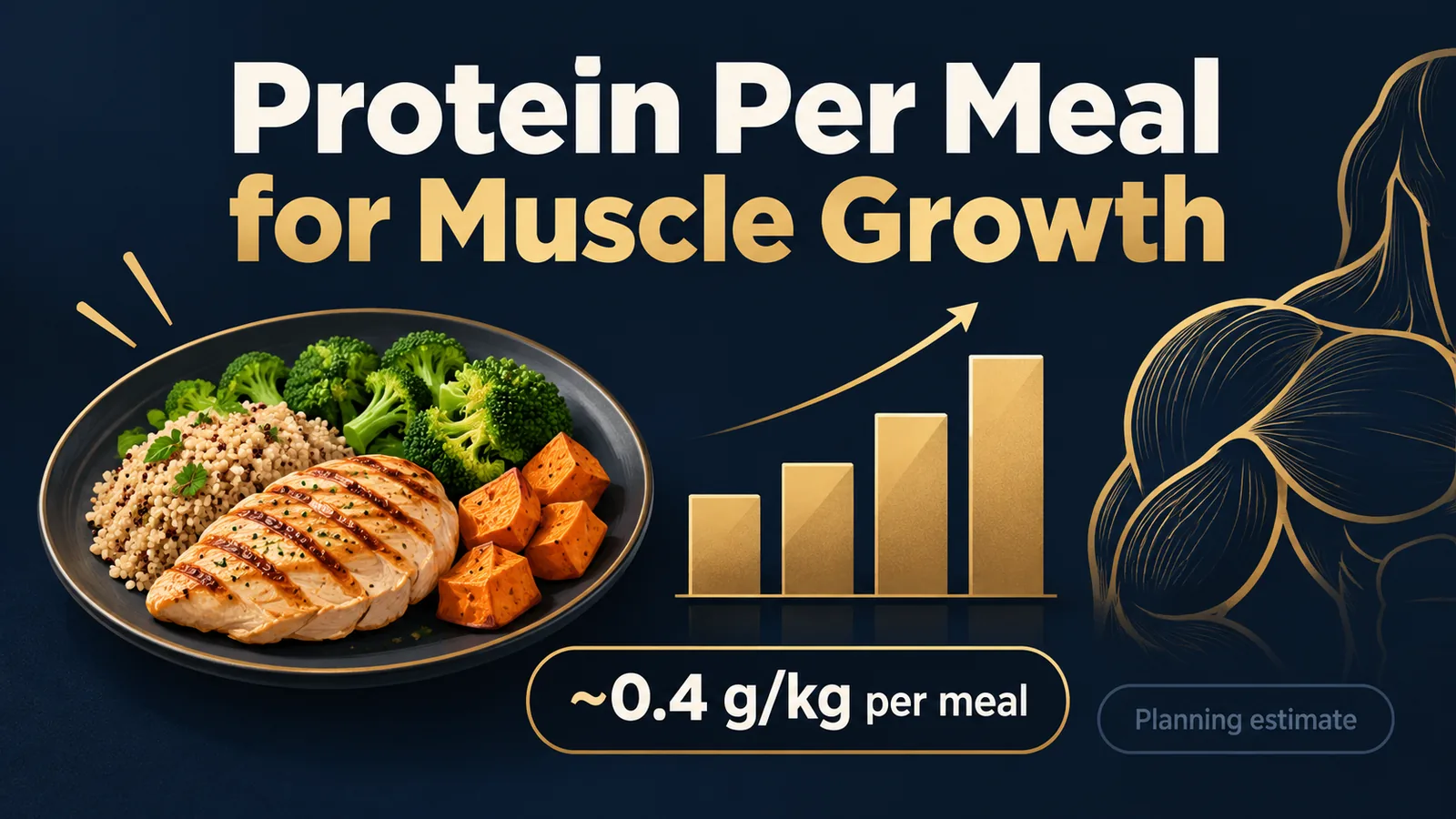
Distribution is still a small lever you can pull. A sensible default is roughly 0.4 g per kilogram of body weight per meal across at least four meals, adjusting meal size or count to reach your daily target. An occasional large meal is not wasted. Every study below was checked on PubMed on September 28, 2026.
At a glance
| Verdict | Your daily total matters far more than the split; the 20 to 25 g per-meal cap doesn’t hold up. |
|---|---|
| Effect size / key numbers | Morton 2018: +0.30 kg fat-free mass with protein; gains plateaued near 1.62 g/kg/day (95% CI 1.03 to 2.20). |
| Evidence strength | Daily total: strongest evidence (49 trials). Per-meal split: a handful of small lean-mass trials, mostly no difference. |
| What to do | About 0.4 g/kg per meal over 4+ meals to reach 1.6 g/kg/day (28 g at 70 kg, 36 g at 90 kg). |
| Main caveat | Big-meal studies measured hours of protein synthesis, not muscle size. With kidney disease, follow your clinician. |
Studies checked on PubMed, September 28, 2026.
Why does total daily protein matter more than protein per meal for muscle growth?
That daily total is where the strongest evidence sits. A 2018 meta-analysis by Morton and colleagues pooled 49 randomized trials in which people lifted for at least six weeks, measuring outcomes such as strength and fat-free mass. Extra protein added a modest amount of lean mass on top of training, and the benefit leveled off near 1.6 g per kilogram per day.
That plateau is a loose estimate. Its confidence interval was wide and the two-segment model fell short of statistical significance, so the authors suggested going as high as about 2.2 g/kg/day if you want to cover the uncertainty. Treat about 1.6 g/kg as a useful planning point for most lifters, with up to 2.2 g/kg covering the uncertainty; neither is a hard floor or ceiling.
Timing details barely moved the result. The size of the post-workout dose did not change how much fat-free mass protein added, which is why the per-meal question ranks below the daily total. Training supplies the growth signal, as the mechanical tension guide explains, and protein supports it.
Is there really a 20 to 25 g cap on how much protein per meal you can use?
Once the daily total is covered, the per-meal cap is the next claim to test. It grew out of short tracer studies in young men, where 20 to 25 g of a fast-digesting protein seemed to max out muscle protein synthesis. A 2018 review by Schoenfeld and Aragon pointed out that those results apply to fast-digesting proteins eaten without other nutrients, which is not how most people eat.
Larger doses and longer measurements pushed past that ceiling. In trained men after a whole-body session, Macnaughton 2016 saw 40 g of whey raise myofibrillar protein synthesis more than 20 g, and lean body mass did not change the response. Trommelen 2023 gave 100 g of milk protein after whole-body training and saw a bigger response than 25 g that was still going at 12 hours, with only a small rise in protein burned for fuel.
Keep the limits of this evidence in view. Each of these studies measured protein synthesis over hours after one session, and acute synthesis is only a proxy for growth. They show that a large meal is not wasted the way the cap implies, but none of them measured muscle size.
Does protein distribution across the day change muscle protein synthesis?
A large meal being used still leaves open whether spacing helps. Areta 2013 fed trained men the same 80 g of whey across 12 hours after training in three patterns, and 20 g every three hours beat both smaller frequent doses and two large ones. Mamerow 2014 compared an even split over three meals with a dinner-heavy pattern and saw higher 24-hour synthesis with the even split.
Both studies were small, and newer work with a better proxy points the other way. Askow 2025 used deuterated water to capture synthesis across whole days of controlled diets and three training sessions. Daily myofibrillar synthesis was similar whether protein arrived in five equal feedings or a lopsided split weighted toward the last meal.
The Trommelen team drew the same practical line from their 100 g data. Larger, less frequent meals look like a workable alternative to frequent small ones, at least in healthy young men who lift.
Which studies measured actual muscle gain over weeks?
Hours of synthesis data can only hint at what happens over months, so the trials that measured lean mass carry the most weight. There are only a handful, and the table separates them from the proxy studies.
| Study | Who and how long | Comparison | What was measured | Result |
|---|---|---|---|---|
| Morton 2018 (meta-analysis) | 49 trials, 1,863 adults, at least 6 wk of lifting | Protein supplement vs none; total daily intake | Fat-free mass (lean mass) | +0.30 kg (95% CI 0.09 to 0.52) with protein; gains plateaued at 1.62 g/kg/day (95% CI 1.03 to 2.20), p = 0.079 |
| Macnaughton 2016 | 30 trained young men, two trials (crossover) | 20 vs 40 g whey after whole-body training | Myofibrillar synthesis (proxy) | 0.049 vs 0.059 %/h; 40 g higher |
| Trommelen 2023 | 36 recreationally active young men, one session | 0 vs 25 vs 100 g milk protein after whole-body training | Muscle and whole-body synthesis over 12 h (proxy) | 100 g larger and longer; myofibrillar synthesis about 20% higher at 0 to 4 h and about 40% higher at 4 to 12 h vs 25 g |
| Areta 2013 | 24 trained men, one session | 80 g whey over 12 h as 8 × 10 g, 4 × 20 g or 2 × 40 g | Myofibrillar synthesis (proxy) | 4 × 20 g was 31 to 48% higher than the other patterns |
| Mamerow 2014 | 8 adults, 7-day crossover, no training | 31.5 / 29.9 / 32.7 g vs 10.7 / 16.0 / 63.4 g at three meals | 24-h mixed muscle synthesis (proxy) | 0.075 vs 0.056 %/h, favoring the even split |
| Askow 2025 | 40 young adults, 9 days, 3 whole-body sessions | Five equal feedings vs 10 / 30 / 60% split at 1.1 to 1.2 g/kg/day | Daily myofibrillar synthesis, deuterated water (proxy) | No difference between patterns |
| Yasuda 2020 | 26 young men, 12 wk supervised lifting | 0.33 vs 0.12 g/kg at breakfast, same daily total | DXA lean soft tissue mass | +2.5 vs +1.8 kg; P = 0.06, Cohen’s d = 0.795 |
| Hudson 2017 | 41 adults with overweight, 16 wk lifting at a 750 kcal/day deficit | Even vs skewed, 90 g/day (about 1.0 g/kg/day) | DXA lean mass, thigh muscle area | No difference between patterns |
| Tavares 2025 | 32 trained men randomized, 18 finished, 8 wk | 3 vs 5 high-protein meals (above 0.24 g/kg each), same daily total | DXA lean mass, ultrasound thigh area | +1.15 vs +0.63 kg lean mass; no significant difference |
| Jespersen 2021 (systematic review) | 15 studies, healthy adults 20 to 85 | Even vs skewed distribution | Muscle mass, strength, protein turnover | 3 of 7 studies linked an even split with more muscle mass; 1 of 6 with higher protein synthesis |
Hudson 2017: the two ways the same 90 g/day was split
Read across the lean-mass rows, the split rarely decides the outcome. Yasuda is the one trial that leaned toward a more even day, and it did so by moving protein from dinner to breakfast. The effect size was large but the result missed statistical significance in 26 people, so treat it as a hint.
The null trials have caveats of their own. Hudson ran at a calorie deficit with modest protein, and Tavares lost nearly half its participants. No trial has pitted one or two huge meals against several moderate ones in trained lifters over months, so that question remains open.
How much protein per meal should you aim for at 70 kg or 90 kg?
Because the daily total leads and the split is a tiebreaker, set the per-meal number from body weight. Schoenfeld and Aragon proposed 0.4 g/kg per meal across at least four meals to reach 1.6 g/kg/day, and up to 0.55 g/kg per meal to reach 2.2. The Morton paper also mentioned splitting 1.6 g/kg/day into doses of about 0.25 g/kg.
| Target | Per kg of body weight | 70 kg lifter | 90 kg lifter |
|---|---|---|---|
| Daily planning point (Morton plateau) | 1.6 g/kg/day | 112 g/day | 144 g/day |
| Daily upper end (top of the interval) | 2.2 g/kg/day | 154 g/day | 198 g/day |
| Four meals, reaching 1.6 g/kg | 0.4 g/kg per meal | 28 g per meal | 36 g per meal |
| Four meals, reaching the upper end | 0.55 g/kg per meal | 38.5 g per meal | 49.5 g per meal |
| Three meals, reaching 1.6 g/kg | 1.6 g/kg ÷ 3 per meal | 37.3 g per meal | 48 g per meal |
| Three meals, reaching the upper end | 2.2 g/kg ÷ 3 per meal | 51.3 g per meal | 66 g per meal |
| Smaller feedings (Morton’s suggested dose) | 0.25 g/kg per feeding | 17.5 g per feeding | 22.5 g per feeding |
All figures were calculated from the per-kilogram targets and checked in Wolfram|Alpha. The three-meal rows land above the old 25 g cap for most lifters, and the Trommelen and Tavares results suggest that is fine. If your day has room for four or five protein feedings, the 0.4 g/kg rows are the more evidence-backed default.
Protein is one part of recovery between hard sessions. For how long to space demanding training days, the recovery window after heavy leg days guide covers the training side. People with kidney disease should follow their clinician’s guidance on protein rather than these targets.
Who should change how they split protein, and who can leave it alone?
With the numbers in hand, the verdict depends on how you eat now. Find the line that matches your current day.
- You eat under about 1.6 g/kg/day: raise the daily total first. Distribution is a minor concern until the total is covered.
- You hit the total but eat little protein before dinner: move some of it to breakfast or lunch. This is the pattern Yasuda tested, and it is the one place the lean-mass data lean toward a more even split.
- You hit the total across at least four meals of roughly 0.4 g/kg or more: you are already covered, and fine-tuning meal timing is unlikely to add visible muscle.
- You eat one or two large meals for schedule reasons: the acute data show big meals are used, not wasted. Long-term trials in lifters are missing, so keep the daily total at the higher end if this is your pattern.
Your next step: multiply your body weight by 1.6, divide it across the meals you already eat, and then put your effort back into training. The mechanical tension guide covers the training signal that gives that protein something to build.
Sources
- Morton RW, et al. A systematic review, meta-analysis and meta-regression of the effect of protein supplementation on resistance training-induced gains in muscle mass and strength in healthy adults. Br J Sports Med. 2018. doi:10.1136/bjsports-2017-097608
- Schoenfeld BJ, Aragon AA. How much protein can the body use in a single meal for muscle-building? Implications for daily protein distribution. J Int Soc Sports Nutr. 2018. doi:10.1186/s12970-018-0215-1
- Macnaughton LS, et al. The response of muscle protein synthesis following whole-body resistance exercise is greater following 40 g than 20 g of ingested whey protein. Physiol Rep. 2016. doi:10.14814/phy2.12893
- Trommelen J, et al. The anabolic response to protein ingestion during recovery from exercise has no upper limit in magnitude and duration in vivo in humans. Cell Rep Med. 2023. doi:10.1016/j.xcrm.2023.101324
- Areta JL, et al. Timing and distribution of protein ingestion during prolonged recovery from resistance exercise alters myofibrillar protein synthesis. J Physiol. 2013. doi:10.1113/jphysiol.2012.244897
- Mamerow MM, et al. Dietary protein distribution positively influences 24-h muscle protein synthesis in healthy adults. J Nutr. 2014. doi:10.3945/jn.113.185280
- Askow AT, et al. Impact of vegan diets on resistance exercise-mediated myofibrillar protein synthesis in healthy young males and females: a randomized controlled trial. Med Sci Sports Exerc. 2025. doi:10.1249/MSS.0000000000003725
- Yasuda J, et al. Evenly distributed protein intake over 3 meals augments resistance exercise-induced muscle hypertrophy in healthy young men. J Nutr. 2020. doi:10.1093/jn/nxaa101
- Hudson JL, Kim JE, Paddon-Jones D, Campbell WW. Within-day protein distribution does not influence body composition responses during weight loss in resistance-training adults who are overweight. Am J Clin Nutr. 2017. doi:10.3945/ajcn.117.158246
- Tavares H, et al. Effects of daily protein intake frequency during 8 weeks of resistance training on lean mass and strength adaptations: a randomized non-controlled clinical trial. J Sports Med Phys Fitness. 2025. doi:10.23736/S0022-4707.25.16698-X
- Jespersen SE, Agergaard J. Evenness of dietary protein distribution is associated with higher muscle mass but not muscle strength or protein turnover in healthy adults: a systematic review. Eur J Nutr. 2021. doi:10.1007/s00394-021-02487-2
Sources checked September 28, 2026. Research summaries describe the cited studies; individual results vary.